 Add to Chrome
 Add to Firefox
 Add to Edge
Beyond Fail-to-Pass: Iterative Hardening of Co-Generated Bug Reproduction Tests and Fixes
Jul 22, 2026
Large language models (LLMs) have made automated program repair (APR) increasingly practical for real-world bugs, but repairing directly from bug reports remains underconstrained. Bug reproduction tests (BRTs) help close this gap by turning a bug report into an executable, bug-specific signal that can guide repair and validate candidate patches. Existing work has therefore studied BRT generation as a core subproblem in APR and mainly evaluates a generated BRT using the fail-to-pass (F->P) criterion, which requires the test to fail on the buggy code but pass on the golden fix. We show that F->P alone is insufficient when the goal of a BRT is to improve downstream repair. In particular, some F->P BRTs are lax, reproducing the observed symptom yet still admitting plausible-but-incorrect patches. We formalize this missing quality dimension by separating F->P BRTs into rigorous and lax ones, and show empirically that only the former consistently improve repair success. We further find that co-generation introduces test--fix error coupling, where the in-trajectory fail-to-pass (F->P) check can pass even when both the generated patch and generated test are wrong. Based on these findings, we propose CoHarden, a co-generation framework that uses the Lax signal as an in-loop convergence criterion. CoHarden first generates a test before any fix, then iteratively hardens the test and fix against surviving mutation patches until the generated test no longer admits Lax regressions. Experiments show that CoHarden reaches 69.4% Resolved and 78.9% F->P on SWE-bench Verified, outperforming the strongest fix-only and cogeneration baselines by +9.6 and +7.9 percentage points in Resolved, respectively, with consistent gains across LLM backbones and benchmarks.

Uncertainty Quantification for LLM-based Code Generation
May 12, 2026Prediction sets provide a theoretically grounded framework for quantifying uncertainty in machine learning models. Adapting them to structured generation tasks, in particular, large language model (LLM) based code generation, remains a challenging problem. An existing attempt proposes PAC prediction sets but is limited by its strong monotonicity assumption on risk and single-label classification framework, which severely limits the space of candidate programs and cannot accommodate the multiple valid outputs inherent to code generation. To address these limitations, we propose an approach RisCoSet that leverages multiple hypothesis testing to construct risk-controlling predictions for LLM-based code generation. Given a trained code generation model, we produce a prediction set represented by a partial program, which is guaranteed to contain a correct solution with high confidence. Extensive experiments on three LLMs demonstrate the effectiveness of the proposed method. For instance, compared with the state-of-the-art, our method can significantly reduce the code removal by up to 24.5%, at the same level of risk.
Fair Conformal Classification via Learning Representation-Based Groups
May 12, 2026Conformal prediction methods provide statistically rigorous marginal coverage guarantees for machine learning models, but such guarantees fail to account for algorithmic biases, thereby undermining fairness and trust. This paper introduces a fair conformal inference framework for classification tasks. The proposed method constructs prediction sets that guarantee conditional coverage on adaptively identified subgroups, which can be implicitly defined through nonlinear feature combinations. By balancing effectiveness and efficiency in producing compact, informative prediction sets and ensuring adaptive equalized coverage across unfairly treated subgroups, our approach paves a practical pathway toward trustworthy machine learning. Extensive experiments on both synthetic and real-world datasets demonstrate the effectiveness of the framework.
Dirichlet Diffusion Score Model for Biological Sequence Generation
May 18, 2023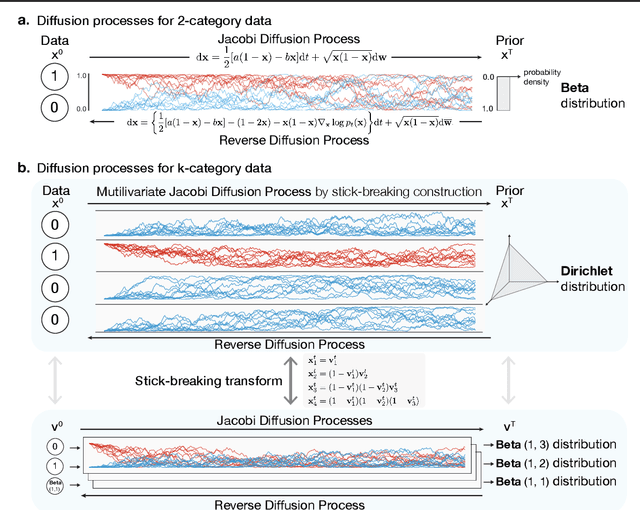


Designing biological sequences is an important challenge that requires satisfying complex constraints and thus is a natural problem to address with deep generative modeling. Diffusion generative models have achieved considerable success in many applications. Score-based generative stochastic differential equations (SDE) model is a continuous-time diffusion model framework that enjoys many benefits, but the originally proposed SDEs are not naturally designed for modeling discrete data. To develop generative SDE models for discrete data such as biological sequences, here we introduce a diffusion process defined in the probability simplex space with stationary distribution being the Dirichlet distribution. This makes diffusion in continuous space natural for modeling discrete data. We refer to this approach as Dirchlet diffusion score model. We demonstrate that this technique can generate samples that satisfy hard constraints using a Sudoku generation task. This generative model can also solve Sudoku, including hard puzzles, without additional training. Finally, we applied this approach to develop the first human promoter DNA sequence design model and showed that designed sequences share similar properties with natural promoter sequences.