 Add to Chrome
 Add to Firefox
 Add to Edge
NARU: A Benchmark for NARrative Evolution and Cultural Nuance Understanding in Japanese Extreme Long Video
Aug 13, 2026
Long-form video understanding encompasses tasks that go beyond retrieving isolated events, including tracking an evolving narrative and interpreting social meaning that may remain implicit. However, existing benchmarks rarely evaluate these capabilities jointly, particularly in high-context, non-English media. To address this gap, we introduce NARU, a benchmark designed to evaluate Narrative evolution and Reasoning on cultural Understanding in Japanese long-form video. NARU consists of 1,481 questions grounded in 155 videos totaling 146.8 hours, spanning four narrative and five cultural dimensions. To construct the benchmark at this scale, we propose a hierarchical memory-based annotation pipeline that transforms raw video into structured event, narrative, and cultural annotations, then generates questions via task-oriented synthesis and iterative shortcut removal. The construction process includes two native-speaker verification stages involving 68 annotators. Evaluations across eight model configurations reveal substantial limitations in both long-range narrative integration and culturally grounded reasoning. By exposing these persistent gaps, NARU offers a systematic testing ground for developing MLLMs capable of reliably interpreting long-form, high-context video.

Code-MUE: Measuring Code LLMs' Uncertainty through Execution-based Semantic Interaction Graphs
Jul 14, 2026As Code Large Language Models (LLMs) become central to modern software engineering, their inherent stochasticity poses significant real-world risks, where even minor errors can lead to severe functional, security, or safety consequences. Reliable automation, therefore, demands the ability to distinguish between confident, well-supported predictions and stochastic guessing. However, existing uncertainty estimation methods face a critical gap: white and grey-box techniques are often inapplicable to closed-source models, while standard "black-box" text metrics fail to capture the unique fragility of code, where syntactic variation does not always imply semantic divergence. To bridge this syntax-semantics gap, we introduce Code-MUE, a purely black-box framework that measures uncertainty through execution-based Semantic Interaction Graphs. Unlike prior approaches that rely on superficial textual similarity, Code-MUE grounds uncertainty in observable runtime behavior, calculating the Von Neumann entropy of the solution space to quantify global semantic diversity. A large-scale empirical study across eight state-of-the-art LLMs demonstrates that Code-MUE achieves a strong negative correlation with functional correctness (Spearman's correlation up to -0.98), significantly outperforming lexical and embedding-based baselines while enabling robust risk detection and selective prediction in practical workflows.
ScaffoldAgent: Utility-Guided Dynamic Outline Optimization for Open-Ended Deep Research
Jun 18, 2026Open-ended deep research (OEDR) requires systems to acquire knowledge through multi-round retrieval and generate coherent long-form reports. The outline plays a central role as a structural scaffold that coordinates retrieval, evidence organization, and generation. However, existing methods either fix the outline before writing or refine it with local heuristics, leading to scaffold drift under continuous information accumulation and delayed feedback for evaluating outline modifications. We propose ScaffoldAgent, a utility-guided dynamic outline optimization framework for OEDR. ScaffoldAgent models outline evolution as a structured decision process with three operations: Expansion, Contraction, and Revision, enabling controlled updates to the report scaffold. It further introduces a utility-guided feedback mechanism that estimates the downstream value of each outline operation from retrieval gain, structural coherence, and trial-generation quality. The resulting utility signal guides node selection, operation scheduling, and termination during inference. Experiments on DeepResearch Bench and DeepResearch Gym show that ScaffoldAgent consistently improves long-form report generation and factual grounding over existing deep research agents.
The Llama 4 Herd: Architecture, Training, Evaluation, and Deployment Notes
Jan 15, 2026This document consolidates publicly reported technical details about Metas Llama 4 model family. It summarizes (i) released variants (Scout and Maverick) and the broader herd context including the previewed Behemoth teacher model, (ii) architectural characteristics beyond a high-level MoE description covering routed/shared-expert structure, early-fusion multimodality, and long-context design elements reported for Scout (iRoPE and length generalization strategies), (iii) training disclosures spanning pre-training, mid-training for long-context extension, and post-training methodology (lightweight SFT, online RL, and lightweight DPO) as described in release materials, (iv) developer-reported benchmark results for both base and instruction-tuned checkpoints, and (v) practical deployment constraints observed across major serving environments, including provider-specific context limits and quantization packaging. The manuscript also summarizes licensing obligations relevant to redistribution and derivative naming, and reviews publicly described safeguards and evaluation practices. The goal is to provide a compact technical reference for researchers and practitioners who need precise, source-backed facts about Llama 4.
Evaluating Implicit Regulatory Compliance in LLM Tool Invocation via Logic-Guided Synthesis
Jan 13, 2026The integration of large language models (LLMs) into autonomous agents has enabled complex tool use, yet in high-stakes domains, these systems must strictly adhere to regulatory standards beyond simple functional correctness. However, existing benchmarks often overlook implicit regulatory compliance, thus failing to evaluate whether LLMs can autonomously enforce mandatory safety constraints. To fill this gap, we introduce LogiSafetyGen, a framework that converts unstructured regulations into Linear Temporal Logic oracles and employs logic-guided fuzzing to synthesize valid, safety-critical traces. Building on this framework, we construct LogiSafetyBench, a benchmark comprising 240 human-verified tasks that require LLMs to generate Python programs that satisfy both functional objectives and latent compliance rules. Evaluations of 13 state-of-the-art (SOTA) LLMs reveal that larger models, despite achieving better functional correctness, frequently prioritize task completion over safety, which results in non-compliant behavior.
End4: End-to-end Denoising Diffusion for Diffusion-Based Inpainting Detection
Sep 16, 2025The powerful generative capabilities of diffusion models have significantly advanced the field of image synthesis, enhancing both full image generation and inpainting-based image editing. Despite their remarkable advancements, diffusion models also raise concerns about potential misuse for malicious purposes. However, existing approaches struggle to identify images generated by diffusion-based inpainting models, even when similar inpainted images are included in their training data. To address this challenge, we propose a novel detection method based on End-to-end denoising diffusion (End4). Specifically, End4 designs a denoising reconstruction model to improve the alignment degree between the latent spaces of the reconstruction and detection processes, thus reconstructing features that are more conducive to detection. Meanwhile, it leverages a Scale-aware Pyramid-like Fusion Module (SPFM) that refines local image features under the guidance of attention pyramid layers at different scales, enhancing feature discriminability. Additionally, to evaluate detection performance on inpainted images, we establish a comprehensive benchmark comprising images generated from five distinct masked regions. Extensive experiments demonstrate that our End4 effectively generalizes to unseen masking patterns and remains robust under various perturbations. Our code and dataset will be released soon.
Risk Assessment Framework for Code LLMs via Leveraging Internal States
Apr 20, 2025The pre-training paradigm plays a key role in the success of Large Language Models (LLMs), which have been recognized as one of the most significant advancements of AI recently. Building on these breakthroughs, code LLMs with advanced coding capabilities bring huge impacts on software engineering, showing the tendency to become an essential part of developers' daily routines. However, the current code LLMs still face serious challenges related to trustworthiness, as they can generate incorrect, insecure, or unreliable code. Recent exploratory studies find that it can be promising to detect such risky outputs by analyzing LLMs' internal states, akin to how the human brain unconsciously recognizes its own mistakes. Yet, most of these approaches are limited to narrow sub-domains of LLM operations and fall short of achieving industry-level scalability and practicability. To address these challenges, in this paper, we propose PtTrust, a two-stage risk assessment framework for code LLM based on internal state pre-training, designed to integrate seamlessly with the existing infrastructure of software companies. The core idea is that the risk assessment framework could also undergo a pre-training process similar to LLMs. Specifically, PtTrust first performs unsupervised pre-training on large-scale unlabeled source code to learn general representations of LLM states. Then, it uses a small, labeled dataset to train a risk predictor. We demonstrate the effectiveness of PtTrust through fine-grained, code line-level risk assessment and demonstrate that it generalizes across tasks and different programming languages. Further experiments also reveal that PtTrust provides highly intuitive and interpretable features, fostering greater user trust. We believe PtTrust makes a promising step toward scalable and trustworthy assurance for code LLMs.
* To appear in the 33rd ACM International Conference on the Foundations of Software Engineering (FSE Companion'25 Industry Track), June 23-28, 2025, Trondheim, Norway. This work was supported by Fujitsu Limited
No More Tuning: Prioritized Multi-Task Learning with Lagrangian Differential Multiplier Methods
Dec 16, 2024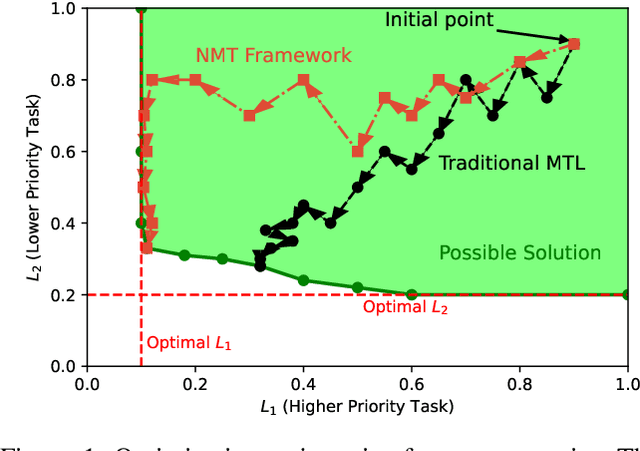


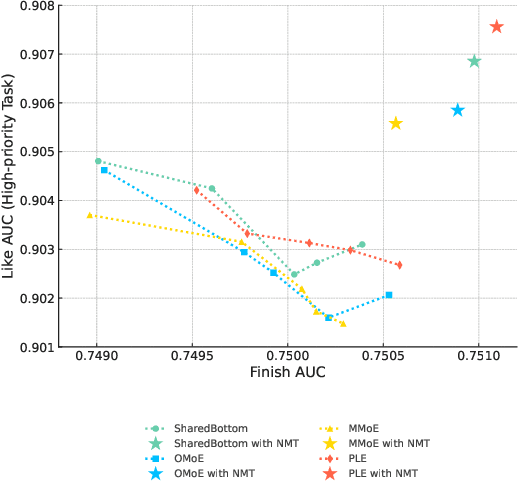
Given the ubiquity of multi-task in practical systems, Multi-Task Learning (MTL) has found widespread application across diverse domains. In real-world scenarios, these tasks often have different priorities. For instance, In web search, relevance is often prioritized over other metrics, such as click-through rates or user engagement. Existing frameworks pay insufficient attention to the prioritization among different tasks, which typically adjust task-specific loss function weights to differentiate task priorities. However, this approach encounters challenges as the number of tasks grows, leading to exponential increases in hyper-parameter tuning complexity. Furthermore, the simultaneous optimization of multiple objectives can negatively impact the performance of high-priority tasks due to interference from lower-priority tasks. In this paper, we introduce a novel multi-task learning framework employing Lagrangian Differential Multiplier Methods for step-wise multi-task optimization. It is designed to boost the performance of high-priority tasks without interference from other tasks. Its primary advantage lies in its ability to automatically optimize multiple objectives without requiring balancing hyper-parameters for different tasks, thereby eliminating the need for manual tuning. Additionally, we provide theoretical analysis demonstrating that our method ensures optimization guarantees, enhancing the reliability of the process. We demonstrate its effectiveness through experiments on multiple public datasets and its application in Taobao search, a large-scale industrial search ranking system, resulting in significant improvements across various business metrics.
Towards Understanding Retrieval Accuracy and Prompt Quality in RAG Systems
Nov 29, 2024Retrieval-Augmented Generation (RAG) is a pivotal technique for enhancing the capability of large language models (LLMs) and has demonstrated promising efficacy across a diverse spectrum of tasks. While LLM-driven RAG systems show superior performance, they face unique challenges in stability and reliability. Their complexity hinders developers' efforts to design, maintain, and optimize effective RAG systems. Therefore, it is crucial to understand how RAG's performance is impacted by its design. In this work, we conduct an early exploratory study toward a better understanding of the mechanism of RAG systems, covering three code datasets, three QA datasets, and two LLMs. We focus on four design factors: retrieval document type, retrieval recall, document selection, and prompt techniques. Our study uncovers how each factor impacts system correctness and confidence, providing valuable insights for developing an accurate and reliable RAG system. Based on these findings, we present nine actionable guidelines for detecting defects and optimizing the performance of RAG systems. We hope our early exploration can inspire further advancements in engineering, improving and maintaining LLM-driven intelligent software systems for greater efficiency and reliability.
LADEV: A Language-Driven Testing and Evaluation Platform for Vision-Language-Action Models in Robotic Manipulation
Oct 07, 2024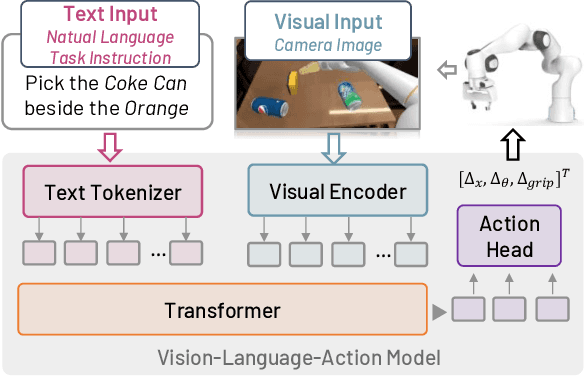
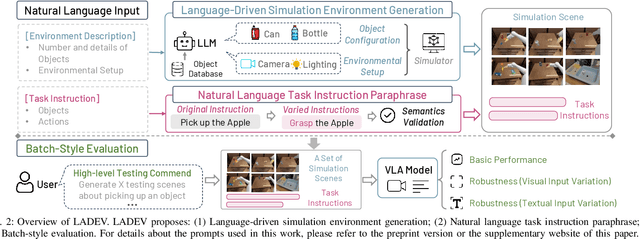

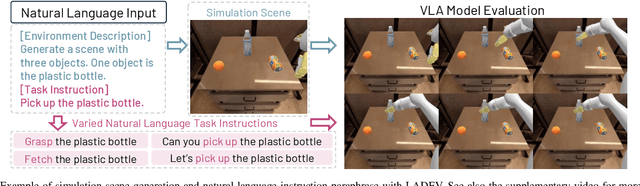
Building on the advancements of Large Language Models (LLMs) and Vision Language Models (VLMs), recent research has introduced Vision-Language-Action (VLA) models as an integrated solution for robotic manipulation tasks. These models take camera images and natural language task instructions as input and directly generate control actions for robots to perform specified tasks, greatly improving both decision-making capabilities and interaction with human users. However, the data-driven nature of VLA models, combined with their lack of interpretability, makes the assurance of their effectiveness and robustness a challenging task. This highlights the need for a reliable testing and evaluation platform. For this purpose, in this work, we propose LADEV, a comprehensive and efficient platform specifically designed for evaluating VLA models. We first present a language-driven approach that automatically generates simulation environments from natural language inputs, mitigating the need for manual adjustments and significantly improving testing efficiency. Then, to further assess the influence of language input on the VLA models, we implement a paraphrase mechanism that produces diverse natural language task instructions for testing. Finally, to expedite the evaluation process, we introduce a batch-style method for conducting large-scale testing of VLA models. Using LADEV, we conducted experiments on several state-of-the-art VLA models, demonstrating its effectiveness as a tool for evaluating these models. Our results showed that LADEV not only enhances testing efficiency but also establishes a solid baseline for evaluating VLA models, paving the way for the development of more intelligent and advanced robotic systems.