 Add to Chrome
 Add to Firefox
 Add to Edge
Agent Skills Can Be Harmful: An Empirical Study of Skill-Induced Failures in LLM Agents
Aug 12, 2026
Agent skills are the de facto mechanism for extending LLM agents with reusable guidance. A skill can shape the agent's task execution, including planning, tool use, problem-solving, and validation. Prior work reported mixed results of agent skills: some skills improve task success rates, while others have no effect, increase token use and execution time, and even reduce success rates. This paper presents a comprehensive analysis of skill-induced agent failures by attributing task failures and cost regressions to specific loaded skills. We introduce a differential analysis framework that attributes a failure or regression to a skill by comparing a target skill-guided run against a no-skill or semantically matched skill reference run that solves the same task, or solves it more cheaply. We instantiate this framework on SkillsBench and SWE-Skills-Bench, yielding 307 skill-induced failures, including 125 functional failures and 182 efficiency regressions. We also build SkillTriage, a taxonomy-guided attribution tool that normalizes paired cases, extracts differential evidence, and produces triage reports. Our major findings include: (1) Skill induced functional failures are rarely caused by obviously irrelevant skills; instead, seemingly relevant skills often make the agent incorrectly implement or omit task-required implementation elements. (2) Skill-induced efficiency regressions are not explained by prompt length alone. (3) The largest sources within Excessive Procedure are excessive verification and heavy implementation pipelines, contributing 67 and 30 cases, respectively. This shows that skills often turn validation checklists and construction recipes into mandatory work. Based on our findings, we propose research topics and tooling improvements for safer and more cost-aware skill reuse.

ToolAtlas: Learning Once, Reusing Everywhere with Tool-Side Memory
Jul 13, 2026Large language model (LLM) agents increasingly rely on external tools served by shared providers and accessed by heterogeneous downstream agents. Existing approaches improve tool use on the agent side through parameter updates, prompt refinement, or agent-side memory, making tool knowledge difficult to share and limited to behaviors observed in past tasks. We argue that reusable tool knowledge should instead be maintained by the tool provider. We introduce ToolAtlas, a graph-based framework that builds a persistent provider-side tool memory of tool capabilities, failure boundaries, and cross-tool compositions through execution-verified probing. At inference time, agents query the tool memory via adaptive graph traversal. Across two MCP-based benchmarks spanning eight services, ToolAtlas outperforms existing tool-side optimization and agent-side memory baselines by up to 21.61% in pass@1 and 18.61% in pass@4. The same tool memory also transfers across environment instances and agent frameworks without retraining or task-time exploration, yielding up to 24.16%/16.22% and 17.49%/14.27% relative gains in pass@1/pass@4, respectively. Ablation studies show that these gains arise from combining tool-centered memory organization with capability-guided execution probing. These results establish provider-side tool memory as an effective and reusable paradigm for tool servers. Our code is in: https://github.com/PuppyKnightUniversity/ToolAtlas.
GUI-360$^\circ$: A Comprehensive Dataset and Benchmark for Computer-Using Agents
Nov 10, 2025We introduce GUI-360$^\circ$, a large-scale, comprehensive dataset and benchmark suite designed to advance computer-using agents (CUAs). CUAs present unique challenges and is constrained by three persistent gaps: a scarcity of real-world CUA tasks, the lack of automated collection-and-annotation pipelines for multi-modal trajectories, and the absence of a unified benchmark that jointly evaluates GUI grounding, screen parsing, and action prediction. GUI-360$^\circ$ addresses these gaps with an LLM-augmented, largely automated pipeline for query sourcing, environment-template construction, task instantiation, batched execution, and LLM-driven quality filtering. The released corpus contains over 1.2M executed action steps across thousands of trajectories in popular Windows office applications, and includes full-resolution screenshots, accessibility metadata when available, instantiated goals, intermediate reasoning traces, and both successful and failed action trajectories. The dataset supports three canonical tasks, GUI grounding, screen parsing, and action prediction, and a hybrid GUI+API action space that reflects modern agent designs. Benchmarking state-of-the-art vision--language models on GUI-360$^\circ$ reveals substantial out-of-the-box shortcomings in grounding and action prediction; supervised fine-tuning and reinforcement learning yield significant gains but do not close the gap to human-level reliability. We release GUI-360$^\circ$ and accompanying code to facilitate reproducible research and accelerate progress on robust desktop CUAs. The full dataset has been made public on https://huggingface.co/datasets/vyokky/GUI-360.
GUI-360: A Comprehensive Dataset and Benchmark for Computer-Using Agents
Nov 06, 2025We introduce GUI-360$^\circ$, a large-scale, comprehensive dataset and benchmark suite designed to advance computer-using agents (CUAs). CUAs present unique challenges and is constrained by three persistent gaps: a scarcity of real-world CUA tasks, the lack of automated collection-and-annotation pipelines for multi-modal trajectories, and the absence of a unified benchmark that jointly evaluates GUI grounding, screen parsing, and action prediction. GUI-360$^\circ$ addresses these gaps with an LLM-augmented, largely automated pipeline for query sourcing, environment-template construction, task instantiation, batched execution, and LLM-driven quality filtering. The released corpus contains over 1.2M executed action steps across thousands of trajectories in popular Windows office applications, and includes full-resolution screenshots, accessibility metadata when available, instantiated goals, intermediate reasoning traces, and both successful and failed action trajectories. The dataset supports three canonical tasks, GUI grounding, screen parsing, and action prediction, and a hybrid GUI+API action space that reflects modern agent designs. Benchmarking state-of-the-art vision--language models on GUI-360$^\circ$ reveals substantial out-of-the-box shortcomings in grounding and action prediction; supervised fine-tuning and reinforcement learning yield significant gains but do not close the gap to human-level reliability. We release GUI-360$^\circ$ and accompanying code to facilitate reproducible research and accelerate progress on robust desktop CUAs. The full dataset has been made public on https://huggingface.co/datasets/vyokky/GUI-360.
UFO2: The Desktop AgentOS
Apr 20, 2025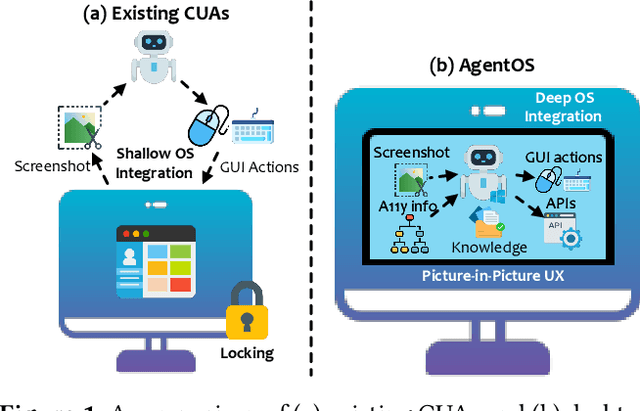
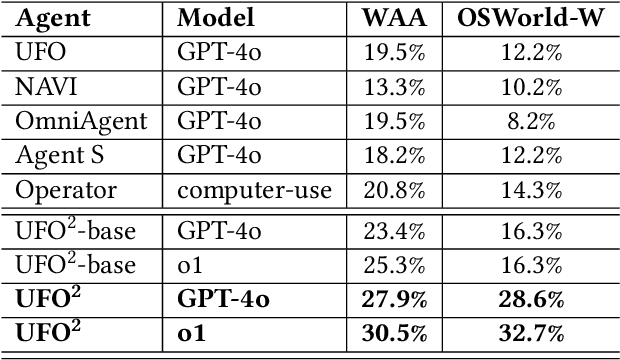
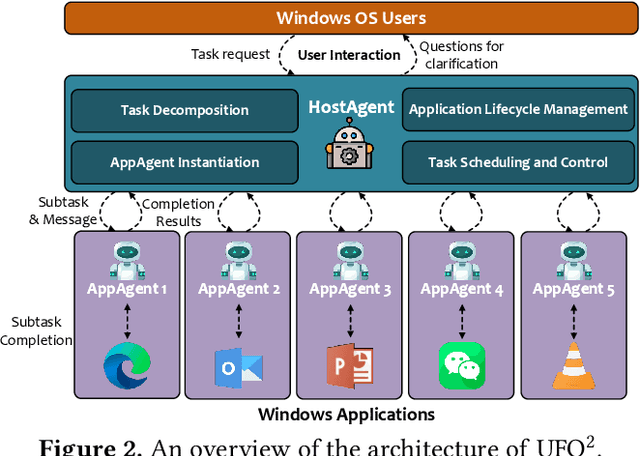
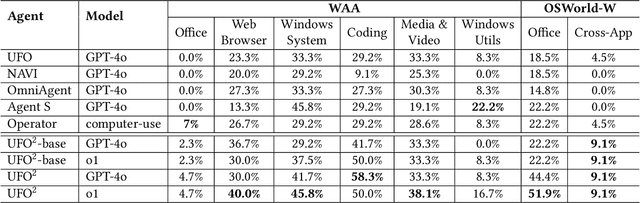
Recent Computer-Using Agents (CUAs), powered by multimodal large language models (LLMs), offer a promising direction for automating complex desktop workflows through natural language. However, most existing CUAs remain conceptual prototypes, hindered by shallow OS integration, fragile screenshot-based interaction, and disruptive execution. We present UFO2, a multiagent AgentOS for Windows desktops that elevates CUAs into practical, system-level automation. UFO2 features a centralized HostAgent for task decomposition and coordination, alongside a collection of application-specialized AppAgent equipped with native APIs, domain-specific knowledge, and a unified GUI--API action layer. This architecture enables robust task execution while preserving modularity and extensibility. A hybrid control detection pipeline fuses Windows UI Automation (UIA) with vision-based parsing to support diverse interface styles. Runtime efficiency is further enhanced through speculative multi-action planning, reducing per-step LLM overhead. Finally, a Picture-in-Picture (PiP) interface enables automation within an isolated virtual desktop, allowing agents and users to operate concurrently without interference. We evaluate UFO2 across over 20 real-world Windows applications, demonstrating substantial improvements in robustness and execution accuracy over prior CUAs. Our results show that deep OS integration unlocks a scalable path toward reliable, user-aligned desktop automation.
API Agents vs. GUI Agents: Divergence and Convergence
Mar 14, 2025Large language models (LLMs) have evolved beyond simple text generation to power software agents that directly translate natural language commands into tangible actions. While API-based LLM agents initially rose to prominence for their robust automation capabilities and seamless integration with programmatic endpoints, recent progress in multimodal LLM research has enabled GUI-based LLM agents that interact with graphical user interfaces in a human-like manner. Although these two paradigms share the goal of enabling LLM-driven task automation, they diverge significantly in architectural complexity, development workflows, and user interaction models. This paper presents the first comprehensive comparative study of API-based and GUI-based LLM agents, systematically analyzing their divergence and potential convergence. We examine key dimensions and highlight scenarios in which hybrid approaches can harness their complementary strengths. By proposing clear decision criteria and illustrating practical use cases, we aim to guide practitioners and researchers in selecting, combining, or transitioning between these paradigms. Ultimately, we indicate that continuing innovations in LLM-based automation are poised to blur the lines between API- and GUI-driven agents, paving the way for more flexible, adaptive solutions in a wide range of real-world applications.
Large Language Model-Brained GUI Agents: A Survey
Dec 03, 2024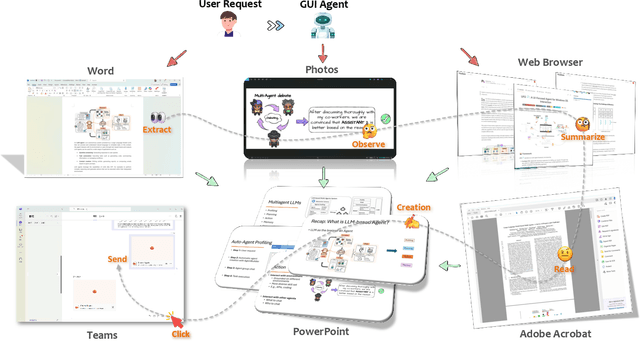


GUIs have long been central to human-computer interaction, providing an intuitive and visually-driven way to access and interact with digital systems. The advent of LLMs, particularly multimodal models, has ushered in a new era of GUI automation. They have demonstrated exceptional capabilities in natural language understanding, code generation, and visual processing. This has paved the way for a new generation of LLM-brained GUI agents capable of interpreting complex GUI elements and autonomously executing actions based on natural language instructions. These agents represent a paradigm shift, enabling users to perform intricate, multi-step tasks through simple conversational commands. Their applications span across web navigation, mobile app interactions, and desktop automation, offering a transformative user experience that revolutionizes how individuals interact with software. This emerging field is rapidly advancing, with significant progress in both research and industry. To provide a structured understanding of this trend, this paper presents a comprehensive survey of LLM-brained GUI agents, exploring their historical evolution, core components, and advanced techniques. We address research questions such as existing GUI agent frameworks, the collection and utilization of data for training specialized GUI agents, the development of large action models tailored for GUI tasks, and the evaluation metrics and benchmarks necessary to assess their effectiveness. Additionally, we examine emerging applications powered by these agents. Through a detailed analysis, this survey identifies key research gaps and outlines a roadmap for future advancements in the field. By consolidating foundational knowledge and state-of-the-art developments, this work aims to guide both researchers and practitioners in overcoming challenges and unlocking the full potential of LLM-brained GUI agents.
Thread: A Logic-Based Data Organization Paradigm for How-To Question Answering with Retrieval Augmented Generation
Jun 19, 2024


Current question answering systems leveraging retrieval augmented generation perform well in answering factoid questions but face challenges with non-factoid questions, particularly how-to queries requiring detailed step-by-step instructions and explanations. In this paper, we introduce Thread, a novel data organization paradigm that transforms documents into logic units based on their inter-connectivity. Extensive experiments across open-domain and industrial scenarios demonstrate that Thread outperforms existing data organization paradigms in RAG-based QA systems, significantly improving the handling of how-to questions.
Nissist: An Incident Mitigation Copilot based on Troubleshooting Guides
Feb 27, 2024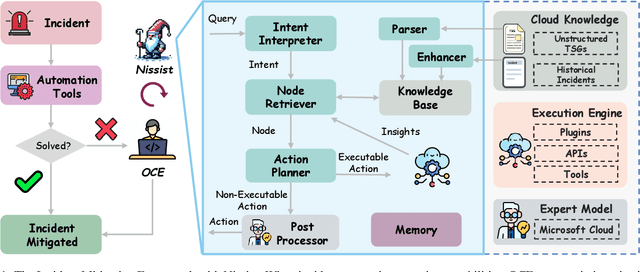
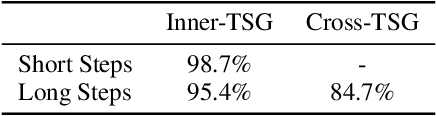
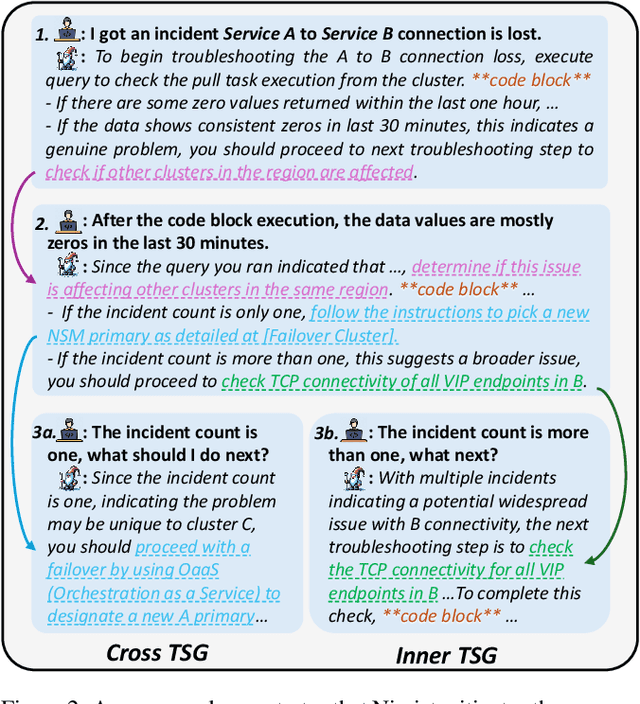
Effective incident management is pivotal for the smooth operation of enterprises-level cloud services. In order to expedite incident mitigation, service teams compile troubleshooting knowledge into Troubleshooting Guides (TSGs) accessible to on-call engineers (OCEs). While automated pipelines are enabled to resolve the most frequent and easy incidents, there still exist complex incidents that require OCEs' intervention. However, TSGs are often unstructured and incomplete, which requires manual interpretation by OCEs, leading to on-call fatigue and decreased productivity, especially among new-hire OCEs. In this work, we propose Nissist which leverages TSGs and incident mitigation histories to provide proactive suggestions, reducing human intervention. Leveraging Large Language Models (LLM), Nissist extracts insights from unstructured TSGs and historical incident mitigation discussions, forming a comprehensive knowledge base. Its multi-agent system design enhances proficiency in precisely discerning user queries, retrieving relevant information, and delivering systematic plans consecutively. Through our user case and experiment, we demonstrate that Nissist significant reduce Time to Mitigate (TTM) in incident mitigation, alleviating operational burdens on OCEs and improving service reliability. Our demo is available at https://aka.ms/nissist_demo.
UFO: A UI-Focused Agent for Windows OS Interaction
Feb 23, 2024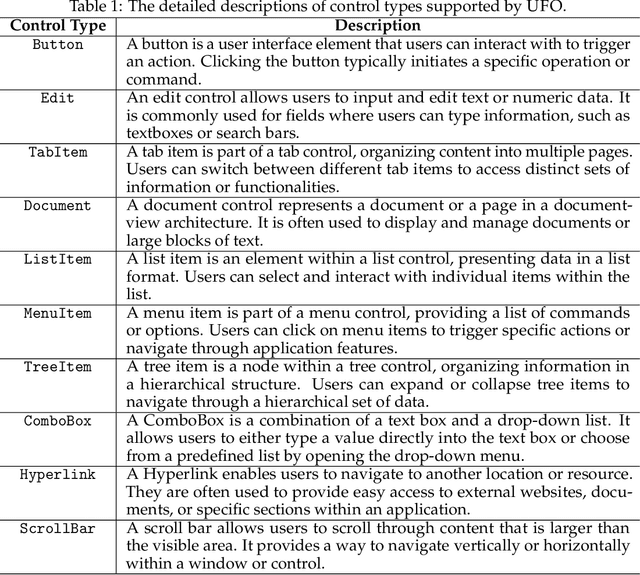
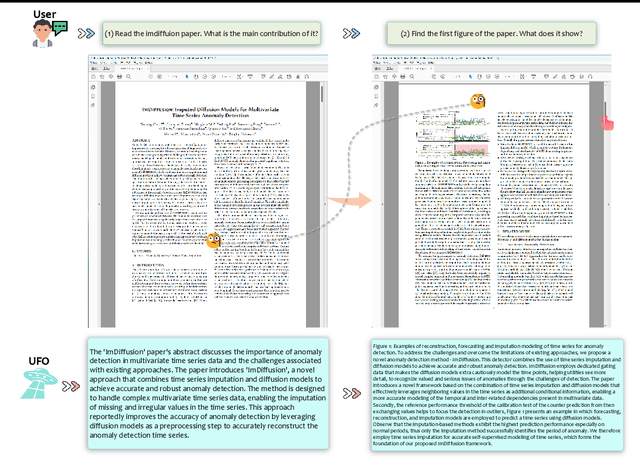
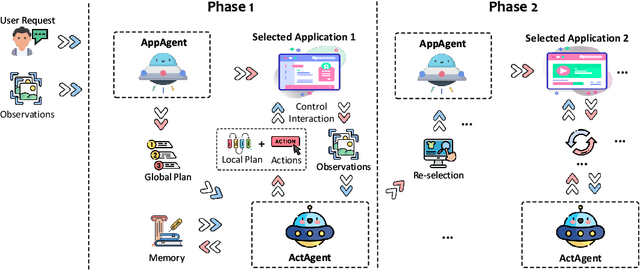
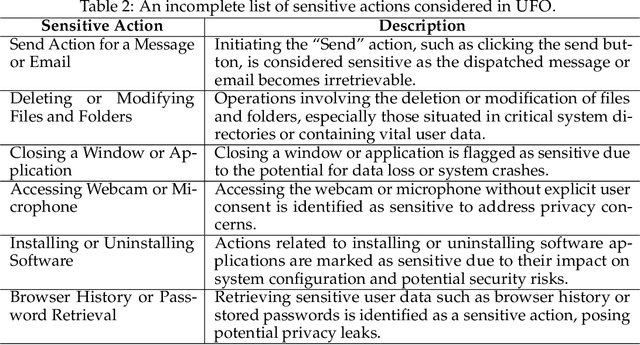
We introduce UFO, an innovative UI-Focused agent to fulfill user requests tailored to applications on Windows OS, harnessing the capabilities of GPT-Vision. UFO employs a dual-agent framework to meticulously observe and analyze the graphical user interface (GUI) and control information of Windows applications. This enables the agent to seamlessly navigate and operate within individual applications and across them to fulfill user requests, even when spanning multiple applications. The framework incorporates a control interaction module, facilitating action grounding without human intervention and enabling fully automated execution. Consequently, UFO transforms arduous and time-consuming processes into simple tasks achievable solely through natural language commands. We conducted testing of UFO across 9 popular Windows applications, encompassing a variety of scenarios reflective of users' daily usage. The results, derived from both quantitative metrics and real-case studies, underscore the superior effectiveness of UFO in fulfilling user requests. To the best of our knowledge, UFO stands as the first UI agent specifically tailored for task completion within the Windows OS environment. The open-source code for UFO is available on https://github.com/microsoft/UFO.