 Add to Chrome
 Add to Firefox
 Add to Edge
Event-Based Upper-Body Humanoid Teleoperation Under Challenging Illumination
Jul 31, 2026
We present a real-time upper-body human-to-humanoid motion imitation framework driven by neuromorphic event-based vision. This work addresses practical perceptual bottlenecks of conventional frame-based RGB sensors, specifically their difficulty in high dynamic range (HDR) scenes and rapid motions due to fixed integration times. By leveraging the Prophesee EVK4 event camera, which operates asynchronously with high temporal resolution and a dynamic range exceeding 120 dB, our system supports stable tracking in conditions where standard vision pipelines degrade, such as severe backlighting and very low light environments below 5 lux. The architecture integrates a low-latency Perception Module, utilizing optimized event accumulation and gravity-aligned inertial fusion, with a causal Motion Module (TWIST) that performs online kinematic retargeting. We validate the system on an embedded NVIDIA Booster T1 platform and an 18-DoF humanoid upper-body setup, demonstrating an end-to-end photon-to-action latency of 23-34 ms and advantages over RGB baselines under our experimental setup. The results indicate a practical trade-off: events can be preferable for fast or poorly lit upper-body teleoperation, whereas well-lit static scenes may favor RGB or hybrid sensing.

MEMPROBE: Probing Long-Term Agent Memory via Hidden User-State Recovery
Jun 23, 2026Long-term memory promises LLM agents that grow more capable across sessions, maintaining an accurate, evolving understanding of the user that interaction forms. In practice, however, this memory is evaluated mostly through downstream behavior, such as later answers, personalization quality, or task success, which tests that understanding only indirectly and leaves the memory artifact itself largely unaudited. We argue that long-term memory should instead be evaluated as an auditable post-interaction artifact: after ordinary assistance, what structured user state can be reconstructed from the memory the agent leaves behind? We instantiate this view in MEMPROBE, a benchmark in which a memory-equipped agent assists simulated users, each carrying a hidden, taxonomy-anchored user-state bank, across a trajectory of leak-controlled tasks, after which that bank is reconstructed from the agent's resulting memory under both full-store and top-k access. Built on synthetic ground truth for efficient, scalable measurement, MEMPROBE spans 50 simulated users with 31 hidden dimensions each (1,550 recovery targets) and tests 5 representative memory systems. Testing state-of-the-art memory agents, we find that successful assistance and recoverable memory behave as distinct capabilities. Task completion nearly saturates, even for a memoryless baseline, while category-balanced recovery stays moderate (about 0.6) and drops further under top-k retrieval. MEMPROBE is the first benchmark to study memory recovery directly, reconstructing the user state a system retains and scoring it against ground truth. We see recovery as a concrete objective for future memory agents to optimize, and MEMPROBE as a step toward an environment where agents are trained to remember their users, growing more faithful the longer they know them.
ARC-STAR: Auditable Post-Hoc Correction for PDE Foundation Models
May 21, 2026Partial differential equation (PDE) foundation models are pretrained networks that forecast how physical fields like velocity and pressure evolve from a single reusable solver. On unfamiliar flows their predictions drift step by step, errors concentrate in a few regions, yet retraining destabilizes the network and uniform post-hoc correction overlooks this spatial concentration. To address this, we propose a frozen-solver post-hoc correction framework, Adaptive Risk-Calibrated Spatial Triage for Auditable Refinement (ARC-STAR). ARC-STAR organizes correction into three stages: a global corrector removes broad solver bias, a blockwise local refiner cleans the post-global residual, and, at deployment, a label-free score routes refinement to high-risk blocks under a compute budget. The framework is designed to be (i) frozen-host, preserving the pretrained solver without fine-tuning; (ii) auditable, with global and local stages trained and evaluated separately for measurable contributions; and (iii) budget-aware, using a blockwise interface that either refines the full field or routes limited compute to high-risk regions. Across five flow benchmarks spanning ten regime cells, ARC-STAR is the only method that cuts velocity rollout error by at least 36x over raw Poseidon on every cell. The global stage reduces raw host error by 91-99%, and the local stage further reduces the remaining post-global residual by up to 94.4%. Our code implementation is available at https://anonymous.4open.science/r/arc_star.
A Deployment Audit of Release-Side Risk in Conformal Triage under Prevalence Shift
May 20, 2026Conformal triage converts predictive scores into deployment actions that either release a case, flag it for urgent attention, or defer it to human review. Under prevalence shift, however, the usual summaries of marginal coverage and human-review rate can miss the safety-critical question of whether patients who truly experience the target event are released without review. To address this gap, we introduce a leakage-aware deployment audit for release-side conformal triage. It first assigns target subjects to three non-overlapping roles: prevalence correction, conformal calibration, and held-out release-safety evaluation. This separation then lets the audit evaluate release directly: how many event-positive patients are cleared without review, whether the pilot has enough event labels for calibration, and how the safety-review trade-off shifts. Applying this audit to a retrospective NSCLC pilot shows why lower review can be misleading: after prevalence correction, the pooled conformal branch lowers review by releasing more patients, some of whom are event-positive. Within the audit, the classwise branch acts as a scarcity diagnostic: the pilot has too few event labels to certify safe low-review release.
EvoSkills: Self-Evolving Agent Skills via Co-Evolutionary Verification
Apr 02, 2026Anthropic proposes the concept of skills for LLM agents to tackle multi-step professional tasks that simple tool invocations cannot address. A tool is a single, self-contained function, whereas a skill is a structured bundle of interdependent multi-file artifacts. Currently, skill generation is not only label-intensive due to manual authoring, but also may suffer from human--machine cognitive misalignment, which can lead to degraded agent performance, as evidenced by evaluations on SkillsBench. Therefore, we aim to enable agents to autonomously generate skills. However, existing self-evolving methods designed for tools cannot be directly applied to skills due to their increased complexity. To address these issues, we propose EvoSkills, a self-evolving skills framework that enables agents to autonomously construct complex, multi-file skill packages. Specifically, EvoSkills couples a Skill Generator that iteratively refines skills with a Surrogate Verifier that co-evolves to provide informative and actionable feedback without access to ground-truth test content. On SkillsBench, EvoSkills achieves the highest pass rate among five baselines on both Claude Code and Codex, and also exhibits strong generalization capabilities to six additional LLMs.
To See is Not to Master: Teaching LLMs to Use Private Libraries for Code Generation
Mar 17, 2026Large Language Models (LLMs) have shown strong potential for code generation, yet they remain limited in private-library-oriented code generation, where the goal is to generate code using APIs from private libraries. Existing approaches mainly rely on retrieving private-library API documentation and injecting relevant knowledge into the context at inference time. However, our study shows that this is insufficient: even given accurate required knowledge, LLMs still struggle to invoke private-library APIs effectively. To address this limitation, we propose PriCoder, an approach that teaches LLMs to invoke private-library APIs through automatically synthesized data. Specifically, PriCoder models private-library data synthesis as the construction of a graph, and alternates between two graph operators: (1) Progressive Graph Evolution, which improves data diversity by progressively synthesizing more diverse training samples from basic ones, and (2) Multidimensional Graph Pruning, which improves data quality through a rigorous filtering pipeline. To support rigorous evaluation, we construct two new benchmarks based on recently released libraries that are unfamiliar to the tested models. Experiments on three mainstream LLMs show that PriCoder substantially improves private-library-oriented code generation, yielding gains of over 20% in pass@1 in many settings, while causing negligible impact on general code generation capability. Our code and benchmarks are publicly available at https://github.com/eniacode/PriCoder.
See-through: Single-image Layer Decomposition for Anime Characters
Feb 03, 2026We introduce a framework that automates the transformation of static anime illustrations into manipulatable 2.5D models. Current professional workflows require tedious manual segmentation and the artistic ``hallucination'' of occluded regions to enable motion. Our approach overcomes this by decomposing a single image into fully inpainted, semantically distinct layers with inferred drawing orders. To address the scarcity of training data, we introduce a scalable engine that bootstraps high-quality supervision from commercial Live2D models, capturing pixel-perfect semantics and hidden geometry. Our methodology couples a diffusion-based Body Part Consistency Module, which enforces global geometric coherence, with a pixel-level pseudo-depth inference mechanism. This combination resolves the intricate stratification of anime characters, e.g., interleaving hair strands, allowing for dynamic layer reconstruction. We demonstrate that our approach yields high-fidelity, manipulatable models suitable for professional, real-time animation applications.
What Do Agents Learn from Trajectory-SFT: Semantics or Interfaces?
Feb 02, 2026Large language models are increasingly evaluated as interactive agents, yet standard agent benchmarks conflate two qualitatively distinct sources of success: semantic tool-use and interface-specific interaction pattern memorization. Because both mechanisms can yield identical task success on the original interface, benchmark scores alone are not identifiable evidence of environment-invariant capability. We propose PIPE, a protocol-level evaluation augmentation for diagnosing interface reliance by minimally rewriting environment interfaces while preserving task semantics and execution behavior. Across 16 environments from AgentBench and AgentGym and a range of open-source and API-based agents, PIPE reveals that trajectory-SFT substantially amplifies interface shortcutting: trained agents degrade sharply under minimal interface rewrites, while non-trajectory-trained models remain largely stable. We further introduce Interface Reliance (IR), a counterbalanced alias-based metric that quantifies preference for training-time interfaces, and show that interface shortcutting exhibits environment-dependent, non-monotonic training dynamics that remain invisible under standard evaluation. Our code is available at https://anonymous.4open.science/r/What-Do-Agents-Learn-from-Trajectory-SFT-Semantics-or-Interfaces--0831/.
FeatBench: Evaluating Coding Agents on Feature Implementation for Vibe Coding
Sep 26, 2025The rapid advancement of Large Language Models (LLMs) has given rise to a novel software development paradigm known as "vibe coding," where users interact with coding agents through high-level natural language. However, existing evaluation benchmarks for code generation inadequately assess an agent's vibe coding capabilities. Existing benchmarks are misaligned, as they either require code-level specifications or focus narrowly on issue-solving, neglecting the critical scenario of feature implementation within the vibe coding paradiam. To address this gap, we propose FeatBench, a novel benchmark for vibe coding that focuses on feature implementation. Our benchmark is distinguished by several key features: 1. Pure Natural Language Prompts. Task inputs consist solely of abstract natural language descriptions, devoid of any code or structural hints. 2. A Rigorous & Evolving Data Collection Process. FeatBench is built on a multi-level filtering pipeline to ensure quality and a fully automated pipeline to evolve the benchmark, mitigating data contamination. 3. Comprehensive Test Cases. Each task includes Fail-to-Pass (F2P) and Pass-to-Pass (P2P) tests to verify correctness and prevent regressions. 4. Diverse Application Domains. The benchmark includes repositories from diverse domains to ensure it reflects real-world scenarios. We evaluate two state-of-the-art agent frameworks with four leading LLMs on FeatBench. Our evaluation reveals that feature implementation within the vibe coding paradigm is a significant challenge, with the highest success rate of only 29.94%. Our analysis also reveals a tendency for "aggressive implementation," a strategy that paradoxically leads to both critical failures and superior software design. We release FeatBench, our automated collection pipeline, and all experimental results to facilitate further community research.
NodeRAG: Structuring Graph-based RAG with Heterogeneous Nodes
Apr 15, 2025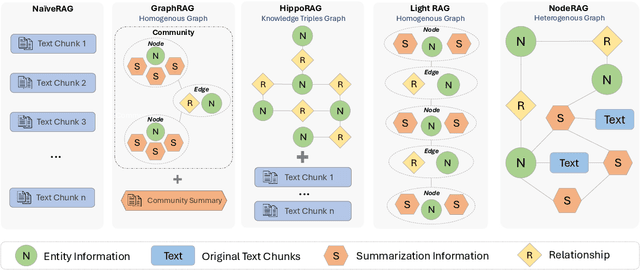
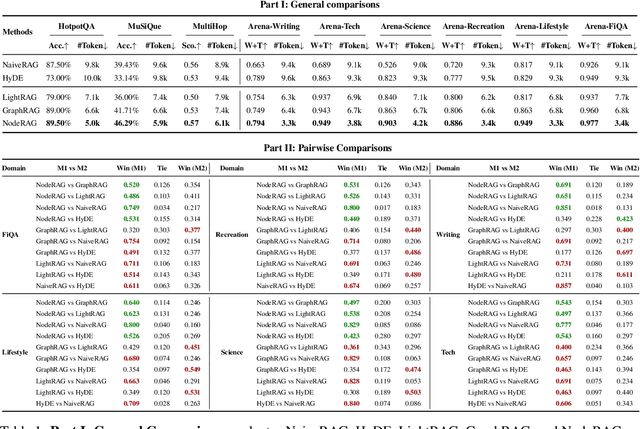
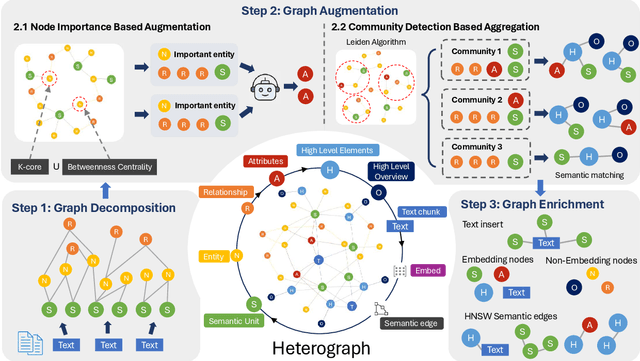
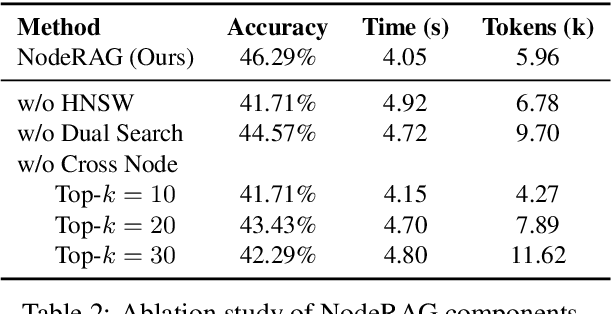
Retrieval-augmented generation (RAG) empowers large language models to access external and private corpus, enabling factually consistent responses in specific domains. By exploiting the inherent structure of the corpus, graph-based RAG methods further enrich this process by building a knowledge graph index and leveraging the structural nature of graphs. However, current graph-based RAG approaches seldom prioritize the design of graph structures. Inadequately designed graph not only impede the seamless integration of diverse graph algorithms but also result in workflow inconsistencies and degraded performance. To further unleash the potential of graph for RAG, we propose NodeRAG, a graph-centric framework introducing heterogeneous graph structures that enable the seamless and holistic integration of graph-based methodologies into the RAG workflow. By aligning closely with the capabilities of LLMs, this framework ensures a fully cohesive and efficient end-to-end process. Through extensive experiments, we demonstrate that NodeRAG exhibits performance advantages over previous methods, including GraphRAG and LightRAG, not only in indexing time, query time, and storage efficiency but also in delivering superior question-answering performance on multi-hop benchmarks and open-ended head-to-head evaluations with minimal retrieval tokens. Our GitHub repository could be seen at https://github.com/Terry-Xu-666/NodeRAG.