 Add to Chrome
 Add to Firefox
 Add to Edge
VideoDeepResearch: Long Video Understanding With Agentic Tool Using
Jun 12, 2025
Long video understanding (LVU) presents a significant challenge for current multi-modal large language models (MLLMs) due to the task's inherent complexity and context window constraint. It is widely assumed that addressing LVU tasks requires foundation MLLMs with extended context windows, strong visual perception capabilities, and proficient domain expertise. In this work, we challenge this common belief by introducing VideoDeepResearch, a novel agentic framework for long video understanding. Our approach relies solely on a text-only large reasoning model (LRM) combined with a modular multi-modal toolkit, including multimodal retrievers and visual perceivers, all of which are readily available in practice. For each LVU task, the system formulates a problem-solving strategy through reasoning, while selectively accessing and utilizing essential video content via tool using. We conduct extensive experiments on popular LVU benchmarks, including MLVU, Video-MME, and LVBench. Our results demonstrate that VideoDeepResearch achieves substantial improvements over existing MLLM baselines, surpassing the previous state-of-the-art by 9.6%, 6.6%, and 3.9% on MLVU (test), LVBench, and LongVideoBench, respectively. These findings highlight the promise of agentic systems in overcoming key challenges in LVU problems.

Fact in Fragments: Deconstructing Complex Claims via LLM-based Atomic Fact Extraction and Verification
Jun 09, 2025Fact verification plays a vital role in combating misinformation by assessing the veracity of claims through evidence retrieval and reasoning. However, traditional methods struggle with complex claims requiring multi-hop reasoning over fragmented evidence, as they often rely on static decomposition strategies and surface-level semantic retrieval, which fail to capture the nuanced structure and intent of the claim. This results in accumulated reasoning errors, noisy evidence contamination, and limited adaptability to diverse claims, ultimately undermining verification accuracy in complex scenarios. To address this, we propose Atomic Fact Extraction and Verification (AFEV), a novel framework that iteratively decomposes complex claims into atomic facts, enabling fine-grained retrieval and adaptive reasoning. AFEV dynamically refines claim understanding and reduces error propagation through iterative fact extraction, reranks evidence to filter noise, and leverages context-specific demonstrations to guide the reasoning process. Extensive experiments on five benchmark datasets demonstrate that AFEV achieves state-of-the-art performance in both accuracy and interpretability.
Towards Effective Code-Integrated Reasoning
May 30, 2025In this paper, we investigate code-integrated reasoning, where models generate code when necessary and integrate feedback by executing it through a code interpreter. To acquire this capability, models must learn when and how to use external code tools effectively, which is supported by tool-augmented reinforcement learning (RL) through interactive learning. Despite its benefits, tool-augmented RL can still suffer from potential instability in the learning dynamics. In light of this challenge, we present a systematic approach to improving the training effectiveness and stability of tool-augmented RL for code-integrated reasoning. Specifically, we develop enhanced training strategies that balance exploration and stability, progressively building tool-use capabilities while improving reasoning performance. Through extensive experiments on five mainstream mathematical reasoning benchmarks, our model demonstrates significant performance improvements over multiple competitive baselines. Furthermore, we conduct an in-depth analysis of the mechanism and effect of code-integrated reasoning, revealing several key insights, such as the extension of model's capability boundaries and the simultaneous improvement of reasoning efficiency through code integration. All data and code for reproducing this work are available at: https://github.com/RUCAIBox/CIR.
Mod-Adapter: Tuning-Free and Versatile Multi-concept Personalization via Modulation Adapter
May 24, 2025Personalized text-to-image generation aims to synthesize images of user-provided concepts in diverse contexts. Despite recent progress in multi-concept personalization, most are limited to object concepts and struggle to customize abstract concepts (e.g., pose, lighting). Some methods have begun exploring multi-concept personalization supporting abstract concepts, but they require test-time fine-tuning for each new concept, which is time-consuming and prone to overfitting on limited training images. In this work, we propose a novel tuning-free method for multi-concept personalization that can effectively customize both object and abstract concepts without test-time fine-tuning. Our method builds upon the modulation mechanism in pretrained Diffusion Transformers (DiTs) model, leveraging the localized and semantically meaningful properties of the modulation space. Specifically, we propose a novel module, Mod-Adapter, to predict concept-specific modulation direction for the modulation process of concept-related text tokens. It incorporates vision-language cross-attention for extracting concept visual features, and Mixture-of-Experts (MoE) layers that adaptively map the concept features into the modulation space. Furthermore, to mitigate the training difficulty caused by the large gap between the concept image space and the modulation space, we introduce a VLM-guided pretraining strategy that leverages the strong image understanding capabilities of vision-language models to provide semantic supervision signals. For a comprehensive comparison, we extend a standard benchmark by incorporating abstract concepts. Our method achieves state-of-the-art performance in multi-concept personalization, supported by quantitative, qualitative, and human evaluations.
SimpleDeepSearcher: Deep Information Seeking via Web-Powered Reasoning Trajectory Synthesis
May 22, 2025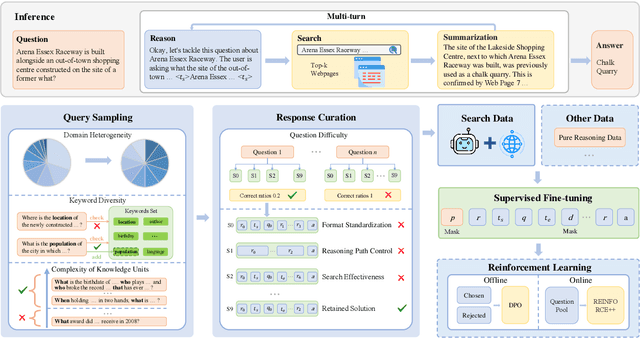
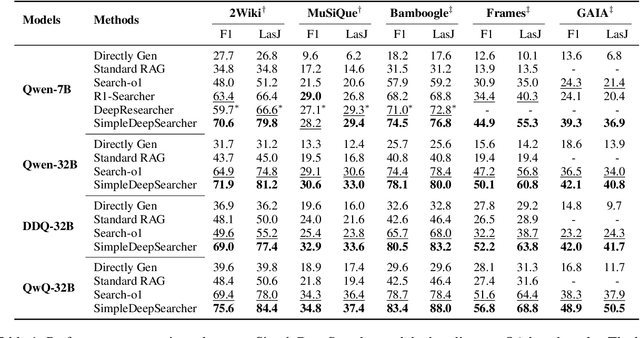
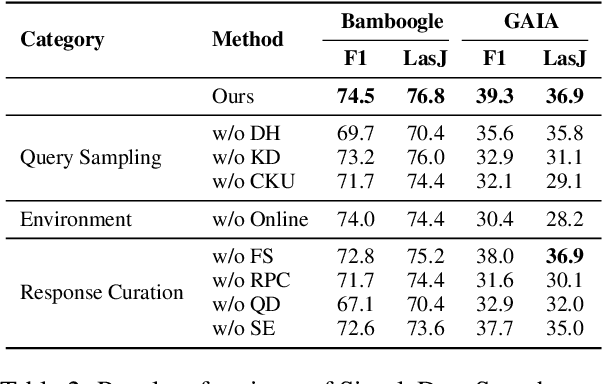
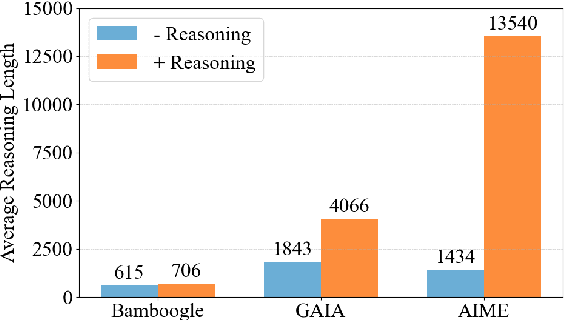
Retrieval-augmented generation (RAG) systems have advanced large language models (LLMs) in complex deep search scenarios requiring multi-step reasoning and iterative information retrieval. However, existing approaches face critical limitations that lack high-quality training trajectories or suffer from the distributional mismatches in simulated environments and prohibitive computational costs for real-world deployment. This paper introduces SimpleDeepSearcher, a lightweight yet effective framework that bridges this gap through strategic data engineering rather than complex training paradigms. Our approach synthesizes high-quality training data by simulating realistic user interactions in live web search environments, coupled with a multi-criteria curation strategy that optimizes the diversity and quality of input and output side. Experiments on five benchmarks across diverse domains demonstrate that SFT on only 871 curated samples yields significant improvements over RL-based baselines. Our work establishes SFT as a viable pathway by systematically addressing the data-scarce bottleneck, offering practical insights for efficient deep search systems. Our code is available at https://github.com/RUCAIBox/SimpleDeepSearcher.
Logic-of-Thought: Empowering Large Language Models with Logic Programs for Solving Puzzles in Natural Language
May 22, 2025Solving puzzles in natural language poses a long-standing challenge in AI. While large language models (LLMs) have recently shown impressive capabilities in a variety of tasks, they continue to struggle with complex puzzles that demand precise reasoning and exhaustive search. In this paper, we propose Logic-of-Thought (Logot), a novel framework that bridges LLMs with logic programming to address this problem. Our method leverages LLMs to translate puzzle rules and states into answer set programs (ASPs), the solution of which are then accurately and efficiently inferred by an ASP interpreter. This hybrid approach combines the natural language understanding of LLMs with the precise reasoning capabilities of logic programs. We evaluate our method on various grid puzzles and dynamic puzzles involving actions, demonstrating near-perfect accuracy across all tasks. Our code and data are available at: https://github.com/naiqili/Logic-of-Thought.
Single LLM, Multiple Roles: A Unified Retrieval-Augmented Generation Framework Using Role-Specific Token Optimization
May 21, 2025Existing studies have optimized retrieval-augmented generation (RAG) across various sub-tasks, such as query understanding and retrieval refinement, but integrating these optimizations into a unified framework remains challenging. To tackle this problem, this work proposes RoleRAG, a unified RAG framework that achieves efficient multi-task processing through role-specific token optimization. RoleRAG comprises six modules, each handling a specific sub-task within the RAG process. Additionally, we introduce a query graph to represent the decomposition of the query, which can be dynamically resolved according to the decomposing state. All modules are driven by the same underlying LLM, distinguished by task-specific role tokens that are individually optimized. This design allows RoleRAG to dynamically activate different modules within a single LLM instance, thereby streamlining deployment and reducing resource consumption. Experimental results on five open-domain question-answering datasets demonstrate the effectiveness, generalizability, and flexibility of our framework.
R2MED: A Benchmark for Reasoning-Driven Medical Retrieval
May 20, 2025Current medical retrieval benchmarks primarily emphasize lexical or shallow semantic similarity, overlooking the reasoning-intensive demands that are central to clinical decision-making. In practice, physicians often retrieve authoritative medical evidence to support diagnostic hypotheses. Such evidence typically aligns with an inferred diagnosis rather than the surface form of a patient's symptoms, leading to low lexical or semantic overlap between queries and relevant documents. To address this gap, we introduce R2MED, the first benchmark explicitly designed for reasoning-driven medical retrieval. It comprises 876 queries spanning three tasks: Q&A reference retrieval, clinical evidence retrieval, and clinical case retrieval. These tasks are drawn from five representative medical scenarios and twelve body systems, capturing the complexity and diversity of real-world medical information needs. We evaluate 15 widely-used retrieval systems on R2MED and find that even the best model achieves only 31.4 nDCG@10, demonstrating the benchmark's difficulty. Classical re-ranking and generation-augmented retrieval methods offer only modest improvements. Although large reasoning models improve performance via intermediate inference generation, the best results still peak at 41.4 nDCG@10. These findings underscore a substantial gap between current retrieval techniques and the reasoning demands of real clinical tasks. We release R2MED as a challenging benchmark to foster the development of next-generation medical retrieval systems with enhanced reasoning capabilities. Data and code are available at https://github.com/R2MED/R2MED
Towards A Generalist Code Embedding Model Based On Massive Data Synthesis
May 19, 2025Code embedding models attract increasing attention due to the widespread popularity of retrieval-augmented generation (RAG) in software development. These models are expected to capture the rich semantic relationships inherent to code, which differ significantly from those found in text. However, existing models remain severely limited due to the scarcity of high-quality training data. In this work, we introduce \textbf{CodeR} (\underline{Code} \underline{R}etrieval), a state-of-the-art embedding model for general-purpose code retrieval. The superior performance of CodeR is built upon CodeR-Pile, a large-scale synthetic dataset constructed under the DRU (Diversity, Reliability, Usability) principle via a novel data synthesis pipeline. To optimize training effectiveness, we propose Annealing, a curriculum learning strategy that enables effective knowledge transfer across heterogeneous sources of data. We evaluate CodeR based on 16 diverse code retrieval tasks, where it significantly outperforms existing baselines and exhibits strong out-of-domain generalization performance. We have publicly released our code and the well-trained model to facilitate further research in this critical area. https://github.com/FlagOpen/FlagEmbedding/tree/master/research/BGE_Coder.
Scent of Knowledge: Optimizing Search-Enhanced Reasoning with Information Foraging
May 14, 2025Augmenting large language models (LLMs) with external retrieval has become a standard method to address their inherent knowledge cutoff limitations. However, traditional retrieval-augmented generation methods employ static, pre-inference retrieval strategies, making them inadequate for complex tasks involving ambiguous, multi-step, or evolving information needs. Recent advances in test-time scaling techniques have demonstrated significant potential in enabling LLMs to dynamically interact with external tools, motivating the shift toward adaptive inference-time retrieval. Inspired by Information Foraging Theory (IFT), we propose InForage, a reinforcement learning framework that formalizes retrieval-augmented reasoning as a dynamic information-seeking process. Unlike existing approaches, InForage explicitly rewards intermediate retrieval quality, encouraging LLMs to iteratively gather and integrate information through adaptive search behaviors. To facilitate training, we construct a human-guided dataset capturing iterative search and reasoning trajectories for complex, real-world web tasks. Extensive evaluations across general question answering, multi-hop reasoning tasks, and a newly developed real-time web QA dataset demonstrate InForage's superior performance over baseline methods. These results highlight InForage's effectiveness in building robust, adaptive, and efficient reasoning agents.