 Add to Chrome
 Add to Firefox
 Add to Edge
GenieDrive: Towards Physics-Aware Driving World Model with 4D Occupancy Guided Video Generation
Dec 14, 2025
Physics-aware driving world model is essential for drive planning, out-of-distribution data synthesis, and closed-loop evaluation. However, existing methods often rely on a single diffusion model to directly map driving actions to videos, which makes learning difficult and leads to physically inconsistent outputs. To overcome these challenges, we propose GenieDrive, a novel framework designed for physics-aware driving video generation. Our approach starts by generating 4D occupancy, which serves as a physics-informed foundation for subsequent video generation. 4D occupancy contains rich physical information, including high-resolution 3D structures and dynamics. To facilitate effective compression of such high-resolution occupancy, we propose a VAE that encodes occupancy into a latent tri-plane representation, reducing the latent size to only 58% of that used in previous methods. We further introduce Mutual Control Attention (MCA) to accurately model the influence of control on occupancy evolution, and we jointly train the VAE and the subsequent prediction module in an end-to-end manner to maximize forecasting accuracy. Together, these designs yield a 7.2% improvement in forecasting mIoU at an inference speed of 41 FPS, while using only 3.47 M parameters. Additionally, a Normalized Multi-View Attention is introduced in the video generation model to generate multi-view driving videos with guidance from our 4D occupancy, significantly improving video quality with a 20.7% reduction in FVD. Experiments demonstrate that GenieDrive enables highly controllable, multi-view consistent, and physics-aware driving video generation.

DrivePI: Spatial-aware 4D MLLM for Unified Autonomous Driving Understanding, Perception, Prediction and Planning
Dec 14, 2025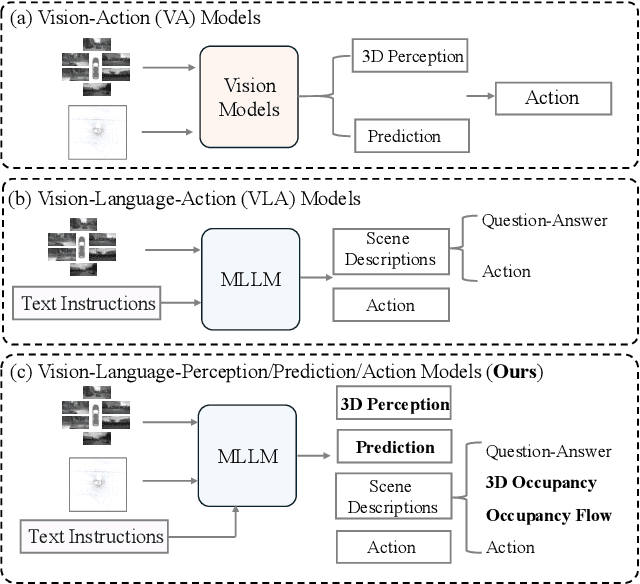
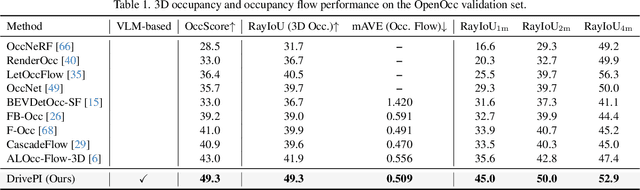
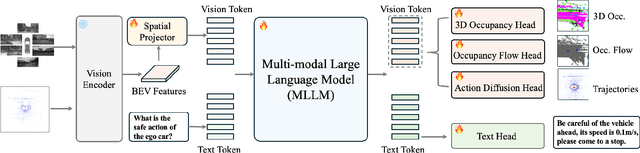
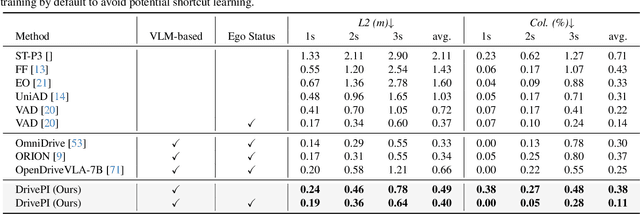
Although multi-modal large language models (MLLMs) have shown strong capabilities across diverse domains, their application in generating fine-grained 3D perception and prediction outputs in autonomous driving remains underexplored. In this paper, we propose DrivePI, a novel spatial-aware 4D MLLM that serves as a unified Vision-Language-Action (VLA) framework that is also compatible with vision-action (VA) models. Our method jointly performs spatial understanding, 3D perception (i.e., 3D occupancy), prediction (i.e., occupancy flow), and planning (i.e., action outputs) in parallel through end-to-end optimization. To obtain both precise geometric information and rich visual appearance, our approach integrates point clouds, multi-view images, and language instructions within a unified MLLM architecture. We further develop a data engine to generate text-occupancy and text-flow QA pairs for 4D spatial understanding. Remarkably, with only a 0.5B Qwen2.5 model as MLLM backbone, DrivePI as a single unified model matches or exceeds both existing VLA models and specialized VA models. Specifically, compared to VLA models, DrivePI outperforms OpenDriveVLA-7B by 2.5% mean accuracy on nuScenes-QA and reduces collision rate by 70% over ORION (from 0.37% to 0.11%) on nuScenes. Against specialized VA models, DrivePI surpasses FB-OCC by 10.3 RayIoU for 3D occupancy on OpenOcc, reduces the mAVE from 0.591 to 0.509 for occupancy flow on OpenOcc, and achieves 32% lower L2 error than VAD (from 0.72m to 0.49m) for planning on nuScenes. Code will be available at https://github.com/happinesslz/DrivePI
Beyond Elicitation: Provision-based Prompt Optimization for Knowledge-Intensive Tasks
Nov 13, 2025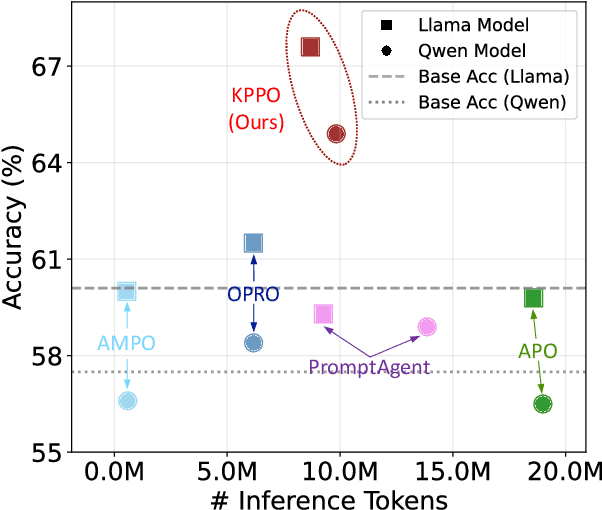
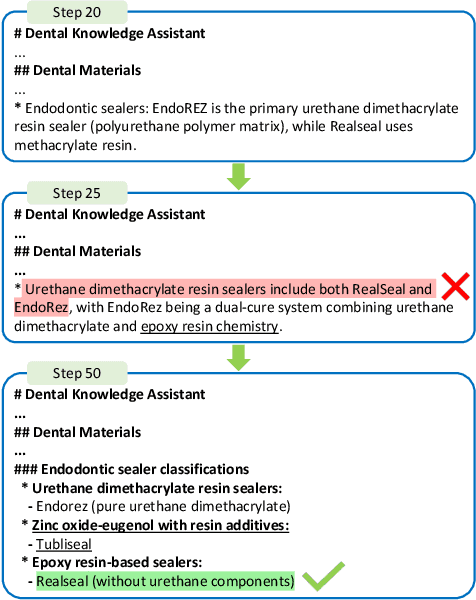
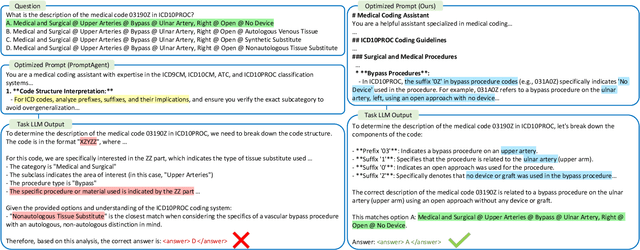

While prompt optimization has emerged as a critical technique for enhancing language model performance, existing approaches primarily focus on elicitation-based strategies that search for optimal prompts to activate models' capabilities. These methods exhibit fundamental limitations when addressing knowledge-intensive tasks, as they operate within fixed parametric boundaries rather than providing the factual knowledge, terminology precision, and reasoning patterns required in specialized domains. To address these limitations, we propose Knowledge-Provision-based Prompt Optimization (KPPO), a framework that reformulates prompt optimization as systematic knowledge integration rather than potential elicitation. KPPO introduces three key innovations: 1) a knowledge gap filling mechanism for knowledge gap identification and targeted remediation; 2) a batch-wise candidate evaluation approach that considers both performance improvement and distributional stability; 3) an adaptive knowledge pruning strategy that balances performance and token efficiency, reducing up to 29% token usage. Extensive evaluation on 15 knowledge-intensive benchmarks from various domains demonstrates KPPO's superiority over elicitation-based methods, with an average performance improvement of ~6% over the strongest baseline while achieving comparable or lower token consumption. Code at: https://github.com/xyz9911/KPPO.
DIAL-GS: Dynamic Instance Aware Reconstruction for Label-free Street Scenes with 4D Gaussian Splatting
Nov 10, 2025Urban scene reconstruction is critical for autonomous driving, enabling structured 3D representations for data synthesis and closed-loop testing. Supervised approaches rely on costly human annotations and lack scalability, while current self-supervised methods often confuse static and dynamic elements and fail to distinguish individual dynamic objects, limiting fine-grained editing. We propose DIAL-GS, a novel dynamic instance-aware reconstruction method for label-free street scenes with 4D Gaussian Splatting. We first accurately identify dynamic instances by exploiting appearance-position inconsistency between warped rendering and actual observation. Guided by instance-level dynamic perception, we employ instance-aware 4D Gaussians as the unified volumetric representation, realizing dynamic-adaptive and instance-aware reconstruction. Furthermore, we introduce a reciprocal mechanism through which identity and dynamics reinforce each other, enhancing both integrity and consistency. Experiments on urban driving scenarios show that DIAL-GS surpasses existing self-supervised baselines in reconstruction quality and instance-level editing, offering a concise yet powerful solution for urban scene modeling.
Visual Spatial Tuning
Nov 07, 2025Capturing spatial relationships from visual inputs is a cornerstone of human-like general intelligence. Several previous studies have tried to enhance the spatial awareness of Vision-Language Models (VLMs) by adding extra expert encoders, which brings extra overhead and usually harms general capabilities. To enhance the spatial ability in general architectures, we introduce Visual Spatial Tuning (VST), a comprehensive framework to cultivate VLMs with human-like visuospatial abilities, from spatial perception to reasoning. We first attempt to enhance spatial perception in VLMs by constructing a large-scale dataset termed VST-P, which comprises 4.1 million samples spanning 19 skills across single views, multiple images, and videos. Then, we present VST-R, a curated dataset with 135K samples that instruct models to reason in space. In particular, we adopt a progressive training pipeline: supervised fine-tuning to build foundational spatial knowledge, followed by reinforcement learning to further improve spatial reasoning abilities. Without the side-effect to general capabilities, the proposed VST consistently achieves state-of-the-art results on several spatial benchmarks, including $34.8\%$ on MMSI-Bench and $61.2\%$ on VSIBench. It turns out that the Vision-Language-Action models can be significantly enhanced with the proposed spatial tuning paradigm, paving the way for more physically grounded AI.
Jailbreaking Commercial Black-Box LLMs with Explicitly Harmful Prompts
Aug 14, 2025Evaluating jailbreak attacks is challenging when prompts are not overtly harmful or fail to induce harmful outputs. Unfortunately, many existing red-teaming datasets contain such unsuitable prompts. To evaluate attacks accurately, these datasets need to be assessed and cleaned for maliciousness. However, existing malicious content detection methods rely on either manual annotation, which is labor-intensive, or large language models (LLMs), which have inconsistent accuracy in harmful types. To balance accuracy and efficiency, we propose a hybrid evaluation framework named MDH (Malicious content Detection based on LLMs with Human assistance) that combines LLM-based annotation with minimal human oversight, and apply it to dataset cleaning and detection of jailbroken responses. Furthermore, we find that well-crafted developer messages can significantly boost jailbreak success, leading us to propose two new strategies: D-Attack, which leverages context simulation, and DH-CoT, which incorporates hijacked chains of thought. The Codes, datasets, judgements, and detection results will be released in github repository: https://github.com/AlienZhang1996/DH-CoT.
HybridTM: Combining Transformer and Mamba for 3D Semantic Segmentation
Jul 24, 2025Transformer-based methods have demonstrated remarkable capabilities in 3D semantic segmentation through their powerful attention mechanisms, but the quadratic complexity limits their modeling of long-range dependencies in large-scale point clouds. While recent Mamba-based approaches offer efficient processing with linear complexity, they struggle with feature representation when extracting 3D features. However, effectively combining these complementary strengths remains an open challenge in this field. In this paper, we propose HybridTM, the first hybrid architecture that integrates Transformer and Mamba for 3D semantic segmentation. In addition, we propose the Inner Layer Hybrid Strategy, which combines attention and Mamba at a finer granularity, enabling simultaneous capture of long-range dependencies and fine-grained local features. Extensive experiments demonstrate the effectiveness and generalization of our HybridTM on diverse indoor and outdoor datasets. Furthermore, our HybridTM achieves state-of-the-art performance on ScanNet, ScanNet200, and nuScenes benchmarks. The code will be made available at https://github.com/deepinact/HybridTM.
MobileIE: An Extremely Lightweight and Effective ConvNet for Real-Time Image Enhancement on Mobile Devices
Jul 02, 2025Recent advancements in deep neural networks have driven significant progress in image enhancement (IE). However, deploying deep learning models on resource-constrained platforms, such as mobile devices, remains challenging due to high computation and memory demands. To address these challenges and facilitate real-time IE on mobile, we introduce an extremely lightweight Convolutional Neural Network (CNN) framework with around 4K parameters. Our approach integrates reparameterization with an Incremental Weight Optimization strategy to ensure efficiency. Additionally, we enhance performance with a Feature Self-Transform module and a Hierarchical Dual-Path Attention mechanism, optimized with a Local Variance-Weighted loss. With this efficient framework, we are the first to achieve real-time IE inference at up to 1,100 frames per second (FPS) while delivering competitive image quality, achieving the best trade-off between speed and performance across multiple IE tasks. The code will be available at https://github.com/AVC2-UESTC/MobileIE.git.
SafeMobile: Chain-level Jailbreak Detection and Automated Evaluation for Multimodal Mobile Agents
Jul 01, 2025With the wide application of multimodal foundation models in intelligent agent systems, scenarios such as mobile device control, intelligent assistant interaction, and multimodal task execution are gradually relying on such large model-driven agents. However, the related systems are also increasingly exposed to potential jailbreak risks. Attackers may induce the agents to bypass the original behavioral constraints through specific inputs, and then trigger certain risky and sensitive operations, such as modifying settings, executing unauthorized commands, or impersonating user identities, which brings new challenges to system security. Existing security measures for intelligent agents still have limitations when facing complex interactions, especially in detecting potentially risky behaviors across multiple rounds of conversations or sequences of tasks. In addition, an efficient and consistent automated methodology to assist in assessing and determining the impact of such risks is currently lacking. This work explores the security issues surrounding mobile multimodal agents, attempts to construct a risk discrimination mechanism by incorporating behavioral sequence information, and designs an automated assisted assessment scheme based on a large language model. Through preliminary validation in several representative high-risk tasks, the results show that the method can improve the recognition of risky behaviors to some extent and assist in reducing the probability of agents being jailbroken. We hope that this study can provide some valuable references for the security risk modeling and protection of multimodal intelligent agent systems.
Screen Hijack: Visual Poisoning of VLM Agents in Mobile Environments
Jun 16, 2025With the growing integration of vision-language models (VLMs), mobile agents are now widely used for tasks like UI automation and camera-based user assistance. These agents are often fine-tuned on limited user-generated datasets, leaving them vulnerable to covert threats during the training process. In this work we present GHOST, the first clean-label backdoor attack specifically designed for mobile agents built upon VLMs. Our method manipulates only the visual inputs of a portion of the training samples - without altering their corresponding labels or instructions - thereby injecting malicious behaviors into the model. Once fine-tuned with this tampered data, the agent will exhibit attacker-controlled responses when a specific visual trigger is introduced at inference time. The core of our approach lies in aligning the gradients of poisoned samples with those of a chosen target instance, embedding backdoor-relevant features into the poisoned training data. To maintain stealth and enhance robustness, we develop three realistic visual triggers: static visual patches, dynamic motion cues, and subtle low-opacity overlays. We evaluate our method across six real-world Android apps and three VLM architectures adapted for mobile use. Results show that our attack achieves high attack success rates (up to 94.67 percent) while maintaining high clean-task performance (FSR up to 95.85 percent). Additionally, ablation studies shed light on how various design choices affect the efficacy and concealment of the attack. Overall, this work is the first to expose critical security flaws in VLM-based mobile agents, highlighting their susceptibility to clean-label backdoor attacks and the urgent need for effective defense mechanisms in their training pipelines. Code and examples are available at: https://anonymous.4open.science/r/ase-2025-C478.