 Add to Chrome
 Add to Firefox
 Add to Edge
CASIAL: Geometric Distortion Robust Image Watermarking
Jul 29, 2026
Deep learning-based watermarking has shown strong robustness against non-geometric distortions, yet its performance under geometric transformations remains limited. Such transformations induce two fundamental failure modes: region removal, such as cropping or masking, which eliminates the information carried by removed pixels, and desynchronization, such as scaling or rotation, which misaligns pixel positions and disrupts decoding. We argue that achieving geometric robustness requires two essential properties: (1) global spread of the watermark message, ensuring resilience even when large regions are removed, and (2) geometry-invariant representations, enabling decoding to remain synchronized despite spatial transformations. Building on these insights, we propose CASIAL, a geometric distortion-robust watermarking framework with cover image-aware message spreading (CAS) strategy and invariance alignment learning (IAL) module. CAS tightly couples watermark bits with cover image features and distributes them adaptively across the entire image, enhancing per-pixel information capacity and robustness to region removal. IAL leverages spatial attention to capture cross-pixel dependencies and align perturbed features into a shared geometry-invariant representation space, mitigating failures due to desynchronization. Across six challenging geometric transformations, CASIAL achieves substantially stronger robustness than eleven prior baselines while preserving high visual quality. It also maintains competitive performance under six signal distortions and four photometric transformations. Notably, although trained only with white-box distortions, CASIAL also exhibits strong transfer robustness to unseen black-box distortions. Comprehensive experiments demonstrate the broad robustness and superior visual quality of our method.

SnapGuard: Lightweight Prompt Injection Detection for Screenshot-Based Web Agents
Apr 28, 2026Web agents have emerged as an effective paradigm for automating interactions with complex web environments, yet remain vulnerable to prompt injection attacks that embed malicious instructions into webpage content to induce unintended actions. This threat is further amplified for screenshot-based web agents, which operate on rendered visual webpages rather than structured textual representations, making predominant text-centric defenses ineffective. Although multimodal detection methods have been explored, they often rely on large vision-language models (VLMs), incurring significant computational overhead. The bottleneck lies in the complexity of modern webpages: VLMs must comprehend the global semantics of an entire page, resulting in substantial inference time and GPU memory usage. This raises a critical question: can we detect prompt injection attacks from screenshots in a lightweight manner? In this paper, we observe that injected webpages exhibit distinct characteristics compared to benign ones from both visual and textual perspectives. Building on this insight, we propose SnapGuard, a lightweight yet accurate method that reformulates prompt injection detection as multimodal representation analysis over webpage screenshots. SnapGuard leverages two complementary signals: a visual stability indicator that identifies abnormally smooth gradient distributions induced by malicious content, and action-oriented textual signals recovered via contrast-polarity reversal. Extensive evaluations across eight attacks and two benign settings demonstrate that SnapGuard achieves an F1 score of 0.75, outperforming GPT-4o-prompt while being 8x faster (1.81s vs. 14.50s) and introducing no additional memory overhead.
ResetEdit: Precise Text-guided Editing of Generated Image via Resettable Starting Latent
Apr 28, 2026Recent advances in diffusion models have enabled high-quality image generation, leading to increasing demand for post-generation editing that modifies local regions while preserving global structure. Achieving such flexible and precise editing requires a high-quality starting point, a latent representation that provides both the freedom needed for diverse modifications and the precision required for fine-grained, region-specific control. However, existing inversion-based approaches such as DDIM inversion often yield unsatisfactory starting latents, resulting in degraded edit fidelity and structural inconsistency. Ideally, the most suitable editing anchor should be the original latent used during the generation process, as it inherently captures the scene's structure and semantics. Yet, storing this latent for every generated image is impractical due to massive storage and retrieval costs. To address this challenge, we propose ResetEdit, a proactive diffusion editing framework that embeds recoverable latent information directly into the generation process. By injecting the discrepancy between the clean and diffused latents into the diffusion trajectory and extracting it during inversion, ResetEdit reconstructs a resettable latent that closely approximates the true starting state. Additionally, a lightweight latent optimization module compensates for reconstruction bias caused by VAE asymmetry. Built upon Stable Diffusion, ResetEdit integrates seamlessly with existing tuning-free editing methods and consistently outperforms state-of-the-art baselines in both controllability and visual fidelity.
Less Approximates More: Harmonizing Performance and Confidence Faithfulness via Hybrid Post-Training for High-Stakes Tasks
Apr 09, 2026Large language models are increasingly deployed in high-stakes tasks, where confident yet incorrect inferences may cause severe real-world harm, bringing the previously overlooked issue of confidence faithfulness back to the forefront. A promising solution is to jointly optimize unsupervised Reinforcement Learning from Internal Feedback (RLIF) with reasoning-trace-guided Reasoning Distillation (RD), which may face three persistent challenges: scarcity of high-quality training corpora, factually unwarranted overconfidence and indiscriminate fusion that amplifies erroneous updates. Inspired by the human confidence accumulation from uncertainty to certainty, we propose Progressive Reasoning Gain (PRG) to measure whether reasoning steps progressively strengthen support for the final answer. Furthermore, we introduce HyTuning, a hybrid post-training framework that adaptively reweights RD and RLIF via a PRG-style metric, using scarce supervised reasoning traces as a stable anchor while exploiting abundant unlabeled queries for scalability. Experiments on several domain-specific and general benchmarks demonstrate that HyTuning improves accuracy while achieving confidence faithfulness under limited supervision, supporting a practical "Less Approximates More" effect.
ResGuard: Enhancing Robustness Against Known Original Attacks in Deep Watermarking
Apr 04, 2026Deep learning-based image watermarking commonly adopts an "Encoder-Noise Layer-Decoder" (END) architecture to improve robustness against random channel distortions, yet it often overlooks intentional manipulations introduced by adversaries with additional knowledge. In this paper, we revisit this paradigm and expose a critical yet underexplored vulnerability: the Known Original Attack (KOA), where an adversary has access to multiple original-watermarked image pairs, enabling various targeted suppression strategies. We show that even a simple residual-based removal approach, namely estimating an embedding residual from known pairs and subtracting it from unseen watermarked images, can almost completely remove the watermark while preserving visual quality. This vulnerability stems from the insufficient image dependency of residuals produced by END frameworks, which makes them transferable across images. To address this, we propose ResGuard, a plug-and-play module that enhances KOA robustness by enforcing image-dependent embedding. Its core lies in a residual specificity enhancement loss, which encourages residuals to be tightly coupled with their host images and thus improves image dependency. Furthermore, an auxiliary KOA noise layer injects residual-style perturbations during training, allowing the decoder to remain reliable under stronger embedding inconsistencies. Integrated into existing frameworks, ResGuard boosts KOA robustness, improving average watermark extraction accuracy from 59.87% to 99.81%.
SafeMobile: Chain-level Jailbreak Detection and Automated Evaluation for Multimodal Mobile Agents
Jul 01, 2025With the wide application of multimodal foundation models in intelligent agent systems, scenarios such as mobile device control, intelligent assistant interaction, and multimodal task execution are gradually relying on such large model-driven agents. However, the related systems are also increasingly exposed to potential jailbreak risks. Attackers may induce the agents to bypass the original behavioral constraints through specific inputs, and then trigger certain risky and sensitive operations, such as modifying settings, executing unauthorized commands, or impersonating user identities, which brings new challenges to system security. Existing security measures for intelligent agents still have limitations when facing complex interactions, especially in detecting potentially risky behaviors across multiple rounds of conversations or sequences of tasks. In addition, an efficient and consistent automated methodology to assist in assessing and determining the impact of such risks is currently lacking. This work explores the security issues surrounding mobile multimodal agents, attempts to construct a risk discrimination mechanism by incorporating behavioral sequence information, and designs an automated assisted assessment scheme based on a large language model. Through preliminary validation in several representative high-risk tasks, the results show that the method can improve the recognition of risky behaviors to some extent and assist in reducing the probability of agents being jailbroken. We hope that this study can provide some valuable references for the security risk modeling and protection of multimodal intelligent agent systems.
Screen Hijack: Visual Poisoning of VLM Agents in Mobile Environments
Jun 16, 2025With the growing integration of vision-language models (VLMs), mobile agents are now widely used for tasks like UI automation and camera-based user assistance. These agents are often fine-tuned on limited user-generated datasets, leaving them vulnerable to covert threats during the training process. In this work we present GHOST, the first clean-label backdoor attack specifically designed for mobile agents built upon VLMs. Our method manipulates only the visual inputs of a portion of the training samples - without altering their corresponding labels or instructions - thereby injecting malicious behaviors into the model. Once fine-tuned with this tampered data, the agent will exhibit attacker-controlled responses when a specific visual trigger is introduced at inference time. The core of our approach lies in aligning the gradients of poisoned samples with those of a chosen target instance, embedding backdoor-relevant features into the poisoned training data. To maintain stealth and enhance robustness, we develop three realistic visual triggers: static visual patches, dynamic motion cues, and subtle low-opacity overlays. We evaluate our method across six real-world Android apps and three VLM architectures adapted for mobile use. Results show that our attack achieves high attack success rates (up to 94.67 percent) while maintaining high clean-task performance (FSR up to 95.85 percent). Additionally, ablation studies shed light on how various design choices affect the efficacy and concealment of the attack. Overall, this work is the first to expose critical security flaws in VLM-based mobile agents, highlighting their susceptibility to clean-label backdoor attacks and the urgent need for effective defense mechanisms in their training pipelines. Code and examples are available at: https://anonymous.4open.science/r/ase-2025-C478.
AttackSeqBench: Benchmarking Large Language Models' Understanding of Sequential Patterns in Cyber Attacks
Mar 05, 2025The observations documented in Cyber Threat Intelligence (CTI) reports play a critical role in describing adversarial behaviors, providing valuable insights for security practitioners to respond to evolving threats. Recent advancements of Large Language Models (LLMs) have demonstrated significant potential in various cybersecurity applications, including CTI report understanding and attack knowledge graph construction. While previous works have proposed benchmarks that focus on the CTI extraction ability of LLMs, the sequential characteristic of adversarial behaviors within CTI reports remains largely unexplored, which holds considerable significance in developing a comprehensive understanding of how adversaries operate. To address this gap, we introduce AttackSeqBench, a benchmark tailored to systematically evaluate LLMs' capability to understand and reason attack sequences in CTI reports. Our benchmark encompasses three distinct Question Answering (QA) tasks, each task focuses on the varying granularity in adversarial behavior. To alleviate the laborious effort of QA construction, we carefully design an automated dataset construction pipeline to create scalable and well-formulated QA datasets based on real-world CTI reports. To ensure the quality of our dataset, we adopt a hybrid approach of combining human evaluation and systematic evaluation metrics. We conduct extensive experiments and analysis with both fast-thinking and slow-thinking LLMs, while highlighting their strengths and limitations in analyzing the sequential patterns in cyber attacks. The overarching goal of this work is to provide a benchmark that advances LLM-driven CTI report understanding and fosters its application in real-world cybersecurity operations. Our dataset and code are available at https://github.com/Javiery3889/AttackSeqBench .
Revisiting Backdoor Attacks against Large Vision-Language Models
Jun 27, 2024Instruction tuning enhances large vision-language models (LVLMs) but raises security risks through potential backdoor attacks due to their openness. Previous backdoor studies focus on enclosed scenarios with consistent training and testing instructions, neglecting the practical domain gaps that could affect attack effectiveness. This paper empirically examines the generalizability of backdoor attacks during the instruction tuning of LVLMs for the first time, revealing certain limitations of most backdoor strategies in practical scenarios. We quantitatively evaluate the generalizability of six typical backdoor attacks on image caption benchmarks across multiple LVLMs, considering both visual and textual domain offsets. Our findings indicate that attack generalizability is positively correlated with the backdoor trigger's irrelevance to specific images/models and the preferential correlation of the trigger pattern. Additionally, we modify existing backdoor attacks based on the above key observations, demonstrating significant improvements in cross-domain scenario generalizability (+86% attack success rate). Notably, even without access to the instruction datasets, a multimodal instruction set can be successfully poisoned with a very low poisoning rate (0.2%), achieving an attack success rate of over 97%. This paper underscores that even simple traditional backdoor strategies pose a serious threat to LVLMs, necessitating more attention and in-depth research.
AttacKG+:Boosting Attack Knowledge Graph Construction with Large Language Models
May 08, 2024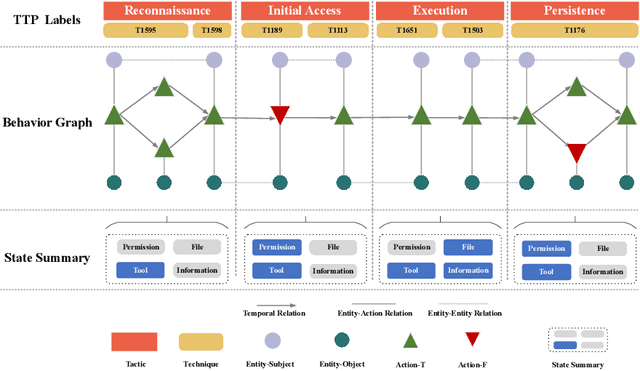
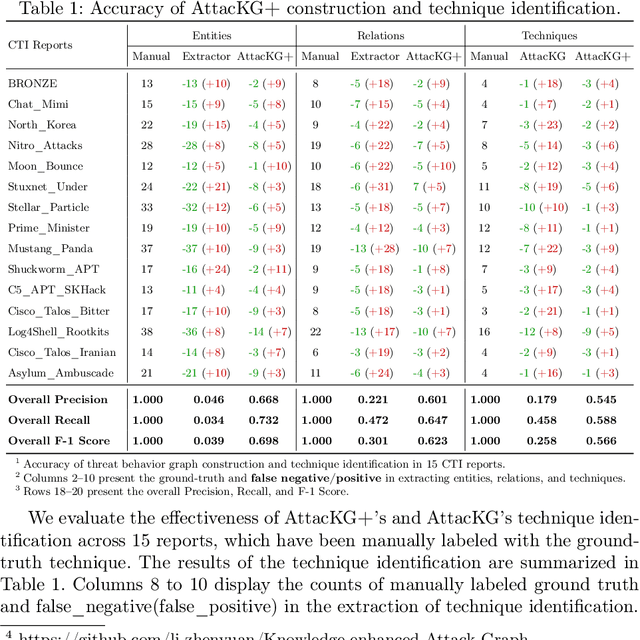
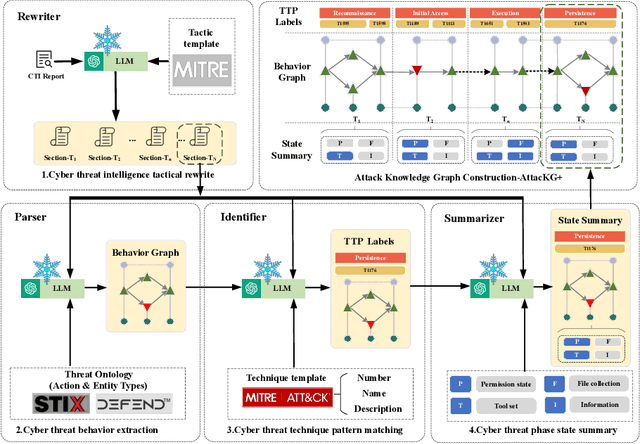
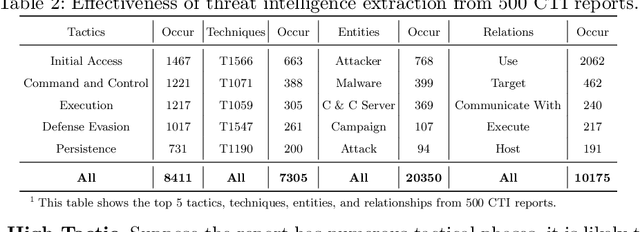
Attack knowledge graph construction seeks to convert textual cyber threat intelligence (CTI) reports into structured representations, portraying the evolutionary traces of cyber attacks. Even though previous research has proposed various methods to construct attack knowledge graphs, they generally suffer from limited generalization capability to diverse knowledge types as well as requirement of expertise in model design and tuning. Addressing these limitations, we seek to utilize Large Language Models (LLMs), which have achieved enormous success in a broad range of tasks given exceptional capabilities in both language understanding and zero-shot task fulfillment. Thus, we propose a fully automatic LLM-based framework to construct attack knowledge graphs named: AttacKG+. Our framework consists of four consecutive modules: rewriter, parser, identifier, and summarizer, each of which is implemented by instruction prompting and in-context learning empowered by LLMs. Furthermore, we upgrade the existing attack knowledge schema and propose a comprehensive version. We represent a cyber attack as a temporally unfolding event, each temporal step of which encapsulates three layers of representation, including behavior graph, MITRE TTP labels, and state summary. Extensive evaluation demonstrates that: 1) our formulation seamlessly satisfies the information needs in threat event analysis, 2) our construction framework is effective in faithfully and accurately extracting the information defined by AttacKG+, and 3) our attack graph directly benefits downstream security practices such as attack reconstruction. All the code and datasets will be released upon acceptance.