 Add to Chrome
 Add to Firefox
 Add to Edge
MemoryArena: Benchmarking Agent Memory in Interdependent Multi-Session Agentic Tasks
Feb 18, 2026
Existing evaluations of agents with memory typically assess memorization and action in isolation. One class of benchmarks evaluates memorization by testing recall of past conversations or text but fails to capture how memory is used to guide future decisions. Another class focuses on agents acting in single-session tasks without the need for long-term memory. However, in realistic settings, memorization and action are tightly coupled: agents acquire memory while interacting with the environment, and subsequently rely on that memory to solve future tasks. To capture this setting, we introduce MemoryArena, a unified evaluation gym for benchmarking agent memory in multi-session Memory-Agent-Environment loops. The benchmark consists of human-crafted agentic tasks with explicitly interdependent subtasks, where agents must learn from earlier actions and feedback by distilling experiences into memory, and subsequently use that memory to guide later actions to solve the overall task. MemoryArena supports evaluation across web navigation, preference-constrained planning, progressive information search, and sequential formal reasoning, and reveals that agents with near-saturated performance on existing long-context memory benchmarks like LoCoMo perform poorly in our agentic setting, exposing a gap in current evaluations for agents with memory.

Confusing Pair Correction Based on Category Prototype for Domain Adaptation under Noisy Environments
Mar 19, 2024
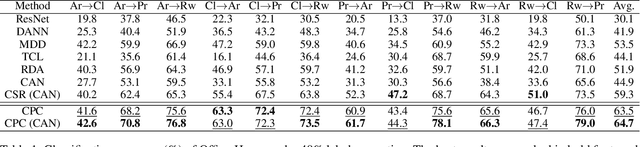

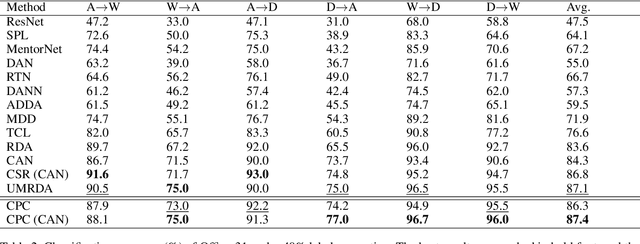
In this paper, we address unsupervised domain adaptation under noisy environments, which is more challenging and practical than traditional domain adaptation. In this scenario, the model is prone to overfitting noisy labels, resulting in a more pronounced domain shift and a notable decline in the overall model performance. Previous methods employed prototype methods for domain adaptation on robust feature spaces. However, these approaches struggle to effectively classify classes with similar features under noisy environments. To address this issue, we propose a new method to detect and correct confusing class pair. We first divide classes into easy and hard classes based on the small loss criterion. We then leverage the top-2 predictions for each sample after aligning the source and target domain to find the confusing pair in the hard classes. We apply label correction to the noisy samples within the confusing pair. With the proposed label correction method, we can train our model with more accurate labels. Extensive experiments confirm the effectiveness of our method and demonstrate its favorable performance compared with existing state-of-the-art methods. Our codes are publicly available at https://github.com/Hehxcf/CPC/.