 Add to Chrome
 Add to Firefox
 Add to Edge
Alignment Defends LLMs from Property Inference Attacks
Jun 08, 2026
Large language models (LLMs) are increasingly fine-tuned on domain-specific datasets that may contain sensitive, dataset-level properties. Recent work has shown that such dataset-level information can be effectively extracted through property inference attacks, posing a confidentiality risk. Existing defenses against these attacks primarily operate by modifying the training data distribution and hence require access to the original data and retraining the model, limiting their applicability to settings where data is unavailable or models are already deployed. In this work, we propose alignment-based defenses for mitigating property inference attacks in LLMs. Our approach reshapes the model's output distribution towards a target property ratio via post-training alignment, without modifying the training data. In particular, we adapt two widely used RLHF frameworks--Direct Preference Optimization (DPO) and Group Relative Policy Optimization (GRPO)--as our defenses by constructing preference pairs and defining a specific reward function respectively. Through comprehensive experiments, we show that our alignment based defenses effectively mitigate property inference attacks while maintaining a strong utility confidentiality tradeoff.

One Turn Too Late: Response-Aware Defense Against Hidden Malicious Intent in Multi-Turn Dialogue
May 07, 2026Hidden malicious intent in multi-turn dialogue poses a growing threat to deployed large language models (LLMs). Rather than exposing a harmful objective in a single prompt, increasingly capable attackers can distribute their intent across multiple benign-looking turns. Recent studies show that even modern commercial models with advanced guardrails remain vulnerable to such attacks despite advances in safety alignment and external guardrails. In this work, we address this challenge by detecting the earliest turn at which delivering the candidate response would make the accumulated interaction sufficient to enable harmful action. This objective requires precise turn-level intervention that identifies the harm-enabling closure point while avoiding premature refusal of benign exploratory conversations. To further support training and evaluation, we construct the Multi-Turn Intent Dataset (MTID), which contains branching attack rollouts, matched benign hard negatives, and annotations of the earliest harm-enabling turns. We show that MTID helps enable a turn-level monitor TurnGate, which substantially outperforms existing baselines in harmful-intent detection while maintaining low over-refusal rates. TurnGate further generalizes across domains, attacker pipelines, and target models. Our code is available at https://github.com/Graph-COM/TurnGate.
Private-RAG: Answering Multiple Queries with LLMs while Keeping Your Data Private
Nov 10, 2025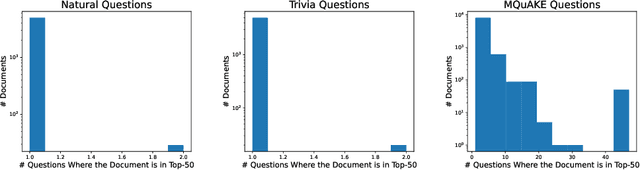
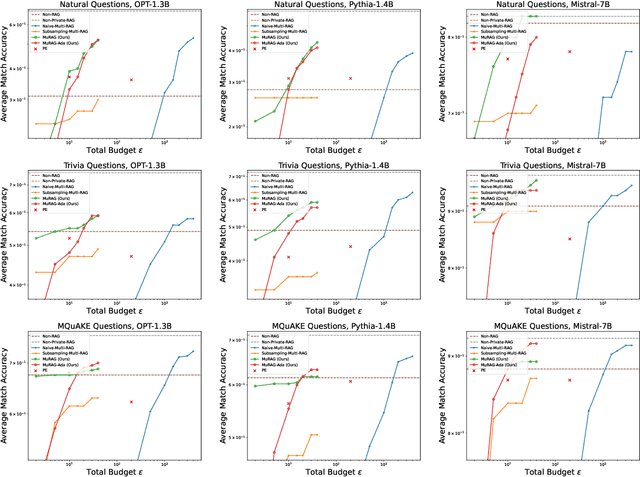
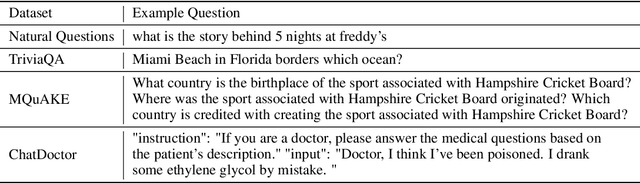
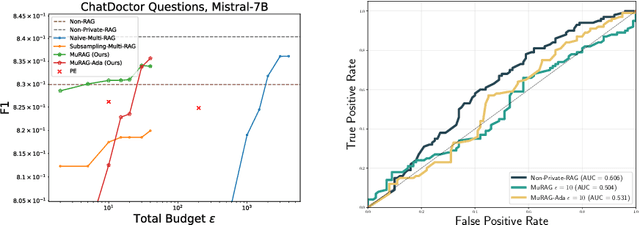
Retrieval-augmented generation (RAG) enhances large language models (LLMs) by retrieving documents from an external corpus at inference time. When this corpus contains sensitive information, however, unprotected RAG systems are at risk of leaking private information. Prior work has introduced differential privacy (DP) guarantees for RAG, but only in single-query settings, which fall short of realistic usage. In this paper, we study the more practical multi-query setting and propose two DP-RAG algorithms. The first, MURAG, leverages an individual privacy filter so that the accumulated privacy loss only depends on how frequently each document is retrieved rather than the total number of queries. The second, MURAG-ADA, further improves utility by privately releasing query-specific thresholds, enabling more precise selection of relevant documents. Our experiments across multiple LLMs and datasets demonstrate that the proposed methods scale to hundreds of queries within a practical DP budget ($\varepsilon\approx10$), while preserving meaningful utility.
Learning-Time Encoding Shapes Unlearning in LLMs
Jun 18, 2025As large language models (LLMs) are increasingly deployed in the real world, the ability to ``unlearn'', or remove specific pieces of knowledge post hoc, has become essential for a variety of reasons ranging from privacy regulations to correcting outdated or harmful content. Prior work has proposed unlearning benchmarks and algorithms, and has typically assumed that the training process and the target model are fixed. In this work, we empirically investigate how learning-time choices in knowledge encoding impact the effectiveness of unlearning factual knowledge. Our experiments reveal two key findings: (1) learning with paraphrased descriptions improves unlearning performance and (2) unlearning individual piece of knowledge from a chunk of text is challenging. Our results suggest that learning-time knowledge encoding may play a central role in enabling reliable post-hoc unlearning.
Can We Infer Confidential Properties of Training Data from LLMs?
Jun 12, 2025Large language models (LLMs) are increasingly fine-tuned on domain-specific datasets to support applications in fields such as healthcare, finance, and law. These fine-tuning datasets often have sensitive and confidential dataset-level properties -- such as patient demographics or disease prevalence -- that are not intended to be revealed. While prior work has studied property inference attacks on discriminative models (e.g., image classification models) and generative models (e.g., GANs for image data), it remains unclear if such attacks transfer to LLMs. In this work, we introduce PropInfer, a benchmark task for evaluating property inference in LLMs under two fine-tuning paradigms: question-answering and chat-completion. Built on the ChatDoctor dataset, our benchmark includes a range of property types and task configurations. We further propose two tailored attacks: a prompt-based generation attack and a shadow-model attack leveraging word frequency signals. Empirical evaluations across multiple pretrained LLMs show the success of our attacks, revealing a previously unrecognized vulnerability in LLMs.
Do LLMs Really Forget? Evaluating Unlearning with Knowledge Correlation and Confidence Awareness
Jun 06, 2025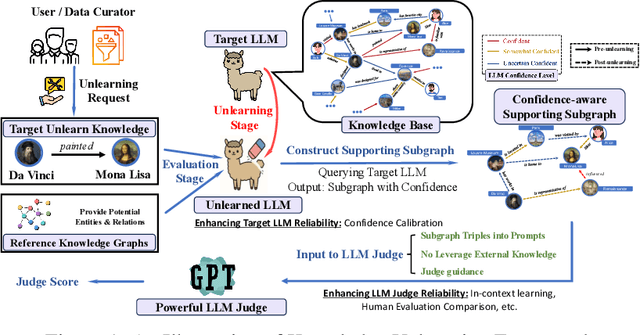

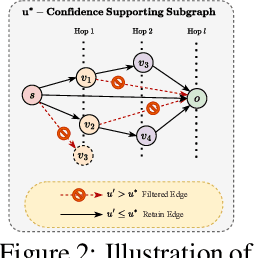
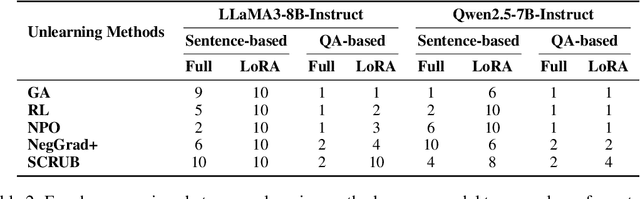
Machine unlearning techniques aim to mitigate unintended memorization in large language models (LLMs). However, existing approaches predominantly focus on the explicit removal of isolated facts, often overlooking latent inferential dependencies and the non-deterministic nature of knowledge within LLMs. Consequently, facts presumed forgotten may persist implicitly through correlated information. To address these challenges, we propose a knowledge unlearning evaluation framework that more accurately captures the implicit structure of real-world knowledge by representing relevant factual contexts as knowledge graphs with associated confidence scores. We further develop an inference-based evaluation protocol leveraging powerful LLMs as judges; these judges reason over the extracted knowledge subgraph to determine unlearning success. Our LLM judges utilize carefully designed prompts and are calibrated against human evaluations to ensure their trustworthiness and stability. Extensive experiments on our newly constructed benchmark demonstrate that our framework provides a more realistic and rigorous assessment of unlearning performance. Moreover, our findings reveal that current evaluation strategies tend to overestimate unlearning effectiveness. Our code is publicly available at https://github.com/Graph-COM/Knowledge_Unlearning.git.
Privacy-Preserving Retrieval Augmented Generation with Differential Privacy
Dec 06, 2024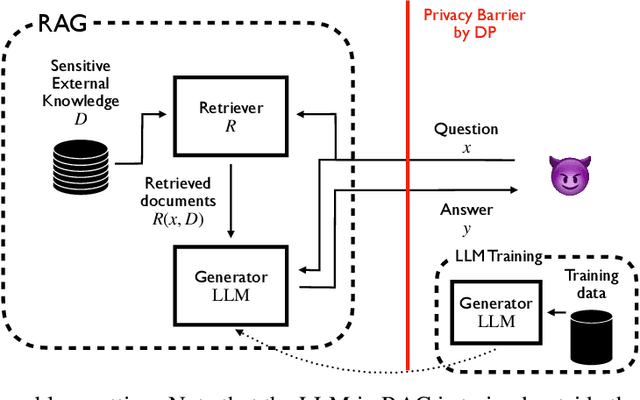

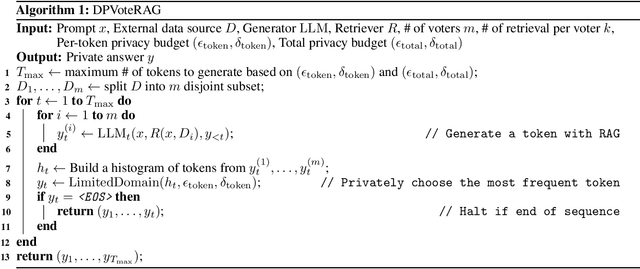

With the recent remarkable advancement of large language models (LLMs), there has been a growing interest in utilizing them in the domains with highly sensitive data that lies outside their training data. For this purpose, retrieval augmented generation (RAG) is particularly effective -- it assists LLMs by directly providing relevant information from the external knowledge sources. However, without extra privacy safeguards, RAG outputs risk leaking sensitive information from the external data source. In this work, we explore RAG under differential privacy (DP), a formal guarantee of data privacy. The main challenge with differentially private RAG is how to generate long accurate answers within a moderate privacy budget. We address this by proposing an algorithm that smartly spends privacy budget only for the tokens that require the sensitive information and uses the non-private LLM for other tokens. Our extensive empirical evaluations reveal that our algorithm outperforms the non-RAG baseline under a reasonable privacy budget of $\epsilon\approx 10$ across different models and datasets.
Evaluating Deep Unlearning in Large Language Models
Oct 19, 2024
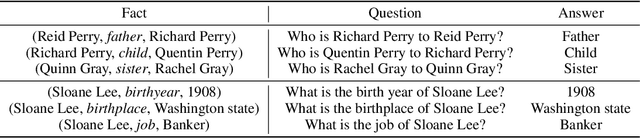
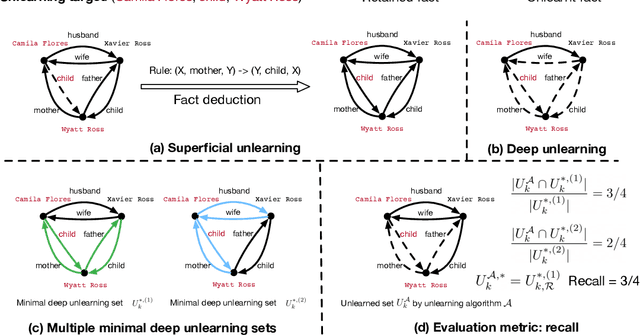

Machine unlearning is a key requirement of many data protection regulations such as GDPR. Prior work on unlearning has mostly considered superficial unlearning tasks where a single or a few related pieces of information are required to be removed. However, the task of unlearning a fact is much more challenging in recent large language models (LLMs), because the facts in LLMs can be deduced from each other. In this work, we investigate whether current unlearning methods for LLMs succeed beyond superficial unlearning of facts. Specifically, we formally propose a framework and a definition for deep unlearning facts that are interrelated. We design the metric, recall, to quantify the extent of deep unlearning. To systematically evaluate deep unlearning, we construct a synthetic dataset EDU-RELAT, which consists of a synthetic knowledge base of family relationships and biographies, together with a realistic logical rule set that connects them. We use this dataset to test four unlearning methods in four LLMs at different sizes. Our findings reveal that in the task of deep unlearning only a single fact, they either fail to properly unlearn with high recall, or end up unlearning many other irrelevant facts. Our dataset and code are publicly available at: https://github.com/wrh14/deep_unlearning.
Influence-based Attributions can be Manipulated
Sep 10, 2024Influence Functions are a standard tool for attributing predictions to training data in a principled manner and are widely used in applications such as data valuation and fairness. In this work, we present realistic incentives to manipulate influencebased attributions and investigate whether these attributions can be systematically tampered by an adversary. We show that this is indeed possible and provide efficient attacks with backward-friendly implementations. Our work raises questions on the reliability of influence-based attributions under adversarial circumstances.
On Speeding Up Language Model Evaluation
Jul 08, 2024Large language models (LLMs) currently dominate the field of natural language processing (NLP), representing the state-of-the-art across a diverse array of tasks. Developing a model of this nature, from training to inference, requires making numerous decisions which define a combinatorial search problem. For example, selecting the optimal pre-trained LLM, prompt, or hyperparameters to attain the best performance for a task often requires evaluating multiple candidates on an entire test set. This exhaustive evaluation can be time-consuming and costly, as both inference and metric computation with LLMs are resource-intensive. In this paper, we address the challenge of identifying the best method within a limited budget for evaluating methods on test examples. By leveraging the well-studied multi-armed bandit framework, which sequentially selects the next method-example pair to evaluate, our approach, combining multi-armed bandit algorithms with low-rank factorization, significantly reduces the required resources. Experiments show that our algorithms can identify the top-performing method using only 5-15\% of the typically needed resources, resulting in an 85-95\% reduction in cost.