 Add to Chrome
 Add to Firefox
 Add to Edge
Qwen-Image-2.0 Technical Report
May 11, 2026
We present Qwen-Image-2.0, an omni-capable image generation foundation model that unifies high-fidelity generation and precise image editing within a single framework. Despite recent progress, existing models still struggle with ultra-long text rendering, multilingual typography, high-resolution photorealism, robust instruction following, and efficient deployment, especially in text-rich and compositionally complex scenarios. Qwen-Image-2.0 addresses these challenges by coupling Qwen3-VL as the condition encoder with a Multimodal Diffusion Transformer for joint condition-target modeling, supported by large-scale data curation and a customized multi-stage training pipeline. This enables strong multimodal understanding while preserving flexible generation and editing capabilities. The model supports instructions of up to 1K tokens for generating text-rich content such as slides, posters, infographics, and comics, while significantly improving multilingual text fidelity and typography. It also enhances photorealistic generation with richer details, more realistic textures, and coherent lighting, and follows complex prompts more reliably across diverse styles. Extensive human evaluations show that Qwen-Image-2.0 substantially outperforms previous Qwen-Image models in both generation and editing, marking a step toward more general, reliable, and practical image generation foundation models.

Logics-Parsing-Omni Technical Report
Mar 12, 2026Addressing the challenges of fragmented task definitions and the heterogeneity of unstructured data in multimodal parsing, this paper proposes the Omni Parsing framework. This framework establishes a Unified Taxonomy covering documents, images, and audio-visual streams, introducing a progressive parsing paradigm that bridges perception and cognition. Specifically, the framework integrates three hierarchical levels: 1) Holistic Detection, which achieves precise spatial-temporal grounding of objects or events to establish a geometric baseline for perception; 2) Fine-grained Recognition, which performs symbolization (e.g., OCR/ASR) and attribute extraction on localized objects to complete structured entity parsing; and 3) Multi-level Interpreting, which constructs a reasoning chain from local semantics to global logic. A pivotal advantage of this framework is its evidence anchoring mechanism, which enforces a strict alignment between high-level semantic descriptions and low-level facts. This enables ``evidence-based'' logical induction, transforming unstructured signals into standardized knowledge that is locatable, enumerable, and traceable. Building on this foundation, we constructed a standardized dataset and released the Logics-Parsing-Omni model, which successfully converts complex audio-visual signals into machine-readable structured knowledge. Experiments demonstrate that fine-grained perception and high-level cognition are synergistic, effectively enhancing model reliability. Furthermore, to quantitatively evaluate these capabilities, we introduce OmniParsingBench. Code, models and the benchmark are released at https://github.com/alibaba/Logics-Parsing/tree/master/Logics-Parsing-Omni.
Yuan 2.0-M32: Mixture of Experts with Attention Router
May 29, 2024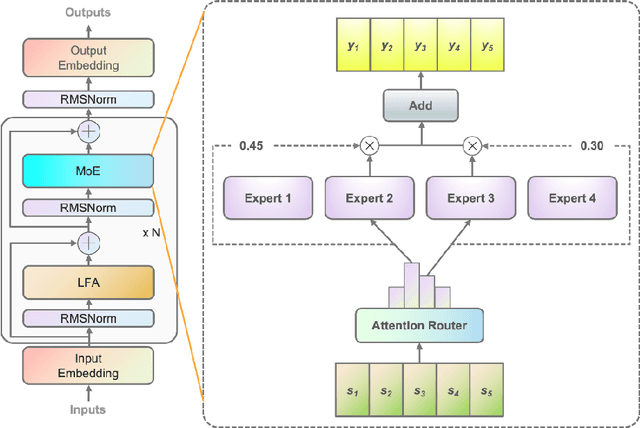
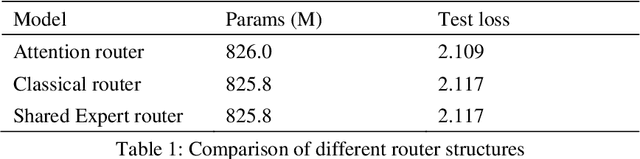
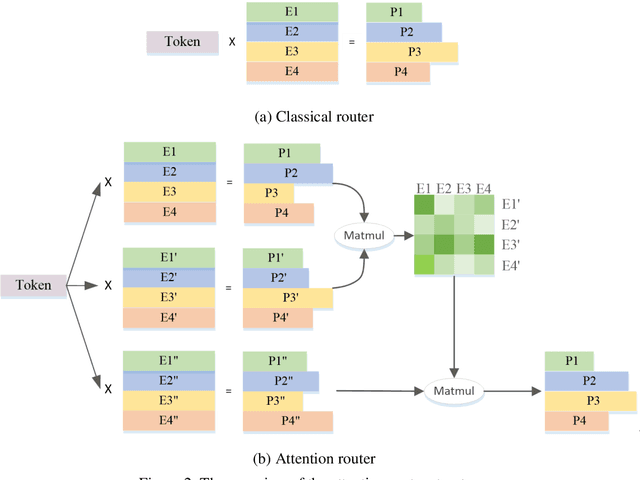
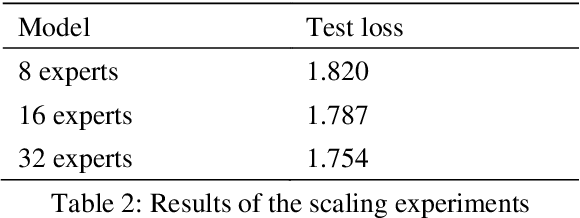
Yuan 2.0-M32, with a similar base architecture as Yuan-2.0 2B, uses a mixture-of-experts architecture with 32 experts of which 2 experts are active. A new router network, Attention Router, is proposed and adopted for a more efficient selection of experts, which improves the accuracy compared to the model with classical router network. Yuan 2.0-M32 is trained with 2000B tokens from scratch, and the training computation consumption is only 9.25% of a dense model at the same parameter scale. Yuan 2.0-M32 demonstrates competitive capability on coding, math, and various domains of expertise, with only 3.7B active parameters of 40B in total, and 7.4 GFlops forward computation per token, both of which are only 1/19 of Llama3-70B. Yuan 2.0-M32 surpass Llama3-70B on MATH and ARC-Challenge benchmark, with accuracy of 55.89 and 95.8 respectively. The models and source codes of Yuan 2.0-M32 are released at Github1.