 Add to Chrome
 Add to Firefox
 Add to Edge
Evaluating the Representation Space of Diffusion Models via Self-Supervised Principles
Jun 08, 2026
Diffusion models have demonstrated remarkable generative capabilities and have also emerged as powerful self-supervised representation learners, yet the connection between these two abilities remains less explored. Drawing inspiration from self-supervised learning (SSL), we introduce a framework for jointly evaluating the representation and generation capabilities of diffusion models. Specifically, we decompose features into invariant and residual components and derive the Invariant Contamination Ratio (ICR), a Fisher-based metric that quantifies how residual variation contaminates invariant signal in feature space. We use this framework to analyze both discriminative and generative behavior of diffusion models. On the representation side, we find that invariance peaks at intermediate noise levels, which also yield the best downstream classification performance. On the generative side, we study how training transitions from genuine generalization to memorization in data-limited regimes, and show that ICR serves as a sensitive training-time indicator of early learning: increasing residual energy along Fisher directions marks the onset of memorization, detectable from training features alone without external evaluators or held-out test sets. Overall, our results show that diffusion models can be monitored from a self-supervised perspective through the geometry of their learned representations.

ForcingDAS: Unified and Robust Data Assimilation via Diffusion Forcing
May 14, 2026Data assimilation (DA) estimates the state of an evolving dynamical system from noisy, partial observations, and is widely used in scientific simulation as well as weather and climate science. In practice, filtering methods rely on frame-to-frame transition models. However, these models are fragile when observations are non-Markovian (when they form only a partial slice of a higher-dimensional latent state as in real-world weather data): they tend to accumulate errors over long horizons. At the same time, learned DA methods typically commit to a single regime, either filtering (nowcasting, real-time forecasting) or smoothing (retrospective reanalysis), which splits what should be a shared prior across application-specific pipelines. To address both issues, we introduce ForcingDAS, a unified and robust DA framework. Built on Diffusion Forcing with an independent noise level assigned to each frame, ForcingDAS learns a joint-trajectory prior instead of frame-to-frame transitions. This allows it to capture long-horizon temporal dependencies and reduce error accumulation. In addition, the same trained model spans the full filtering to smoothing spectrum at inference time. Specifically, nowcasting, fixed-lag smoothing, and batch reanalysis are selected through the inference schedule alone, without retraining. We evaluate ForcingDAS on 2D Navier-Stokes vorticity, precipitation nowcasting, and global atmospheric state estimation. Across all settings, a single model is competitive with or outperforms both learned and classical baselines that are specialized for individual regimes, with the largest gains observed on real-world weather benchmarks.
Generalization of Diffusion Models Arises with a Balanced Representation Space
Dec 24, 2025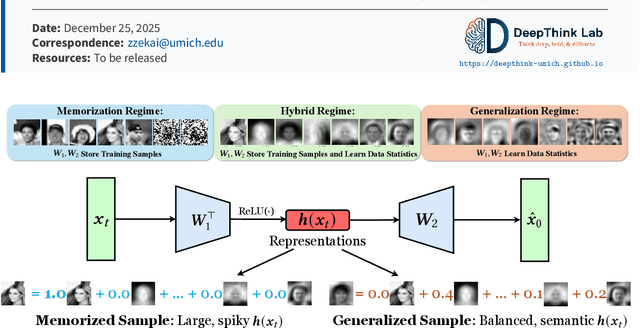
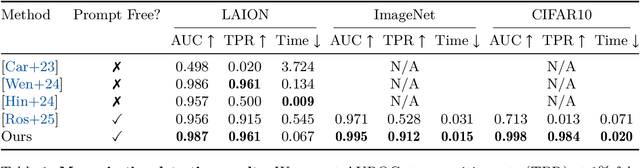
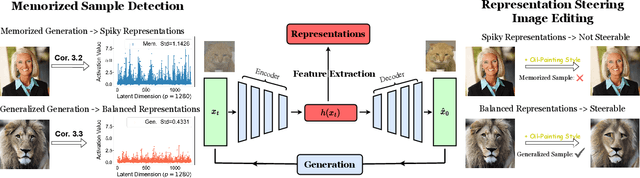
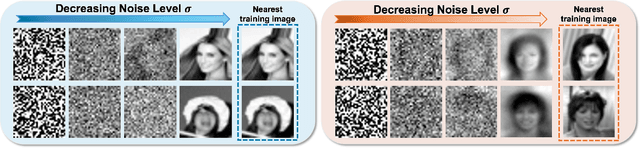
Diffusion models excel at generating high-quality, diverse samples, yet they risk memorizing training data when overfit to the training objective. We analyze the distinctions between memorization and generalization in diffusion models through the lens of representation learning. By investigating a two-layer ReLU denoising autoencoder (DAE), we prove that (i) memorization corresponds to the model storing raw training samples in the learned weights for encoding and decoding, yielding localized "spiky" representations, whereas (ii) generalization arises when the model captures local data statistics, producing "balanced" representations. Furthermore, we validate these theoretical findings on real-world unconditional and text-to-image diffusion models, demonstrating that the same representation structures emerge in deep generative models with significant practical implications. Building on these insights, we propose a representation-based method for detecting memorization and a training-free editing technique that allows precise control via representation steering. Together, our results highlight that learning good representations is central to novel and meaningful generative modeling.