 Add to Chrome
 Add to Firefox
 Add to Edge
SciAgentGym: Benchmarking Multi-Step Scientific Tool-use in LLM Agents
Feb 13, 2026
Scientific reasoning inherently demands integrating sophisticated toolkits to navigate domain-specific knowledge. Yet, current benchmarks largely overlook agents' ability to orchestrate tools for such rigorous workflows. To bridge this gap, we introduce SciAgentGym, a scalable interactive environment featuring 1,780 domain-specific tools across four natural science disciplines, supported by a robust execution infrastructure. Complementing this, we present SciAgentBench, a tiered evaluation suite designed to stress-test agentic capabilities from elementary actions to long-horizon workflows. Our evaluation identifies a critical bottleneck: state-of-the-art models struggle with complex scientific tool-use. Even for a leading model like GPT-5, success rates drop sharply from 60.6% to 30.9% as interaction horizons extend, primarily due to failures in multi-step workflow execution. To address this, we propose SciForge, a data synthesis method that models the tool action space as a dependency graph to generate logic-aware training trajectories. By fine-tuning on these trajectories, our SciAgent-8B outperforms the significantly larger Qwen3-VL-235B-Instruct while exhibiting positive cross-domain transfer of scientific tool-use capabilities. These results underscore the promising potential of next-generation autonomous scientific agents.

OpenNovelty: An LLM-powered Agentic System for Verifiable Scholarly Novelty Assessment
Jan 04, 2026Evaluating novelty is critical yet challenging in peer review, as reviewers must assess submissions against a vast, rapidly evolving literature. This report presents OpenNovelty, an LLM-powered agentic system for transparent, evidence-based novelty analysis. The system operates through four phases: (1) extracting the core task and contribution claims to generate retrieval queries; (2) retrieving relevant prior work based on extracted queries via semantic search engine; (3) constructing a hierarchical taxonomy of core-task-related work and performing contribution-level full-text comparisons against each contribution; and (4) synthesizing all analyses into a structured novelty report with explicit citations and evidence snippets. Unlike naive LLM-based approaches, \textsc{OpenNovelty} grounds all assessments in retrieved real papers, ensuring verifiable judgments. We deploy our system on 500+ ICLR 2026 submissions with all reports publicly available on our website, and preliminary analysis suggests it can identify relevant prior work, including closely related papers that authors may overlook. OpenNovelty aims to empower the research community with a scalable tool that promotes fair, consistent, and evidence-backed peer review.
LLMEval-Med: A Real-world Clinical Benchmark for Medical LLMs with Physician Validation
Jun 04, 2025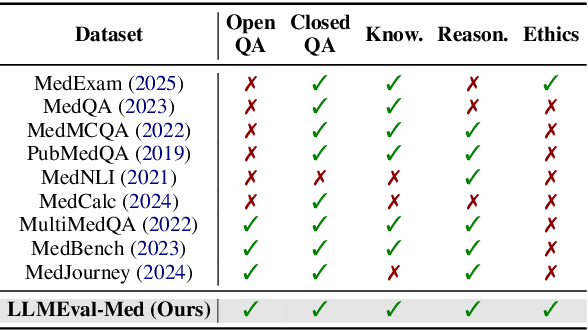
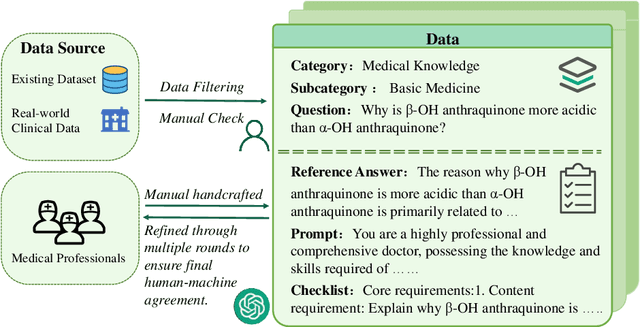
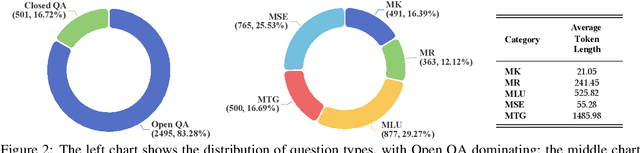
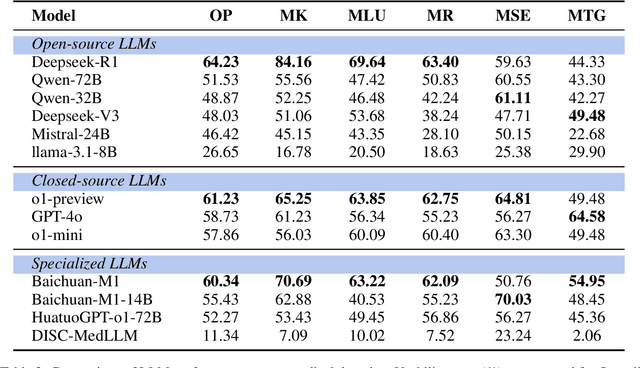
Evaluating large language models (LLMs) in medicine is crucial because medical applications require high accuracy with little room for error. Current medical benchmarks have three main types: medical exam-based, comprehensive medical, and specialized assessments. However, these benchmarks have limitations in question design (mostly multiple-choice), data sources (often not derived from real clinical scenarios), and evaluation methods (poor assessment of complex reasoning). To address these issues, we present LLMEval-Med, a new benchmark covering five core medical areas, including 2,996 questions created from real-world electronic health records and expert-designed clinical scenarios. We also design an automated evaluation pipeline, incorporating expert-developed checklists into our LLM-as-Judge framework. Furthermore, our methodology validates machine scoring through human-machine agreement analysis, dynamically refining checklists and prompts based on expert feedback to ensure reliability. We evaluate 13 LLMs across three categories (specialized medical models, open-source models, and closed-source models) on LLMEval-Med, providing valuable insights for the safe and effective deployment of LLMs in medical domains. The dataset is released in https://github.com/llmeval/LLMEval-Med.