 Add to Chrome
 Add to Firefox
 Add to Edge
Q-Learning With World Models
Aug 17, 2026
Off-policy reinforcement learning (RL) has become increasingly sample-efficient, enabling applications such as RL fine-tuning of Vision-Language-Action models into reliable, high-performing policies. World models offer a further lever for sample efficiency, as they predict state changes rather than actions alone, but their success has largely been confined to supervised policy learning. Prior model-based RL methods often optimize the policy or value function directly on imagined rollouts, which is prone to compounding bias and struggles to scale to large, high-dimensional problems such as real-world robotics, a problem that worsens with task horizon and visual complexity. In this work, we instead ask whether we can leverage world models directly on top of standard Q-learning to improve performance, while remaining trained and grounded in the real, online setting. We propose QWM, a framework that leverages world models to perform test-time search over imagined trajectories on top of Q-learning to select high-value actions during both online rollouts and evaluation. Since the policy and value function are trained only on real transitions, QWM avoids compounding model bias while still gaining the sample-efficiency benefits of predictive search. On challenging manipulation benchmarks Robomimic and LIBERO, QWM significantly outperforms strong prior state-of-the-art methods on both sample efficiency and performance.

Lift3D-VLA: Lifting VLA Models to 3D Geometry and Dynamics-Aware Manipulation
Jul 07, 2026Recently, Vision-Language-Action (VLA) models have demonstrated strong generalization across diverse tasks. However, effective robotic manipulation in physical environments fundamentally requires geometric understanding and spatial reasoning. While some VLA approaches attempt to incorporate 3D information, they are constrained by limited data availability and geometric information loss in current 3D encoding pipelines, and fail to jointly capture 3D geometry and temporally structured actions in dynamic environments. To address these limitations, we introduce Lift3D-VLA, a unified VLA framework that equips models with explicit 3D point cloud reasoning and enables temporally coherent action generation. First, building upon our previous work Lift3D, an enhanced 2D model-lifting strategy is proposed to geometrically align 3D points with pretrained 2D positional embeddings. This design enables direct point-cloud encoding within the VLA vision encoder while minimizing spatial information loss. Based on explicit 3D inputs, we propose Geometry-Centric Masked Autoencoding (GC-MAE), a dual-objective self-supervised framework that reconstructs the current point cloud while predicting its future geometric evolution. This formulation allows the 2D vision encoder to internalize both 3D structure and physical dynamics. To fully exploit 3D representations, we further design layer-wise temporal action modeling, which leverages multiple layers of the LLM to collaboratively predict action chunks, enabling temporally consistent predictions. Across 22 simulated tasks and 8 real-world manipulation tasks, Lift3D-VLA achieves 10.8% and 11.1% higher mean success rates on MetaWorld and RLBench than the best-performing prior VLA methods, and outperforms the strongest real-world baseline by 4 percentage points, while exhibiting stronger generalization to out-of-distribution perturbations.
TACO: TActile World Model as a Self-COrrector forScalable VLA Post-Training
Jul 03, 2026Vision-Language-Action (VLA) models have shown promising generalization in robotic manipulation, but they still struggle with contact-rich tasks, where minor contact perturbations can cause unrecoverable failures that are hard to detect from vision alone. Since these failures are localized rather than task-level semantic errors, tactile-aware corrective post-training offers an efficient way to improve recovery. However, scaling such supervision through human intervention is costly. Recent works have explored world models to synthesize imagined rollouts for policy improvement, but vision-only world models may produce visually plausible yet contact-inconsistent trajectories. We therefore introduce TACO, a tactile-aware world-model-driven framework for scalable VLA post-training in contact-rich manipulation. Given real robot rollouts, TACO follows a Recognize-Imagine-Label loop with a tactile-aware world model: a unified progress-action model recognizes failure-adjacent states using progress estimates, a visuo-tactile generation model imagines local correction segments, and the progress-action model labels them with executable corrective actions. To incorporate tactile corrective supervision into VLA post-training, TACO combines knowledge-insulated tactile adaptation with advantage-conditioned training, enabling the policy to learn from imagined corrections without degrading pretrained visual-language priors. These components enable TACO to convert real-world failures into imagined visuo-tactile corrections for iterative VLA post-training. Experiments on real-world contact-rich manipulation tasks show that TACO achieves 44% absolute success rate improvement over the base policy and 32% over the policy without knowledge-insulated tactile adaptation.
HarmoWAM: Harmonizing Generalizable and Precise Manipulation via Adaptive World Action Models
May 11, 2026World Action Models (WAMs) have emerged as a promising paradigm for robot control by modeling physical dynamics. Current WAMs generally follow two paradigms: the "Imagine-then-Execute" approach, which uses video prediction to infer actions via inverse dynamics, and the "Joint Modeling" approach, which jointly models actions and video representations. Based on systematic experiments, we observe a fundamental trade-off between these paradigms: the former explicitly leverages world models for generalizable transit but lacks interaction precision, whereas the latter enables fine-grained, temporally coherent action generation but is constrained by the exploration space of the training distribution. Motivated by these findings, we propose HarmoWAM, an end-to-end WAM that fully leverages a world model to unify predictive and reactive control, enabling both generalizable transit and precise manipulation. Specifically, the world model provides spatio-temporal physical priors that condition two complementary action experts: a predictive expert that leverages latent dynamics for iterative action generation, and a reactive expert that directly infers actions from predicted visual evolution. To enable adaptive coordination, a Process-Adaptive Gating Mechanism is proposed to automatically determine the timing and location of switching between them. This allows the world model to drive the reactive expert to expand the exploration space and the predictive expert to perform precise interactions across different stages of a task. For evaluation, we construct three training-unseen test environments across six real-world robotic tasks, covering variations in background, position, and object semantics. Notably, HarmoWAM achieves strong zero-shot generalization across these scenarios, significantly outperforming prior state-of-the-art VLA models and WAMs by margins of 33% and 29%, respectively.
WoW: Towards a World omniscient World model Through Embodied Interaction
Sep 26, 2025Humans develop an understanding of intuitive physics through active interaction with the world. This approach is in stark contrast to current video models, such as Sora, which rely on passive observation and therefore struggle with grasping physical causality. This observation leads to our central hypothesis: authentic physical intuition of the world model must be grounded in extensive, causally rich interactions with the real world. To test this hypothesis, we present WoW, a 14-billion-parameter generative world model trained on 2 million robot interaction trajectories. Our findings reveal that the model's understanding of physics is a probabilistic distribution of plausible outcomes, leading to stochastic instabilities and physical hallucinations. Furthermore, we demonstrate that this emergent capability can be actively constrained toward physical realism by SOPHIA, where vision-language model agents evaluate the DiT-generated output and guide its refinement by iteratively evolving the language instructions. In addition, a co-trained Inverse Dynamics Model translates these refined plans into executable robotic actions, thus closing the imagination-to-action loop. We establish WoWBench, a new benchmark focused on physical consistency and causal reasoning in video, where WoW achieves state-of-the-art performance in both human and autonomous evaluation, demonstrating strong ability in physical causality, collision dynamics, and object permanence. Our work provides systematic evidence that large-scale, real-world interaction is a cornerstone for developing physical intuition in AI. Models, data, and benchmarks will be open-sourced.
ASGDiffusion: Parallel High-Resolution Generation with Asynchronous Structure Guidance
Dec 09, 2024Training-free high-resolution (HR) image generation has garnered significant attention due to the high costs of training large diffusion models. Most existing methods begin by reconstructing the overall structure and then proceed to refine the local details. Despite their advancements, they still face issues with repetitive patterns in HR image generation. Besides, HR generation with diffusion models incurs significant computational costs. Thus, parallel generation is essential for interactive applications. To solve the above limitations, we introduce a novel method named ASGDiffusion for parallel HR generation with Asynchronous Structure Guidance (ASG) using pre-trained diffusion models. To solve the pattern repetition problem of HR image generation, ASGDiffusion leverages the low-resolution (LR) noise weighted by the attention mask as the structure guidance for the denoising step to ensure semantic consistency. The proposed structure guidance can significantly alleviate the pattern repetition problem. To enable parallel generation, we further propose a parallelism strategy, which calculates the patch noises and structure guidance asynchronously. By leveraging multi-GPU parallel acceleration, we significantly accelerate generation speed and reduce memory usage per GPU. Extensive experiments demonstrate that our method effectively and efficiently addresses common issues like pattern repetition and achieves state-of-the-art HR generation.
Lift3D Foundation Policy: Lifting 2D Large-Scale Pretrained Models for Robust 3D Robotic Manipulation
Nov 27, 2024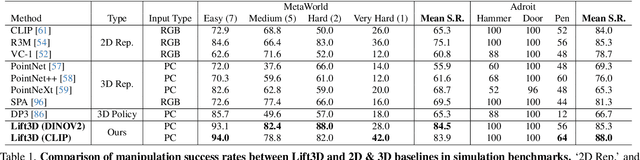
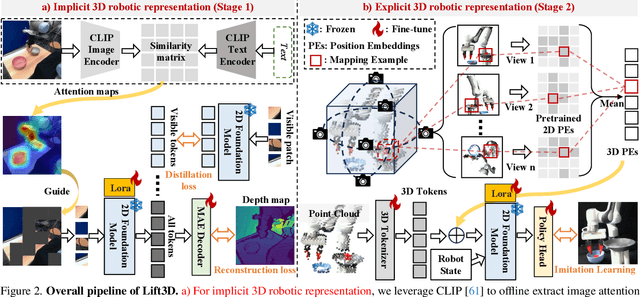


3D geometric information is essential for manipulation tasks, as robots need to perceive the 3D environment, reason about spatial relationships, and interact with intricate spatial configurations. Recent research has increasingly focused on the explicit extraction of 3D features, while still facing challenges such as the lack of large-scale robotic 3D data and the potential loss of spatial geometry. To address these limitations, we propose the Lift3D framework, which progressively enhances 2D foundation models with implicit and explicit 3D robotic representations to construct a robust 3D manipulation policy. Specifically, we first design a task-aware masked autoencoder that masks task-relevant affordance patches and reconstructs depth information, enhancing the 2D foundation model's implicit 3D robotic representation. After self-supervised fine-tuning, we introduce a 2D model-lifting strategy that establishes a positional mapping between the input 3D points and the positional embeddings of the 2D model. Based on the mapping, Lift3D utilizes the 2D foundation model to directly encode point cloud data, leveraging large-scale pretrained knowledge to construct explicit 3D robotic representations while minimizing spatial information loss. In experiments, Lift3D consistently outperforms previous state-of-the-art methods across several simulation benchmarks and real-world scenarios.
DesignEdit: Multi-Layered Latent Decomposition and Fusion for Unified & Accurate Image Editing
Mar 21, 2024


Recently, how to achieve precise image editing has attracted increasing attention, especially given the remarkable success of text-to-image generation models. To unify various spatial-aware image editing abilities into one framework, we adopt the concept of layers from the design domain to manipulate objects flexibly with various operations. The key insight is to transform the spatial-aware image editing task into a combination of two sub-tasks: multi-layered latent decomposition and multi-layered latent fusion. First, we segment the latent representations of the source images into multiple layers, which include several object layers and one incomplete background layer that necessitates reliable inpainting. To avoid extra tuning, we further explore the inner inpainting ability within the self-attention mechanism. We introduce a key-masking self-attention scheme that can propagate the surrounding context information into the masked region while mitigating its impact on the regions outside the mask. Second, we propose an instruction-guided latent fusion that pastes the multi-layered latent representations onto a canvas latent. We also introduce an artifact suppression scheme in the latent space to enhance the inpainting quality. Due to the inherent modular advantages of such multi-layered representations, we can achieve accurate image editing, and we demonstrate that our approach consistently surpasses the latest spatial editing methods, including Self-Guidance and DiffEditor. Last, we show that our approach is a unified framework that supports various accurate image editing tasks on more than six different editing tasks.