 Add to Chrome
 Add to Firefox
 Add to Edge
HarmoWAM: Harmonizing Generalizable and Precise Manipulation via Adaptive World Action Models
May 11, 2026
World Action Models (WAMs) have emerged as a promising paradigm for robot control by modeling physical dynamics. Current WAMs generally follow two paradigms: the "Imagine-then-Execute" approach, which uses video prediction to infer actions via inverse dynamics, and the "Joint Modeling" approach, which jointly models actions and video representations. Based on systematic experiments, we observe a fundamental trade-off between these paradigms: the former explicitly leverages world models for generalizable transit but lacks interaction precision, whereas the latter enables fine-grained, temporally coherent action generation but is constrained by the exploration space of the training distribution. Motivated by these findings, we propose HarmoWAM, an end-to-end WAM that fully leverages a world model to unify predictive and reactive control, enabling both generalizable transit and precise manipulation. Specifically, the world model provides spatio-temporal physical priors that condition two complementary action experts: a predictive expert that leverages latent dynamics for iterative action generation, and a reactive expert that directly infers actions from predicted visual evolution. To enable adaptive coordination, a Process-Adaptive Gating Mechanism is proposed to automatically determine the timing and location of switching between them. This allows the world model to drive the reactive expert to expand the exploration space and the predictive expert to perform precise interactions across different stages of a task. For evaluation, we construct three training-unseen test environments across six real-world robotic tasks, covering variations in background, position, and object semantics. Notably, HarmoWAM achieves strong zero-shot generalization across these scenarios, significantly outperforming prior state-of-the-art VLA models and WAMs by margins of 33% and 29%, respectively.

Look Before Acting: Enhancing Vision Foundation Representations for Vision-Language-Action Models
Mar 17, 2026Vision-Language-Action (VLA) models have recently emerged as a promising paradigm for robotic manipulation, in which reliable action prediction critically depends on accurately interpreting and integrating visual observations conditioned on language instructions. Although recent works have sought to enhance the visual capabilities of VLA models, most approaches treat the LLM backbone as a black box, providing limited insight into how visual information is grounded into action generation. Therefore, we perform a systematic analysis of multiple VLA models across different action-generation paradigms and observe that sensitivity to visual tokens progressively decreases in deeper layers during action generation. Motivated by this observation, we propose \textbf{DeepVision-VLA}, built on a \textbf{Vision-Language Mixture-of-Transformers (VL-MoT)} framework. This framework enables shared attention between the vision foundation model and the VLA backbone, injecting multi-level visual features from the vision expert into deeper layers of the VLA backbone to enhance visual representations for precise and complex manipulation. In addition, we introduce \textbf{Action-Guided Visual Pruning (AGVP)}, which leverages shallow-layer attention to prune irrelevant visual tokens while preserving task-relevant ones, reinforcing critical visual cues for manipulation with minimal computational overhead. DeepVision-VLA outperforms prior state-of-the-art methods by 9.0\% and 7.5\% on simulated and real-world tasks, respectively, providing new insights for the design of visually enhanced VLA models.
URDF-Anything+: Autoregressive Articulated 3D Models Generation for Physical Simulation
Mar 14, 2026Articulated objects are fundamental for robotics, simulation of physics, and interactive virtual environments. However, reconstructing them from visual input remains challenging, as it requires jointly inferring both part geometry and kinematic structure. We present, an end-to-end autoregressive framework that directly generates executable articulated object models from visual observations. Given image and object-level 3D cues, our method sequentially produces part geometries and their associated joint parameters, resulting in complete URDF models without reliance on multi-stage pipelines. The generation proceeds until the model determines that all parts have been produced, automatically inferring complete geometry and kinematics. Building on this capability, we enable a new Real-Follow-Sim paradigm, where high-fidelity digital twins constructed from visual observations allow policies trained and tested purely in simulation to transfer to real robots without online adaptation. Experiments on large-scale articulated object benchmarks and real-world robotic tasks demonstrate that outperforms prior methods in geometric reconstruction quality, joint parameter accuracy, and physical executability.
EMD: Explicit Motion Modeling for High-Quality Street Gaussian Splatting
Nov 23, 2024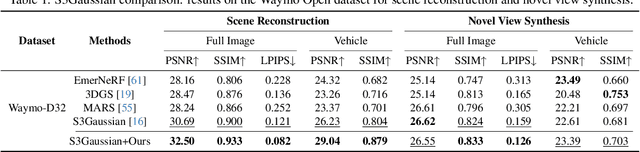
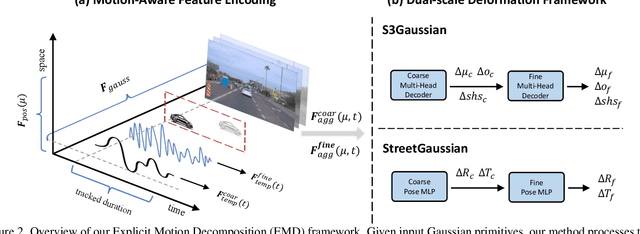
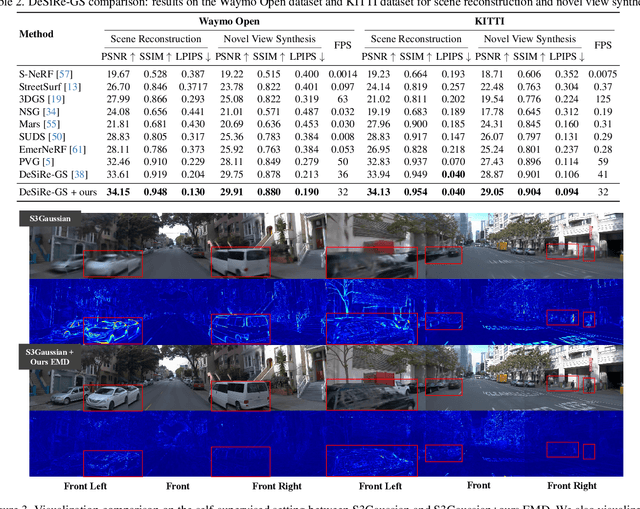

Photorealistic reconstruction of street scenes is essential for developing real-world simulators in autonomous driving. While recent methods based on 3D/4D Gaussian Splatting (GS) have demonstrated promising results, they still encounter challenges in complex street scenes due to the unpredictable motion of dynamic objects. Current methods typically decompose street scenes into static and dynamic objects, learning the Gaussians in either a supervised manner (e.g., w/ 3D bounding-box) or a self-supervised manner (e.g., w/o 3D bounding-box). However, these approaches do not effectively model the motions of dynamic objects (e.g., the motion speed of pedestrians is clearly different from that of vehicles), resulting in suboptimal scene decomposition. To address this, we propose Explicit Motion Decomposition (EMD), which models the motions of dynamic objects by introducing learnable motion embeddings to the Gaussians, enhancing the decomposition in street scenes. The proposed EMD is a plug-and-play approach applicable to various baseline methods. We also propose tailored training strategies to apply EMD to both supervised and self-supervised baselines. Through comprehensive experimentation, we illustrate the effectiveness of our approach with various established baselines. The code will be released at: https://qingpowuwu.github.io/emdgaussian.github.io/.