 Add to Chrome
 Add to Firefox
 Add to Edge
Better Decomposition, Free Aggregation: A Synthesizer-Folding Framework for Multilingual Multi-Hop Question Answering
Aug 13, 2026
Multilingual retrieval-augmented generation (mRAG) equips large language models with access to globally distributed external knowledge for complex multilingual question answering. Recent approaches either translate retrieved documents into English or the query language to bridge the cross-lingual semantic gap, or decompose a complex query into sub-questions and aggregate the intermediate reasoning process. However, both lines of work suffer from two limitations. First, one-size-fits-all translation alignment, blanket translation discards culturally and linguistically native information unique to the target language, introduces translation noise, and inflates system cost. Second, greedy decomposition and aggregation, uncontrolled decomposition produces redundant sub-questions that compound errors during step-wise reasoning, and the final aggregation over reasoning paths further amplifies these errors. We address both with our method Syfer, a synthesizer-folding framework for multilingual multi-hop question answering that defers translation rather than applying it by default. Syfer first invokes a format-constrained decomposer to produce a sub-question graph in the original language, followed by a decomposition-quality check; when the check passes, sub-questions are answered sequentially under a retrieve-then-answer policy in the target language, and the English translation pathway with bilingual sub-question graph alignment is activated only when the check fails. Experiments across multiple languages show that Syfer attains competitive accuracy while striking a favourable balance between performance and computational cost.

ToFu: A White-Box, Token-Efficient Agent Harness for Researchers
Jul 13, 2026Agentic coding tools present new opportunities to transform research workflows. The performance of agent systems built depends on both large language models (LLMs) and the harness around LLMs, which is the orchestration code that determines an agent's behavior. We present ToFu, an agentic harness for researchers that reads your codebase, edits files, runs commands, and integrates with your development tools. ToFu plays a dual role in research. As a research assistant, it supports practical research workflows with superior token efficiency, lower cost, and multilingual capability compared with existing agentic harnesses. Its release under the MIT License further enables local deployment for privacy-sensitive users. As a research object, ToFu provides a white-box agentic harness that allows researchers to inspect, modify, and evaluate its orchestration logic, tool-use behavior, and harness design, while retaining strong benchmark performance and an application-level user experience.
LANG: Reinforcement Learning for Multilingual Reasoning with Language-Adaptive Hint Guidance
May 21, 2026Reinforcement learning has proven effective for enhancing multi-step reasoning in large language models (LLMs), yet its benefits have not fully translated to multilingual contexts. Existing methods struggle with a fundamental trade-off: prioritizing input-language consistency severely hampers reasoning quality, while prioritizing reasoning often leads to unintended language drift toward English. We address this challenge with LANG, a novel framework that leverages language-conditioned hints to guide exploration in non-English reasoning tasks. Our method incorporates two key mechanisms to prevent dependency on these hints: a progressive decay schedule that gradually withdraws scaffolding, and a language-adaptive switch that tailors learning horizons to specific language difficulties. Empirical results on challenging multilingual mathematical benchmarks reveal that LANG substantially enhances reasoning performance without compromising language consistency. Moreover, we show that our framework generalizes beyond mathematics, fostering more consistent language alignment across model layers
DaPT: A Dual-Path Framework for Multilingual Multi-hop Question Answering
Mar 19, 2026Retrieval-augmented generation (RAG) systems have made significant progress in solving complex multi-hop question answering (QA) tasks in the English scenario. However, RAG systems inevitably face the application scenario of retrieving across multilingual corpora and queries, leaving several open challenges. The first one involves the absence of benchmarks that assess RAG systems' capabilities under the multilingual multi-hop (MM-hop) QA setting. The second centers on the overreliance on LLMs' strong semantic understanding in English, which diminishes effectiveness in multilingual scenarios. To address these challenges, we first construct multilingual multi-hop QA benchmarks by translating English-only benchmarks into five languages, and then we propose DaPT, a novel multilingual RAG framework. DaPT generates sub-question graphs in parallel for both the source-language query and its English translation counterpart, then merges them before employing a bilingual retrieval-and-answer strategy to sequentially solve sub-questions. Our experimental results demonstrate that advanced RAG systems suffer from a significant performance imbalance in multilingual scenarios. Furthermore, our proposed method consistently yields more accurate and concise answers compared to the baselines, significantly enhancing RAG performance on this task. For instance, on the most challenging MuSiQue benchmark, DaPT achieves a relative improvement of 18.3\% in average EM score over the strongest baseline.
Know More, Know Clearer: A Meta-Cognitive Framework for Knowledge Augmentation in Large Language Models
Feb 13, 2026Knowledge augmentation has significantly enhanced the performance of Large Language Models (LLMs) in knowledge-intensive tasks. However, existing methods typically operate on the simplistic premise that model performance equates with internal knowledge, overlooking the knowledge-confidence gaps that lead to overconfident errors or uncertain truths. To bridge this gap, we propose a novel meta-cognitive framework for reliable knowledge augmentation via differentiated intervention and alignment. Our approach leverages internal cognitive signals to partition the knowledge space into mastered, confused, and missing regions, guiding targeted knowledge expansion. Furthermore, we introduce a cognitive consistency mechanism to synchronize subjective certainty with objective accuracy, ensuring calibrated knowledge boundaries. Extensive experiments demonstrate the our framework consistently outperforms strong baselines, validating its rationality in not only enhancing knowledge capabilities but also fostering cognitive behaviors that better distinguish knowns from unknowns.
SpanNorm: Reconciling Training Stability and Performance in Deep Transformers
Jan 30, 2026The success of Large Language Models (LLMs) hinges on the stable training of deep Transformer architectures. A critical design choice is the placement of normalization layers, leading to a fundamental trade-off: the ``PreNorm'' architecture ensures training stability at the cost of potential performance degradation in deep models, while the ``PostNorm'' architecture offers strong performance but suffers from severe training instability. In this work, we propose SpanNorm, a novel technique designed to resolve this dilemma by integrating the strengths of both paradigms. Structurally, SpanNorm establishes a clean residual connection that spans the entire transformer block to stabilize signal propagation, while employing a PostNorm-style computation that normalizes the aggregated output to enhance model performance. We provide a theoretical analysis demonstrating that SpanNorm, combined with a principled scaling strategy, maintains bounded signal variance throughout the network, preventing the gradient issues that plague PostNorm models, and also alleviating the representation collapse of PreNorm. Empirically, SpanNorm consistently outperforms standard normalization schemes in both dense and Mixture-of-Experts (MoE) scenarios, paving the way for more powerful and stable Transformer architectures.
ClueAnchor: Clue-Anchored Knowledge Reasoning Exploration and Optimization for Retrieval-Augmented Generation
May 30, 2025Retrieval-Augmented Generation (RAG) augments Large Language Models (LLMs) with external knowledge to improve factuality. However, existing RAG systems frequently underutilize the retrieved documents, failing to extract and integrate the key clues needed to support faithful and interpretable reasoning, especially in cases where relevant evidence is implicit, scattered, or obscured by noise. To address this issue, we propose ClueAnchor, a novel framework for enhancing RAG via clue-anchored reasoning exploration and optimization. ClueAnchor extracts key clues from retrieved content and generates multiple reasoning paths based on different knowledge configurations, optimizing the model by selecting the most effective one through reward-based preference optimization. Experiments show that ClueAnchor significantly outperforms prior RAG baselines in reasoning completeness and robustness. Further analysis confirms its strong resilience to noisy or partially relevant retrieved content, as well as its capability to identify supporting evidence even in the absence of explicit clue supervision during inference.
SLAM: Towards Efficient Multilingual Reasoning via Selective Language Alignment
Jan 07, 2025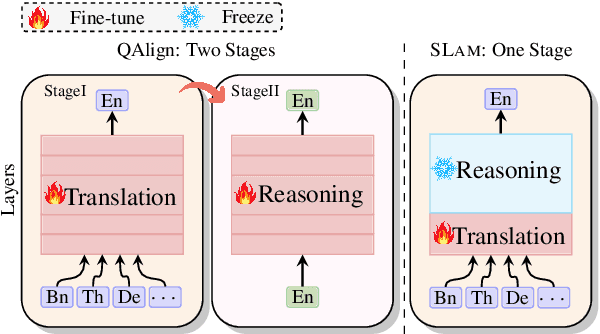
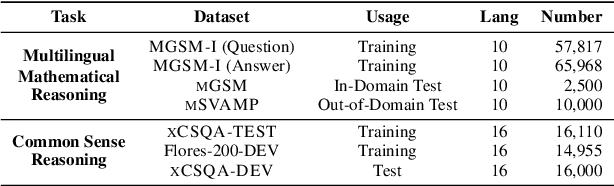
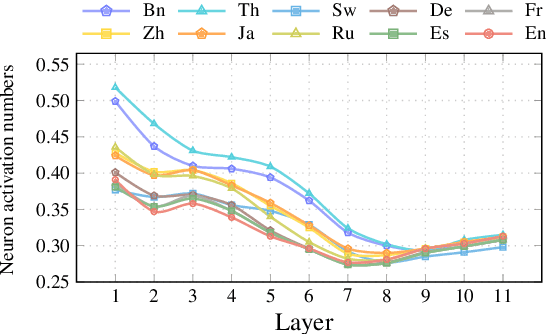
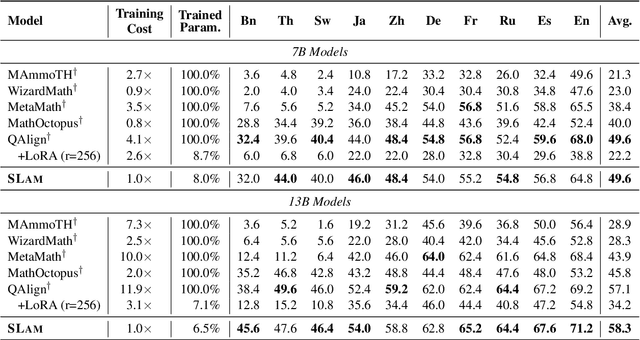
Despite the significant improvements achieved by large language models (LLMs) in English reasoning tasks, these models continue to struggle with multilingual reasoning. Recent studies leverage a full-parameter and two-stage training paradigm to teach models to first understand non-English questions and then reason. However, this method suffers from both substantial computational resource computing and catastrophic forgetting. The fundamental cause is that, with the primary goal of enhancing multilingual comprehension, an excessive number of irrelevant layers and parameters are tuned during the first stage. Given our findings that the representation learning of languages is merely conducted in lower-level layers, we propose an efficient multilingual reasoning alignment approach that precisely identifies and fine-tunes the layers responsible for handling multilingualism. Experimental results show that our method, SLAM, only tunes 6 layers' feed-forward sub-layers including 6.5-8% of all parameters within 7B and 13B LLMs, achieving superior average performance than all strong baselines across 10 languages. Meanwhile, SLAM only involves one training stage, reducing training time by 4.1-11.9 compared to the two-stage method.
Advancing Large Language Model Attribution through Self-Improving
Oct 17, 2024


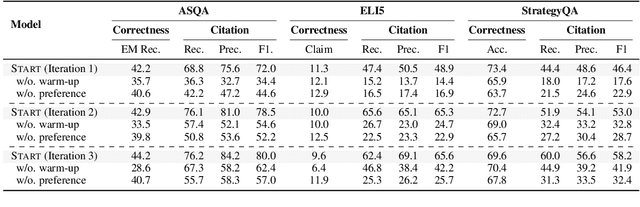
Teaching large language models (LLMs) to generate text with citations to evidence sources can mitigate hallucinations and enhance verifiability in information-seeking systems. However, improving this capability requires high-quality attribution data, which is costly and labor-intensive. Inspired by recent advances in self-improvement that enhance LLMs without manual annotation, we present START, a Self-Taught AttRibuTion framework for iteratively improving the attribution capability of LLMs. First, to prevent models from stagnating due to initially insufficient supervision signals, START leverages the model to self-construct synthetic training data for warming up. To further self-improve the model's attribution ability, START iteratively utilizes fine-grained preference supervision signals constructed from its sampled responses to encourage robust, comprehensive, and attributable generation. Experiments on three open-domain question-answering datasets, covering long-form QA and multi-step reasoning, demonstrate significant performance gains of 25.13% on average without relying on human annotations and more advanced models. Further analysis reveals that START excels in aggregating information across multiple sources.
NDP: Next Distribution Prediction as a More Broad Target
Aug 30, 2024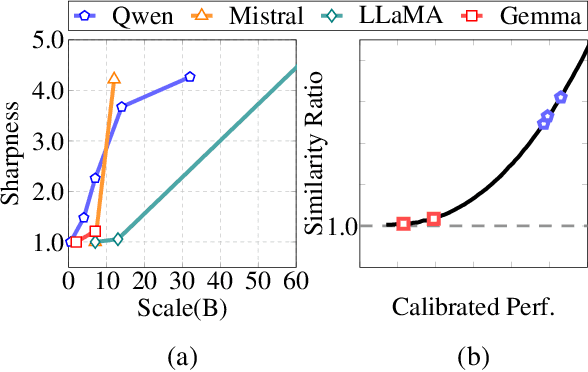
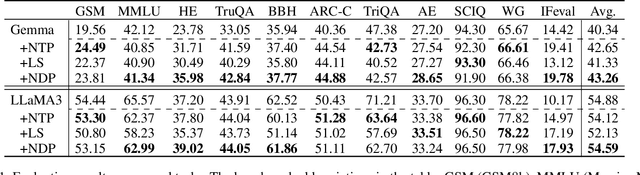
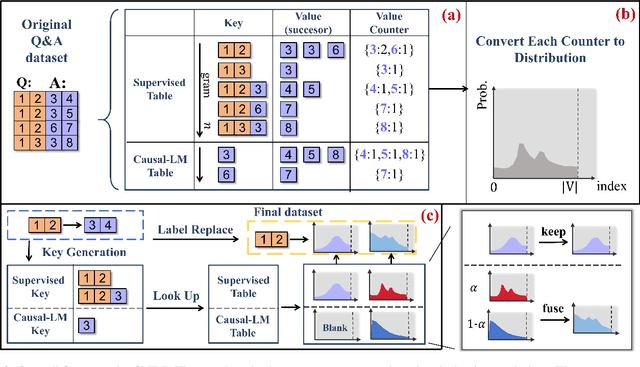
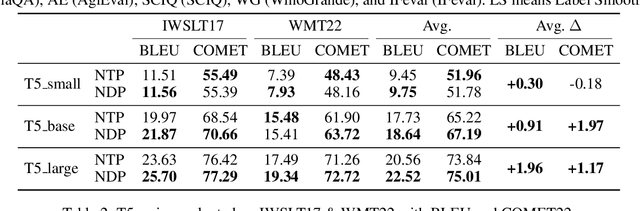
Large language models (LLMs) trained on next-token prediction (NTP) paradigm have demonstrated powerful capabilities. However, the existing NTP paradigm contains several limitations, particularly related to planned task complications and error propagation during inference. In our work, we extend the critique of NTP, highlighting its limitation also due to training with a narrow objective: the prediction of a sub-optimal one-hot distribution. To support this critique, we conducted a pre-experiment treating the output distribution from powerful LLMs as efficient world data compression. By evaluating the similarity between the $n$-gram distribution and the one-hot distribution with LLMs, we observed that the $n$-gram distributions align more closely with the output distribution of LLMs. Based on this insight, we introduce Next Distribution Prediction (NDP), which uses $n$-gram distributions to replace the one-hot targets, enhancing learning without extra online training time. We conducted experiments across translation, general task, language transfer, and medical domain adaptation. Compared to NTP, NDP can achieve up to +2.97 COMET improvement in translation tasks, +0.61 average improvement in general tasks, and incredible +10.75 average improvement in the medical domain. This demonstrates the concrete benefits of addressing the target narrowing problem, pointing to a new direction for future work on improving NTP.