 Add to Chrome
 Add to Firefox
 Add to Edge
Better Decomposition, Free Aggregation: A Synthesizer-Folding Framework for Multilingual Multi-Hop Question Answering
Aug 13, 2026
Multilingual retrieval-augmented generation (mRAG) equips large language models with access to globally distributed external knowledge for complex multilingual question answering. Recent approaches either translate retrieved documents into English or the query language to bridge the cross-lingual semantic gap, or decompose a complex query into sub-questions and aggregate the intermediate reasoning process. However, both lines of work suffer from two limitations. First, one-size-fits-all translation alignment, blanket translation discards culturally and linguistically native information unique to the target language, introduces translation noise, and inflates system cost. Second, greedy decomposition and aggregation, uncontrolled decomposition produces redundant sub-questions that compound errors during step-wise reasoning, and the final aggregation over reasoning paths further amplifies these errors. We address both with our method Syfer, a synthesizer-folding framework for multilingual multi-hop question answering that defers translation rather than applying it by default. Syfer first invokes a format-constrained decomposer to produce a sub-question graph in the original language, followed by a decomposition-quality check; when the check passes, sub-questions are answered sequentially under a retrieve-then-answer policy in the target language, and the English translation pathway with bilingual sub-question graph alignment is activated only when the check fails. Experiments across multiple languages show that Syfer attains competitive accuracy while striking a favourable balance between performance and computational cost.

MEGRAG: Multi-Granular Evidence Graphs for Answer-Aware Multi-Hop RAG
Aug 03, 2026Multi-hop question answering is a fundamental challenge in retrieval-augmented generation (RAG), because deriving an answer requires integrating dispersed evidence. Iterative RAG (iRAG) is widely used for this challenge, but existing methods have two limitations. First, most methods still support each reasoning step with single-granularity evidence, making it difficult to balance information density and contextual noise. Second, existing methods often answer the original question only after aggregating evidence retrieved across intermediate steps, so redundant evidence and intermediate retrieval errors may accumulate and degrade the final answer. To address these limitations, we propose MEGRAG, an answer-aware framework that represents multi-hop reasoning as a path-structured multi-granular evidence graph. Offline, MEGRAG links passages to their sentences and extracted triples through a cross-granularity index. Online, it retrieves passages for the current query and selects aligned evidence, starting with compact triples and adding sentence or passage context as needed. MEGRAG uses the resulting intermediate answer and prior reasoning to decide whether the Initial Query has been resolved. If not, it identifies the missing information and formulates a focused next query; otherwise, it stops retrieval and returns the answer. Extensive experiments demonstrate consistent gains over a diverse set of RAG baselines.
FedUP: One-Shot Federated Unlearning via Centroid-Guided Plug-in Filters
Jun 24, 2026Federated unlearning (FU) is critical for complying with legal mandates like the right to be forgotten in decentralized systems, yet current methods face a persistent dilemma between non-target knowledge loss and high request latency. To resolve these issues, we propose FedUP, a one-shot federated unlearning framework utilizing lightweight pluggable filters that act as a "knowledge funnel" to screen out target data while preserving original model performance. By freezing original model parameters and training filters at the server side using differentially private (DP)-protected class centroid samples, FedUP bypasses the need for multi-round client-server communication and complex retraining, reducing unlearning latency from minutes to mere seconds. Additionally, the framework's pluggable architecture ensures inherent reversibility, enabling the seamless restoration of forgotten knowledge by simply removing the filters. Extensive experiments on diverse image and text tasks demonstrate that FedUP effectively reduces non-target knowledge loss and achieves superior unlearning precision and efficiency across various scenarios. Code is available at: https://github.com/suows/FedUP-code.
DIAL-KG: Schema-Free Incremental Knowledge Graph Construction via Dynamic Schema Induction and Evolution-Intent Assessment
Mar 20, 2026Knowledge Graphs (KGs) are foundational to applications such as search, question answering, and recommendation. Conventional knowledge graph construction methods are predominantly static, rely ing on a single-step construction from a fixed corpus with a prede f ined schema. However, such methods are suboptimal for real-world sce narios where data arrives dynamically, as incorporating new informa tion requires complete and computationally expensive graph reconstruc tions. Furthermore, predefined schemas hinder the flexibility of knowl edge graph construction. To address these limitations, we introduce DIAL KG, a closed-loop framework for incremental KG construction orches trated by a Meta-Knowledge Base (MKB). The framework oper ates in a three-stage cycle: (i) Dual-Track Extraction, which ensures knowledge completeness by defaulting to triple generation and switching to event extraction for complex knowledge; (ii) Governance Adjudica tion, which ensures the fidelity and currency of extracted facts to prevent hallucinations and knowledge staleness; and (iii) Schema Evolution, in which new schemas are induced from validated knowledge to guide subsequent construction cycles, and knowledge from the current round is incrementally applied to the existing KG. Extensive experiments demon strate that our framework achieves state-of-the-art (SOTA) performance in the quality of both the constructed graph and the induced schemas.
Rethink Efficiency Side of Neural Combinatorial Solver: An Offline and Self-Play Paradigm
Feb 24, 2026We propose ECO, a versatile learning paradigm that enables efficient offline self-play for Neural Combinatorial Optimization (NCO). ECO addresses key limitations in the field through: 1) Paradigm Shift: Moving beyond inefficient online paradigms, we introduce a two-phase offline paradigm consisting of supervised warm-up and iterative Direct Preference Optimization (DPO); 2) Architecture Shift: We deliberately design a Mamba-based architecture to further enhance the efficiency in the offline paradigm; and 3) Progressive Bootstrapping: To stabilize training, we employ a heuristic-based bootstrapping mechanism that ensures continuous policy improvement during training. Comparison results on TSP and CVRP highlight that ECO performs competitively with up-to-date baselines, with significant advantage on the efficiency side in terms of memory utilization and training throughput. We provide further in-depth analysis on the efficiency, throughput and memory usage of ECO. Ablation studies show rationale behind our designs.
CIRAG: Construction-Integration Retrieval and Adaptive Generation for Multi-hop Question Answering
Jan 11, 2026Triple-based Iterative Retrieval-Augmented Generation (iRAG) mitigates document-level noise for multi-hop question answering. However, existing methods still face limitations: (i) greedy single-path expansion, which propagates early errors and fails to capture parallel evidence from different reasoning branches, and (ii) granularity-demand mismatch, where a single evidence representation struggles to balance noise control with contextual sufficiency. In this paper, we propose the Construction-Integration Retrieval and Adaptive Generation model, CIRAG. It introduces an Iterative Construction-Integration module that constructs candidate triples and history-conditionally integrates them to distill core triples and generate the next-hop query. This module mitigates the greedy trap by preserving multiple plausible evidence chains. Besides, we propose an Adaptive Cascaded Multi-Granularity Generation module that progressively expands contextual evidence based on the problem requirements, from triples to supporting sentences and full passages. Moreover, we introduce Trajectory Distillation, which distills the teacher model's integration policy into a lightweight student, enabling efficient and reliable long-horizon reasoning. Extensive experiments demonstrate that CIRAG achieves superior performance compared to existing iRAG methods.
SacFL: Self-Adaptive Federated Continual Learning for Resource-Constrained End Devices
May 01, 2025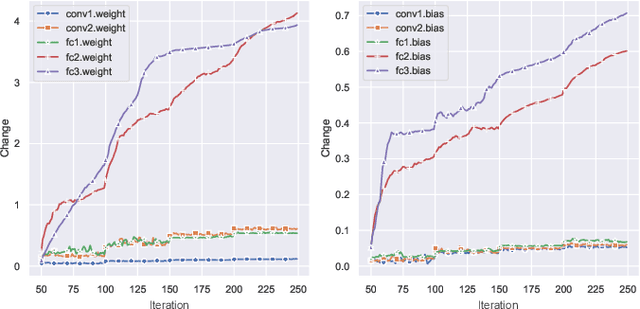
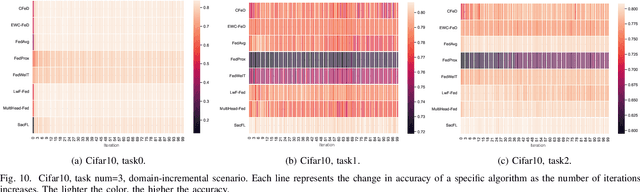
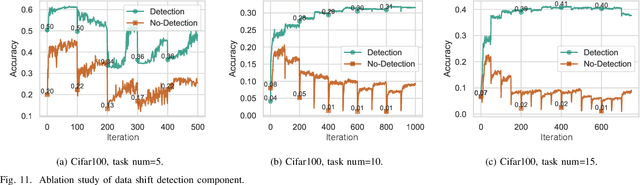
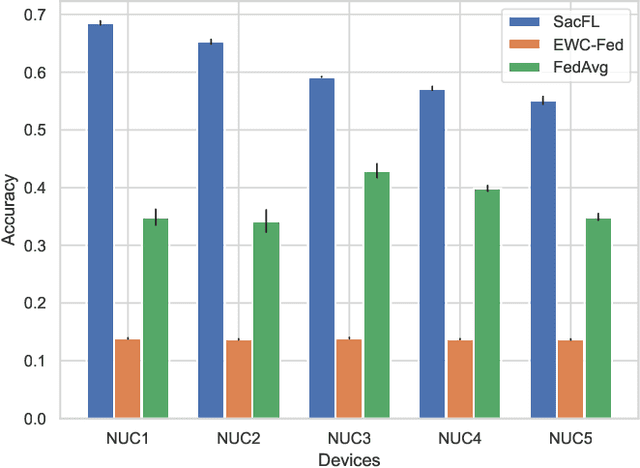
The proliferation of end devices has led to a distributed computing paradigm, wherein on-device machine learning models continuously process diverse data generated by these devices. The dynamic nature of this data, characterized by continuous changes or data drift, poses significant challenges for on-device models. To address this issue, continual learning (CL) is proposed, enabling machine learning models to incrementally update their knowledge and mitigate catastrophic forgetting. However, the traditional centralized approach to CL is unsuitable for end devices due to privacy and data volume concerns. In this context, federated continual learning (FCL) emerges as a promising solution, preserving user data locally while enhancing models through collaborative updates. Aiming at the challenges of limited storage resources for CL, poor autonomy in task shift detection, and difficulty in coping with new adversarial tasks in FCL scenario, we propose a novel FCL framework named SacFL. SacFL employs an Encoder-Decoder architecture to separate task-robust and task-sensitive components, significantly reducing storage demands by retaining lightweight task-sensitive components for resource-constrained end devices. Moreover, $\rm{SacFL}$ leverages contrastive learning to introduce an autonomous data shift detection mechanism, enabling it to discern whether a new task has emerged and whether it is a benign task. This capability ultimately allows the device to autonomously trigger CL or attack defense strategy without additional information, which is more practical for end devices. Comprehensive experiments conducted on multiple text and image datasets, such as Cifar100 and THUCNews, have validated the effectiveness of $\rm{SacFL}$ in both class-incremental and domain-incremental scenarios. Furthermore, a demo system has been developed to verify its practicality.
Efficient Multi-Task Modeling through Automated Fusion of Trained Models
Apr 14, 2025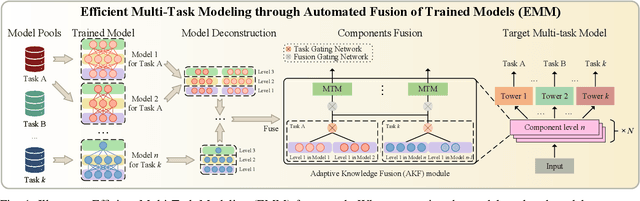
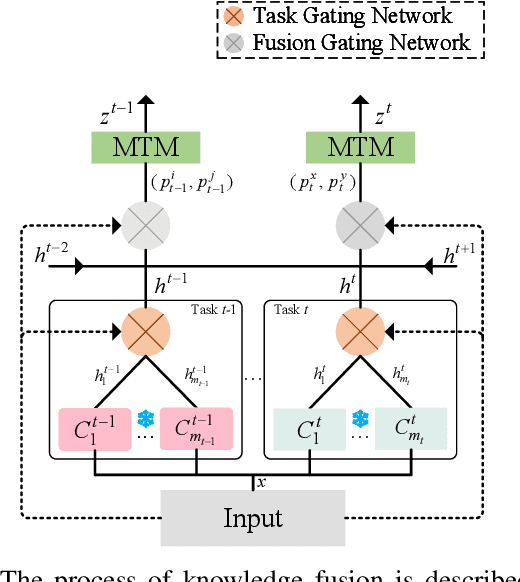
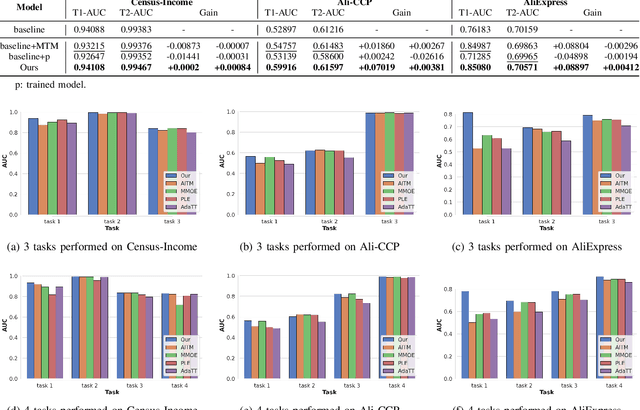
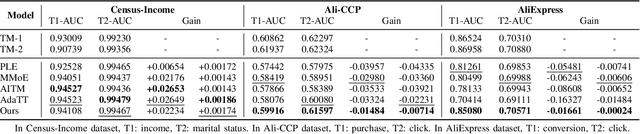
Although multi-task learning is widely applied in intelligent services, traditional multi-task modeling methods often require customized designs based on specific task combinations, resulting in a cumbersome modeling process. Inspired by the rapid development and excellent performance of single-task models, this paper proposes an efficient multi-task modeling method that can automatically fuse trained single-task models with different structures and tasks to form a multi-task model. As a general framework, this method allows modelers to simply prepare trained models for the required tasks, simplifying the modeling process while fully utilizing the knowledge contained in the trained models. This eliminates the need for excessive focus on task relationships and model structure design. To achieve this goal, we consider the structural differences among various trained models and employ model decomposition techniques to hierarchically decompose them into multiple operable model components. Furthermore, we have designed an Adaptive Knowledge Fusion (AKF) module based on Transformer, which adaptively integrates intra-task and inter-task knowledge based on model components. Through the proposed method, we achieve efficient and automated construction of multi-task models, and its effectiveness is verified through extensive experiments on three datasets.
CUT: Pruning Pre-Trained Multi-Task Models into Compact Models for Edge Devices
Apr 14, 2025Multi-task learning has garnered widespread attention in the industry due to its efficient data utilization and strong generalization capabilities, making it particularly suitable for providing high-quality intelligent services to users. Edge devices, as the primary platforms directly serving users, play a crucial role in delivering multi-task services. However, current multi-task models are often large, and user task demands are increasingly diverse. Deploying such models directly on edge devices not only increases the burden on these devices but also leads to task redundancy. To address this issue, this paper innovatively proposes a pre-trained multi-task model pruning method specifically designed for edge computing. The goal is to utilize existing pre-trained multi-task models to construct a compact multi-task model that meets the needs of edge devices. The specific implementation steps are as follows: First, decompose the tasks within the pre-trained multi-task model and select tasks based on actual user needs. Next, while retaining the knowledge of the original pre-trained model, evaluate parameter importance and use a parameter fusion method to effectively integrate shared parameters among tasks. Finally, obtain a compact multi-task model suitable for edge devices. To validate the effectiveness of the proposed method, we conducted experiments on three public image datasets. The experimental results fully demonstrate the superiority and efficiency of this method, providing a new solution for multi-task learning on edge devices.
Multi-task Federated Learning with Encoder-Decoder Structure: Enabling Collaborative Learning Across Different Tasks
Apr 14, 2025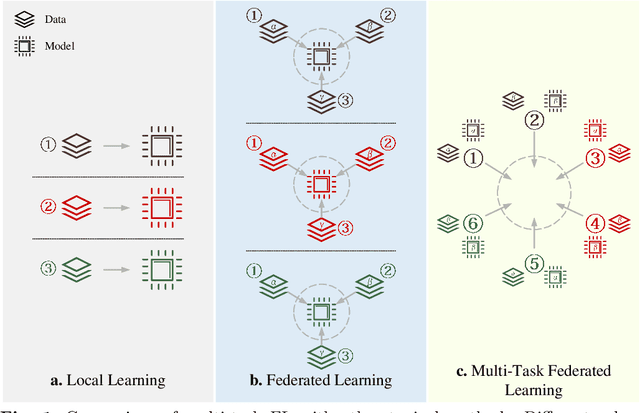

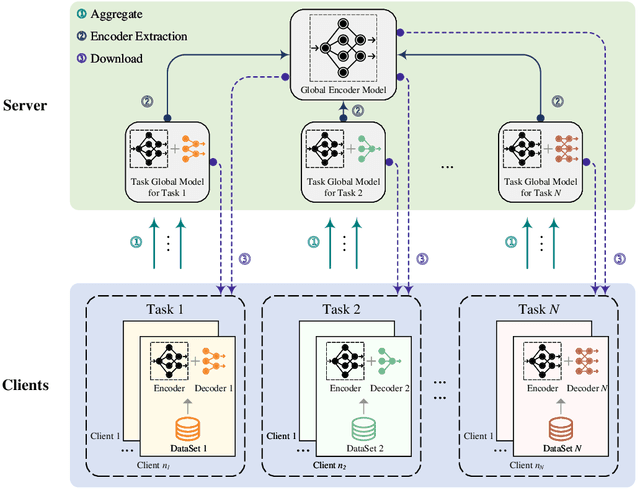

Federated learning has been extensively studied and applied due to its ability to ensure data security in distributed environments while building better models. However, clients participating in federated learning still face limitations, as clients with different structures or tasks cannot participate in learning together. In view of this, constructing a federated learning framework that allows collaboration between clients with different model structures and performing different tasks, enabling them to share valuable knowledge to enhance model efficiency, holds significant practical implications for the widespread application of federated learning. To achieve this goal, we propose a multi-task federated learning with encoder-decoder structure (M-Fed). Specifically, given the widespread adoption of the encoder-decoder architecture in current models, we leverage this structure to share intra-task knowledge through traditional federated learning methods and extract general knowledge from the encoder to achieve cross-task knowledge sharing. The training process is similar to traditional federated learning, and we incorporate local decoder and global decoder information into the loss function. The local decoder iteratively updates and gradually approaches the global decoder until sufficient cross-task knowledge sharing is achieved. Our method is lightweight and modular, demonstrating innovation compared to previous research. It enables clients performing different tasks to share general knowledge while maintaining the efficiency of traditional federated learning systems. We conducted experiments on two widely used benchmark datasets to verify the feasibility of M-Fed and compared it with traditional methods. The experimental results demonstrate the effectiveness of M-Fed in multi-task federated learning.