 Add to Chrome
 Add to Firefox
 Add to Edge
Posterior-GRPO: Rewarding Reasoning Processes in Code Generation
Aug 07, 2025
Reinforcement learning (RL) has significantly advanced code generation for large language models (LLMs). However, current paradigms rely on outcome-based rewards from test cases, neglecting the quality of the intermediate reasoning process. While supervising the reasoning process directly is a promising direction, it is highly susceptible to reward hacking, where the policy model learns to exploit the reasoning reward signal without improving final outcomes. To address this, we introduce a unified framework that can effectively incorporate the quality of the reasoning process during RL. First, to enable reasoning evaluation, we develop LCB-RB, a benchmark comprising preference pairs of superior and inferior reasoning processes. Second, to accurately score reasoning quality, we introduce an Optimized-Degraded based (OD-based) method for reward model training. This method generates high-quality preference pairs by systematically optimizing and degrading initial reasoning paths along curated dimensions of reasoning quality, such as factual accuracy, logical rigor, and coherence. A 7B parameter reward model with this method achieves state-of-the-art (SOTA) performance on LCB-RB and generalizes well to other benchmarks. Finally, we introduce Posterior-GRPO (P-GRPO), a novel RL method that conditions process-based rewards on task success. By selectively applying rewards to the reasoning processes of only successful outcomes, P-GRPO effectively mitigates reward hacking and aligns the model's internal reasoning with final code correctness. A 7B parameter model with P-GRPO achieves superior performance across diverse code generation tasks, outperforming outcome-only baselines by 4.5%, achieving comparable performance to GPT-4-Turbo. We further demonstrate the generalizability of our approach by extending it to mathematical tasks. Our models, dataset, and code are publicly available.

Quasi-Clique Discovery via Energy Diffusion
Aug 06, 2025Discovering quasi-cliques -- subgraphs with edge density no less than a given threshold -- is a fundamental task in graph mining, with broad applications in social networks, bioinformatics, and e-commerce. Existing heuristics often rely on greedy rules, similarity measures, or metaheuristic search, but struggle to maintain both efficiency and solution consistency across diverse graphs. This paper introduces EDQC, a novel quasi-clique discovery algorithm inspired by energy diffusion. Instead of explicitly enumerating candidate subgraphs, EDQC performs stochastic energy diffusion from source vertices, naturally concentrating energy within structurally cohesive regions. The approach enables efficient dense subgraph discovery without exhaustive search or dataset-specific tuning. Experimental results on 30 real-world datasets demonstrate that EDQC consistently discovers larger quasi-cliques than state-of-the-art baselines on the majority of datasets, while also yielding lower variance in solution quality. To the best of our knowledge, EDQC is the first method to incorporate energy diffusion into quasi-clique discovery.
Kimi K2: Open Agentic Intelligence
Jul 28, 2025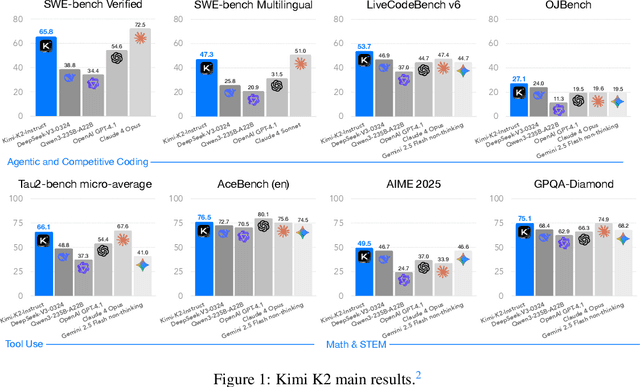
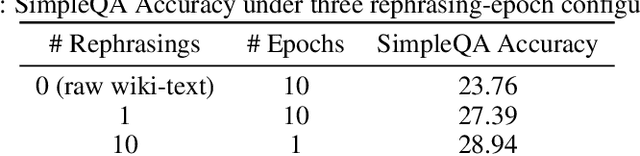
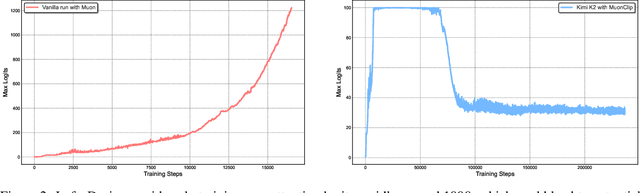
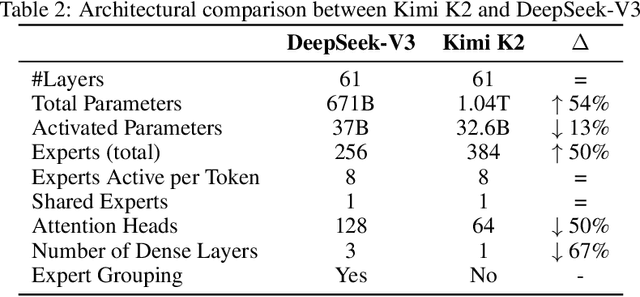
We introduce Kimi K2, a Mixture-of-Experts (MoE) large language model with 32 billion activated parameters and 1 trillion total parameters. We propose the MuonClip optimizer, which improves upon Muon with a novel QK-clip technique to address training instability while enjoying the advanced token efficiency of Muon. Based on MuonClip, K2 was pre-trained on 15.5 trillion tokens with zero loss spike. During post-training, K2 undergoes a multi-stage post-training process, highlighted by a large-scale agentic data synthesis pipeline and a joint reinforcement learning (RL) stage, where the model improves its capabilities through interactions with real and synthetic environments. Kimi K2 achieves state-of-the-art performance among open-source non-thinking models, with strengths in agentic capabilities. Notably, K2 obtains 66.1 on Tau2-Bench, 76.5 on ACEBench (En), 65.8 on SWE-Bench Verified, and 47.3 on SWE-Bench Multilingual -- surpassing most open and closed-sourced baselines in non-thinking settings. It also exhibits strong capabilities in coding, mathematics, and reasoning tasks, with a score of 53.7 on LiveCodeBench v6, 49.5 on AIME 2025, 75.1 on GPQA-Diamond, and 27.1 on OJBench, all without extended thinking. These results position Kimi K2 as one of the most capable open-source large language models to date, particularly in software engineering and agentic tasks. We release our base and post-trained model checkpoints to facilitate future research and applications of agentic intelligence.
Non-Orthogonal AFDM: A Promising Spectrum-Efficient Waveform for 6G High-Mobility Communications
Jul 23, 2025This paper proposes a spectrum-efficient nonorthogonal affine frequency division multiplexing (AFDM) waveform for reliable high-mobility communications in the upcoming sixth-generation (6G) mobile systems. Our core idea is to introduce a compression factor to enable controllable subcarrier overlapping in chirp-based AFDM modulation. To mitigate intercarrier interference (ICI), we introduce linear precoding at the transmitter and an iterative detection scheme at the receiver. Simulation results demonstrate that these techniques can effectively reduce interference and maintain robust bit error rate (BER) performance even under aggressive compression factors and high-mobility channel conditions. The proposed non-orthogonal AFDM waveform offers a promising solution for next-generation wireless networks, balancing spectrum efficiency and Doppler resilience in highly dynamic environments.
Spontaneous Spatial Cognition Emerges during Egocentric Video Viewing through Non-invasive BCI
Jul 16, 2025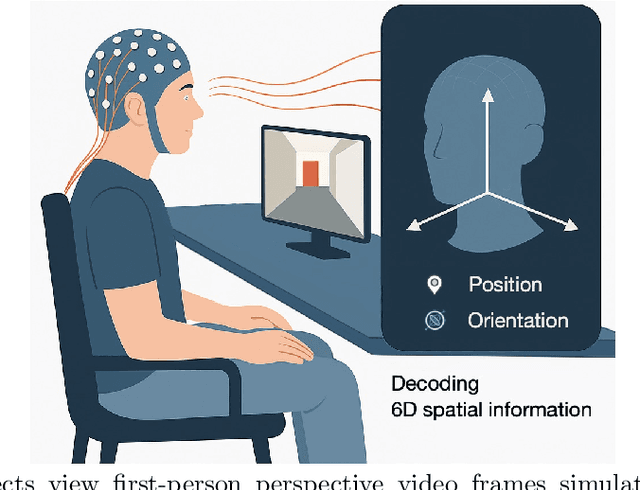
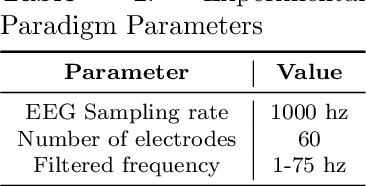
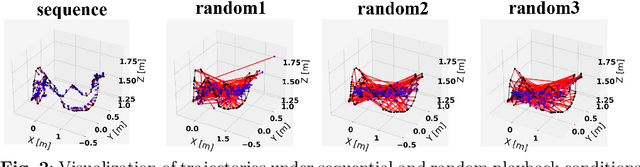
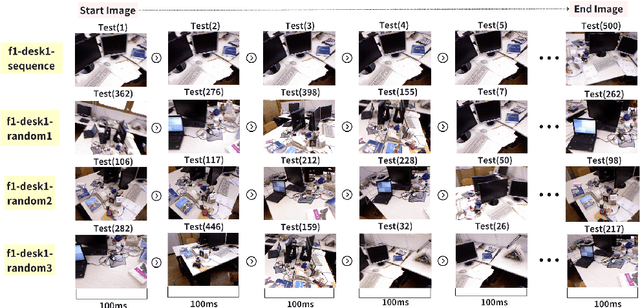
Humans possess a remarkable capacity for spatial cognition, allowing for self-localization even in novel or unfamiliar environments. While hippocampal neurons encoding position and orientation are well documented, the large-scale neural dynamics supporting spatial representation, particularly during naturalistic, passive experience, remain poorly understood. Here, we demonstrate for the first time that non-invasive brain-computer interfaces (BCIs) based on electroencephalography (EEG) can decode spontaneous, fine-grained egocentric 6D pose, comprising three-dimensional position and orientation, during passive viewing of egocentric video. Despite EEG's limited spatial resolution and high signal noise, we find that spatially coherent visual input (i.e., continuous and structured motion) reliably evokes decodable spatial representations, aligning with participants' subjective sense of spatial engagement. Decoding performance further improves when visual input is presented at a frame rate of 100 ms per image, suggesting alignment with intrinsic neural temporal dynamics. Using gradient-based backpropagation through a neural decoding model, we identify distinct EEG channels contributing to position -- and orientation specific -- components, revealing a distributed yet complementary neural encoding scheme. These findings indicate that the brain's spatial systems operate spontaneously and continuously, even under passive conditions, challenging traditional distinctions between active and passive spatial cognition. Our results offer a non-invasive window into the automatic construction of egocentric spatial maps and advance our understanding of how the human mind transforms everyday sensory experience into structured internal representations.
STARS: A Unified Framework for Singing Transcription, Alignment, and Refined Style Annotation
Jul 09, 2025Recent breakthroughs in singing voice synthesis (SVS) have heightened the demand for high-quality annotated datasets, yet manual annotation remains prohibitively labor-intensive and resource-intensive. Existing automatic singing annotation (ASA) methods, however, primarily tackle isolated aspects of the annotation pipeline. To address this fundamental challenge, we present STARS, which is, to our knowledge, the first unified framework that simultaneously addresses singing transcription, alignment, and refined style annotation. Our framework delivers comprehensive multi-level annotations encompassing: (1) precise phoneme-audio alignment, (2) robust note transcription and temporal localization, (3) expressive vocal technique identification, and (4) global stylistic characterization including emotion and pace. The proposed architecture employs hierarchical acoustic feature processing across frame, word, phoneme, note, and sentence levels. The novel non-autoregressive local acoustic encoders enable structured hierarchical representation learning. Experimental validation confirms the framework's superior performance across multiple evaluation dimensions compared to existing annotation approaches. Furthermore, applications in SVS training demonstrate that models utilizing STARS-annotated data achieve significantly enhanced perceptual naturalness and precise style control. This work not only overcomes critical scalability challenges in the creation of singing datasets but also pioneers new methodologies for controllable singing voice synthesis. Audio samples are available at https://gwx314.github.io/stars-demo/.
PAST: A multimodal single-cell foundation model for histopathology and spatial transcriptomics in cancer
Jul 08, 2025While pathology foundation models have transformed cancer image analysis, they often lack integration with molecular data at single-cell resolution, limiting their utility for precision oncology. Here, we present PAST, a pan-cancer single-cell foundation model trained on 20 million paired histopathology images and single-cell transcriptomes spanning multiple tumor types and tissue contexts. By jointly encoding cellular morphology and gene expression, PAST learns unified cross-modal representations that capture both spatial and molecular heterogeneity at the cellular level. This approach enables accurate prediction of single-cell gene expression, virtual molecular staining, and multimodal survival analysis directly from routine pathology slides. Across diverse cancers and downstream tasks, PAST consistently exceeds the performance of existing approaches, demonstrating robust generalizability and scalability. Our work establishes a new paradigm for pathology foundation models, providing a versatile tool for high-resolution spatial omics, mechanistic discovery, and precision cancer research.
An RRT* algorithm based on Riemannian metric model for optimal path planning
Jul 02, 2025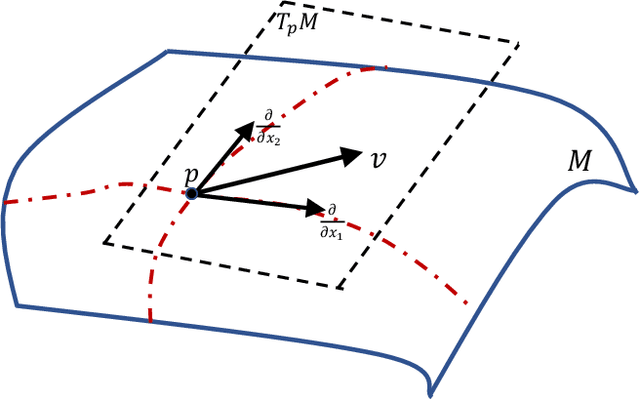
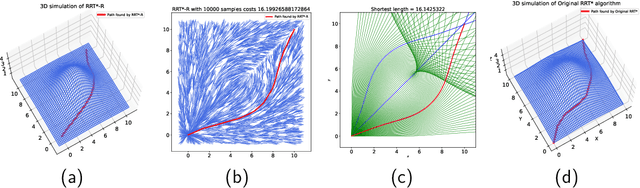
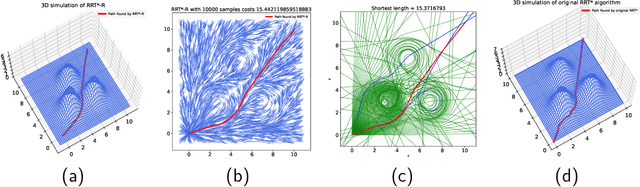
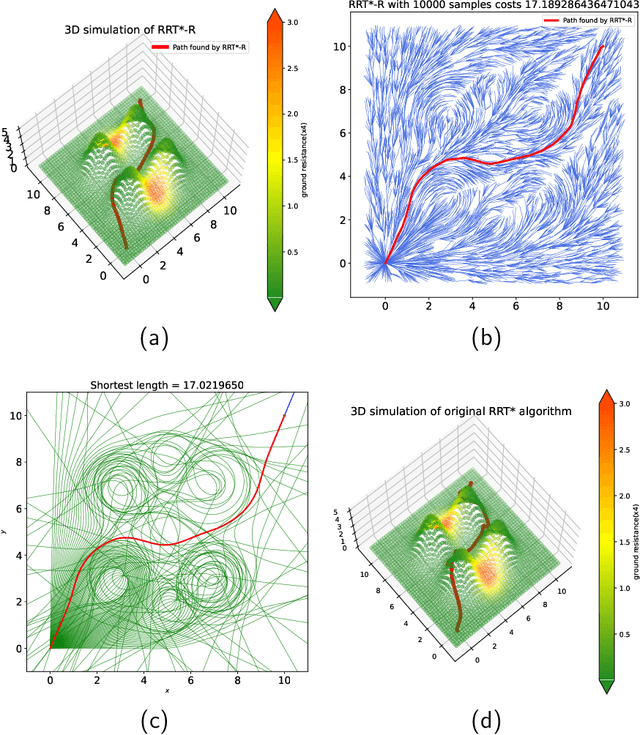
This paper presents a Riemannian metric-based model to solve the optimal path planning problem on two-dimensional smooth submanifolds in high-dimensional space. Our model is based on constructing a new Riemannian metric on a two-dimensional projection plane, which is induced by the high-dimensional Euclidean metric on two-dimensional smooth submanifold and reflects the environmental information of the robot. The optimal path planning problem in high-dimensional space is therefore transformed into a geometric problem on the two-dimensional plane with new Riemannian metric. Based on the new Riemannian metric, we proposed an incremental algorithm RRT*-R on the projection plane. The experimental results show that the proposed algorithm is suitable for scenarios with uneven fields in multiple dimensions. The proposed algorithm can help the robot to effectively avoid areas with drastic changes in height, ground resistance and other environmental factors. More importantly, the RRT*-R algorithm shows better smoothness and optimization properties compared with the original RRT* algorithm using Euclidean distance in high-dimensional workspace. The length of the entire path by RRT*-R is a good approximation of the theoretical minimum geodesic distance on projection plane.
Surrogate Modeling via Factorization Machine and Ising Model with Enhanced Higher-Order Interaction Learning
Jul 02, 2025Recently, a surrogate model was proposed that employs a factorization machine to approximate the underlying input-output mapping of the original system, with quantum annealing used to optimize the resulting surrogate function. Inspired by this approach, we propose an enhanced surrogate model that incorporates additional slack variables into both the factorization machine and its associated Ising representation thereby unifying what was by design a two-step process into a single, integrated step. During the training phase, the slack variables are iteratively updated, enabling the model to account for higher-order feature interactions. We apply the proposed method to the task of predicting drug combination effects. Experimental results indicate that the introduction of slack variables leads to a notable improvement of performance. Our algorithm offers a promising approach for building efficient surrogate models that exploit potential quantum advantages.
Multimodal LLMs for Visualization Reconstruction and Understanding
Jun 26, 2025Visualizations are crucial for data communication, yet understanding them requires comprehension of both visual elements and their underlying data relationships. Current multimodal large models, while effective in natural image understanding, struggle with visualization due to their inability to decode the data-to-visual mapping rules and extract structured information. To address these challenges, we present a novel dataset and train multimodal visualization LLMs specifically designed for understanding. Our approach combines chart images with their corresponding vectorized representations, encoding schemes, and data features. The proposed vector format enables compact and accurate reconstruction of visualization content. Experimental results demonstrate significant improvements in both data extraction accuracy and chart reconstruction quality.