 Add to Chrome
 Add to Firefox
 Add to Edge
BagShift: Measuring How Patch Selection Changes the Evidence Seen by Whole-Slide MIL
Aug 16, 2026
Whole-slide multiple-instance learning (MIL) observes only the patches admitted by its selector. Deployment can alter this selector through compute limits, tissue masking, or regional workflows, even when the patch count is unchanged. We introduce BagShift, a paired protocol that changes the selector for the same case while holding its features and predictor fixed, thereby isolating selector response from case mix. With equal 128-patch budgets, sampling across the tissue or concentrating around one coordinate exposes markedly different evidence: on PANDA, the two views reduce quadratic weighted kappa by 1.57 and 17.96 points, respectively (QWK reported on the $\times100$ scale). On CAMELYON16, lesion annotations withheld from model development show that localized views retain tumor in only 10.0\% of micrometastatic observations, and matched exposure does not consistently recover the loss. The same fixed-count stressor produces a much smaller response on external lung subtyping, although differences in relative coverage make cross-task severity descriptive. When repeated localized observations are available, unioning their patches before one nonlinear MIL pass improves PANDA QWK by 7.87 points over averaging regional predictions. Patch count specifies computation, not observed evidence; deployment evaluations should report both what a selector preserves and how repeated observations are aggregated.

HiPath: Hierarchical Vision-Language Alignment for Structured Pathology Report Prediction
Mar 20, 2026Pathology reports are structured, multi-granular documents encoding diagnostic conclusions, histological grades, and ancillary test results across one or more anatomical sites; yet existing pathology vision-language models (VLMs) reduce this output to a flat label or free-form text. We present HiPath, a lightweight VLM framework built on frozen UNI2 and Qwen3 backbones that treats structured report prediction as its primary training objective. Three trainable modules totalling 15M parameters address complementary aspects of the problem: a Hierarchical Patch Aggregator (HiPA) for multi-image visual encoding, Hierarchical Contrastive Learning (HiCL) for cross-modal alignment via optimal transport, and Slot-based Masked Diagnosis Prediction (Slot-MDP) for structured diagnosis generation. Trained on 749K real-world Chinese pathology cases from three hospitals, HiPath achieves 68.9% strict and 74.7% clinically acceptable accuracy with a 97.3% safety rate, outperforming all baselines under the same frozen backbone. Cross-hospital evaluation confirms generalisation with only a 3.4pp drop in strict accuracy while maintaining 97.1% safety.
SK-Adapter: Skeleton-Based Structural Control for Native 3D Generation
Mar 14, 2026Native 3D generative models have achieved remarkable fidelity and speed, yet they suffer from a critical limitation: inability to prescribe precise structural articulations, where precise structural control within the native 3D space remains underexplored. This paper proposes SK-Adapter, a simple and yet highly efficient and effective framework that unlocks precise skeletal manipulation for native 3D generation. Moving beyond text or image prompts, which can be ambiguous for precise structure, we treat the 3D skeleton as a first-class control signal. SK-Adapter is a lightweight structural adapter network that encodes joint coordinates and topology into learnable tokens, which are injected into the frozen 3D generation backbone via cross-attention. This smart design allows the model to not only effectively "attend" to specific 3D structural constraints but also preserve its original generative priors. To bridge the data gap, we contribute Objaverse-TMS dataset, a large-scale dataset of 24k text-mesh-skeleton pairs. Extensive experiments confirm that our method achieves robust structural control while preserving the geometry and texture quality of the foundation model, significantly outperforming existing baselines. Furthermore, we extend this capability to local 3D editing, enabling the region specific editing of existing assets with skeletal guidance, which is unattainable by previous methods. Project Page: https://sk-adapter.github.io/
Towards Trustworthy Selective Generation: Reliability-Guided Diffusion for Ultra-Low-Field to High-Field MRI Synthesis
Mar 11, 2026Low-field to high-field MRI synthesis has emerged as a cost-effective strategy to enhance image quality under hardware and acquisition constraints, particularly in scenarios where access to high-field scanners is limited or impractical. Despite recent progress in diffusion models, diffusion-based approaches often struggle to balance fine-detail recovery and structural fidelity. In particular, the uncontrolled generation of high-resolution details in structurally ambiguous regions may introduce anatomically inconsistent patterns, such as spurious edges or artificial texture variations. These artifacts can bias downstream quantitative analysis. For example, they may cause inaccurate tissue boundary delineation or erroneous volumetric estimation, ultimately reducing clinical trust in synthesized images. These limitations highlight the need for generative models that are not only visually accurate but also spatially reliable and anatomically consistent. To address this issue, we propose a reliability-aware diffusion framework (ReDiff) that improves synthesis robustness at both the sampling and post-generation stages. Specifically, we introduce a reliability-guided sampling strategy to suppress unreliable responses during the denoising process. We further develop an uncertainty-aware multi-candidate selection scheme to enhance the reliability of the final prediction. Experiments on multi-center MRI datasets demonstrate improved structural fidelity and reduced artifacts compared with state-of-the-art methods.
GPU Kernel Optimization Beyond Full Builds: An LLM Framework with Minimal Executable Programs
Dec 15, 2025In high-performance computing, hotspot GPU kernels are primary bottlenecks, and expert manual tuning is costly and hard to port. Large language model methods often assume kernels can be compiled and executed cheaply, which fails in large applications where full builds and runs are expensive. We present an end-to-end LLM framework with performance feedback that optimizes kernels without building the full application. From independently extracted hotspot kernels, it automatically completes code into a Minimal Executable Program (MEP), then performs multi-round iterative optimization and evaluation outside the full application. The framework integrates Automatic Error Repair and Performance Pattern Inheritance to fix faults, preserve correctness, reuse effective tiling/memory/synchronization strategies, and reduce search cost. Optimized variants are reintegrated into the original application for validation. We evaluate on NVIDIA GPUs and the Haiguang Deep Computing Unit (DCU) platform (AMD-licensed architecture) using PolyBench, the AMD APP SDK, and hotspot kernels from large-scale supercomputing applications. The method achieves average speedups of 5.05x (PolyBench on NVIDIA), 7.77x (PolyBench on DCU), 1.77x (AMD APP SDK), and 1.25x on three hotspot kernels, surpassing direct LLM optimization. The approach requires no full-source dependencies, offers cross-platform portability, and enables practical, low-cost GPU kernel optimization.
MedSapiens: Taking a Pose to Rethink Medical Imaging Landmark Detection
Nov 06, 2025This paper does not introduce a novel architecture; instead, it revisits a fundamental yet overlooked baseline: adapting human-centric foundation models for anatomical landmark detection in medical imaging. While landmark detection has traditionally relied on domain-specific models, the emergence of large-scale pre-trained vision models presents new opportunities. In this study, we investigate the adaptation of Sapiens, a human-centric foundation model designed for pose estimation, to medical imaging through multi-dataset pretraining, establishing a new state of the art across multiple datasets. Our proposed model, MedSapiens, demonstrates that human-centric foundation models, inherently optimized for spatial pose localization, provide strong priors for anatomical landmark detection, yet this potential has remained largely untapped. We benchmark MedSapiens against existing state-of-the-art models, achieving up to 5.26% improvement over generalist models and up to 21.81% improvement over specialist models in the average success detection rate (SDR). To further assess MedSapiens adaptability to novel downstream tasks with few annotations, we evaluate its performance in limited-data settings, achieving 2.69% improvement over the few-shot state of the art in SDR. Code and model weights are available at https://github.com/xmed-lab/MedSapiens .
Surrogate Modeling via Factorization Machine and Ising Model with Enhanced Higher-Order Interaction Learning
Jul 02, 2025Recently, a surrogate model was proposed that employs a factorization machine to approximate the underlying input-output mapping of the original system, with quantum annealing used to optimize the resulting surrogate function. Inspired by this approach, we propose an enhanced surrogate model that incorporates additional slack variables into both the factorization machine and its associated Ising representation thereby unifying what was by design a two-step process into a single, integrated step. During the training phase, the slack variables are iteratively updated, enabling the model to account for higher-order feature interactions. We apply the proposed method to the task of predicting drug combination effects. Experimental results indicate that the introduction of slack variables leads to a notable improvement of performance. Our algorithm offers a promising approach for building efficient surrogate models that exploit potential quantum advantages.
ReverseNER: A Self-Generated Example-Driven Framework for Zero-Shot Named Entity Recognition with Large Language Models
Nov 04, 2024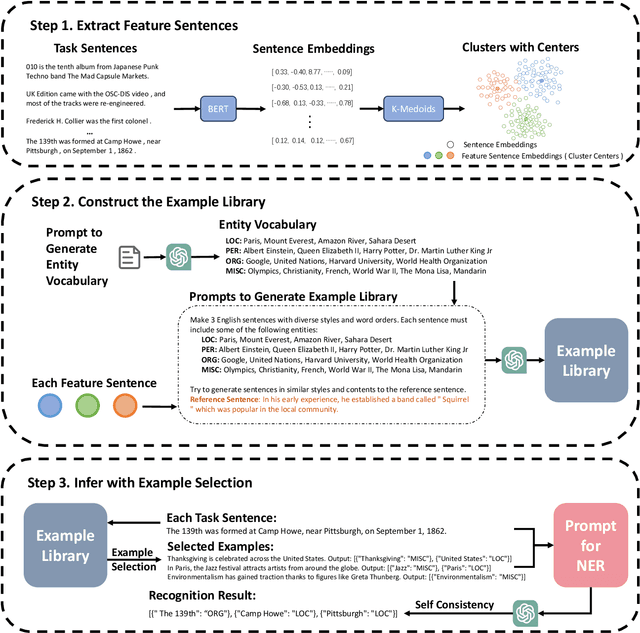

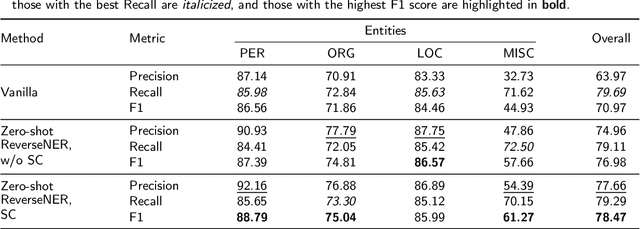
This paper presents ReverseNER, a framework aimed at overcoming the limitations of large language models (LLMs) in zero-shot Named Entity Recognition (NER) tasks, particularly in cases where certain entity types have ambiguous boundaries. ReverseNER tackles this challenge by constructing a reliable example library with the reversed process of NER. Rather than beginning with sentences, this method uses an LLM to generate entities based on their definitions and then expands them into full sentences. During sentence generation, the LLM is guided to replicate the structure of a specific 'feature sentence', extracted from the task sentences by clustering. This results in well-annotated sentences with clearly labeled entities, while preserving semantic and structural similarity to the task sentences. Once the example library is constructed, the method selects the most semantically similar example labels for each task sentence to support the LLM's inference. We also propose an entity-level self-consistency scoring mechanism to improve NER performance with LLMs. Experiments show that ReverseNER significantly outperforms traditional zero-shot NER with LLMs and surpasses several few-shot methods, marking a notable improvement in NER for domains with limited labeled data.
Maximising Quantum-Computing Expressive Power through Randomised Circuits
Dec 04, 2023In the noisy intermediate-scale quantum era, variational quantum algorithms (VQAs) have emerged as a promising avenue to obtain quantum advantage. However, the success of VQAs depends on the expressive power of parameterised quantum circuits, which is constrained by the limited gate number and the presence of barren plateaus. In this work, we propose and numerically demonstrate a novel approach for VQAs, utilizing randomised quantum circuits to generate the variational wavefunction. We parameterize the distribution function of these random circuits using artificial neural networks and optimize it to find the solution. This random-circuit approach presents a trade-off between the expressive power of the variational wavefunction and time cost, in terms of the sampling cost of quantum circuits. Given a fixed gate number, we can systematically increase the expressive power by extending the quantum-computing time. With a sufficiently large permissible time cost, the variational wavefunction can approximate any quantum state with arbitrary accuracy. Furthermore, we establish explicit relationships between expressive power, time cost, and gate number for variational quantum eigensolvers. These results highlight the promising potential of the random-circuit approach in achieving a high expressive power in quantum computing.