 Add to Chrome
 Add to Firefox
 Add to Edge
RealisticTritonBench: A Benchmark for Triton-Kernel Generation in Real-World AI Frameworks
Aug 12, 2026
In modern AI frameworks, GPU kernels are key to overall system performance. Combining usability, portability, and near-handwritten CUDA performance, Triton is widely adopted for implementing GPU kernels. Recent advances show the potential of large language models (LLMs) to automatically generate Triton kernels, reducing the manual effort required from expert kernel developers. Several benchmarks evaluate LLM-generated Triton kernels. However, they suffer from three key limitations: (1) they restrict tasks to PyTorch-to-Triton translation, failing to reflect the diversity and complexity of real-world Triton tasks; (2) they evaluate only individual-kernel performance rather than end-to-end performance, the core criterion for real-world deployment in AI frameworks; and (3) they rely on manually written evaluation scripts for individual kernels, which may contain flaws that models can exploit to bypass correctness checks and obtain inflated scores. To address these limitations, we introduce RealisticTritonBench, the first benchmark to derive Triton kernel generation tasks from real-world pull requests in popular AI frameworks, enabling realistic, production-like evaluation. RealisticTritonBench systematically extracts PRs that modify Triton kernels from popular open-source AI frameworks and transforms them into generation tasks with concrete engineering contexts. Each task takes a natural language requirement as input and requires a corresponding Triton kernel implementation, with a complete and reproducible evaluation environment. Unlike prior benchmarks focused on isolated kernel performance, RealisticTritonBench integrates generated kernels into their original frameworks and evaluates them using end-to-end tests, enabling a more faithful assessment. We evaluate leading LLMs on RealisticTritonBench and find that they still struggle with real-world Triton kernel generation tasks.

Effective and Efficient Context Retrieval via Partial Dependency Graph for Repository-Level Code Generation
Aug 03, 2026LLM-based repository-level code generation aims to generate code using the context available in a software repository, requiring LLMs to reason over complex code dependencies. Due to limited context windows and insufficient repository-specific understanding, LLMs typically rely on retrieval-augmented generation (RAG) to incorporate relevant code. Early RAG approaches primarily employ similarity-based retrieval, which often fails to retrieve code snippets that the target function depends on. Recent work introduces graph-based retrieval to model such dependencies, but typically relies on manually designed rules and static global graphs, leading to limited flexibility and high construction and maintenance costs. In contrast, human developers collect helpful context by implicitly constructing a partial dependency graph and iteratively inspecting along it. Inspired by this behavior, we propose DyRetriever, an efficient context retrieval method via partial dependency graphs. DyRetriever uses an LLM to first select a set of entry-point functions and then perform multi-hop reasoning along the code dependency graph. During multi-hop reasoning, it uses the LLM's semantic understanding to validate whether a function can help generate the target function, eliminating manually designed rules and enabling flexibility across scenarios. Instead of statically constructing a global dependency graph, DyRetriever builds a partial graph on demand and discards it after use, reducing construction and maintenance costs. We integrate DyRetriever with a similarity-based code retriever to build DyCoder and evaluate it on CoderEval and DevEval. Experimental results show that DyCoder achieves relative Pass@1 improvements of 25.63% and 59.73% on CoderEval and DevEval, respectively, compared with existing RAG-based methods, while being 7.4x faster than baselines based on static dependency graph construction.
SynH-Rank: Quality-Aware Code Search via Diverse Data Synthesis and Hierarchical Ranking Training
Jul 19, 2026Code search enhances developer productivity by enabling efficient code reuse. Current code search systems often use a retrieve-then-rerank pipeline, where rerankers focus on modeling semantic relevance between queries and code. However, these rerankers overlook critical non-functional qualities like execution speed, memory usage, and maintainability, which are essential for practical software development. Studies reveal developers expect results to maintain high coding standards and satisfy specific needs, such as resource optimization, highlighting the importance of quality-aware code search. Achieving quality-aware code search faces two major challenges: the scarcity of quality-annotated datasets for effective training and the limitations of standard contrastive learning objectives, which fail to capture the ordinal relationships among high-quality, low-quality, and irrelevant code. Although contrastive learning excels in distinguishing relevant from irrelevant code, its binary objective does not support nuanced quality distinctions.To address these challenges, we propose SynH-Rank, a quality-aware code reranking framework that combines LLM-driven diverse data synthesis with hierarchical ranking training. SynH-Rank employs a three-level labeling scheme to explicitly model the hierarchy: high-quality relevant > low-quality relevant > irrelevant. Additionally, we introduce a new benchmark with 4,209 pairs and two novel metrics: Quality Preference Accuracy (QPA) for assessing prioritization of high-quality code and Multi-Condition Accuracy (MCA) for evaluating performance under complex constraints.Experimental results show SynH-Rank improves QPA by 20.15\% over backbone models and outperforms standard relevance-only contrastive training by 15.80\%, while simultaneously enhancing traditional relevance metrics and multi-condition generalizability.
Inside the Skill Market: From Software Engineering Activities to Reusable Agent Skills
Jul 10, 2026Software engineering (abbrev. SE) has continuously evolved through increasingly powerful forms of reuse, from source code and libraries to components and services. Recent advances in AI agents have introduced a potentially new reusable artifact: skills. Emerging agent skill repositories and marketplaces enable developers to package, share, and reuse SE expertise as reusable skills. This trend raises a fundamental question: what SE activities are being encapsulated into reusable skills? Existing studies primarily focus on a broad range of skills acquisition, safety, or benchmarking, while lacking a systematic understanding of SE-specific skills and their coverage across the software development lifecycle. To address this gap, we conduct the first large-scale empirical study of SE skills in public repositories and marketplaces. We collect and analyze a large corpus of SE skills, examining the activities they encapsulate, lifecycle coverage, evolution characteristics, and evaluation mechanisms. Our findings reveal that SE activities are increasingly becoming reusable artifacts via skills and suggest promising research opportunities for skill recommendation and engineering-oriented structuring, as well as the need for mechanisms to encapsulate high-context SE activities into reusable skills. Overall, our study provides the first activity-centric characterization of SE skills and reveals how SE activities are increasingly being transformed into reusable skills. These findings offer new insights into skill reuse, ecosystem development, and the future of agent-centric SE.
DeepGuard: Secure Code Generation via Multi-Layer Semantic Aggregation
Apr 10, 2026Large Language Models (LLMs) for code generation can replicate insecure patterns from their training data. To mitigate this, a common strategy for security hardening is to fine-tune models using supervision derived from the final transformer layer. However, this design may suffer from a final-layer bottleneck: vulnerability-discriminative cues can be distributed across layers and become less detectable near the output representations optimized for next-token prediction. To diagnose this issue, we perform layer-wise linear probing. We observe that vulnerability-related signals are most detectable in a band of intermediate-to-upper layers yet attenuate toward the final layers. Motivated by this observation, we introduce DeepGuard, a framework that leverages distributed security-relevant cues by aggregating representations from multiple upper layers via an attention-based module. The aggregated signal powers a dedicated security analyzer within a multi-objective training objective that balances security enhancement and functional correctness, and further supports a lightweight inference-time steering strategy. Extensive experiments across five code LLMs demonstrate that DeepGuard improves the secure-and-correct generation rate by an average of 11.9% over strong baselines such as SVEN. It also preserves functional correctness while exhibiting generalization to held-out vulnerability types. Our code is public at https://github.com/unknownhl/DeepGuard.
Agentic Software Issue Resolution with Large Language Models: A Survey
Dec 24, 2025Software issue resolution aims to address real-world issues in software repositories (e.g., bug fixing and efficiency optimization) based on natural language descriptions provided by users, representing a key aspect of software maintenance. With the rapid development of large language models (LLMs) in reasoning and generative capabilities, LLM-based approaches have made significant progress in automated software issue resolution. However, real-world software issue resolution is inherently complex and requires long-horizon reasoning, iterative exploration, and feedback-driven decision making, which demand agentic capabilities beyond conventional single-step approaches. Recently, LLM-based agentic systems have become mainstream for software issue resolution. Advancements in agentic software issue resolution not only greatly enhance software maintenance efficiency and quality but also provide a realistic environment for validating agentic systems' reasoning, planning, and execution capabilities, bridging artificial intelligence and software engineering. This work presents a systematic survey of 126 recent studies at the forefront of LLM-based agentic software issue resolution research. It outlines the general workflow of the task and establishes a taxonomy across three dimensions: benchmarks, techniques, and empirical studies. Furthermore, it highlights how the emergence of agentic reinforcement learning has brought a paradigm shift in the design and training of agentic systems for software engineering. Finally, it summarizes key challenges and outlines promising directions for future research.
Intention Chain-of-Thought Prompting with Dynamic Routing for Code Generation
Dec 16, 2025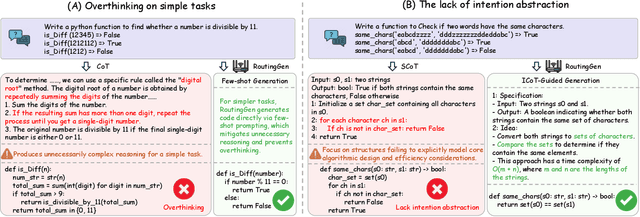
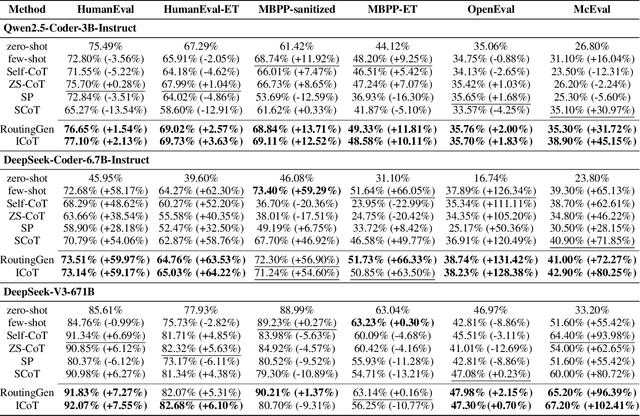
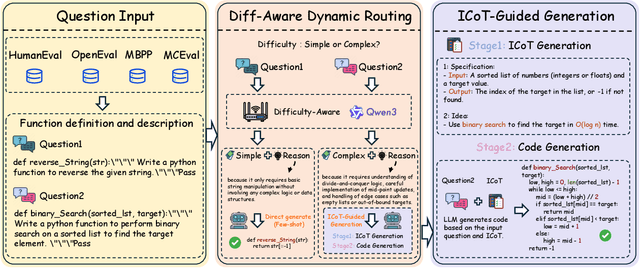
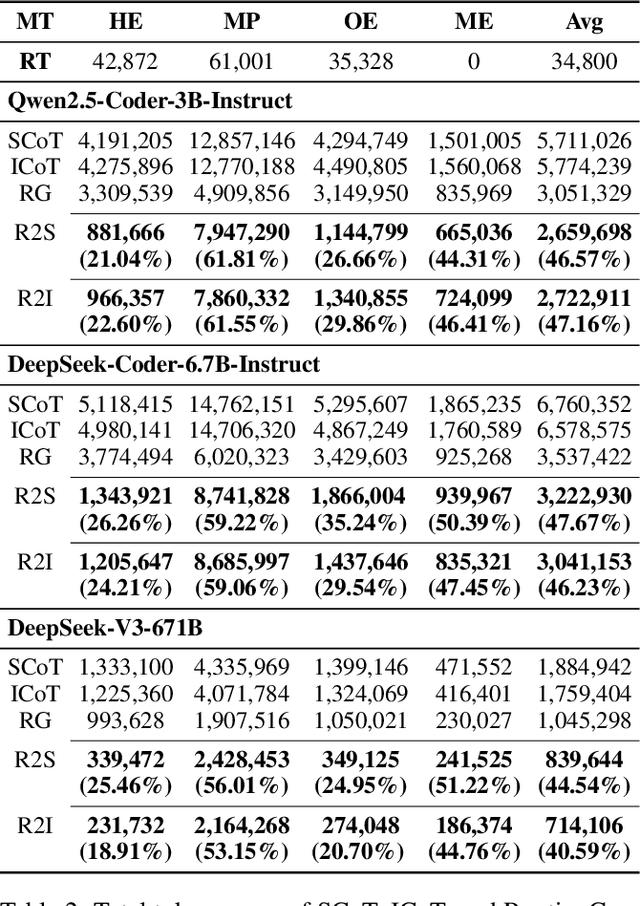
Large language models (LLMs) exhibit strong generative capabilities and have shown great potential in code generation. Existing chain-of-thought (CoT) prompting methods enhance model reasoning by eliciting intermediate steps, but suffer from two major limitations: First, their uniform application tends to induce overthinking on simple tasks. Second, they lack intention abstraction in code generation, such as explicitly modeling core algorithmic design and efficiency, leading models to focus on surface-level structures while neglecting the global problem objective. Inspired by the cognitive economy principle of engaging structured reasoning only when necessary to conserve cognitive resources, we propose RoutingGen, a novel difficulty-aware routing framework that dynamically adapts prompting strategies for code generation. For simple tasks, it adopts few-shot prompting; for more complex ones, it invokes a structured reasoning strategy, termed Intention Chain-of-Thought (ICoT), which we introduce to guide the model in capturing task intention, such as the core algorithmic logic and its time complexity. Experiments across three models and six standard code generation benchmarks show that RoutingGen achieves state-of-the-art performance in most settings, while reducing total token usage by 46.37% on average across settings. Furthermore, ICoT outperforms six existing prompting baselines on challenging benchmarks.
Posterior-GRPO: Rewarding Reasoning Processes in Code Generation
Aug 07, 2025Reinforcement learning (RL) has significantly advanced code generation for large language models (LLMs). However, current paradigms rely on outcome-based rewards from test cases, neglecting the quality of the intermediate reasoning process. While supervising the reasoning process directly is a promising direction, it is highly susceptible to reward hacking, where the policy model learns to exploit the reasoning reward signal without improving final outcomes. To address this, we introduce a unified framework that can effectively incorporate the quality of the reasoning process during RL. First, to enable reasoning evaluation, we develop LCB-RB, a benchmark comprising preference pairs of superior and inferior reasoning processes. Second, to accurately score reasoning quality, we introduce an Optimized-Degraded based (OD-based) method for reward model training. This method generates high-quality preference pairs by systematically optimizing and degrading initial reasoning paths along curated dimensions of reasoning quality, such as factual accuracy, logical rigor, and coherence. A 7B parameter reward model with this method achieves state-of-the-art (SOTA) performance on LCB-RB and generalizes well to other benchmarks. Finally, we introduce Posterior-GRPO (P-GRPO), a novel RL method that conditions process-based rewards on task success. By selectively applying rewards to the reasoning processes of only successful outcomes, P-GRPO effectively mitigates reward hacking and aligns the model's internal reasoning with final code correctness. A 7B parameter model with P-GRPO achieves superior performance across diverse code generation tasks, outperforming outcome-only baselines by 4.5%, achieving comparable performance to GPT-4-Turbo. We further demonstrate the generalizability of our approach by extending it to mathematical tasks. Our models, dataset, and code are publicly available.
Enhancing Project-Specific Code Completion by Inferring Internal API Information
Jul 28, 2025Project-specific code completion is a critical task that leverages context from a project to generate accurate code. State-of-the-art methods use retrieval-augmented generation (RAG) with large language models (LLMs) and project information for code completion. However, they often struggle to incorporate internal API information, which is crucial for accuracy, especially when APIs are not explicitly imported in the file. To address this, we propose a method to infer internal API information without relying on imports. Our method extends the representation of APIs by constructing usage examples and semantic descriptions, building a knowledge base for LLMs to generate relevant completions. We also introduce ProjBench, a benchmark that avoids leaked imports and consists of large-scale real-world projects. Experiments on ProjBench and CrossCodeEval show that our approach significantly outperforms existing methods, improving code exact match by 22.72% and identifier exact match by 18.31%. Additionally, integrating our method with existing baselines boosts code match by 47.80% and identifier match by 35.55%.
Parallel Scaling Law for Language Models
May 15, 2025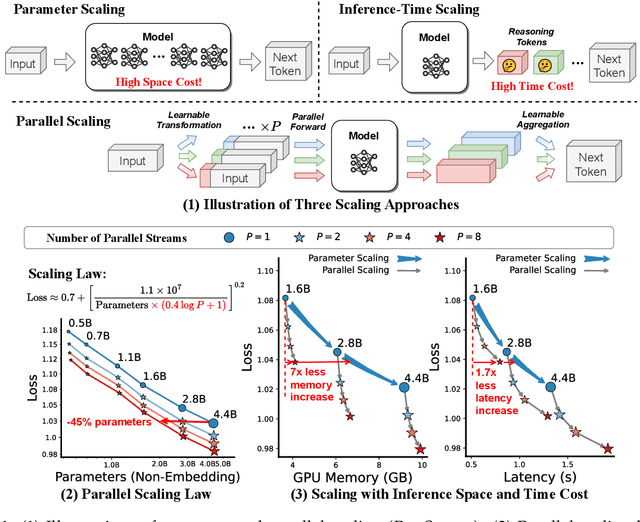

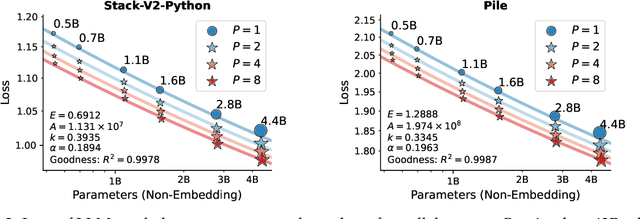

It is commonly believed that scaling language models should commit a significant space or time cost, by increasing the parameters (parameter scaling) or output tokens (inference-time scaling). We introduce the third and more inference-efficient scaling paradigm: increasing the model's parallel computation during both training and inference time. We apply $P$ diverse and learnable transformations to the input, execute forward passes of the model in parallel, and dynamically aggregate the $P$ outputs. This method, namely parallel scaling (ParScale), scales parallel computation by reusing existing parameters and can be applied to any model structure, optimization procedure, data, or task. We theoretically propose a new scaling law and validate it through large-scale pre-training, which shows that a model with $P$ parallel streams is similar to scaling the parameters by $O(\log P)$ while showing superior inference efficiency. For example, ParScale can use up to 22$\times$ less memory increase and 6$\times$ less latency increase compared to parameter scaling that achieves the same performance improvement. It can also recycle an off-the-shelf pre-trained model into a parallelly scaled one by post-training on a small amount of tokens, further reducing the training budget. The new scaling law we discovered potentially facilitates the deployment of more powerful models in low-resource scenarios, and provides an alternative perspective for the role of computation in machine learning.