 Add to Chrome
 Add to Firefox
 Add to Edge
Monkey King Bang: A Unified Scientific Multimodal Foundation Model
Jul 17, 2026
Scientific discovery is increasingly shifting from isolated disciplines to multi-domain reasoning, and AI for science faces a similar transition. Existing systems are either specialised for individual domains or unify scientific data mainly through text tokenisation and prompt-based interfaces, limiting their ability to handle diverse scientific inputs, produce modality-native outputs, and support joint understanding, reasoning, and generation across scientific domains. We introduce MKB, a unified scientific multimodal model for both understanding and generation, built around a shared Transformer backbone and modality-tailored encoders, adapters, and decoders. MKB covers six scientific branches, including DNA, RNA, proteins, small molecules, earth science, and medical images, and supports native outputs such as biological sequences, molecular strings, meteorological fields, and segmentation masks. Training follows a two-stage modality-then-language curriculum: Stage 1 aligns modality-specific components with the frozen backbone, and Stage 2 consolidates them with the language backbone using mixed scientific and general corpora. Experiments show that MKB achieves competitive scientific understanding across biological and molecular benchmarks, produces high-fidelity native outputs for weather forecasting, biological generation, and medical-image segmentation, and largely retains the general capabilities of its Qwen3-VL backbone. These results demonstrate the feasibility of the proposed paradigm, suggesting that shared-backbone models with modality-tailored components can provide a promising foundation for future cross-domain scientific multimodal exploration. The model and code are publicly available at https://github.com/Shanghai-Academy-of-AI-For-Science/MKB and https://huggingface.co/sais-org/MKB.

PAST: A multimodal single-cell foundation model for histopathology and spatial transcriptomics in cancer
Jul 08, 2025While pathology foundation models have transformed cancer image analysis, they often lack integration with molecular data at single-cell resolution, limiting their utility for precision oncology. Here, we present PAST, a pan-cancer single-cell foundation model trained on 20 million paired histopathology images and single-cell transcriptomes spanning multiple tumor types and tissue contexts. By jointly encoding cellular morphology and gene expression, PAST learns unified cross-modal representations that capture both spatial and molecular heterogeneity at the cellular level. This approach enables accurate prediction of single-cell gene expression, virtual molecular staining, and multimodal survival analysis directly from routine pathology slides. Across diverse cancers and downstream tasks, PAST consistently exceeds the performance of existing approaches, demonstrating robust generalizability and scalability. Our work establishes a new paradigm for pathology foundation models, providing a versatile tool for high-resolution spatial omics, mechanistic discovery, and precision cancer research.
Fast on the Easy, Deep on the Hard: Efficient Reasoning via Powered Length Penalty
Jun 12, 2025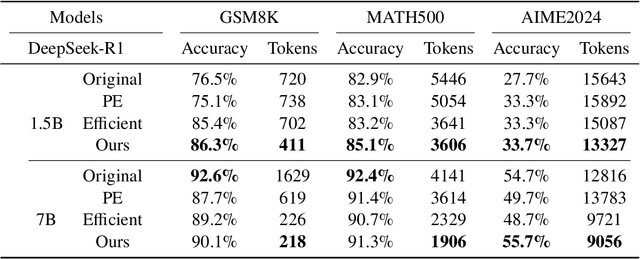
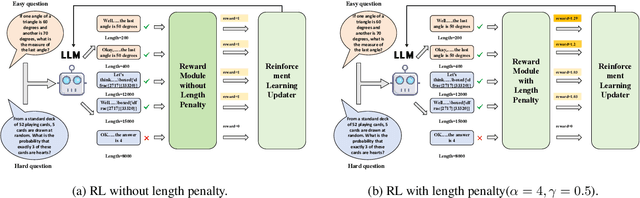
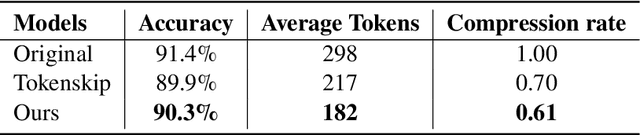
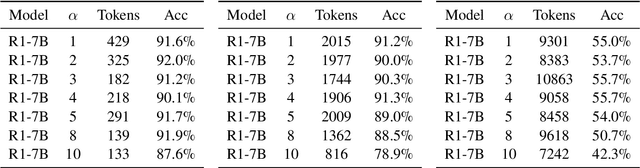
Large language models (LLMs) have demonstrated significant advancements in reasoning capabilities, performing well on various challenging benchmarks. Techniques like Chain-of-Thought prompting have been introduced to further improve reasoning. However, these approaches frequently generate longer outputs, which in turn increase computational latency. Although some methods use reinforcement learning to shorten reasoning, they often apply uniform penalties without considering the problem's complexity, leading to suboptimal outcomes. In this study, we seek to enhance the efficiency of LLM reasoning by promoting conciseness for simpler problems while preserving sufficient reasoning for more complex ones for accuracy, thus improving the model's overall performance. Specifically, we manage the model's reasoning efficiency by dividing the reward function and including a novel penalty for output length. Our approach has yielded impressive outcomes in benchmark evaluations across three datasets: GSM8K, MATH500, and AIME2024. For the comparatively simpler datasets GSM8K and MATH500, our method has effectively shortened output lengths while preserving or enhancing accuracy. On the more demanding AIME2024 dataset, our approach has resulted in improved accuracy.
ChromFound: Towards A Universal Foundation Model for Single-Cell Chromatin Accessibility Data
May 19, 2025The advent of single-cell Assay for Transposase-Accessible Chromatin using sequencing (scATAC-seq) offers an innovative perspective for deciphering regulatory mechanisms by assembling a vast repository of single-cell chromatin accessibility data. While foundation models have achieved significant success in single-cell transcriptomics, there is currently no foundation model for scATAC-seq that supports zero-shot high-quality cell identification and comprehensive multi-omics analysis simultaneously. Key challenges lie in the high dimensionality and sparsity of scATAC-seq data, as well as the lack of a standardized schema for representing open chromatin regions (OCRs). Here, we present \textbf{ChromFound}, a foundation model tailored for scATAC-seq. ChromFound utilizes a hybrid architecture and genome-aware tokenization to effectively capture genome-wide long contexts and regulatory signals from dynamic chromatin landscapes. Pretrained on 1.97 million cells from 30 tissues and 6 disease conditions, ChromFound demonstrates broad applicability across 6 diverse tasks. Notably, it achieves robust zero-shot performance in generating universal cell representations and exhibits excellent transferability in cell type annotation and cross-omics prediction. By uncovering enhancer-gene links undetected by existing computational methods, ChromFound offers a promising framework for understanding disease risk variants in the noncoding genome.