 Add to Chrome
 Add to Firefox
 Add to Edge
Relocation of compact sets in $\mathbb{R}^n$ by diffeomorphisms and linear separability of datasets in $\mathbb{R}^n$
Apr 23, 2026
Relocation of compact sets in an $n$-dimensional manifold by self-diffeomorphism is of its own interest as well as significant potential applications to data classification in data science. This paper presents a theory for relocating a finite number of compact sets in $\mathbb{R}^n$ to be relocated to arbitrary target domains in $\mathbb{R}^n$ by diffeomorphisms of $\mathbb{R}^n$. Furthermore, we prove that for any such collection, there exists a differentiable embedding into $\mathbb{R}^{n+1}$ such that their images become linearly separable. As applications of the established theory, we show that a finite number of compact datasets in $\mathbb{R}^n$ can be made linearly separable by width-$n$ deep neural networks (DNNs) with Leaky-ReLU, ELU, or SELU activation functions, under a mild condition. In addition, we show that any finite number of mutually disjoint compact datasets in $\mathbb{R}^n$ can be made linearly separable in $\mathbb{R}^{n+1}$ by a width-$(n+1)$ DNN.

Minimum Width of Deep Narrow Networks for Universal Approximation
Nov 10, 2025Determining the minimum width of fully connected neural networks has become a fundamental problem in recent theoretical studies of deep neural networks. In this paper, we study the lower bounds and upper bounds of the minimum width required for fully connected neural networks in order to have universal approximation capability, which is important in network design and training. We show that $w_{min}\leq\max(2d_x+1, d_y)$ for networks with ELU, SELU, and the upper bound of this inequality is attained when $d_y=2d_x$, where $d_x$, $d_y$ denote the input and output dimensions, respectively. Besides, we show that $d_x+1\leq w_{min}\leq d_x+d_y$ for networks with LeakyReLU, ELU, CELU, SELU, Softplus, by proving that ReLU can be approximated by these activation functions. In addition, in the case that the activation function is injective or can be uniformly approximated by a sequence of injective functions (e.g., ReLU), we present a new proof of the inequality $w_{min}\ge d_y+\mathbf{1}_{d_x<d_y\leq2d_x}$ by constructing a more intuitive example via a new geometric approach based on Poincar$\acute{\text{e}}$-Miranda Theorem.
Dimensionality reduction and width of deep neural networks based on topological degree theory
Nov 10, 2025In this paper we present a mathematical framework on linking of embeddings of compact topological spaces into Euclidean spaces and separability of linked embeddings under a specific class of dimension reduction maps. As applications of the established theory, we provide some fascinating insights into classification and approximation problems in deep learning theory in the setting of deep neural networks.
An RRT* algorithm based on Riemannian metric model for optimal path planning
Jul 02, 2025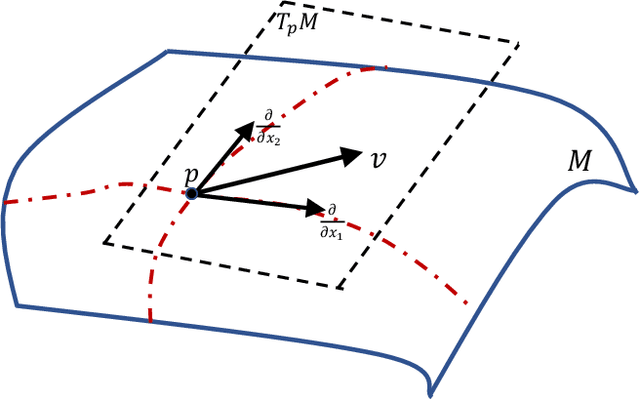
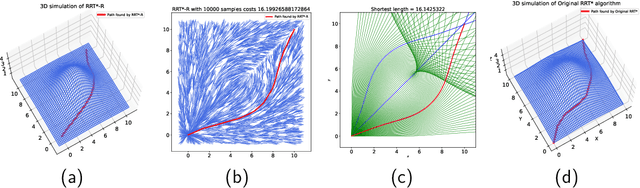
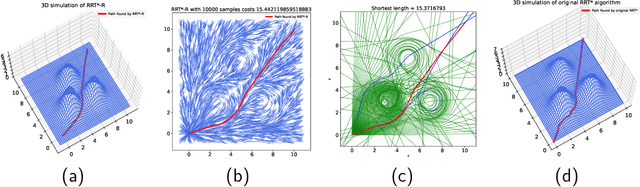
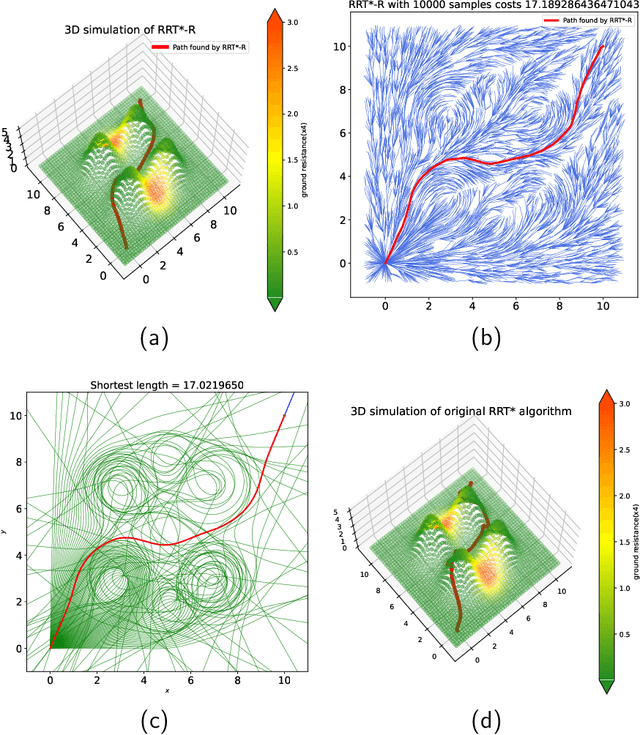
This paper presents a Riemannian metric-based model to solve the optimal path planning problem on two-dimensional smooth submanifolds in high-dimensional space. Our model is based on constructing a new Riemannian metric on a two-dimensional projection plane, which is induced by the high-dimensional Euclidean metric on two-dimensional smooth submanifold and reflects the environmental information of the robot. The optimal path planning problem in high-dimensional space is therefore transformed into a geometric problem on the two-dimensional plane with new Riemannian metric. Based on the new Riemannian metric, we proposed an incremental algorithm RRT*-R on the projection plane. The experimental results show that the proposed algorithm is suitable for scenarios with uneven fields in multiple dimensions. The proposed algorithm can help the robot to effectively avoid areas with drastic changes in height, ground resistance and other environmental factors. More importantly, the RRT*-R algorithm shows better smoothness and optimization properties compared with the original RRT* algorithm using Euclidean distance in high-dimensional workspace. The length of the entire path by RRT*-R is a good approximation of the theoretical minimum geodesic distance on projection plane.