 Add to Chrome
 Add to Firefox
 Add to Edge
FusionANNS: An Efficient CPU/GPU Cooperative Processing Architecture for Billion-scale Approximate Nearest Neighbor Search
Sep 25, 2024
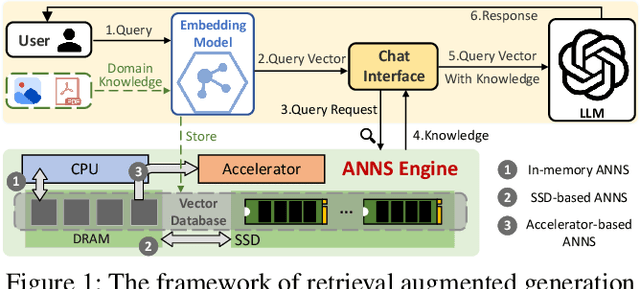
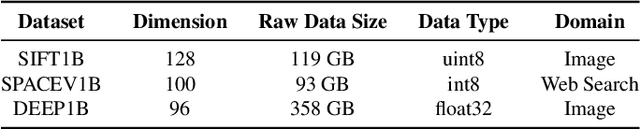
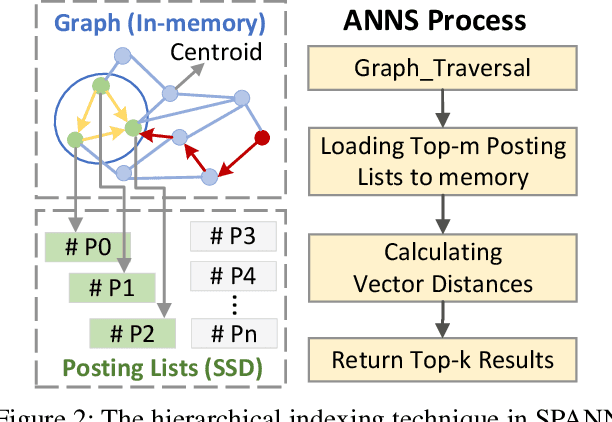
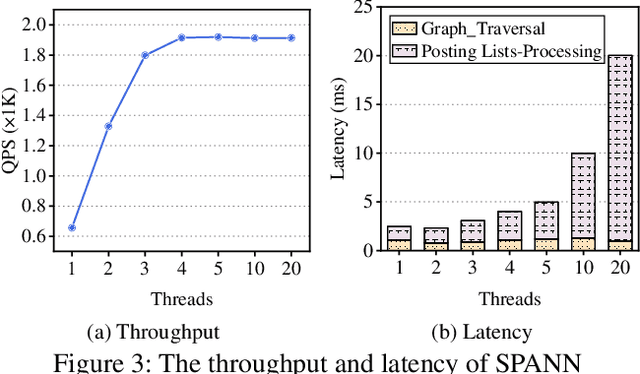
Approximate nearest neighbor search (ANNS) has emerged as a crucial component of database and AI infrastructure. Ever-increasing vector datasets pose significant challenges in terms of performance, cost, and accuracy for ANNS services. None of modern ANNS systems can address these issues simultaneously. We present FusionANNS, a high-throughput, low-latency, cost-efficient, and high-accuracy ANNS system for billion-scale datasets using SSDs and only one entry-level GPU. The key idea of FusionANNS lies in CPU/GPU collaborative filtering and re-ranking mechanisms, which significantly reduce I/O operations across CPUs, GPU, and SSDs to break through the I/O performance bottleneck. Specifically, we propose three novel designs: (1) multi-tiered indexing to avoid data swapping between CPUs and GPU, (2) heuristic re-ranking to eliminate unnecessary I/Os and computations while guaranteeing high accuracy, and (3) redundant-aware I/O deduplication to further improve I/O efficiency. We implement FusionANNS and compare it with the state-of-the-art SSD-based ANNS system--SPANN and GPU-accelerated in-memory ANNS system--RUMMY. Experimental results show that FusionANNS achieves 1) 9.4-13.1X higher query per second (QPS) and 5.7-8.8X higher cost efficiency compared with SPANN; 2) and 2-4.9X higher QPS and 2.3-6.8X higher cost efficiency compared with RUMMY, while guaranteeing low latency and high accuracy.

Brain-Cognition Fingerprinting via Graph-GCCA with Contrastive Learning
Sep 20, 2024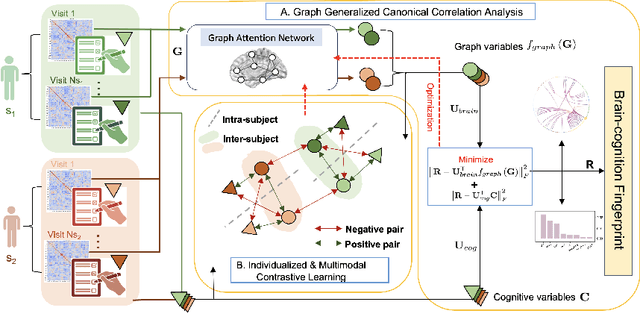
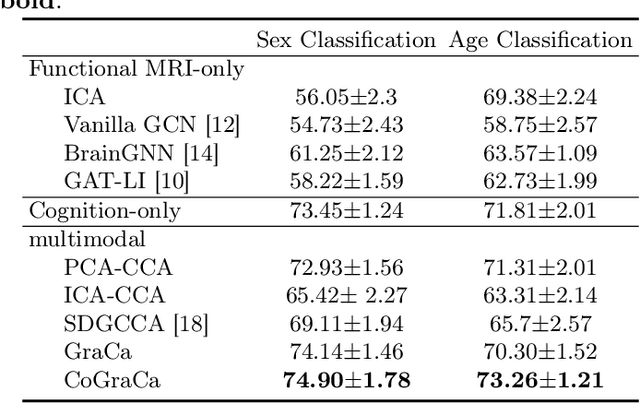
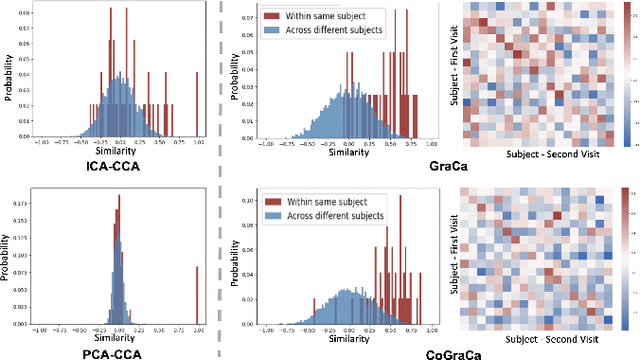
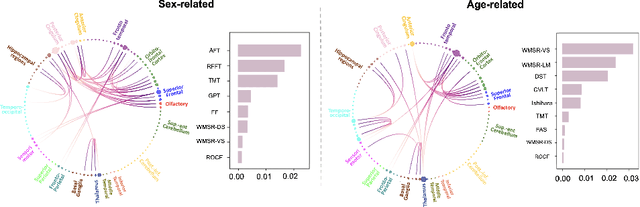
Many longitudinal neuroimaging studies aim to improve the understanding of brain aging and diseases by studying the dynamic interactions between brain function and cognition. Doing so requires accurate encoding of their multidimensional relationship while accounting for individual variability over time. For this purpose, we propose an unsupervised learning model (called \underline{\textbf{Co}}ntrastive Learning-based \underline{\textbf{Gra}}ph Generalized \underline{\textbf{Ca}}nonical Correlation Analysis (CoGraCa)) that encodes their relationship via Graph Attention Networks and generalized Canonical Correlational Analysis. To create brain-cognition fingerprints reflecting unique neural and cognitive phenotype of each person, the model also relies on individualized and multimodal contrastive learning. We apply CoGraCa to longitudinal dataset of healthy individuals consisting of resting-state functional MRI and cognitive measures acquired at multiple visits for each participant. The generated fingerprints effectively capture significant individual differences and outperform current single-modal and CCA-based multimodal models in identifying sex and age. More importantly, our encoding provides interpretable interactions between those two modalities.
Efficient Low-Resolution Face Recognition via Bridge Distillation
Sep 18, 2024Face recognition in the wild is now advancing towards light-weight models, fast inference speed and resolution-adapted capability. In this paper, we propose a bridge distillation approach to turn a complex face model pretrained on private high-resolution faces into a light-weight one for low-resolution face recognition. In our approach, such a cross-dataset resolution-adapted knowledge transfer problem is solved via two-step distillation. In the first step, we conduct cross-dataset distillation to transfer the prior knowledge from private high-resolution faces to public high-resolution faces and generate compact and discriminative features. In the second step, the resolution-adapted distillation is conducted to further transfer the prior knowledge to synthetic low-resolution faces via multi-task learning. By learning low-resolution face representations and mimicking the adapted high-resolution knowledge, a light-weight student model can be constructed with high efficiency and promising accuracy in recognizing low-resolution faces. Experimental results show that the student model performs impressively in recognizing low-resolution faces with only 0.21M parameters and 0.057MB memory. Meanwhile, its speed reaches up to 14,705, ~934 and 763 faces per second on GPU, CPU and mobile phone, respectively.
* This paper is published in IEEE TIP 2020
Evaluating the Quality of Brain MRI Generators
Sep 13, 2024Deep learning models generating structural brain MRIs have the potential to significantly accelerate discovery of neuroscience studies. However, their use has been limited in part by the way their quality is evaluated. Most evaluations of generative models focus on metrics originally designed for natural images (such as structural similarity index and Frechet inception distance). As we show in a comparison of 6 state-of-the-art generative models trained and tested on over 3000 MRIs, these metrics are sensitive to the experimental setup and inadequately assess how well brain MRIs capture macrostructural properties of brain regions (i.e., anatomical plausibility). This shortcoming of the metrics results in inconclusive findings even when qualitative differences between the outputs of models are evident. We therefore propose a framework for evaluating models generating brain MRIs, which requires uniform processing of the real MRIs, standardizing the implementation of the models, and automatically segmenting the MRIs generated by the models. The segmentations are used for quantifying the plausibility of anatomy displayed in the MRIs. To ensure meaningful quantification, it is crucial that the segmentations are highly reliable. Our framework rigorously checks this reliability, a step often overlooked by prior work. Only 3 of the 6 generative models produced MRIs, of which at least 95% had highly reliable segmentations. More importantly, the assessment of each model by our framework is in line with qualitative assessments, reinforcing the validity of our approach.
Gated Slot Attention for Efficient Linear-Time Sequence Modeling
Sep 11, 2024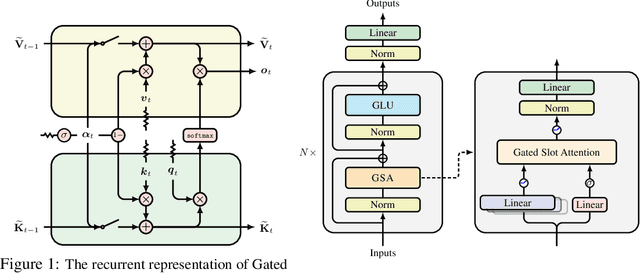


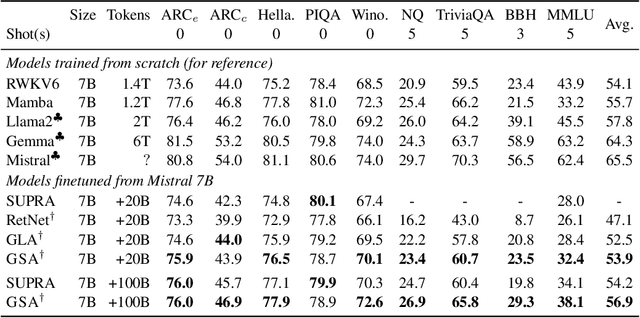
Linear attention Transformers and their gated variants, celebrated for enabling parallel training and efficient recurrent inference, still fall short in recall-intensive tasks compared to traditional Transformers and demand significant resources for training from scratch. This paper introduces Gated Slot Attention (GSA), which enhances Attention with Bounded-memory-Control (ABC) by incorporating a gating mechanism inspired by Gated Linear Attention (GLA). Essentially, GSA comprises a two-layer GLA linked via softmax, utilizing context-aware memory reading and adaptive forgetting to improve memory capacity while maintaining compact recurrent state size. This design greatly enhances both training and inference efficiency through GLA's hardware-efficient training algorithm and reduced state size. Additionally, retaining the softmax operation is particularly beneficial in "finetuning pretrained Transformers to RNNs" (T2R) settings, reducing the need for extensive training from scratch. Extensive experiments confirm GSA's superior performance in scenarios requiring in-context recall and in T2R settings.
UniLearn: Enhancing Dynamic Facial Expression Recognition through Unified Pre-Training and Fine-Tuning on Images and Videos
Sep 10, 2024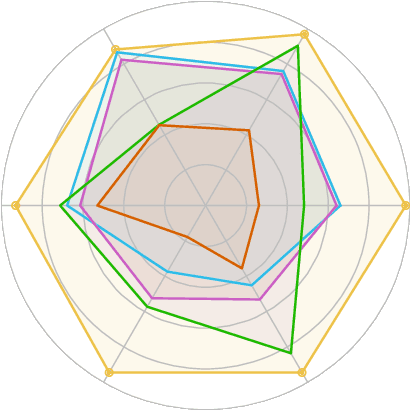
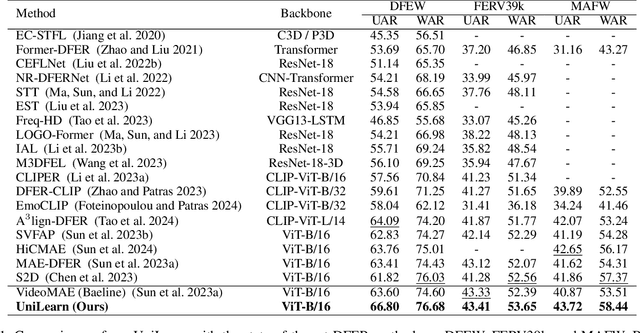
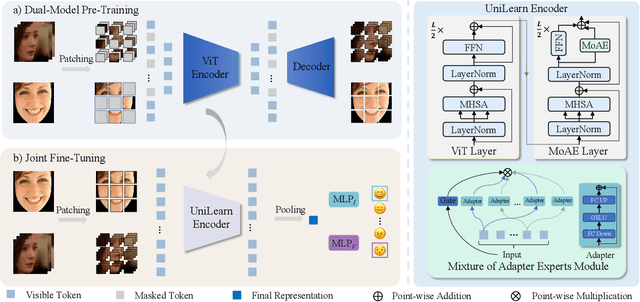
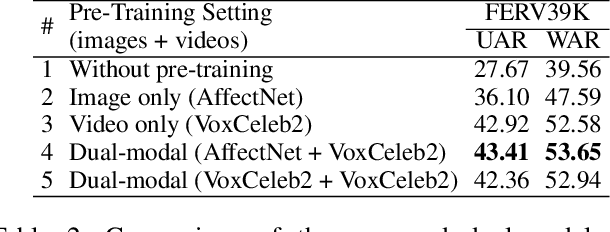
Dynamic facial expression recognition (DFER) is essential for understanding human emotions and behavior. However, conventional DFER methods, which primarily use dynamic facial data, often underutilize static expression images and their labels, limiting their performance and robustness. To overcome this, we introduce UniLearn, a novel unified learning paradigm that integrates static facial expression recognition (SFER) data to enhance DFER task. UniLearn employs a dual-modal self-supervised pre-training method, leveraging both facial expression images and videos to enhance a ViT model's spatiotemporal representation capability. Then, the pre-trained model is fine-tuned on both static and dynamic expression datasets using a joint fine-tuning strategy. To prevent negative transfer during joint fine-tuning, we introduce an innovative Mixture of Adapter Experts (MoAE) module that enables task-specific knowledge acquisition and effectively integrates information from both static and dynamic expression data. Extensive experiments demonstrate UniLearn's effectiveness in leveraging complementary information from static and dynamic facial data, leading to more accurate and robust DFER. UniLearn consistently achieves state-of-the-art performance on FERV39K, MAFW, and DFEW benchmarks, with weighted average recall (WAR) of 53.65\%, 58.44\%, and 76.68\%, respectively. The source code and model weights will be publicly available at \url{https://github.com/MSA-LMC/UniLearn}.
From MOOC to MAIC: Reshaping Online Teaching and Learning through LLM-driven Agents
Sep 05, 2024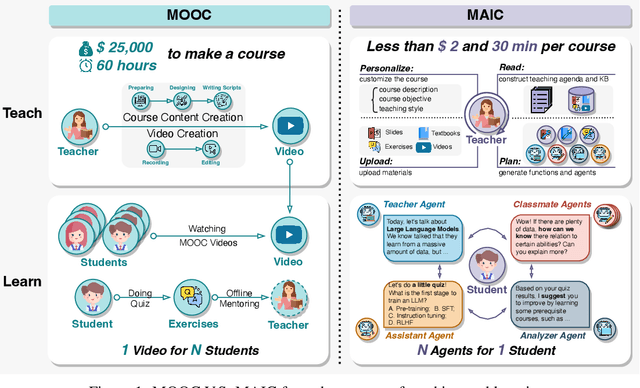
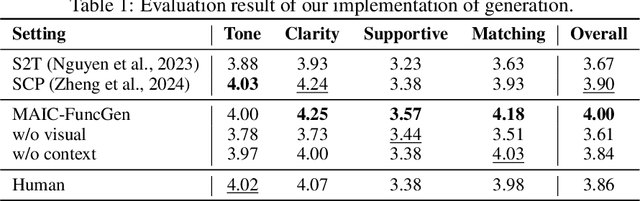
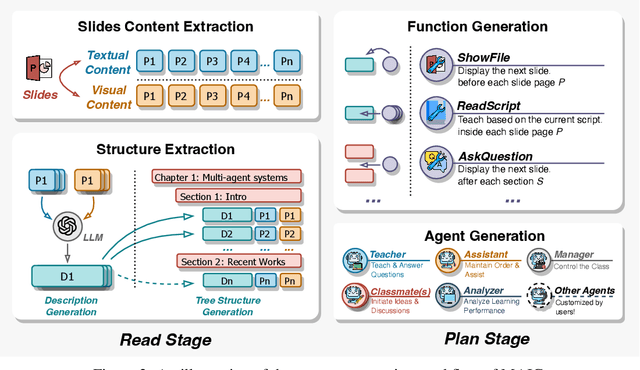
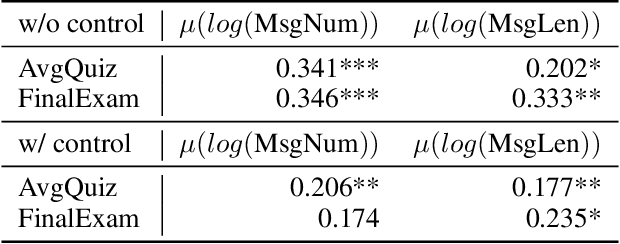
Since the first instances of online education, where courses were uploaded to accessible and shared online platforms, this form of scaling the dissemination of human knowledge to reach a broader audience has sparked extensive discussion and widespread adoption. Recognizing that personalized learning still holds significant potential for improvement, new AI technologies have been continuously integrated into this learning format, resulting in a variety of educational AI applications such as educational recommendation and intelligent tutoring. The emergence of intelligence in large language models (LLMs) has allowed for these educational enhancements to be built upon a unified foundational model, enabling deeper integration. In this context, we propose MAIC (Massive AI-empowered Course), a new form of online education that leverages LLM-driven multi-agent systems to construct an AI-augmented classroom, balancing scalability with adaptivity. Beyond exploring the conceptual framework and technical innovations, we conduct preliminary experiments at Tsinghua University, one of China's leading universities. Drawing from over 100,000 learning records of more than 500 students, we obtain a series of valuable observations and initial analyses. This project will continue to evolve, ultimately aiming to establish a comprehensive open platform that supports and unifies research, technology, and applications in exploring the possibilities of online education in the era of large model AI. We envision this platform as a collaborative hub, bringing together educators, researchers, and innovators to collectively explore the future of AI-driven online education.
LMM-VQA: Advancing Video Quality Assessment with Large Multimodal Models
Aug 26, 2024
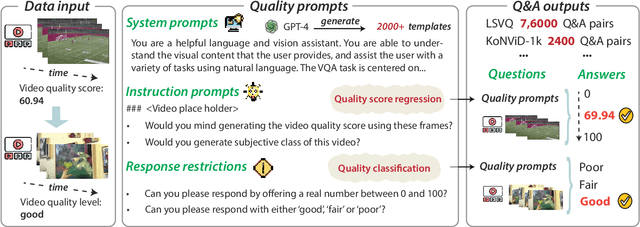
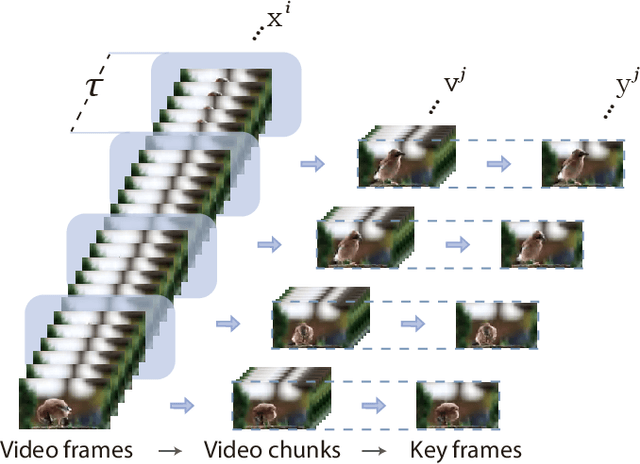
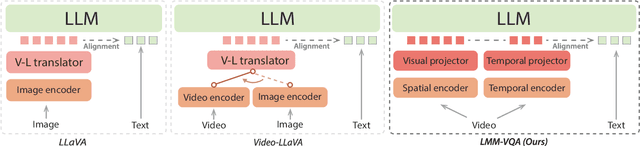
The explosive growth of videos on streaming media platforms has underscored the urgent need for effective video quality assessment (VQA) algorithms to monitor and perceptually optimize the quality of streaming videos. However, VQA remains an extremely challenging task due to the diverse video content and the complex spatial and temporal distortions, thus necessitating more advanced methods to address these issues. Nowadays, large multimodal models (LMMs), such as GPT-4V, have exhibited strong capabilities for various visual understanding tasks, motivating us to leverage the powerful multimodal representation ability of LMMs to solve the VQA task. Therefore, we propose the first Large Multi-Modal Video Quality Assessment (LMM-VQA) model, which introduces a novel spatiotemporal visual modeling strategy for quality-aware feature extraction. Specifically, we first reformulate the quality regression problem into a question and answering (Q&A) task and construct Q&A prompts for VQA instruction tuning. Then, we design a spatiotemporal vision encoder to extract spatial and temporal features to represent the quality characteristics of videos, which are subsequently mapped into the language space by the spatiotemporal projector for modality alignment. Finally, the aligned visual tokens and the quality-inquired text tokens are aggregated as inputs for the large language model (LLM) to generate the quality score and level. Extensive experiments demonstrate that LMM-VQA achieves state-of-the-art performance across five VQA benchmarks, exhibiting an average improvement of $5\%$ in generalization ability over existing methods. Furthermore, due to the advanced design of the spatiotemporal encoder and projector, LMM-VQA also performs exceptionally well on general video understanding tasks, further validating its effectiveness. Our code will be released at https://github.com/Sueqk/LMM-VQA.
Nemesis: Normalizing the Soft-prompt Vectors of Vision-Language Models
Aug 26, 2024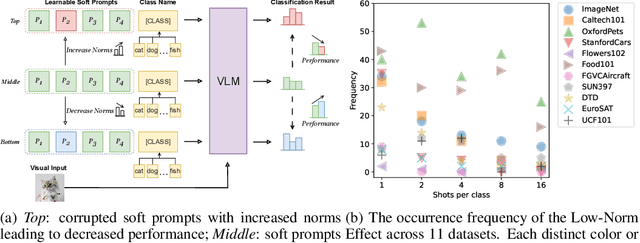
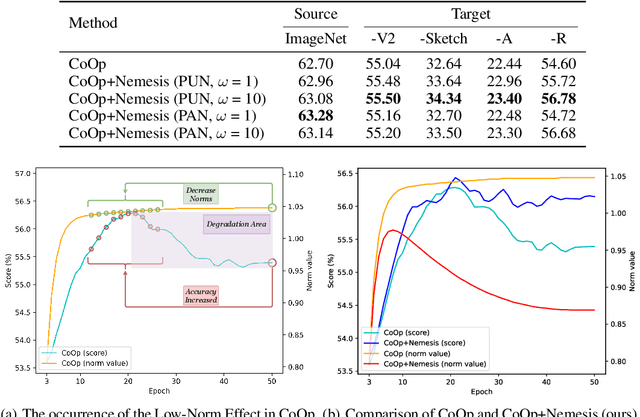
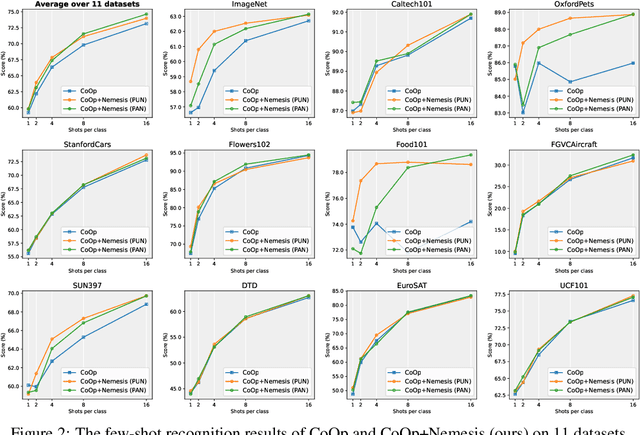
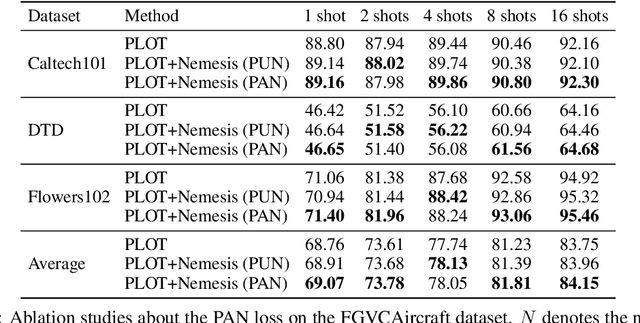
With the prevalence of large-scale pretrained vision-language models (VLMs), such as CLIP, soft-prompt tuning has become a popular method for adapting these models to various downstream tasks. However, few works delve into the inherent properties of learnable soft-prompt vectors, specifically the impact of their norms to the performance of VLMs. This motivates us to pose an unexplored research question: ``Do we need to normalize the soft prompts in VLMs?'' To fill this research gap, we first uncover a phenomenon, called the \textbf{Low-Norm Effect} by performing extensive corruption experiments, suggesting that reducing the norms of certain learned prompts occasionally enhances the performance of VLMs, while increasing them often degrades it. To harness this effect, we propose a novel method named \textbf{N}ormalizing th\textbf{e} soft-pro\textbf{m}pt v\textbf{e}ctors of vi\textbf{si}on-language model\textbf{s} (\textbf{Nemesis}) to normalize soft-prompt vectors in VLMs. To the best of our knowledge, our work is the first to systematically investigate the role of norms of soft-prompt vector in VLMs, offering valuable insights for future research in soft-prompt tuning. The code is available at \texttt{\href{https://github.com/ShyFoo/Nemesis}{https://github.com/ShyFoo/Nemesis}}.
DEGAS: Detailed Expressions on Full-Body Gaussian Avatars
Aug 20, 2024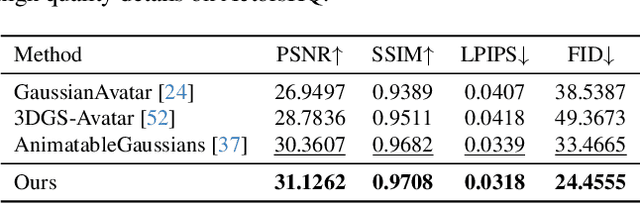
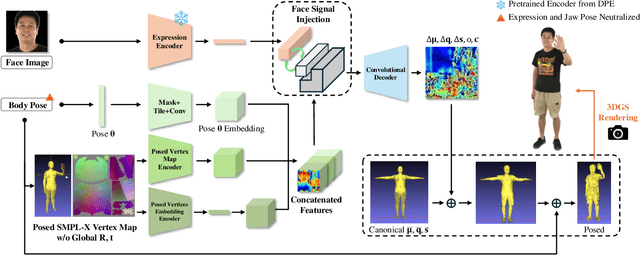
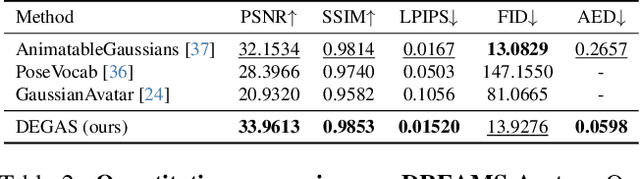

Although neural rendering has made significant advancements in creating lifelike, animatable full-body and head avatars, incorporating detailed expressions into full-body avatars remains largely unexplored. We present DEGAS, the first 3D Gaussian Splatting (3DGS)-based modeling method for full-body avatars with rich facial expressions. Trained on multiview videos of a given subject, our method learns a conditional variational autoencoder that takes both the body motion and facial expression as driving signals to generate Gaussian maps in the UV layout. To drive the facial expressions, instead of the commonly used 3D Morphable Models (3DMMs) in 3D head avatars, we propose to adopt the expression latent space trained solely on 2D portrait images, bridging the gap between 2D talking faces and 3D avatars. Leveraging the rendering capability of 3DGS and the rich expressiveness of the expression latent space, the learned avatars can be reenacted to reproduce photorealistic rendering images with subtle and accurate facial expressions. Experiments on an existing dataset and our newly proposed dataset of full-body talking avatars demonstrate the efficacy of our method. We also propose an audio-driven extension of our method with the help of 2D talking faces, opening new possibilities to interactive AI agents.