 Add to Chrome
 Add to Firefox
 Add to Edge
Network-Aware Bilinear Tokenization for Brain Functional Connectivity Representation Learning
May 13, 2026
Masked autoencoders (MAEs) have recently shown promise for self-supervised representation learning of resting-state brain functional connectivity (FC). However, a fundamental question remains unresolved: how should FC matrices be tokenized to align with the intrinsic modular organization of large-scale brain networks? Existing approaches typically adopt region-centric or graph-based schemes that treat FC as structurally homogeneous elements and overlook the large-scale network brain organization. We introduce NERVE (Network-Aware Representations of Brain Functional Connectivity via Bilinear Tokenization), a self-supervised learning framework that redefines FC tokenization by partitioning FC matrices into patches of intra- and inter-network connectivity blocks. Unlike image-based MAE, where fixed-size patches share a common tokenizer, FC patches defined by network pairs are heterogeneous in size and correspond to distinct functional roles. To resolve this problem, NERVE embeds FC patches through a novel structured bilinear factorization. This formulation preserves network identity and reduces parameter complexity from quadratic to linear scaling in the number of networks. We evaluate NERVE across three large-scale developmental cohorts (ABCD, PNC, and CCNP) for behavior and psychopathology prediction. Compared to structurally agnostic MAE variants and graph-based self-supervised baselines, the proposed network-aware formulation yields more stable and transferable representations, particularly in cross-cohort evaluation. Ablation studies confirm that the proposed bilinear network embedding and anatomically grounded parcellation are critical for performance. These findings highlight the importance of incorporating domain-specific structural priors into self-supervised learning for functional connectomics.

Generative Modeling of Neurodegenerative Brain Anatomy with 4D Longitudinal Diffusion Model
Apr 24, 2026Understanding and predicting the progression of neurodegenerative diseases remains a major challenge in medical AI, with significant implications for early diagnosis, disease monitoring, and treatment planning. However, most available longitudinal neuroimaging datasets are temporally sparse with a few follow-up scans per subject. This scarcity of temporal data limits our ability to model and accurately capture the continuous anatomical changes related to disease progression in individual subjects. To address this problem, we propose a novel 4D (3DxT) diffusion-based generative framework that effectively models and synthesizes longitudinal brain anatomy over time, conditioned on available clinical variables such as health status, age, sex, and other relevant factors. Moreover, while most current approaches focus on manipulating image intensity or texture, our method explicitly learns the data distribution of topology-preserving spatiotemporal deformations to effectively capture the geometric changes of brain structures over time. This design enables the realistic generation of future anatomical states and the reconstruction of anatomically consistent disease trajectories, providing a more faithful representation of longitudinal brain changes. We validate our model through both synthetic sequence generation and downstream longitudinal disease classification, as well as brain segmentation. Experiments on two large-scale longitudinal neuroimage datasets demonstrate that our method outperforms state-of-the-art baselines in generating anatomically accurate, temporally consistent, and clinically meaningful brain trajectories. Our code is available on Github.
Anatomically Guided Latent Diffusion for Brain MRI Progression Modeling
Jan 21, 2026Accurately modeling longitudinal brain MRI progression is crucial for understanding neurodegenerative diseases and predicting individualized structural changes. Existing state-of-the-art approaches, such as Brain Latent Progression (BrLP), often use multi-stage training pipelines with auxiliary conditioning modules but suffer from architectural complexity, suboptimal use of conditional clinical covariates, and limited guarantees of anatomical consistency. We propose Anatomically Guided Latent Diffusion Model (AG-LDM), a segmentation-guided framework that enforces anatomically consistent progression while substantially simplifying the training pipeline. AG-LDM conditions latent diffusion by directly fusing baseline anatomy, noisy follow-up states, and clinical covariates at the input level, a strategy that avoids auxiliary control networks by learning a unified, end-to-end model that represents both anatomy and progression. A lightweight 3D tissue segmentation model (WarpSeg) provides explicit anatomical supervision during both autoencoder fine-tuning and diffusion model training, ensuring consistent brain tissue boundaries and morphometric fidelity. Experiments on 31,713 ADNI longitudinal pairs and zero-shot evaluation on OASIS-3 demonstrate that AG-LDM matches or surpasses more complex diffusion models, achieving state-of-the-art image quality and 15-20\% reduction in volumetric errors in generated images. AG-LDM also exhibits markedly stronger utilization of temporal and clinical covariates (up to 31.5x higher sensitivity than BrLP) and generates biologically plausible counterfactual trajectories, accurately capturing hallmarks of Alzheimer's progression such as limbic atrophy and ventricular expansion. These results highlight AG-LDM as an efficient, anatomically grounded framework for reliable brain MRI progression modeling.
Anatomical Similarity as a New Metric to Evaluate Brain Generative Models
Apr 30, 2025Generative models enhance neuroimaging through data augmentation, quality improvement, and rare condition studies. Despite advances in realistic synthetic MRIs, evaluations focus on texture and perception, lacking sensitivity to crucial anatomical fidelity. This study proposes a new metric, called WASABI (Wasserstein-Based Anatomical Brain Index), to assess the anatomical realism of synthetic brain MRIs. WASABI leverages \textit{SynthSeg}, a deep learning-based brain parcellation tool, to derive volumetric measures of brain regions in each MRI and uses the multivariate Wasserstein distance to compare distributions between real and synthetic anatomies. Based on controlled experiments on two real datasets and synthetic MRIs from five generative models, WASABI demonstrates higher sensitivity in quantifying anatomical discrepancies compared to traditional image-level metrics, even when synthetic images achieve near-perfect visual quality. Our findings advocate for shifting the evaluation paradigm beyond visual inspection and conventional metrics, emphasizing anatomical fidelity as a crucial benchmark for clinically meaningful brain MRI synthesis. Our code is available at https://github.com/BahramJafrasteh/wasabi-mri.
Spectral Graph Sample Weighting for Interpretable Sub-cohort Analysis in Predictive Models for Neuroimaging
Oct 01, 2024Recent advancements in medicine have confirmed that brain disorders often comprise multiple subtypes of mechanisms, developmental trajectories, or severity levels. Such heterogeneity is often associated with demographic aspects (e.g., sex) or disease-related contributors (e.g., genetics). Thus, the predictive power of machine learning models used for symptom prediction varies across subjects based on such factors. To model this heterogeneity, one can assign each training sample a factor-dependent weight, which modulates the subject's contribution to the overall objective loss function. To this end, we propose to model the subject weights as a linear combination of the eigenbases of a spectral population graph that captures the similarity of factors across subjects. In doing so, the learned weights smoothly vary across the graph, highlighting sub-cohorts with high and low predictability. Our proposed sample weighting scheme is evaluated on two tasks. First, we predict initiation of heavy alcohol drinking in young adulthood from imaging and neuropsychological measures from the National Consortium on Alcohol and NeuroDevelopment in Adolescence (NCANDA). Next, we detect Dementia vs. Mild Cognitive Impairment (MCI) using imaging and demographic measurements in subjects from the Alzheimer's Disease Neuroimaging Initiative (ADNI). Compared to existing sample weighting schemes, our sample weights improve interpretability and highlight sub-cohorts with distinct characteristics and varying model accuracy.
Brain-Cognition Fingerprinting via Graph-GCCA with Contrastive Learning
Sep 20, 2024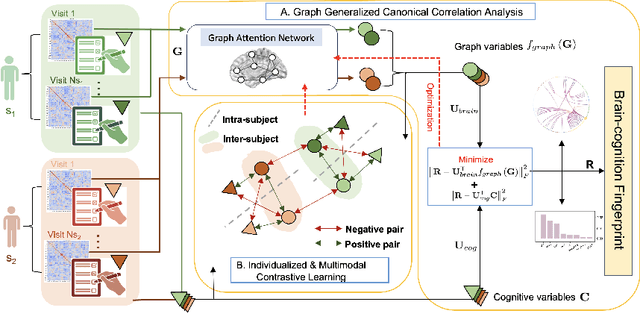
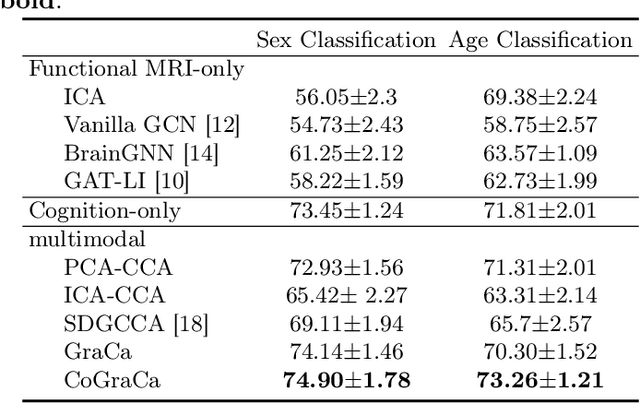
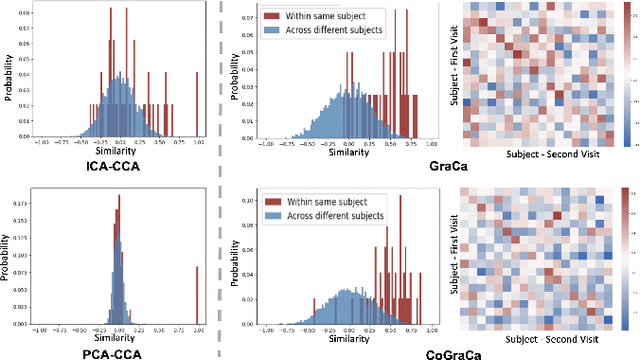
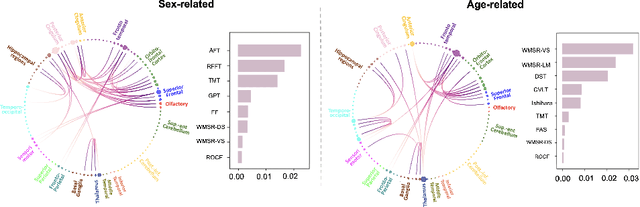
Many longitudinal neuroimaging studies aim to improve the understanding of brain aging and diseases by studying the dynamic interactions between brain function and cognition. Doing so requires accurate encoding of their multidimensional relationship while accounting for individual variability over time. For this purpose, we propose an unsupervised learning model (called \underline{\textbf{Co}}ntrastive Learning-based \underline{\textbf{Gra}}ph Generalized \underline{\textbf{Ca}}nonical Correlation Analysis (CoGraCa)) that encodes their relationship via Graph Attention Networks and generalized Canonical Correlational Analysis. To create brain-cognition fingerprints reflecting unique neural and cognitive phenotype of each person, the model also relies on individualized and multimodal contrastive learning. We apply CoGraCa to longitudinal dataset of healthy individuals consisting of resting-state functional MRI and cognitive measures acquired at multiple visits for each participant. The generated fingerprints effectively capture significant individual differences and outperform current single-modal and CCA-based multimodal models in identifying sex and age. More importantly, our encoding provides interpretable interactions between those two modalities.
Latent 3D Brain MRI Counterfactual
Sep 09, 2024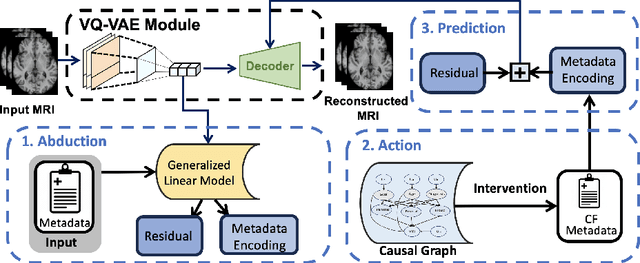
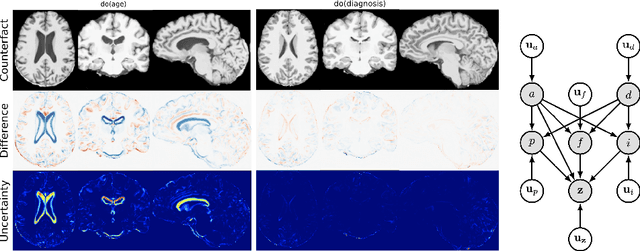
The number of samples in structural brain MRI studies is often too small to properly train deep learning models. Generative models show promise in addressing this issue by effectively learning the data distribution and generating high-fidelity MRI. However, they struggle to produce diverse, high-quality data outside the distribution defined by the training data. One way to address the issue is using causal models developed for 3D volume counterfactuals. However, accurately modeling causality in high-dimensional spaces is a challenge so that these models generally generate 3D brain MRIS of lower quality. To address these challenges, we propose a two-stage method that constructs a Structural Causal Model (SCM) within the latent space. In the first stage, we employ a VQ-VAE to learn a compact embedding of the MRI volume. Subsequently, we integrate our causal model into this latent space and execute a three-step counterfactual procedure using a closed-form Generalized Linear Model (GLM). Our experiments conducted on real-world high-resolution MRI data (1mm) demonstrate that our method can generate high-quality 3D MRI counterfactuals.
Enforcing Conditional Independence for Fair Representation Learning and Causal Image Generation
Apr 21, 2024Conditional independence (CI) constraints are critical for defining and evaluating fairness in machine learning, as well as for learning unconfounded or causal representations. Traditional methods for ensuring fairness either blindly learn invariant features with respect to a protected variable (e.g., race when classifying sex from face images) or enforce CI relative to the protected attribute only on the model output (e.g., the sex label). Neither of these methods are effective in enforcing CI in high-dimensional feature spaces. In this paper, we focus on a nascent approach characterizing the CI constraint in terms of two Jensen-Shannon divergence terms, and we extend it to high-dimensional feature spaces using a novel dynamic sampling strategy. In doing so, we introduce a new training paradigm that can be applied to any encoder architecture. We are able to enforce conditional independence of the diffusion autoencoder latent representation with respect to any protected attribute under the equalized odds constraint and show that this approach enables causal image generation with controllable latent spaces. Our experimental results demonstrate that our approach can achieve high accuracy on downstream tasks while upholding equality of odds.
Metadata-Conditioned Generative Models to Synthesize Anatomically-Plausible 3D Brain MRIs
Oct 07, 2023

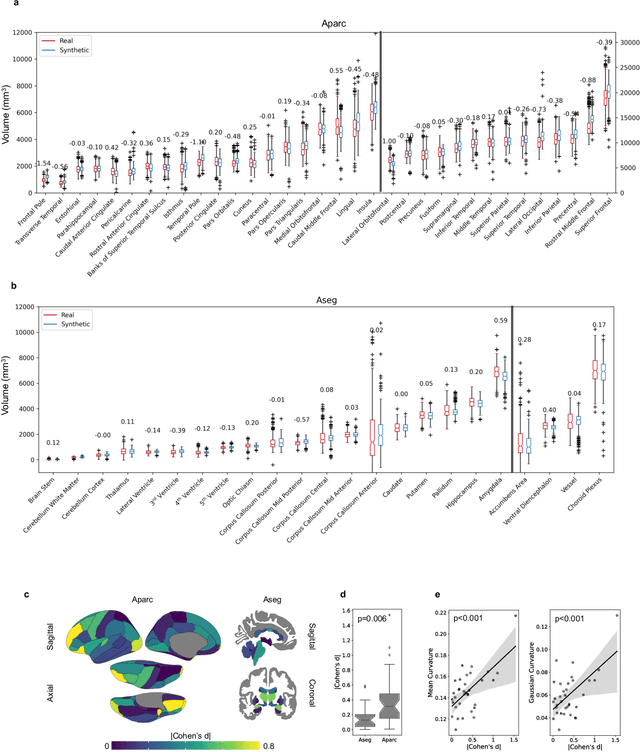
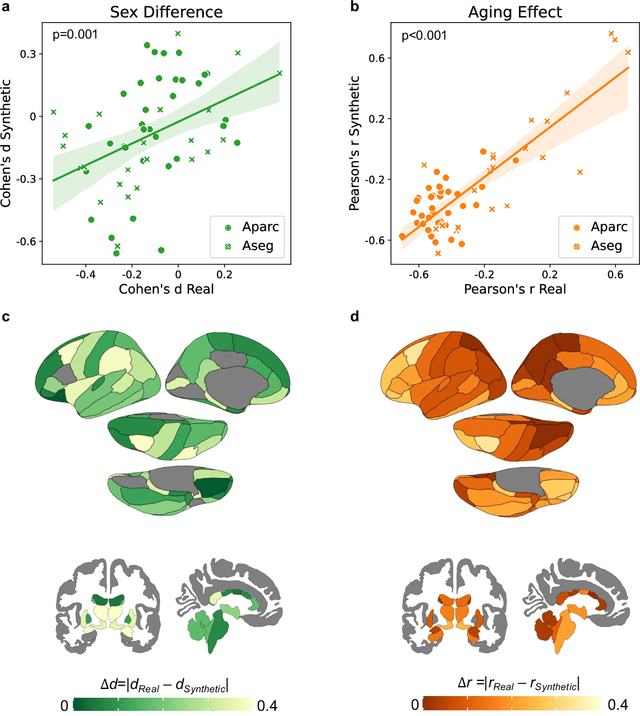
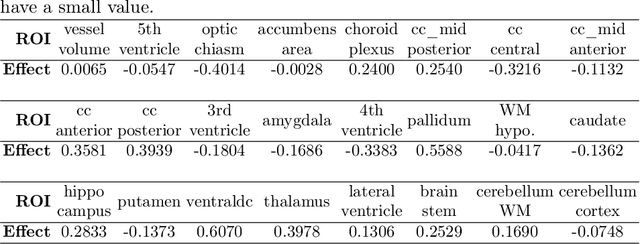
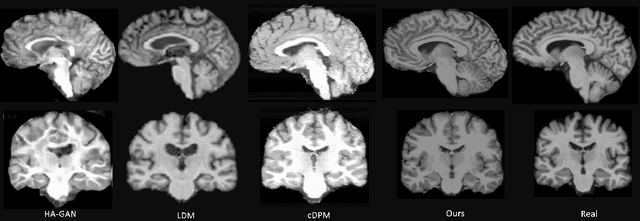
Generative AI models hold great potential in creating synthetic brain MRIs that advance neuroimaging studies by, for example, enriching data diversity. However, the mainstay of AI research only focuses on optimizing the visual quality (such as signal-to-noise ratio) of the synthetic MRIs while lacking insights into their relevance to neuroscience. To gain these insights with respect to T1-weighted MRIs, we first propose a new generative model, BrainSynth, to synthesize metadata-conditioned (e.g., age- and sex-specific) MRIs that achieve state-of-the-art visual quality. We then extend our evaluation with a novel procedure to quantify anatomical plausibility, i.e., how well the synthetic MRIs capture macrostructural properties of brain regions, and how accurately they encode the effects of age and sex. Results indicate that more than half of the brain regions in our synthetic MRIs are anatomically accurate, i.e., with a small effect size between real and synthetic MRIs. Moreover, the anatomical plausibility varies across cortical regions according to their geometric complexity. As is, our synthetic MRIs can significantly improve the training of a Convolutional Neural Network to identify accelerated aging effects in an independent study. These results highlight the opportunities of using generative AI to aid neuroimaging research and point to areas for further improvement.
LSOR: Longitudinally-Consistent Self-Organized Representation Learning
Sep 30, 2023Interpretability is a key issue when applying deep learning models to longitudinal brain MRIs. One way to address this issue is by visualizing the high-dimensional latent spaces generated by deep learning via self-organizing maps (SOM). SOM separates the latent space into clusters and then maps the cluster centers to a discrete (typically 2D) grid preserving the high-dimensional relationship between clusters. However, learning SOM in a high-dimensional latent space tends to be unstable, especially in a self-supervision setting. Furthermore, the learned SOM grid does not necessarily capture clinically interesting information, such as brain age. To resolve these issues, we propose the first self-supervised SOM approach that derives a high-dimensional, interpretable representation stratified by brain age solely based on longitudinal brain MRIs (i.e., without demographic or cognitive information). Called Longitudinally-consistent Self-Organized Representation learning (LSOR), the method is stable during training as it relies on soft clustering (vs. the hard cluster assignments used by existing SOM). Furthermore, our approach generates a latent space stratified according to brain age by aligning trajectories inferred from longitudinal MRIs to the reference vector associated with the corresponding SOM cluster. When applied to longitudinal MRIs of the Alzheimer's Disease Neuroimaging Initiative (ADNI, N=632), LSOR generates an interpretable latent space and achieves comparable or higher accuracy than the state-of-the-art representations with respect to the downstream tasks of classification (static vs. progressive mild cognitive impairment) and regression (determining ADAS-Cog score of all subjects). The code is available at https://github.com/ouyangjiahong/longitudinal-som-single-modality.