 Add to Chrome
 Add to Firefox
 Add to Edge
FlowBlock: Wavefront-Parallel Decoding for Self-Correcting Diffusion Language Models
Jul 20, 2026
Block-wise diffusion large language models (dLLMs) decode sequentially at the block level, enabling effective KV-cache reuse across blocks but making inter-block decoding strictly serial. Prior work has attempted to unlock inter-block parallelism through post-training methods, but achieves only modest speedups and often degrades accuracy. We observe that self-correcting dLLMs offer a training-free alternative: token-to-token (T2T) editing can repair tokens drafted with a slightly stale upstream context, so a downstream block requires only an informative draft rather than a finalized predecessor. This turns block finality from a hard dependency into a scheduling resource. We propose \textbf{\flowblock{}}, a training-free parallel decoding framework built on two mechanisms. (i) \emph{Gated Wavefront Decoding} admits blocks into a bounded wavefront only when a readiness gate is satisfied, jointly refines active blocks via T2T editing, and commits blocks in order under a windowed block-causal mask that preserves exact frozen-prefix KV caches reuse. (ii) \emph{Heterogeneous Wavefront Packing} assigns each request an independent wavefront while packing asynchronous windows into dense, shape-stable batched forwards. Across different benchmarks, \flowblock{} improves tokens per second (TPS) over LLaDA-2.1 and LLaDA-2.0, two serial block-wise dLLMs, by up to 2.95$\times$ and 4.01$\times$, while reducing latency by up to 53.6\% and 77.1\%, respectively. It also improves average accuracy by 1.3 points. Compared with D2F, a training-based inter-block-parallel baseline, \flowblock{} achieves higher accuracy and up to 16$\times$ higher batched serving throughput.

Neuromem: A Granular Decomposition of the Streaming Lifecycle in External Memory for LLMs
Feb 15, 2026Most evaluations of External Memory Module assume a static setting: memory is built offline and queried at a fixed state. In practice, memory is streaming: new facts arrive continuously, insertions interleave with retrievals, and the memory state evolves while the model is serving queries. In this regime, accuracy and cost are governed by the full memory lifecycle, which encompasses the ingestion, maintenance, retrieval, and integration of information into generation. We present Neuromem, a scalable testbed that benchmarks External Memory Modules under an interleaved insertion-and-retrieval protocol and decomposes its lifecycle into five dimensions including memory data structure, normalization strategy, consolidation policy, query formulation strategy, and context integration mechanism. Using three representative datasets LOCOMO, LONGMEMEVAL, and MEMORYAGENTBENCH, Neuromem evaluates interchangeable variants within a shared serving stack, reporting token-level F1 and insertion/retrieval latency. Overall, we observe that performance typically degrades as memory grows across rounds, and time-related queries remain the most challenging category. The memory data structure largely determines the attainable quality frontier, while aggressive compression and generative integration mechanisms mostly shift cost between insertion and retrieval with limited accuracy gain.
FusionANNS: An Efficient CPU/GPU Cooperative Processing Architecture for Billion-scale Approximate Nearest Neighbor Search
Sep 25, 2024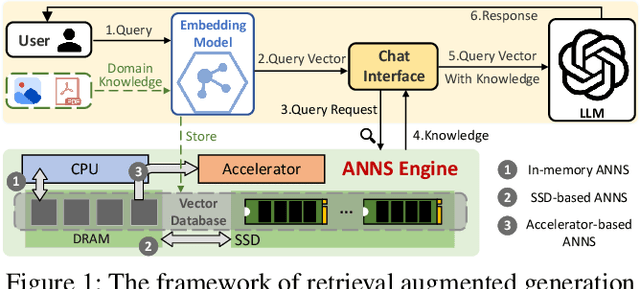
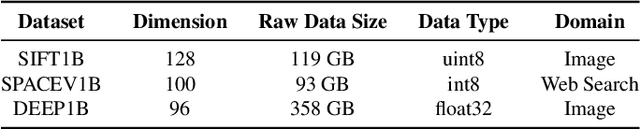
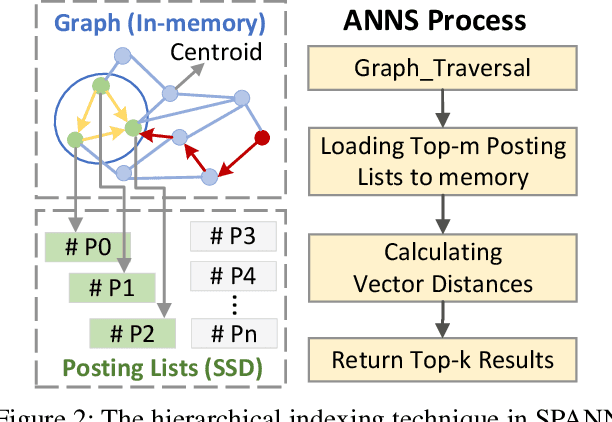
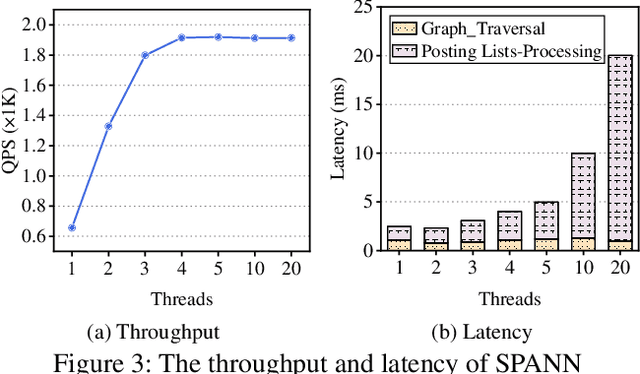
Approximate nearest neighbor search (ANNS) has emerged as a crucial component of database and AI infrastructure. Ever-increasing vector datasets pose significant challenges in terms of performance, cost, and accuracy for ANNS services. None of modern ANNS systems can address these issues simultaneously. We present FusionANNS, a high-throughput, low-latency, cost-efficient, and high-accuracy ANNS system for billion-scale datasets using SSDs and only one entry-level GPU. The key idea of FusionANNS lies in CPU/GPU collaborative filtering and re-ranking mechanisms, which significantly reduce I/O operations across CPUs, GPU, and SSDs to break through the I/O performance bottleneck. Specifically, we propose three novel designs: (1) multi-tiered indexing to avoid data swapping between CPUs and GPU, (2) heuristic re-ranking to eliminate unnecessary I/Os and computations while guaranteeing high accuracy, and (3) redundant-aware I/O deduplication to further improve I/O efficiency. We implement FusionANNS and compare it with the state-of-the-art SSD-based ANNS system--SPANN and GPU-accelerated in-memory ANNS system--RUMMY. Experimental results show that FusionANNS achieves 1) 9.4-13.1X higher query per second (QPS) and 5.7-8.8X higher cost efficiency compared with SPANN; 2) and 2-4.9X higher QPS and 2.3-6.8X higher cost efficiency compared with RUMMY, while guaranteeing low latency and high accuracy.
GIDN: A Lightweight Graph Inception Diffusion Network for High-efficient Link Prediction
Oct 11, 2022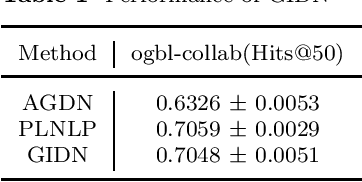
In this paper, we propose a Graph Inception Diffusion Networks(GIDN) model. This model generalizes graph diffusion in different feature spaces, and uses the inception module to avoid the large amount of computations caused by complex network structures. We evaluate GIDN model on Open Graph Benchmark(OGB) datasets, reached an 11% higher performance than AGDN on ogbl-collab dataset.
Accelerating Backward Aggregation in GCN Training with Execution Path Preparing on GPUs
Apr 06, 2022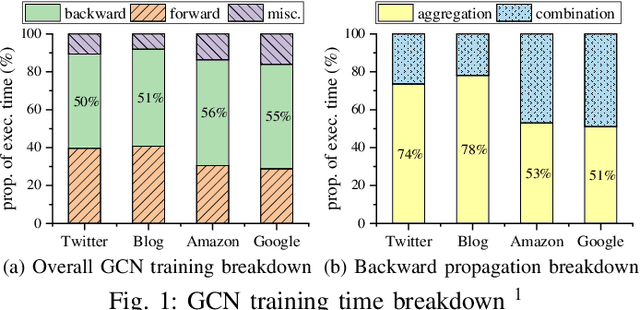
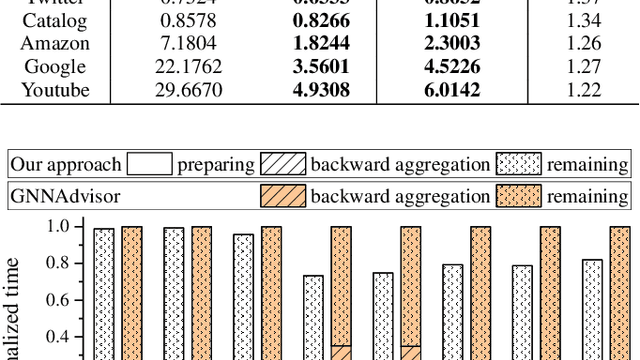
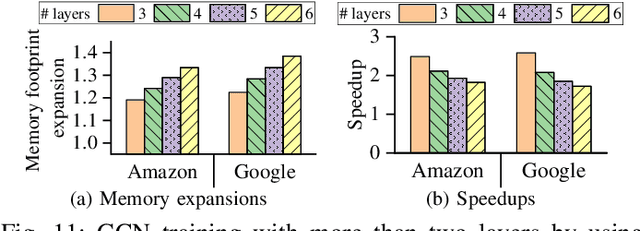
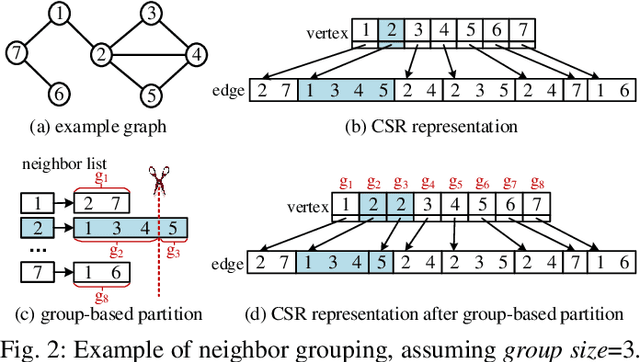
The emerging Graph Convolutional Network (GCN) has now been widely used in many domains, and it is challenging to improve the efficiencies of applications by accelerating the GCN trainings. For the sparsity nature and exploding scales of input real-world graphs, state-of-the-art GCN training systems (e.g., GNNAdvisor) employ graph processing techniques to accelerate the message exchanging (i.e. aggregations) among the graph vertices. Nevertheless, these systems treat both the aggregation stages of forward and backward propagation phases as all-active graph processing procedures that indiscriminately conduct computation on all vertices of an input graph. In this paper, we first point out that in a GCN training problem with a given training set, the aggregation stages of its backward propagation phase (called as backward aggregations in this paper) can be converted to partially-active graph processing procedures, which conduct computation on only partial vertices of the input graph. By leveraging such a finding, we propose an execution path preparing method that collects and coalesces the data used during backward propagations of GCN training conducted on GPUs. The experimental results show that compared with GNNAdvisor, our approach improves the performance of the backward aggregation of GCN trainings on typical real-world graphs by 1.48x~5.65x. Moreover, the execution path preparing can be conducted either before the training (during preprocessing) or on-the-fly with the training. When used during preprocessing, our approach improves the overall GCN training by 1.05x~1.37x. And when used on-the-fly, our approach improves the overall GCN training by 1.03x~1.35x.