 Add to Chrome
 Add to Firefox
 Add to Edge
CopRA: A Progressive LoRA Training Strategy
Oct 30, 2024

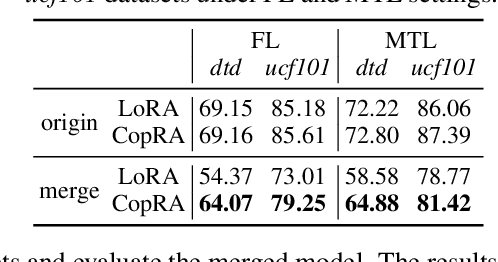
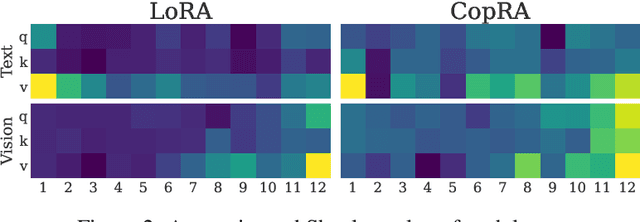
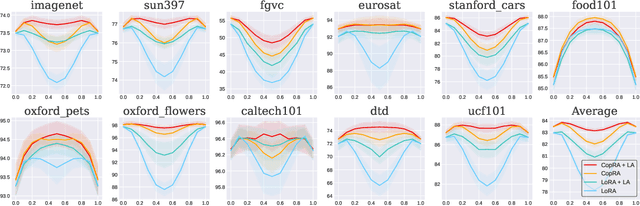
Low-Rank Adaptation (LoRA) is a parameter-efficient technique for rapidly fine-tuning foundation models. In standard LoRA training dynamics, models tend to quickly converge to a local optimum near the initialization. However, this local optimum may not be ideal for out-of-distribution data or tasks such as merging and pruning. In this work, we propose a novel progressive training strategy for LoRA with random layer dropping. This strategy also optimizes the Shapley value of LoRA parameters in each layer, treating each layer as a player in a cooperative game. We refer to this method as Cooperative LoRA (CopRA). Our experimental results demonstrate that parameters trained with CopRA exhibit linear mode connectivity, which enables efficient model merging. This also paves the way for federated learning and multi-task learning via LoRA merging. Additionally, by optimizing the Shapley value, CopRA shows superior performance in pruning tasks.

Multi-Task Interactive Robot Fleet Learning with Visual World Models
Oct 30, 2024Recent advancements in large-scale multi-task robot learning offer the potential for deploying robot fleets in household and industrial settings, enabling them to perform diverse tasks across various environments. However, AI-enabled robots often face challenges with generalization and robustness when exposed to real-world variability and uncertainty. We introduce Sirius-Fleet, a multi-task interactive robot fleet learning framework to address these challenges. Sirius-Fleet monitors robot performance during deployment and involves humans to correct the robot's actions when necessary. We employ a visual world model to predict the outcomes of future actions and build anomaly predictors to predict whether they will likely result in anomalies. As the robot autonomy improves, the anomaly predictors automatically adapt their prediction criteria, leading to fewer requests for human intervention and gradually reducing human workload over time. Evaluations on large-scale benchmarks demonstrate Sirius-Fleet's effectiveness in improving multi-task policy performance and monitoring accuracy. We demonstrate Sirius-Fleet's performance in both RoboCasa in simulation and Mutex in the real world, two diverse, large-scale multi-task benchmarks. More information is available on the project website: https://ut-austin-rpl.github.io/sirius-fleet
NeuroClips: Towards High-fidelity and Smooth fMRI-to-Video Reconstruction
Oct 28, 2024Reconstruction of static visual stimuli from non-invasion brain activity fMRI achieves great success, owning to advanced deep learning models such as CLIP and Stable Diffusion. However, the research on fMRI-to-video reconstruction remains limited since decoding the spatiotemporal perception of continuous visual experiences is formidably challenging. We contend that the key to addressing these challenges lies in accurately decoding both high-level semantics and low-level perception flows, as perceived by the brain in response to video stimuli. To the end, we propose NeuroClips, an innovative framework to decode high-fidelity and smooth video from fMRI. NeuroClips utilizes a semantics reconstructor to reconstruct video keyframes, guiding semantic accuracy and consistency, and employs a perception reconstructor to capture low-level perceptual details, ensuring video smoothness. During inference, it adopts a pre-trained T2V diffusion model injected with both keyframes and low-level perception flows for video reconstruction. Evaluated on a publicly available fMRI-video dataset, NeuroClips achieves smooth high-fidelity video reconstruction of up to 6s at 8FPS, gaining significant improvements over state-of-the-art models in various metrics, e.g., a 128% improvement in SSIM and an 81% improvement in spatiotemporal metrics. Our project is available at https://github.com/gongzix/NeuroClips.
GPT-4o System Card
Oct 25, 2024GPT-4o is an autoregressive omni model that accepts as input any combination of text, audio, image, and video, and generates any combination of text, audio, and image outputs. It's trained end-to-end across text, vision, and audio, meaning all inputs and outputs are processed by the same neural network. GPT-4o can respond to audio inputs in as little as 232 milliseconds, with an average of 320 milliseconds, which is similar to human response time in conversation. It matches GPT-4 Turbo performance on text in English and code, with significant improvement on text in non-English languages, while also being much faster and 50\% cheaper in the API. GPT-4o is especially better at vision and audio understanding compared to existing models. In line with our commitment to building AI safely and consistent with our voluntary commitments to the White House, we are sharing the GPT-4o System Card, which includes our Preparedness Framework evaluations. In this System Card, we provide a detailed look at GPT-4o's capabilities, limitations, and safety evaluations across multiple categories, focusing on speech-to-speech while also evaluating text and image capabilities, and measures we've implemented to ensure the model is safe and aligned. We also include third-party assessments on dangerous capabilities, as well as discussion of potential societal impacts of GPT-4o's text and vision capabilities.
MSGField: A Unified Scene Representation Integrating Motion, Semantics, and Geometry for Robotic Manipulation
Oct 21, 2024Combining accurate geometry with rich semantics has been proven to be highly effective for language-guided robotic manipulation. Existing methods for dynamic scenes either fail to update in real-time or rely on additional depth sensors for simple scene editing, limiting their applicability in real-world. In this paper, we introduce MSGField, a representation that uses a collection of 2D Gaussians for high-quality reconstruction, further enhanced with attributes to encode semantic and motion information. Specially, we represent the motion field compactly by decomposing each primitive's motion into a combination of a limited set of motion bases. Leveraging the differentiable real-time rendering of Gaussian splatting, we can quickly optimize object motion, even for complex non-rigid motions, with image supervision from only two camera views. Additionally, we designed a pipeline that utilizes object priors to efficiently obtain well-defined semantics. In our challenging dataset, which includes flexible and extremely small objects, our method achieve a success rate of 79.2% in static and 63.3% in dynamic environments for language-guided manipulation. For specified object grasping, we achieve a success rate of 90%, on par with point cloud-based methods. Code and dataset will be released at:https://shengyu724.github.io/MSGField.github.io.
Sharpness-Aware Black-Box Optimization
Oct 16, 2024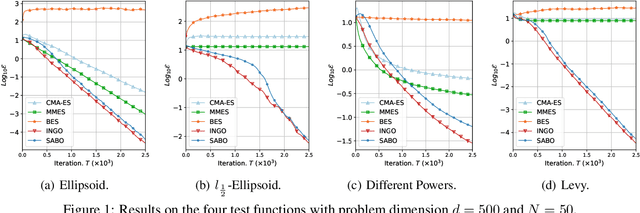
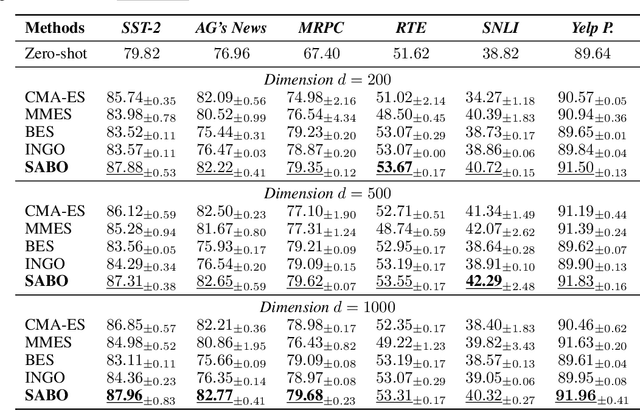
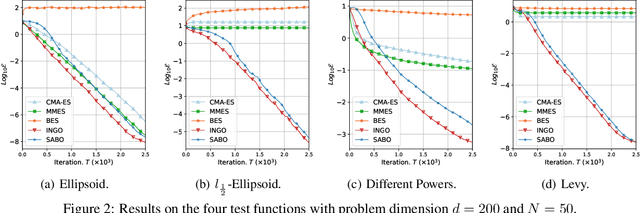
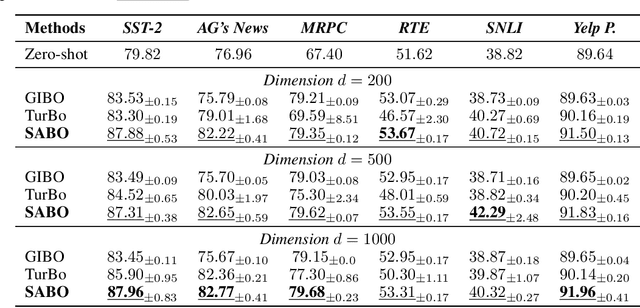
Black-box optimization algorithms have been widely used in various machine learning problems, including reinforcement learning and prompt fine-tuning. However, directly optimizing the training loss value, as commonly done in existing black-box optimization methods, could lead to suboptimal model quality and generalization performance. To address those problems in black-box optimization, we propose a novel Sharpness-Aware Black-box Optimization (SABO) algorithm, which applies a sharpness-aware minimization strategy to improve the model generalization. Specifically, the proposed SABO method first reparameterizes the objective function by its expectation over a Gaussian distribution. Then it iteratively updates the parameterized distribution by approximated stochastic gradients of the maximum objective value within a small neighborhood around the current solution in the Gaussian distribution space. Theoretically, we prove the convergence rate and generalization bound of the proposed SABO algorithm. Empirically, extensive experiments on the black-box prompt fine-tuning tasks demonstrate the effectiveness of the proposed SABO method in improving model generalization performance.
AutoTurb: Using Large Language Models for Automatic Algebraic Model Discovery of Turbulence Closure
Oct 14, 2024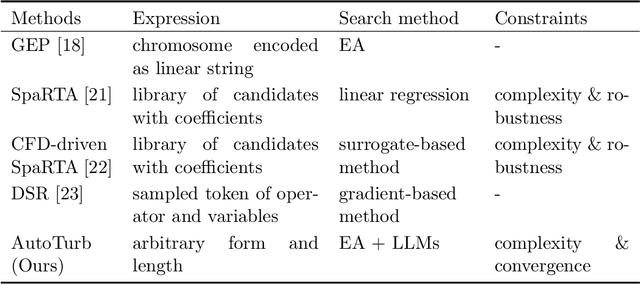
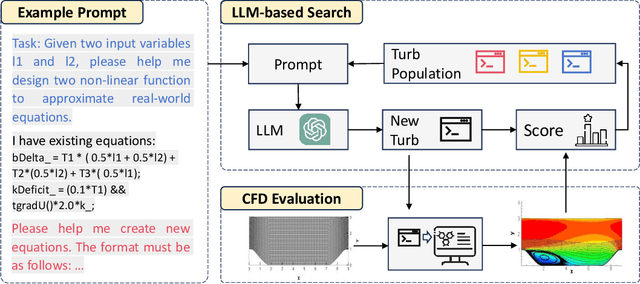

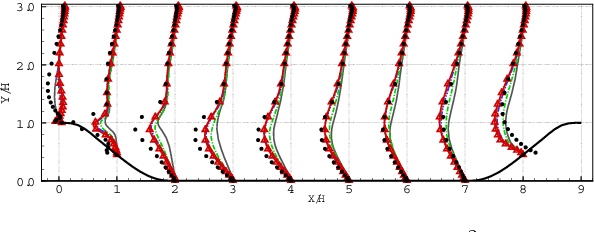
Symbolic regression (SR) methods have been extensively investigated to explore explicit algebraic Reynolds stress models (EARSM) for turbulence closure of Reynolds-averaged Navier-Stokes (RANS) equations. The deduced EARSM can be readily implemented in existing computational fluid dynamic (CFD) codes and promotes the identification of physically interpretable turbulence models. The existing SR methods, such as genetic programming, sparse regression, or artificial neural networks, require user-defined functional operators, a library of candidates, or complex optimization algorithms. In this work, a novel framework using LLMs to automatically discover algebraic expressions for correcting the RSM is proposed. The direct observation of Reynolds stress and the indirect output of the CFD simulation are both involved in the training process to guarantee data consistency and avoid numerical stiffness. Constraints of functional complexity and convergence are supplementally imposed in the objective function on account of the tremendous flexibility of LLMs. The evolutionary search is employed for global optimization. The proposed method is performed for separated flow over periodic hills at Re = 10,595. The generalizability of the discovered model is verified on a set of 2D turbulent separated flow configurations with different Reynolds numbers and geometries. It is demonstrated that the corrective RANS can improve the prediction for both the Reynolds stress and mean velocity fields. Compared with algebraic models discovered by other works, the discovered model performs better in accuracy and generalization capability. The proposed approach provides a promising paradigm for using LLMs to improve turbulence modeling for a given class of flows.
DAT: Dialogue-Aware Transformer with Modality-Group Fusion for Human Engagement Estimation
Oct 11, 2024

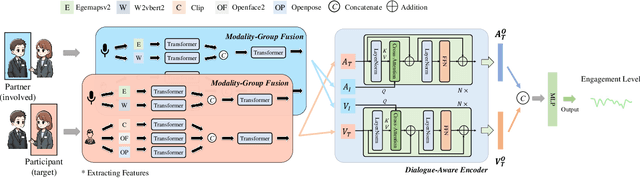

Engagement estimation plays a crucial role in understanding human social behaviors, attracting increasing research interests in fields such as affective computing and human-computer interaction. In this paper, we propose a Dialogue-Aware Transformer framework (DAT) with Modality-Group Fusion (MGF), which relies solely on audio-visual input and is language-independent, for estimating human engagement in conversations. Specifically, our method employs a modality-group fusion strategy that independently fuses audio and visual features within each modality for each person before inferring the entire audio-visual content. This strategy significantly enhances the model's performance and robustness. Additionally, to better estimate the target participant's engagement levels, the introduced Dialogue-Aware Transformer considers both the participant's behavior and cues from their conversational partners. Our method was rigorously tested in the Multi-Domain Engagement Estimation Challenge held by MultiMediate'24, demonstrating notable improvements in engagement-level regression precision over the baseline model. Notably, our approach achieves a CCC score of 0.76 on the NoXi Base test set and an average CCC of 0.64 across the NoXi Base, NoXi-Add, and MPIIGI test sets.
A Lightweight Target-Driven Network of Stereo Matching for Inland Waterways
Oct 10, 2024Stereo matching for inland waterways is one of the key technologies for the autonomous navigation of Unmanned Surface Vehicles (USVs), which involves dividing the stereo images into reference images and target images for pixel-level matching. However, due to the challenges of the inland waterway environment, such as blurred textures, large spatial scales, and computational resource constraints of the USVs platform, the participation of geometric features from the target image is required for efficient target-driven matching. Based on this target-driven concept, we propose a lightweight target-driven stereo matching neural network, named LTNet. Specifically, a lightweight and efficient 4D cost volume, named the Geometry Target Volume (GTV), is designed to fully utilize the geometric information of target features by employing the shifted target features as the filtered feature volume. Subsequently, to address the substantial texture interference and object occlusions present in the waterway environment, a Left-Right Consistency Refinement (LRR) module is proposed. The \text{LRR} utilizes the pixel-level differences in left and right disparities to introduce soft constraints, thereby enhancing the accuracy of predictions during the intermediate stages of the network. Moreover, knowledge distillation is utilized to enhance the generalization capability of lightweight models on the USVInland dataset. Furthermore, a new large-scale benchmark, named Spring, is utilized to validate the applicability of LTNet across various scenarios. In experiments on the aforementioned two datasets, LTNet achieves competitive results, with only 3.7M parameters. The code is available at https://github.com/Open-YiQingZhou/LTNet .
Improved PCRLB for radar tracking in clutter with geometry-dependent target measurement uncertainty and application to radar trajectory control
Oct 08, 2024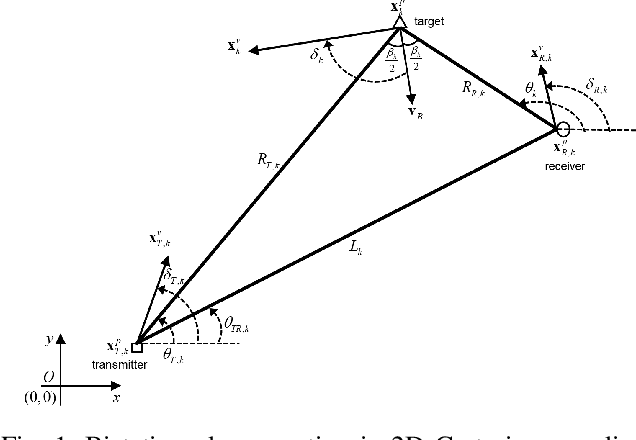
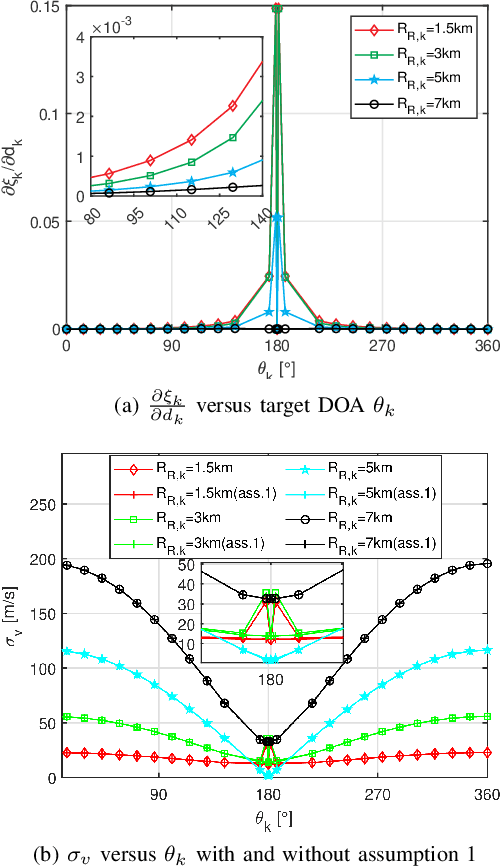
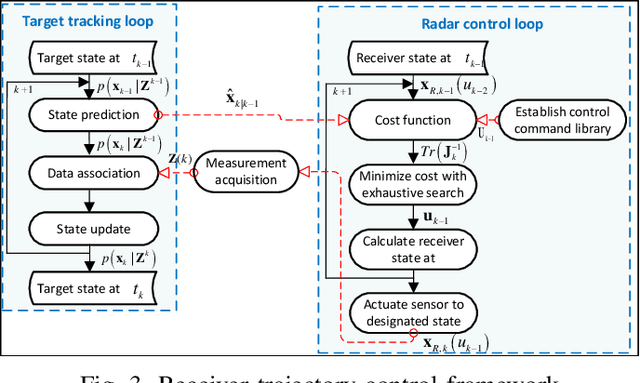
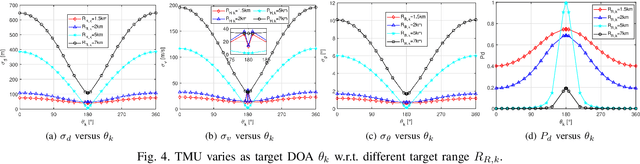
In realistic radar tracking, target measurement uncertainty (TMU) in terms of both detection probability and measurement error covariance is significantly affected by the target-to-radar (T2R) geometry. However, existing posterior Cramer-Rao Lower Bounds (PCRLBs) rarely investigate the fundamental impact of T2R geometry on target measurement uncertainty and eventually on mean square error (MSE) of state estimate, inevitably resulting in over-conservative lower bound. To address this issue, this paper firstly derives the generalized model of target measurement error covariance for bistatic radar with moving receiver and transmitter illuminating any type of signal, along with its approximated solution to specify the impact of T2R geometry on error covariance. Based upon formulated TMU model, an improved PCRLB (IPCRLB) fully accounting for both measurement origin uncertainty and geometry-dependent TMU is then re-derived, both detection probability and measurement error covariance are treated as state-dependent parameters when differentiating log-likelihood with respect to target state. Compared to existing PCRLBs that partially or completely ignore the dependence of target measurement uncertainty on T2R geometry, proposed IPCRLB provides a much accurate (less-conservative) lower bound for radar tracking in clutter with geometry-dependent TMU. The new bound is then applied to radar trajectory control to effectively optimize T2R geometry and exhibits least uncertainty of acquired target measurement and more accurate state estimate for bistatic radar tracking in clutter, compared to state-of-the-art trajectory control methods.