 Add to Chrome
 Add to Firefox
 Add to Edge
To Fuse or to Drop? Dual-Path Learning for Resolving Modality Conflicts in Multimodal Emotion Recognition
May 06, 2026
Multimodal emotion recognition (MER) benefits from combining text, audio, and vision, yet standard fusion often fails when modalities conflict. Crucially, conflicts differ in resolvability: benign conflicts stem from missing, weak, or ambiguous cues and can be mitigated by cross-modal calibration, while severe conflicts arise from intrinsically contradictory (e.g., sarcasm) or misleading signals, for which forced fusion may amplify errors. Recognizing this, we propose Dual-Path Conflict Resolution (DCR), a unified framework that learns when to fuse and when to drop modalities. Path I (Affective Fusion Distiller, AFD) performs reverse distillation from audio/visual teachers to a textual student using temporally weighted class evidence, thereby enhancing representation-level calibration and improving fusion when alignment is beneficial. Path II (Affective Discernment Agent, ADA) formulates MER as a contextual bandit that selects among fusion and unimodal predictions based on a dual-view state and a calibration-aware reward, enabling decision-level arbitration under irreconcilable conflicts without requiring per-modality reliability labels. By taking into account the full multimodal context and coupling soft calibration with hard arbitration, DCR reconciles conflicts that can be aligned while bypassing misleading modalities when fusion is harmful. Across five benchmarks covering both dialogue-level and clip-level MER, DCR consistently outperforms competitive baselines or achieves highly competitive results. Further ablations, conflict-specific subset evaluation, and modality-selection analysis verify that AFD and ADA are complementary and jointly improve robust conflict-aware emotion recognition.

DAT: Dialogue-Aware Transformer with Modality-Group Fusion for Human Engagement Estimation
Oct 11, 2024

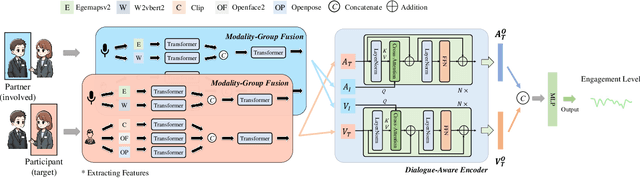

Engagement estimation plays a crucial role in understanding human social behaviors, attracting increasing research interests in fields such as affective computing and human-computer interaction. In this paper, we propose a Dialogue-Aware Transformer framework (DAT) with Modality-Group Fusion (MGF), which relies solely on audio-visual input and is language-independent, for estimating human engagement in conversations. Specifically, our method employs a modality-group fusion strategy that independently fuses audio and visual features within each modality for each person before inferring the entire audio-visual content. This strategy significantly enhances the model's performance and robustness. Additionally, to better estimate the target participant's engagement levels, the introduced Dialogue-Aware Transformer considers both the participant's behavior and cues from their conversational partners. Our method was rigorously tested in the Multi-Domain Engagement Estimation Challenge held by MultiMediate'24, demonstrating notable improvements in engagement-level regression precision over the baseline model. Notably, our approach achieves a CCC score of 0.76 on the NoXi Base test set and an average CCC of 0.64 across the NoXi Base, NoXi-Add, and MPIIGI test sets.
Multimodal Feature Extraction and Fusion for Emotional Reaction Intensity Estimation and Expression Classification in Videos with Transformers
Mar 16, 2023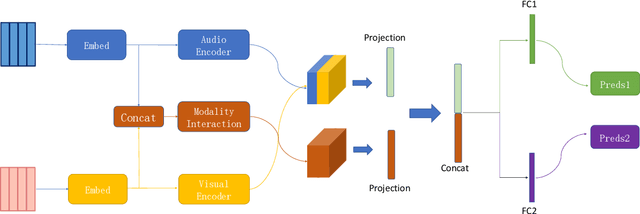
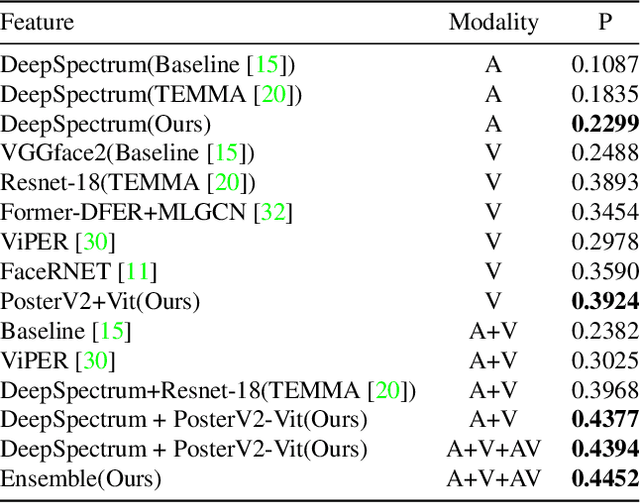
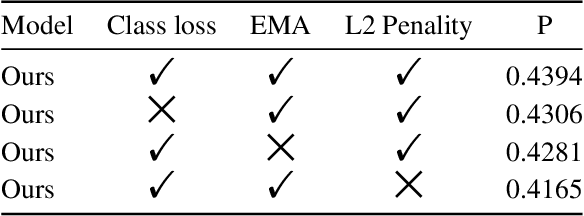
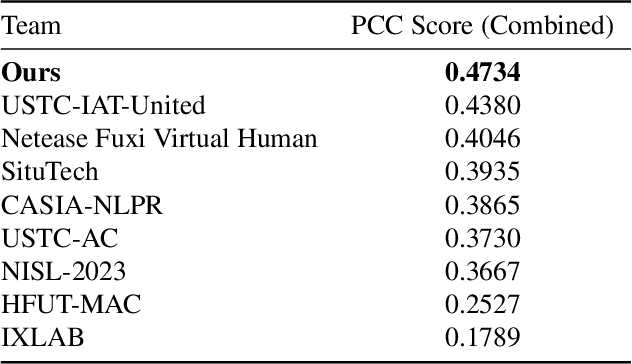
In this paper, we present our solutions to the two sub-challenges of Affective Behavior Analysis in the wild (ABAW) 2023: the Emotional Reaction Intensity (ERI) Estimation Challenge and Expression (Expr) Classification Challenge. ABAW 2023 focuses on the problem of affective behavior analysis in the wild, with the goal of creating machines and robots that have the ability to understand human feelings, emotions and behaviors, which can effectively contribute to the advent of a more intelligent future. In our work, we use different models and tools for the Hume-Reaction dataset to extract features of various aspects, such as audio features, video features, etc. By analyzing, combining, and studying these multimodal features, we effectively improve the accuracy of the model for multimodal sentiment prediction. For the Emotional Reaction Intensity (ERI) Estimation Challenge, our method shows excellent results with a Pearson coefficient on the validation dataset, exceeding the baseline method by 84 percent.