 Add to Chrome
 Add to Firefox
 Add to Edge
From Routes to Steps: Separating Semantic Progress from Local Execution in Vision-and-Language Navigation
Aug 04, 2026
Vision-and-Language Navigation (VLN) requires an agent to follow a route-level instruction by executing its constituent steps from egocentric visual observations. Existing VLM-based navigators typically supervise both capabilities through next-action prediction alone, making progress-tracking errors difficult to distinguish from execution errors. When an agent deviates from the route, a corrective action label may recover the next movement but does not indicate whether the agent selected the wrong sub-instruction or failed to execute the correct one. Consequently, the agent may continue making decisions from an erroneous progress state. To resolve this ambiguity, we propose \textbf{Route2Step}, a framework that decouples semantic progress tracking from action generation through an explicit step-level interface. The Instruction Analysis Module ($\mathcal{M}_{\mathrm{IA}}$) predicts this state from the global instruction and visual history. Conditioned on the predicted state and recent observations, the Action Generation Module ($\mathcal{M}_{\mathrm{AG}}$) generates local action chunks. To supervise the progress state without manual temporal labels, E-SPA, a step-alignment procedure, associates sub-instructions with their corresponding portions of route-level demonstrations. These alignments enable state supervision for incorrect progress estimates, while direct action supervision is reserved for rollout groups that repeatedly fail under the correct active sub-instruction. On R2R-CE, Route2Step improves SR from 48.1\% to 55.3\% and SPL from 43.3\% to 48.2\%, using 190K state-level corrective samples while requiring only 11.5K directly action-supervised states. Experiments in real-world indoor and outdoor environments further demonstrate the practical applicability of Route2Step. The project page is: https://sisyphus-hxy.github.io/Route2Step/.

MSGField: A Unified Scene Representation Integrating Motion, Semantics, and Geometry for Robotic Manipulation
Oct 21, 2024Combining accurate geometry with rich semantics has been proven to be highly effective for language-guided robotic manipulation. Existing methods for dynamic scenes either fail to update in real-time or rely on additional depth sensors for simple scene editing, limiting their applicability in real-world. In this paper, we introduce MSGField, a representation that uses a collection of 2D Gaussians for high-quality reconstruction, further enhanced with attributes to encode semantic and motion information. Specially, we represent the motion field compactly by decomposing each primitive's motion into a combination of a limited set of motion bases. Leveraging the differentiable real-time rendering of Gaussian splatting, we can quickly optimize object motion, even for complex non-rigid motions, with image supervision from only two camera views. Additionally, we designed a pipeline that utilizes object priors to efficiently obtain well-defined semantics. In our challenging dataset, which includes flexible and extremely small objects, our method achieve a success rate of 79.2% in static and 63.3% in dynamic environments for language-guided manipulation. For specified object grasping, we achieve a success rate of 90%, on par with point cloud-based methods. Code and dataset will be released at:https://shengyu724.github.io/MSGField.github.io.
DGRC: An Effective Fine-tuning Framework for Distractor Generation in Chinese Multi-choice Reading Comprehension
May 29, 2024

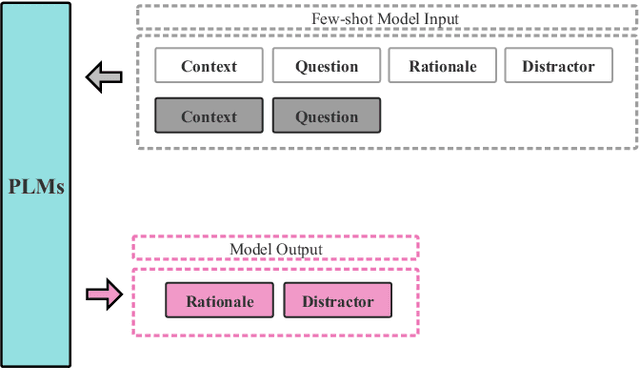
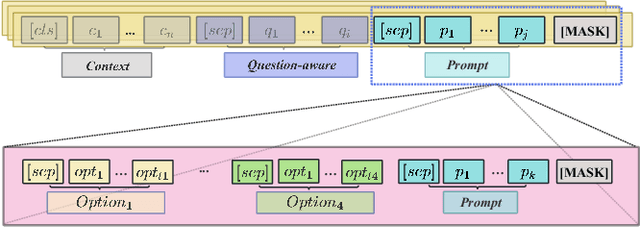
When evaluating a learner's knowledge proficiency, the multiple-choice question is an efficient and widely used format in standardized tests. Nevertheless, generating these questions, particularly plausible distractors (incorrect options), poses a considerable challenge. Generally, the distractor generation can be classified into cloze-style distractor generation (CDG) and natural questions distractor generation (NQDG). In contrast to the CDG, utilizing pre-trained language models (PLMs) for NQDG presents three primary challenges: (1) PLMs are typically trained to generate ``correct'' content, like answers, while rarely trained to generate ``plausible" content, like distractors; (2) PLMs often struggle to produce content that aligns well with specific knowledge and the style of exams; (3) NQDG necessitates the model to produce longer, context-sensitive, and question-relevant distractors. In this study, we introduce a fine-tuning framework named DGRC for NQDG in Chinese multi-choice reading comprehension from authentic examinations. DGRC comprises three major components: hard chain-of-thought, multi-task learning, and generation mask patterns. The experiment results demonstrate that DGRC significantly enhances generation performance, achieving a more than 2.5-fold improvement in BLEU scores.