 Add to Chrome
 Add to Firefox
 Add to Edge
Towards Semantic-based Agent Communication Networks: Vision, Technologies, and Challenges
Mar 25, 2026
The International Telecommunication Union (ITU) identifies "Artificial Intelligence (AI) and Communication" as one of six key usage scenarios for 6G. Agentic AI, characterized by its ca-pabilities in multi-modal environmental sensing, complex task coordination, and continuous self-optimization, is anticipated to drive the evolution toward agent-based communication net-works. Semantic communication (SemCom), in turn, has emerged as a transformative paradigm that offers task-oriented efficiency, enhanced reliability in complex environments, and dynamic adaptation in resource allocation. However, comprehensive reviews that trace their technologi-cal evolution in the contexts of agent communications remain scarce. Addressing this gap, this paper systematically explores the role of semantics in agent communication networks. We first propose a novel architecture for semantic-based agent communication networks, structured into three layers, four entities, and four stages. Three wireless agent network layers define the logical structure and organization of entity interactions: the intention extraction and understanding layer, the semantic encoding and processing layer, and the distributed autonomy and collabora-tion layer. Across these layers, four AI agent entities, namely embodied agents, communication agents, network agents, and application agents, coexist and perform distinct tasks. Furthermore, four operational stages of semantic-enhanced agentic AI systems, namely perception, memory, reasoning, and action, form a cognitive cycle guiding agent behavior. Based on the proposed architecture, we provide a comprehensive review of the state-of-the-art on how semantics en-hance agent communication networks. Finally, we identify key challenges and present potential solutions to offer directional guidance for future research in this emerging field.

From Context to EDUs: Faithful and Structured Context Compression via Elementary Discourse Unit Decomposition
Dec 18, 2025Managing extensive context remains a critical bottleneck for Large Language Models (LLMs), particularly in applications like long-document question answering and autonomous agents where lengthy inputs incur high computational costs and introduce noise. Existing compression techniques often disrupt local coherence through discrete token removal or rely on implicit latent encoding that suffers from positional bias and incompatibility with closed-source APIs. To address these limitations, we introduce the EDU-based Context Compressor, a novel explicit compression framework designed to preserve both global structure and fine-grained details. Our approach reformulates context compression as a structure-then-select process. First, our LingoEDU transforms linear text into a structural relation tree of Elementary Discourse Units (EDUs) which are anchored strictly to source indices to eliminate hallucination. Second, a lightweight ranking module selects query-relevant sub-trees for linearization. To rigorously evaluate structural understanding, we release StructBench, a manually annotated dataset of 248 diverse documents. Empirical results demonstrate that our method achieves state-of-the-art structural prediction accuracy and significantly outperforms frontier LLMs while reducing costs. Furthermore, our structure-aware compression substantially enhances performance across downstream tasks ranging from long-context tasks to complex Deep Search scenarios.
A Lightweight Target-Driven Network of Stereo Matching for Inland Waterways
Oct 10, 2024Stereo matching for inland waterways is one of the key technologies for the autonomous navigation of Unmanned Surface Vehicles (USVs), which involves dividing the stereo images into reference images and target images for pixel-level matching. However, due to the challenges of the inland waterway environment, such as blurred textures, large spatial scales, and computational resource constraints of the USVs platform, the participation of geometric features from the target image is required for efficient target-driven matching. Based on this target-driven concept, we propose a lightweight target-driven stereo matching neural network, named LTNet. Specifically, a lightweight and efficient 4D cost volume, named the Geometry Target Volume (GTV), is designed to fully utilize the geometric information of target features by employing the shifted target features as the filtered feature volume. Subsequently, to address the substantial texture interference and object occlusions present in the waterway environment, a Left-Right Consistency Refinement (LRR) module is proposed. The \text{LRR} utilizes the pixel-level differences in left and right disparities to introduce soft constraints, thereby enhancing the accuracy of predictions during the intermediate stages of the network. Moreover, knowledge distillation is utilized to enhance the generalization capability of lightweight models on the USVInland dataset. Furthermore, a new large-scale benchmark, named Spring, is utilized to validate the applicability of LTNet across various scenarios. In experiments on the aforementioned two datasets, LTNet achieves competitive results, with only 3.7M parameters. The code is available at https://github.com/Open-YiQingZhou/LTNet .
Joint Beamforming and Offloading Design for Integrated Sensing, Communication and Computation System
Jan 04, 2024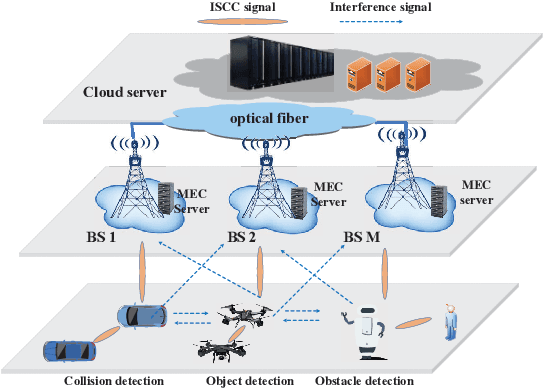
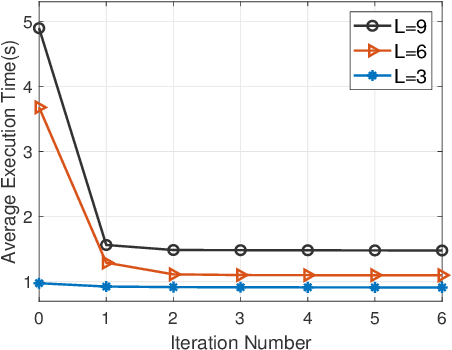
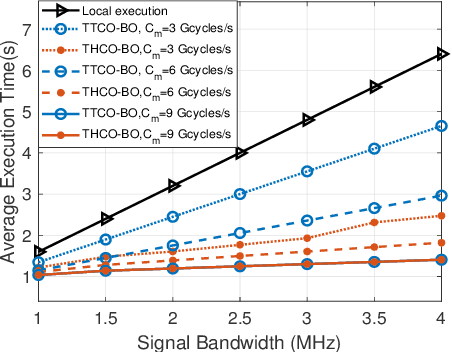
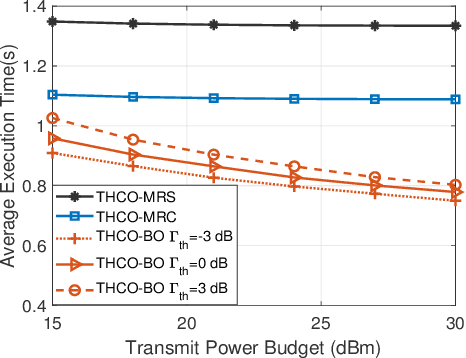
Mobile edge computing (MEC) is powerful to alleviate the heavy computing tasks in integrated sensing and communication (ISAC) systems. In this paper, we investigate joint beamforming and offloading design in a three-tier integrated sensing, communication and computation (ISCC) framework comprising one cloud server, multiple mobile edge servers, and multiple terminals. While executing sensing tasks, the user terminals can optionally offload sensing data to either MEC server or cloud servers. To minimize the execution latency, we jointly optimize the transmit beamforming matrices and offloading decision variables under the constraint of sensing performance. An alternating optimization algorithm based on multidimensional fractional programming is proposed to tackle the non-convex problem. Simulation results demonstrates the superiority of the proposed mechanism in terms of convergence and task execution latency reduction, compared with the state-of-the-art two-tier ISCC framework.