 Add to Chrome
 Add to Firefox
 Add to Edge
An Open-Source Framework for Quality-Assured Smartphone-Based Visible Light Iris Recognition
Dec 17, 2025
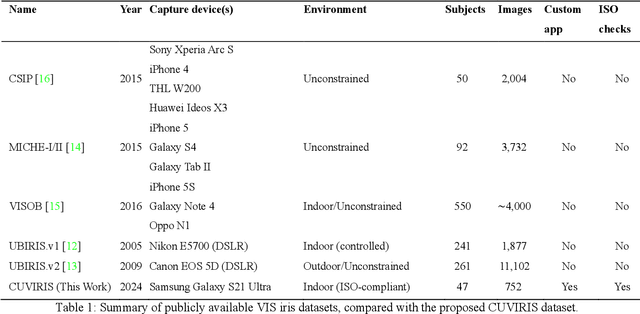
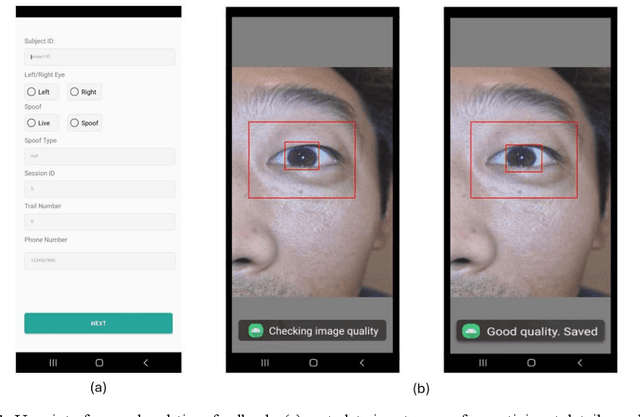
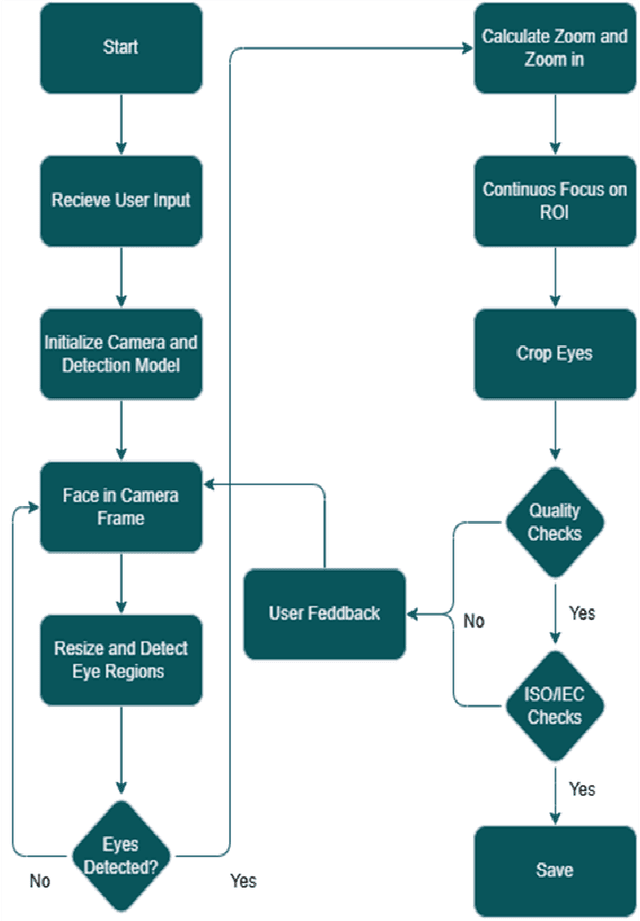

Smartphone-based iris recognition in the visible spectrum (VIS) offers a low-cost and accessible biometric alternative but remains a challenge due to lighting variability, pigmentation effects, and the limited adoption of standardized capture protocols. In this work, we present CUVIRIS, a dataset of 752 ISO/IEC 29794-6 compliant iris images from 47 subjects, collected with a custom Android application that enforces real-time framing, sharpness assessment, and quality feedback. We further introduce LightIrisNet, a MobileNetV3-based multi-task segmentation model optimized for on-device deployment. In addition, we adapt IrisFormer, a transformer-based matcher, to the VIS domain. We evaluate OSIRIS and IrisFormer under a standardized protocol and benchmark against published CNN baselines reported in prior work. On CUVIRIS, the open-source OSIRIS system achieves a TAR of 97.9% at FAR = 0.01 (EER = 0.76%), while IrisFormer, trained only on the UBIRIS.v2 dataset, achieves an EER of 0.057\%. To support reproducibility, we release the Android application, LightIrisNet, trained IrisFormer weights, and a subset of the CUVIRIS dataset. These results show that, with standardized acquisition and VIS-adapted lightweight models, accurate iris recognition on commodity smartphones is feasible under controlled conditions, bringing this modality closer to practical deployment.

Anchoring Values in Temporal and Group Dimensions for Flow Matching Model Alignment
Dec 13, 2025Group Relative Policy Optimization (GRPO) has proven highly effective in enhancing the alignment capabilities of Large Language Models (LLMs). However, current adaptations of GRPO for the flow matching-based image generation neglect a foundational conflict between its core principles and the distinct dynamics of the visual synthesis process. This mismatch leads to two key limitations: (i) Uniformly applying a sparse terminal reward across all timesteps impairs temporal credit assignment, ignoring the differing criticality of generation phases from early structure formation to late-stage tuning. (ii) Exclusive reliance on relative, intra-group rewards causes the optimization signal to fade as training converges, leading to the optimization stagnation when reward diversity is entirely depleted. To address these limitations, we propose Value-Anchored Group Policy Optimization (VGPO), a framework that redefines value estimation across both temporal and group dimensions. Specifically, VGPO transforms the sparse terminal reward into dense, process-aware value estimates, enabling precise credit assignment by modeling the expected cumulative reward at each generative stage. Furthermore, VGPO replaces standard group normalization with a novel process enhanced by absolute values to maintain a stable optimization signal even as reward diversity declines. Extensive experiments on three benchmarks demonstrate that VGPO achieves state-of-the-art image quality while simultaneously improving task-specific accuracy, effectively mitigating reward hacking. Project webpage: https://yawen-shao.github.io/VGPO/.
How AI Agents Follow the Herd of AI? Network Effects, History, and Machine Optimism
Dec 12, 2025Understanding decision-making in multi-AI-agent frameworks is crucial for analyzing strategic interactions in network-effect-driven contexts. This study investigates how AI agents navigate network-effect games, where individual payoffs depend on peer participatio--a context underexplored in multi-agent systems despite its real-world prevalence. We introduce a novel workflow design using large language model (LLM)-based agents in repeated decision-making scenarios, systematically manipulating price trajectories (fixed, ascending, descending, random) and network-effect strength. Our key findings include: First, without historical data, agents fail to infer equilibrium. Second, ordered historical sequences (e.g., escalating prices) enable partial convergence under weak network effects but strong effects trigger persistent "AI optimism"--agents overestimate participation despite contradictory evidence. Third, randomized history disrupts convergence entirely, demonstrating that temporal coherence in data shapes LLMs' reasoning, unlike humans. These results highlight a paradigm shift: in AI-mediated systems, equilibrium outcomes depend not just on incentives, but on how history is curated, which is impossible for human.
From Orbit to Ground: Generative City Photogrammetry from Extreme Off-Nadir Satellite Images
Dec 09, 2025City-scale 3D reconstruction from satellite imagery presents the challenge of extreme viewpoint extrapolation, where our goal is to synthesize ground-level novel views from sparse orbital images with minimal parallax. This requires inferring nearly $90^\circ$ viewpoint gaps from image sources with severely foreshortened facades and flawed textures, causing state-of-the-art reconstruction engines such as NeRF and 3DGS to fail. To address this problem, we propose two design choices tailored for city structures and satellite inputs. First, we model city geometry as a 2.5D height map, implemented as a Z-monotonic signed distance field (SDF) that matches urban building layouts from top-down viewpoints. This stabilizes geometry optimization under sparse, off-nadir satellite views and yields a watertight mesh with crisp roofs and clean, vertically extruded facades. Second, we paint the mesh appearance from satellite images via differentiable rendering techniques. While the satellite inputs may contain long-range, blurry captures, we further train a generative texture restoration network to enhance the appearance, recovering high-frequency, plausible texture details from degraded inputs. Our method's scalability and robustness are demonstrated through extensive experiments on large-scale urban reconstruction. For example, in our teaser figure, we reconstruct a $4\,\mathrm{km}^2$ real-world region from only a few satellite images, achieving state-of-the-art performance in synthesizing photorealistic ground views. The resulting models are not only visually compelling but also serve as high-fidelity, application-ready assets for downstream tasks like urban planning and simulation. Project page can be found at https://pku-vcl-geometry.github.io/Orbit2Ground/.
Wan-Move: Motion-controllable Video Generation via Latent Trajectory Guidance
Dec 09, 2025We present Wan-Move, a simple and scalable framework that brings motion control to video generative models. Existing motion-controllable methods typically suffer from coarse control granularity and limited scalability, leaving their outputs insufficient for practical use. We narrow this gap by achieving precise and high-quality motion control. Our core idea is to directly make the original condition features motion-aware for guiding video synthesis. To this end, we first represent object motions with dense point trajectories, allowing fine-grained control over the scene. We then project these trajectories into latent space and propagate the first frame's features along each trajectory, producing an aligned spatiotemporal feature map that tells how each scene element should move. This feature map serves as the updated latent condition, which is naturally integrated into the off-the-shelf image-to-video model, e.g., Wan-I2V-14B, as motion guidance without any architecture change. It removes the need for auxiliary motion encoders and makes fine-tuning base models easily scalable. Through scaled training, Wan-Move generates 5-second, 480p videos whose motion controllability rivals Kling 1.5 Pro's commercial Motion Brush, as indicated by user studies. To support comprehensive evaluation, we further design MoveBench, a rigorously curated benchmark featuring diverse content categories and hybrid-verified annotations. It is distinguished by larger data volume, longer video durations, and high-quality motion annotations. Extensive experiments on MoveBench and the public dataset consistently show Wan-Move's superior motion quality. Code, models, and benchmark data are made publicly available.
Unison: A Fully Automatic, Task-Universal, and Low-Cost Framework for Unified Understanding and Generation
Dec 08, 2025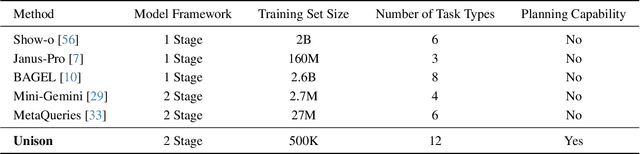
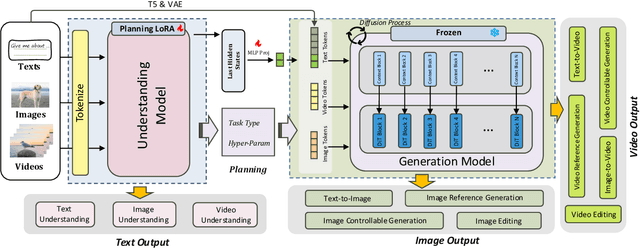
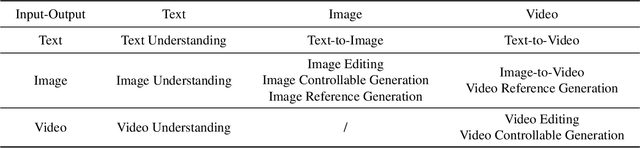

Unified understanding and generation is a highly appealing research direction in multimodal learning. There exist two approaches: one trains a transformer via an auto-regressive paradigm, and the other adopts a two-stage scheme connecting pre-trained understanding and generative models for alignment fine-tuning. The former demands massive data and computing resources unaffordable for ordinary researchers. Though the latter requires a lower training cost, existing works often suffer from limited task coverage or poor generation quality. Both approaches lack the ability to parse input meta-information (such as task type, image resolution, video duration, etc.) and require manual parameter configuration that is tedious and non-intelligent. In this paper, we propose Unison which adopts the two-stage scheme while preserving the capabilities of the pre-trained models well. With an extremely low training cost, we cover a variety of multimodal understanding tasks, including text, image, and video understanding, as well as diverse generation tasks, such as text-to-visual content generation, editing, controllable generation, and IP-based reference generation. We also equip our model with the ability to automatically parse user intentions, determine the target task type, and accurately extract the meta-information required for the corresponding task. This enables full automation of various multimodal tasks without human intervention. Experiments demonstrate that, under a low-cost setting of only 500k training samples and 50 GPU hours, our model can accurately and automatically identify tasks and extract relevant parameters, and achieve superior performance across a variety of understanding and generation tasks.
PathMind: A Retrieve-Prioritize-Reason Framework for Knowledge Graph Reasoning with Large Language Models
Nov 18, 2025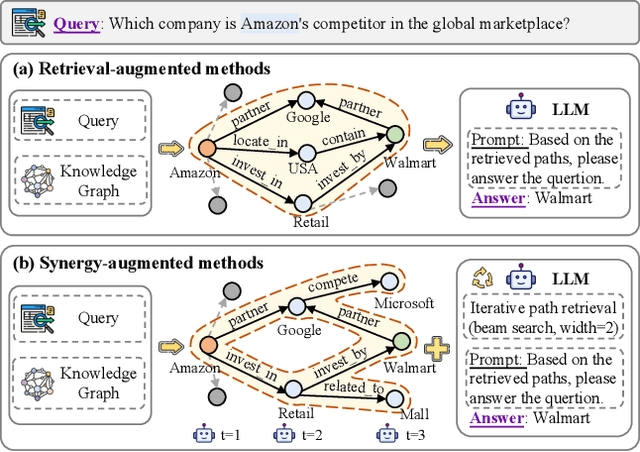
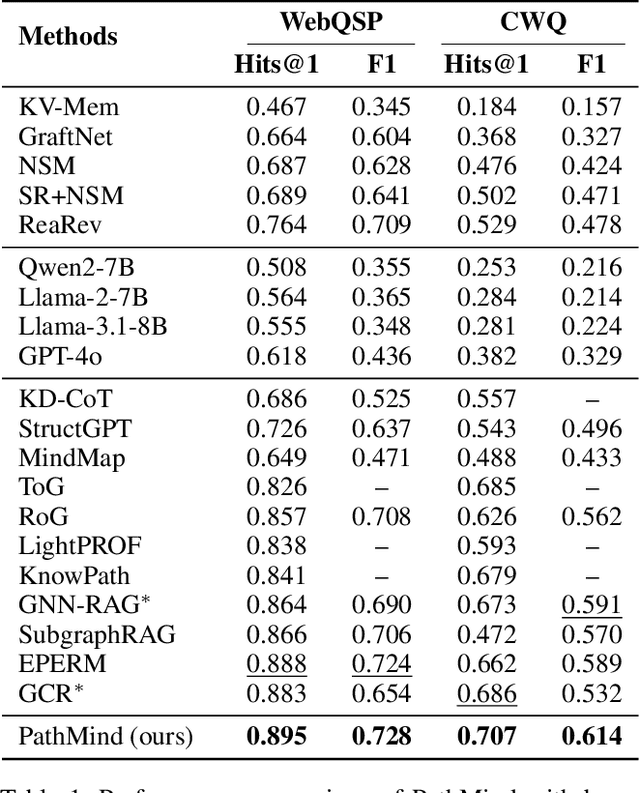
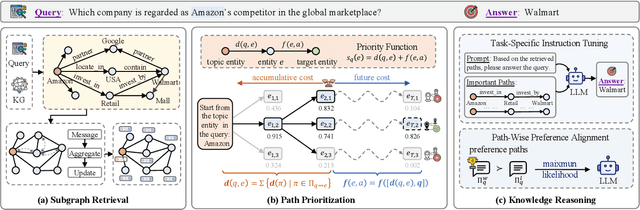
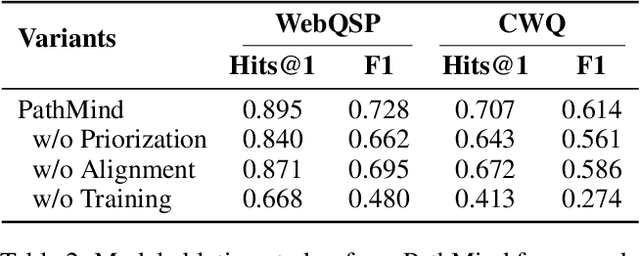
Knowledge graph reasoning (KGR) is the task of inferring new knowledge by performing logical deductions on knowledge graphs. Recently, large language models (LLMs) have demonstrated remarkable performance in complex reasoning tasks. Despite promising success, current LLM-based KGR methods still face two critical limitations. First, existing methods often extract reasoning paths indiscriminately, without assessing their different importance, which may introduce irrelevant noise that misleads LLMs. Second, while many methods leverage LLMs to dynamically explore potential reasoning paths, they require high retrieval demands and frequent LLM calls. To address these limitations, we propose PathMind, a novel framework designed to enhance faithful and interpretable reasoning by selectively guiding LLMs with important reasoning paths. Specifically, PathMind follows a "Retrieve-Prioritize-Reason" paradigm. First, it retrieves a query subgraph from KG through the retrieval module. Next, it introduces a path prioritization mechanism that identifies important reasoning paths using a semantic-aware path priority function, which simultaneously considers the accumulative cost and the estimated future cost for reaching the target. Finally, PathMind generates accurate and logically consistent responses via a dual-phase training strategy, including task-specific instruction tuning and path-wise preference alignment. Extensive experiments on benchmark datasets demonstrate that PathMind consistently outperforms competitive baselines, particularly on complex reasoning tasks with fewer input tokens, by identifying essential reasoning paths.
FDP: A Frequency-Decomposition Preprocessing Pipeline for Unsupervised Anomaly Detection in Brain MRI
Nov 17, 2025Due to the diversity of brain anatomy and the scarcity of annotated data, supervised anomaly detection for brain MRI remains challenging, driving the development of unsupervised anomaly detection (UAD) approaches. Current UAD methods typically utilize artificially generated noise perturbations on healthy MRIs to train generative models for normal anatomy reconstruction, enabling anomaly detection via residual mapping. However, such simulated anomalies lack the biophysical fidelity and morphological complexity characteristic of true clinical lesions. To advance UAD in brain MRI, we conduct the first systematic frequency-domain analysis of pathological signatures, revealing two key properties: (1) anomalies exhibit unique frequency patterns distinguishable from normal anatomy, and (2) low-frequency signals maintain consistent representations across healthy scans. These insights motivate our Frequency-Decomposition Preprocessing (FDP) framework, the first UAD method to leverage frequency-domain reconstruction for simultaneous pathology suppression and anatomical preservation. FDP can integrate seamlessly with existing anomaly simulation techniques, consistently enhancing detection performance across diverse architectures while maintaining diagnostic fidelity. Experimental results demonstrate that FDP consistently improves anomaly detection performance when integrated with existing methods. Notably, FDP achieves a 17.63% increase in DICE score with LDM while maintaining robust improvements across multiple baselines. The code is available at https://github.com/ls1rius/MRI_FDP.
ROI-based Deep Image Compression with Implicit Bit Allocation
Nov 12, 2025Region of Interest (ROI)-based image compression has rapidly developed due to its ability to maintain high fidelity in important regions while reducing data redundancy. However, existing compression methods primarily apply masks to suppress background information before quantization. This explicit bit allocation strategy, which uses hard gating, significantly impacts the statistical distribution of the entropy model, thereby limiting the coding performance of the compression model. In response, this work proposes an efficient ROI-based deep image compression model with implicit bit allocation. To better utilize ROI masks for implicit bit allocation, this paper proposes a novel Mask-Guided Feature Enhancement (MGFE) module, comprising a Region-Adaptive Attention (RAA) block and a Frequency-Spatial Collaborative Attention (FSCA) block. This module allows for flexible bit allocation across different regions while enhancing global and local features through frequencyspatial domain collaboration. Additionally, we use dual decoders to separately reconstruct foreground and background images, enabling the coding network to optimally balance foreground enhancement and background quality preservation in a datadriven manner. To the best of our knowledge, this is the first work to utilize implicit bit allocation for high-quality regionadaptive coding. Experiments on the COCO2017 dataset show that our implicit-based image compression method significantly outperforms explicit bit allocation approaches in rate-distortion performance, achieving optimal results while maintaining satisfactory visual quality in the reconstructed background regions.
Do LLMs Feel? Teaching Emotion Recognition with Prompts, Retrieval, and Curriculum Learning
Nov 12, 2025Emotion Recognition in Conversation (ERC) is a crucial task for understanding human emotions and enabling natural human-computer interaction. Although Large Language Models (LLMs) have recently shown great potential in this field, their ability to capture the intrinsic connections between explicit and implicit emotions remains limited. We propose a novel ERC training framework, PRC-Emo, which integrates Prompt engineering, demonstration Retrieval, and Curriculum learning, with the goal of exploring whether LLMs can effectively perceive emotions in conversational contexts. Specifically, we design emotion-sensitive prompt templates based on both explicit and implicit emotional cues to better guide the model in understanding the speaker's psychological states. We construct the first dedicated demonstration retrieval repository for ERC, which includes training samples from widely used datasets, as well as high-quality dialogue examples generated by LLMs and manually verified. Moreover, we introduce a curriculum learning strategy into the LoRA fine-tuning process, incorporating weighted emotional shifts between same-speaker and different-speaker utterances to assign difficulty levels to dialogue samples, which are then organized in an easy-to-hard training sequence. Experimental results on two benchmark datasets -- IEMOCAP and MELD -- show that our method achieves new state-of-the-art (SOTA) performance, demonstrating the effectiveness and generalizability of our approach in improving LLM-based emotional understanding.