 Add to Chrome
 Add to Firefox
 Add to Edge
An Open-Source Framework for Quality-Assured Smartphone-Based Visible Light Iris Recognition
Dec 17, 2025
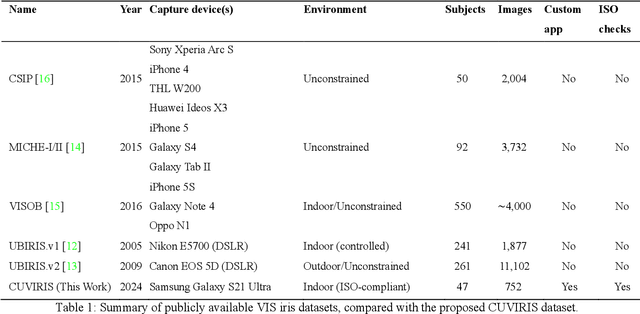
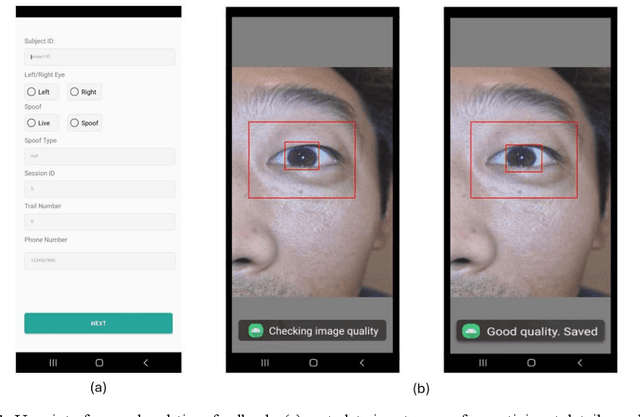
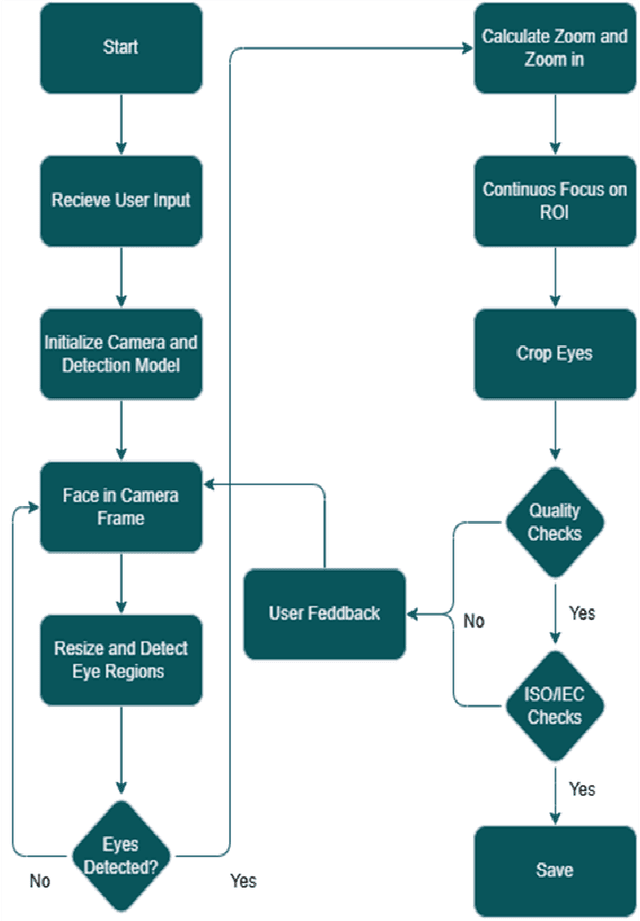
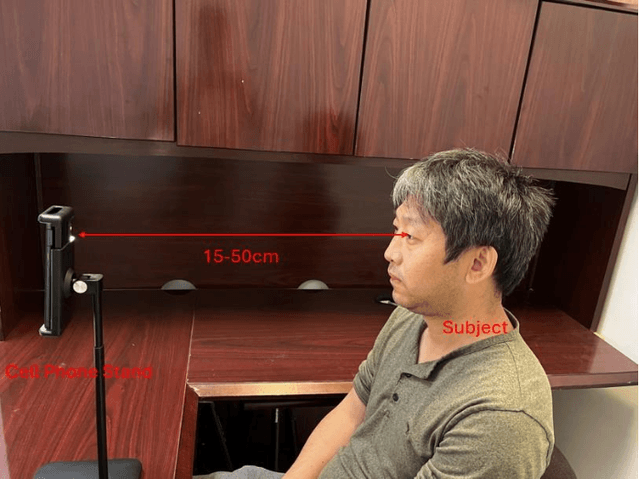
Smartphone-based iris recognition in the visible spectrum (VIS) offers a low-cost and accessible biometric alternative but remains a challenge due to lighting variability, pigmentation effects, and the limited adoption of standardized capture protocols. In this work, we present CUVIRIS, a dataset of 752 ISO/IEC 29794-6 compliant iris images from 47 subjects, collected with a custom Android application that enforces real-time framing, sharpness assessment, and quality feedback. We further introduce LightIrisNet, a MobileNetV3-based multi-task segmentation model optimized for on-device deployment. In addition, we adapt IrisFormer, a transformer-based matcher, to the VIS domain. We evaluate OSIRIS and IrisFormer under a standardized protocol and benchmark against published CNN baselines reported in prior work. On CUVIRIS, the open-source OSIRIS system achieves a TAR of 97.9% at FAR = 0.01 (EER = 0.76%), while IrisFormer, trained only on the UBIRIS.v2 dataset, achieves an EER of 0.057\%. To support reproducibility, we release the Android application, LightIrisNet, trained IrisFormer weights, and a subset of the CUVIRIS dataset. These results show that, with standardized acquisition and VIS-adapted lightweight models, accurate iris recognition on commodity smartphones is feasible under controlled conditions, bringing this modality closer to practical deployment.

User Authentication and Vital Signs Extraction from Low-Frame-Rate and Monochrome No-contact Fingerprint Captures
Dec 10, 2024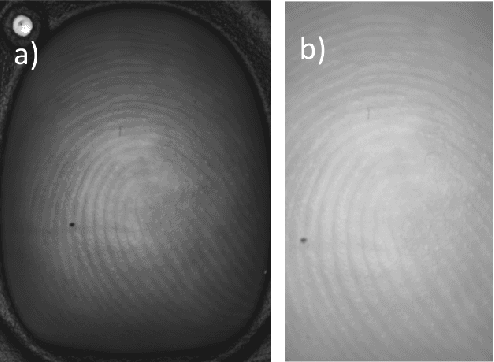

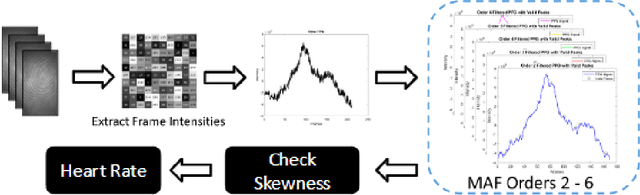
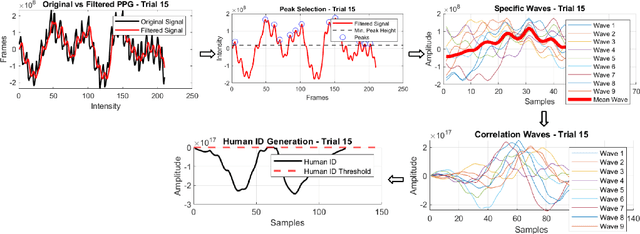
We present our work on leveraging low-frame-rate monochrome (blue light) videos of fingertips, captured with an off-the-shelf fingerprint capture device, to extract vital signs and identify users. These videos utilize photoplethysmography (PPG), commonly used to measure vital signs like heart rate. While prior research predominantly utilizes high-frame-rate, multi-wavelength PPG sensors (e.g., infrared, red, or RGB), our preliminary findings demonstrate that both user identification and vital sign extraction are achievable with the low-frame-rate data we collected. Preliminary results are promising, with low error rates for both heart rate estimation and user authentication. These results indicate promise for effective biometric systems. We anticipate further optimization will enhance accuracy and advance healthcare and security.