 Add to Chrome
 Add to Firefox
 Add to Edge
MTVDiff: Multimodal Conditional Latent Diffusion for Enhanced Thermal-to-Visible Face Translation
Jul 22, 2026
Thermal-to-visible face translation presents fundamental challenges including geometric discontinuities, semantic attribute mismatches, and identity degradation. We propose MTVDiff, a novel multimodal latent diffusion framework that synergistically integrates depth and textual information to address these limitations while preserving identity characteristics. The MTVDiff framework presents three core technical contributions: (1) a Dual-Branch Cross-Attention Fusion (DBCAF) module for multi-scale thermal-depth feature extraction and fusion; (2) a Gated Text-to-Visual Feature Alignment mechanism for semantically-guided generation; and (3) Spatial Feature Transformations (SFT) for adaptive multimodal prior integration. Extensive experiments on the MCXFace and SpeakingFaces datasets demonstrate that our multimodal approach significantly outperforms existing GAN-based and diffusion-based approaches across multiple metrics, achieving substantial improvements in both image quality and face verification performance, with FID reductions of up to 48.3% and Rank-1 accuracy improvements of up to 8.9\%. Our work provides a robust solution for face recognition systems operating under varying illumination conditions and advances the state-of-the-art in cross-spectral facial image translation through effective multimodal integration.

OmniShow: Unifying Multimodal Conditions for Human-Object Interaction Video Generation
Apr 13, 2026In this work, we study Human-Object Interaction Video Generation (HOIVG), which aims to synthesize high-quality human-object interaction videos conditioned on text, reference images, audio, and pose. This task holds significant practical value for automating content creation in real-world applications, such as e-commerce demonstrations, short video production, and interactive entertainment. However, existing approaches fail to accommodate all these requisite conditions. We present OmniShow, an end-to-end framework tailored for this practical yet challenging task, capable of harmonizing multimodal conditions and delivering industry-grade performance. To overcome the trade-off between controllability and quality, we introduce Unified Channel-wise Conditioning for efficient image and pose injection, and Gated Local-Context Attention to ensure precise audio-visual synchronization. To effectively address data scarcity, we develop a Decoupled-Then-Joint Training strategy that leverages a multi-stage training process with model merging to efficiently harness heterogeneous sub-task datasets. Furthermore, to fill the evaluation gap in this field, we establish HOIVG-Bench, a dedicated and comprehensive benchmark for HOIVG. Extensive experiments demonstrate that OmniShow achieves overall state-of-the-art performance across various multimodal conditioning settings, setting a solid standard for the emerging HOIVG task.
Fast and Scalable Analytical Diffusion
Feb 18, 2026Analytical diffusion models offer a mathematically transparent path to generative modeling by formulating the denoising score as an empirical-Bayes posterior mean. However, this interpretability comes at a prohibitive cost: the standard formulation necessitates a full-dataset scan at every timestep, scaling linearly with dataset size. In this work, we present the first systematic study addressing this scalability bottleneck. We challenge the prevailing assumption that the entire training data is necessary, uncovering the phenomenon of Posterior Progressive Concentration: the effective golden support of the denoising score is not static but shrinks asymptotically from the global manifold to a local neighborhood as the signal-to-noise ratio increases. Capitalizing on this, we propose Dynamic Time-Aware Golden Subset Diffusion (GoldDiff), a training-free framework that decouples inference complexity from dataset size. Instead of static retrieval, GoldDiff uses a coarse-to-fine mechanism to dynamically pinpoint the ''Golden Subset'' for inference. Theoretically, we derive rigorous bounds guaranteeing that our sparse approximation converges to the exact score. Empirically, GoldDiff achieves a $\bf 71 \times$ speedup on AFHQ while matching or achieving even better performance than full-scan baselines. Most notably, we demonstrate the first successful scaling of analytical diffusion to ImageNet-1K, unlocking a scalable, training-free paradigm for large-scale generative modeling.
IdentityStory: Taming Your Identity-Preserving Generator for Human-Centric Story Generation
Dec 29, 2025Recent visual generative models enable story generation with consistent characters from text, but human-centric story generation faces additional challenges, such as maintaining detailed and diverse human face consistency and coordinating multiple characters across different images. This paper presents IdentityStory, a framework for human-centric story generation that ensures consistent character identity across multiple sequential images. By taming identity-preserving generators, the framework features two key components: Iterative Identity Discovery, which extracts cohesive character identities, and Re-denoising Identity Injection, which re-denoises images to inject identities while preserving desired context. Experiments on the ConsiStory-Human benchmark demonstrate that IdentityStory outperforms existing methods, particularly in face consistency, and supports multi-character combinations. The framework also shows strong potential for applications such as infinite-length story generation and dynamic character composition.
FDP: A Frequency-Decomposition Preprocessing Pipeline for Unsupervised Anomaly Detection in Brain MRI
Nov 17, 2025Due to the diversity of brain anatomy and the scarcity of annotated data, supervised anomaly detection for brain MRI remains challenging, driving the development of unsupervised anomaly detection (UAD) approaches. Current UAD methods typically utilize artificially generated noise perturbations on healthy MRIs to train generative models for normal anatomy reconstruction, enabling anomaly detection via residual mapping. However, such simulated anomalies lack the biophysical fidelity and morphological complexity characteristic of true clinical lesions. To advance UAD in brain MRI, we conduct the first systematic frequency-domain analysis of pathological signatures, revealing two key properties: (1) anomalies exhibit unique frequency patterns distinguishable from normal anatomy, and (2) low-frequency signals maintain consistent representations across healthy scans. These insights motivate our Frequency-Decomposition Preprocessing (FDP) framework, the first UAD method to leverage frequency-domain reconstruction for simultaneous pathology suppression and anatomical preservation. FDP can integrate seamlessly with existing anomaly simulation techniques, consistently enhancing detection performance across diverse architectures while maintaining diagnostic fidelity. Experimental results demonstrate that FDP consistently improves anomaly detection performance when integrated with existing methods. Notably, FDP achieves a 17.63% increase in DICE score with LDM while maintaining robust improvements across multiple baselines. The code is available at https://github.com/ls1rius/MRI_FDP.
SceneDecorator: Towards Scene-Oriented Story Generation with Scene Planning and Scene Consistency
Oct 27, 2025Recent text-to-image models have revolutionized image generation, but they still struggle with maintaining concept consistency across generated images. While existing works focus on character consistency, they often overlook the crucial role of scenes in storytelling, which restricts their creativity in practice. This paper introduces scene-oriented story generation, addressing two key challenges: (i) scene planning, where current methods fail to ensure scene-level narrative coherence by relying solely on text descriptions, and (ii) scene consistency, which remains largely unexplored in terms of maintaining scene consistency across multiple stories. We propose SceneDecorator, a training-free framework that employs VLM-Guided Scene Planning to ensure narrative coherence across different scenes in a ``global-to-local'' manner, and Long-Term Scene-Sharing Attention to maintain long-term scene consistency and subject diversity across generated stories. Extensive experiments demonstrate the superior performance of SceneDecorator, highlighting its potential to unleash creativity in the fields of arts, films, and games.
HERO: Hierarchical Extrapolation and Refresh for Efficient World Models
Aug 25, 2025
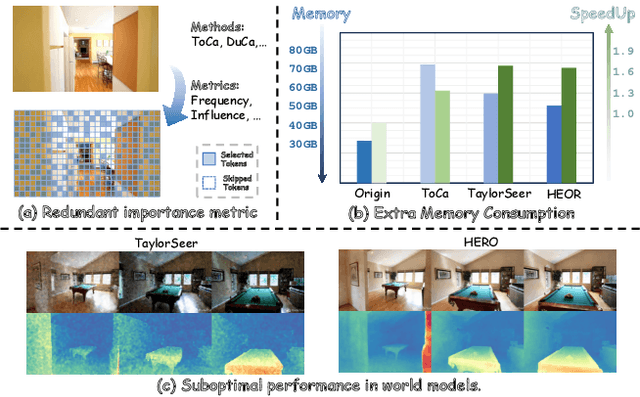
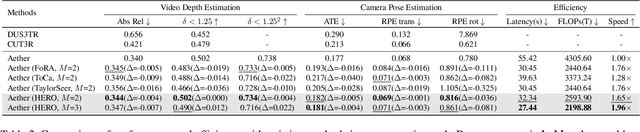

Generation-driven world models create immersive virtual environments but suffer slow inference due to the iterative nature of diffusion models. While recent advances have improved diffusion model efficiency, directly applying these techniques to world models introduces limitations such as quality degradation. In this paper, we present HERO, a training-free hierarchical acceleration framework tailored for efficient world models. Owing to the multi-modal nature of world models, we identify a feature coupling phenomenon, wherein shallow layers exhibit high temporal variability, while deeper layers yield more stable feature representations. Motivated by this, HERO adopts hierarchical strategies to accelerate inference: (i) In shallow layers, a patch-wise refresh mechanism efficiently selects tokens for recomputation. With patch-wise sampling and frequency-aware tracking, it avoids extra metric computation and remain compatible with FlashAttention. (ii) In deeper layers, a linear extrapolation scheme directly estimates intermediate features. This completely bypasses the computations in attention modules and feed-forward networks. Our experiments show that HERO achieves a 1.73$\times$ speedup with minimal quality degradation, significantly outperforming existing diffusion acceleration methods.
HybridGS: Decoupling Transients and Statics with 2D and 3D Gaussian Splatting
Dec 05, 2024


Generating high-quality novel view renderings of 3D Gaussian Splatting (3DGS) in scenes featuring transient objects is challenging. We propose a novel hybrid representation, termed as HybridGS, using 2D Gaussians for transient objects per image and maintaining traditional 3D Gaussians for the whole static scenes. Note that, the 3DGS itself is better suited for modeling static scenes that assume multi-view consistency, but the transient objects appear occasionally and do not adhere to the assumption, thus we model them as planar objects from a single view, represented with 2D Gaussians. Our novel representation decomposes the scene from the perspective of fundamental viewpoint consistency, making it more reasonable. Additionally, we present a novel multi-view regulated supervision method for 3DGS that leverages information from co-visible regions, further enhancing the distinctions between the transients and statics. Then, we propose a straightforward yet effective multi-stage training strategy to ensure robust training and high-quality view synthesis across various settings. Experiments on benchmark datasets show our state-of-the-art performance of novel view synthesis in both indoor and outdoor scenes, even in the presence of distracting elements.
A Grey-box Attack against Latent Diffusion Model-based Image Editing by Posterior Collapse
Aug 20, 2024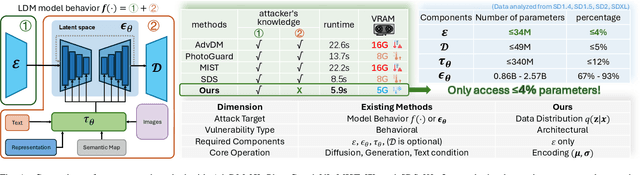
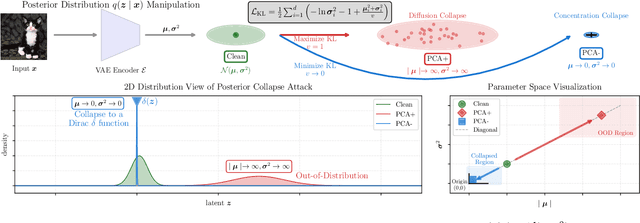
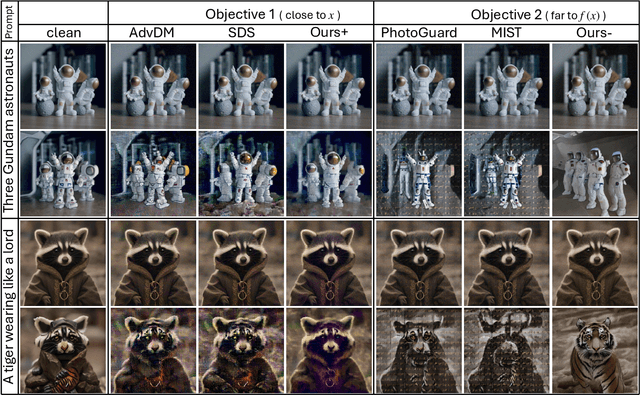
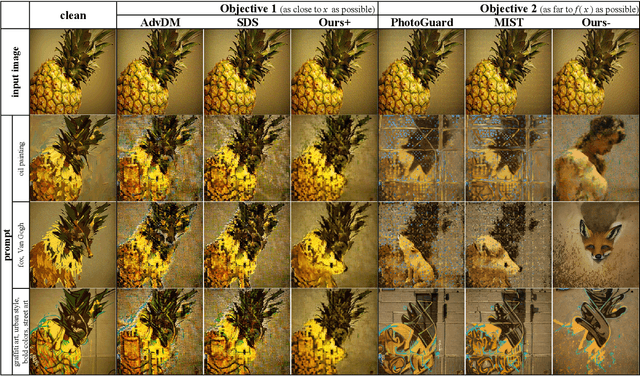
Recent advancements in generative AI, particularly Latent Diffusion Models (LDMs), have revolutionized image synthesis and manipulation. However, these generative techniques raises concerns about data misappropriation and intellectual property infringement. Adversarial attacks on machine learning models have been extensively studied, and a well-established body of research has extended these techniques as a benign metric to prevent the underlying misuse of generative AI. Current approaches to safeguarding images from manipulation by LDMs are limited by their reliance on model-specific knowledge and their inability to significantly degrade semantic quality of generated images. In response to these shortcomings, we propose the Posterior Collapse Attack (PCA) based on the observation that VAEs suffer from posterior collapse during training. Our method minimizes dependence on the white-box information of target models to get rid of the implicit reliance on model-specific knowledge. By accessing merely a small amount of LDM parameters, in specific merely the VAE encoder of LDMs, our method causes a substantial semantic collapse in generation quality, particularly in perceptual consistency, and demonstrates strong transferability across various model architectures. Experimental results show that PCA achieves superior perturbation effects on image generation of LDMs with lower runtime and VRAM. Our method outperforms existing techniques, offering a more robust and generalizable solution that is helpful in alleviating the socio-technical challenges posed by the rapidly evolving landscape of generative AI.
DiffX: Guide Your Layout to Cross-Modal Generative Modeling
Jul 28, 2024


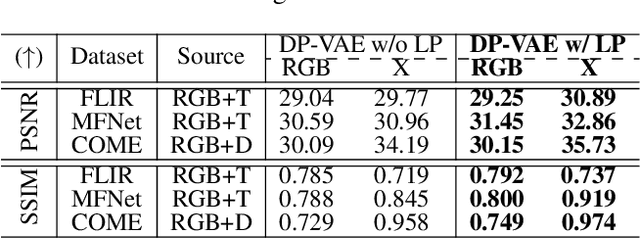
Diffusion models have made significant strides in language-driven and layout-driven image generation. However, most diffusion models are limited to visible RGB image generation. In fact, human perception of the world is enriched by diverse viewpoints, including chromatic contrast, thermal illumination, and depth information. In this paper, we introduce a novel diffusion model for general layout-guided cross-modal ``RGB+X'' generation, called DiffX. Firstly, we construct the cross-modal image datasets with text description by using LLaVA for image captioning, supplemented by manual corrections. Notably, DiffX presents a simple yet effective cross-modal generative modeling pipeline, which conducts diffusion and denoising processes in the modality-shared latent space, facilitated by our Dual Path Variational AutoEncoder (DP-VAE). Moreover, we introduce the joint-modality embedder, which incorporates a gated cross-attention mechanism to link layout and text conditions. Meanwhile, the advanced Long-CLIP is employed for long caption embedding to improve user guidance. Through extensive experiments, DiffX demonstrates robustness and flexibility in cross-modal generation across three RGB+X datasets: FLIR, MFNet, and COME15K, guided by various layout types. It also shows the potential for adaptive generation of ``RGB+X+Y'' or more diverse modalities. Our code and constructed cross-modal image datasets are available at https://github.com/zeyuwang-zju/DiffX.