 Add to Chrome
 Add to Firefox
 Add to Edge
An Open-Source Framework for Quality-Assured Smartphone-Based Visible Light Iris Recognition
Paper and Code

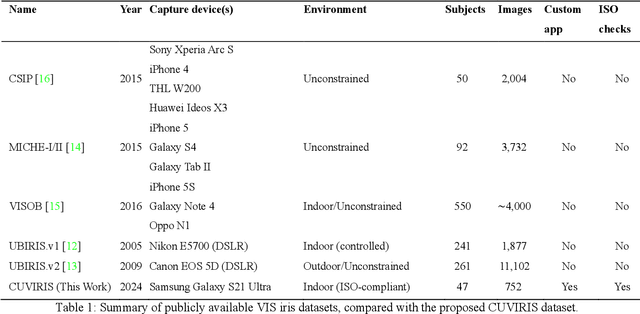
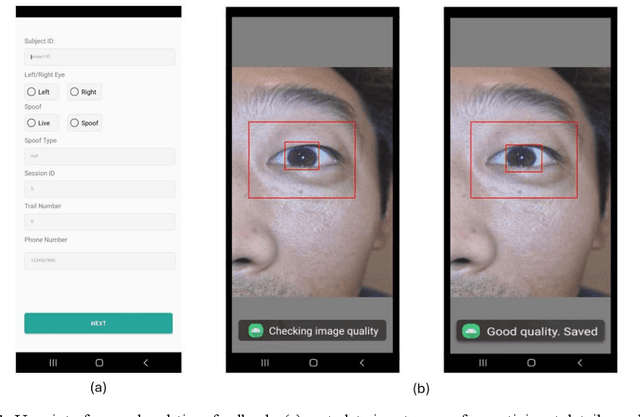
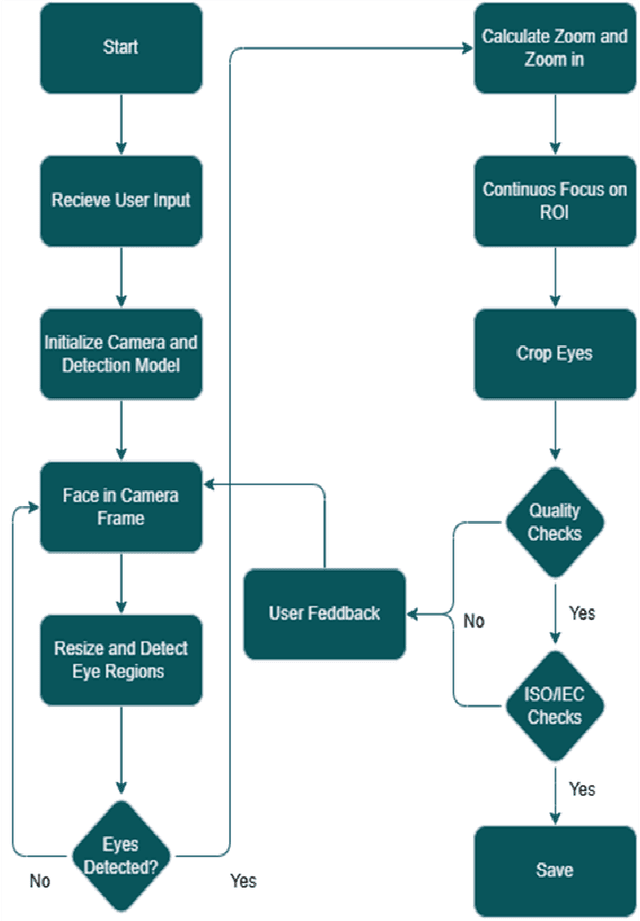
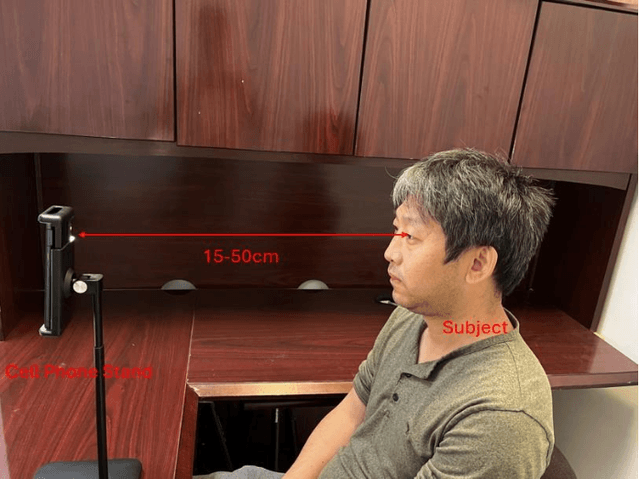
Smartphone-based iris recognition in the visible spectrum (VIS) offers a low-cost and accessible biometric alternative but remains a challenge due to lighting variability, pigmentation effects, and the limited adoption of standardized capture protocols. In this work, we present CUVIRIS, a dataset of 752 ISO/IEC 29794-6 compliant iris images from 47 subjects, collected with a custom Android application that enforces real-time framing, sharpness assessment, and quality feedback. We further introduce LightIrisNet, a MobileNetV3-based multi-task segmentation model optimized for on-device deployment. In addition, we adapt IrisFormer, a transformer-based matcher, to the VIS domain. We evaluate OSIRIS and IrisFormer under a standardized protocol and benchmark against published CNN baselines reported in prior work. On CUVIRIS, the open-source OSIRIS system achieves a TAR of 97.9% at FAR = 0.01 (EER = 0.76%), while IrisFormer, trained only on the UBIRIS.v2 dataset, achieves an EER of 0.057\%. To support reproducibility, we release the Android application, LightIrisNet, trained IrisFormer weights, and a subset of the CUVIRIS dataset. These results show that, with standardized acquisition and VIS-adapted lightweight models, accurate iris recognition on commodity smartphones is feasible under controlled conditions, bringing this modality closer to practical deployment.
