 Add to Chrome
 Add to Firefox
 Add to Edge
Message Tuning Outshines Graph Prompt Tuning: A Prismatic Space Perspective
Jun 02, 2026
Graph Foundation Models (GFMs), built upon the Pre-training and Adaptation paradigm, have emerged as a research hotspot in graph learning. For GNN-based GFMs, graph prompt tuning has become the prevailing adaptation method for downstream tasks. Although recent methods explain why graph prompt tuning works, how to rigorously measure its adaptation capacity remains an open problem. Addressing this problem is critical for understanding the capability limits of graph prompt tuning and for developing more powerful adaptation methods. In this paper, we propose Prismatic Space Theory (PS-Theory), a novel mathematical framework to quantify the capacity of adaptation methods, while focusing on establishing the upper bound for the adaptation capacity of graph prompt tuning. Building upon the proposed PS-Theory, we further introduce Message Tuning for GFMs (MTG), a lightweight approach that injects a small set of learnable message prototypes into each layer of the GNN backbone to adaptively guide message fusion without updating pre-trained weights. Through our PS-Theory, we prove that the adaptation capacity of MTG can exceed the theoretical upper bound of graph prompt tuning. Extensive experiments demonstrate that MTG consistently outperforms graph prompt baselines across diverse benchmark datasets, providing strong empirical support for our theoretical findings.

AbstainGNN: Teaching Graph Neural Networks to Abstain for Graph Classification
May 29, 2026Graph classification is a core task in graph data mining with widespread real-world applications. Recent advances in graph neural networks (GNNs) have led to substantial performance improvements for graph classification. However, existing GNNs are typically forced to make predictions even under high uncertainty or unknown conditions, resulting in unreliable decisions that can severely impact downstream tasks, particularly in safety-critical scenarios. To address this critical limitation, we propose AbstainGNN, a novel and theory-driven framework for graph classification with abstention, which enables GNNs to reject uncertain predictions instead of producing incorrect decisions. Specifically, AbstainGNN explicitly models both the predictive function and the abstention function, allowing for effective utilization of graph structural information. Moreover, unlike existing heuristic abstention methods, we theoretically characterize the trade-off between classification errors and rejection costs from a PAC-Bayesian generalization perspective, and derive a unified learning objective for model optimization. Guided by this theoretical insight, we further develop an efficient two-stage training strategy consisting of predictive function warm-start and abstention function calibration. Extensive experiments on five benchmark datasets show that AbstainGNN outperforms existing abstention methods, achieving superior classification performance under the same rejection rates.
SafeHarness: Lifecycle-Integrated Security Architecture for LLM-based Agent Deployment
Apr 15, 2026The performance of large language model (LLM) agents depends critically on the execution harness, the system layer that orchestrates tool use, context management, and state persistence. Yet this same architectural centrality makes the harness a high-value attack surface: a single compromise at the harness level can cascade through the entire execution pipeline. We observe that existing security approaches suffer from structural mismatch, leaving them blind to harness-internal state and unable to coordinate across the different phases of agent operation. In this paper, we introduce \safeharness{}, a security architecture in which four proposed defense layers are woven directly into the agent lifecycle to address above significant limitations: adversarial context filtering at input processing, tiered causal verification at decision making, privilege-separated tool control at action execution, and safe rollback with adaptive degradation at state update. The proposed cross-layer mechanisms tie these layers together, escalating verification rigor, triggering rollbacks, and tightening tool privileges whenever sustained anomalies are detected. We evaluate \safeharness{} on benchmark datasets across diverse harness configurations, comparing against four security baselines under five attack scenarios spanning six threat categories. Compared to the unprotected baseline, \safeharness{} achieves an average reduction of approximately 38\% in UBR and 42\% in ASR, substantially lowering both the unsafe behavior rate and the attack success rate while preserving core task utility.
CIA: Inferring the Communication Topology from LLM-based Multi-Agent Systems
Apr 14, 2026LLM-based Multi-Agent Systems (MAS) have demonstrated remarkable capabilities in solving complex tasks. Central to MAS is the communication topology which governs how agents exchange information internally. Consequently, the security of communication topologies has attracted increasing attention. In this paper, we investigate a critical privacy risk: MAS communication topologies can be inferred under a restrictive black-box setting, exposing system vulnerabilities and posing significant intellectual property threats. To explore this risk, we propose Communication Inference Attack (CIA), a novel attack that constructs new adversarial queries to induce intermediate agents' reasoning outputs and models their semantic correlations through the proposed global bias disentanglement and LLM-guided weak supervision. Extensive experiments on MAS with optimized communication topologies demonstrate the effectiveness of CIA, achieving an average AUC of 0.87 and a peak AUC of up to 0.99, thereby revealing the substantial privacy risk in MAS.
Hypergraph Neural Diffusion: A PDE-Inspired Framework for Hypergraph Message Passing
Apr 13, 2026Hypergraph neural networks (HGNNs) have shown remarkable potential in modeling high-order relationships that naturally arise in many real-world data domains. However, existing HGNNs often suffer from shallow propagation, oversmoothing, and limited adaptability to complex hypergraph structures. In this paper, we propose Hypergraph Neural Diffusion (HND), a novel framework that unifies nonlinear diffusion equations with neural message passing on hypergraphs. HND is grounded in a continuous-time hypergraph diffusion equation, formulated via hypergraph gradient and divergence operators, and modulated by a learnable, structure-aware coefficient matrix over hyperedge-node pairs. This partial differential equation (PDE) based formulation provides a physically interpretable view of hypergraph learning, where feature propagation is understood as an anisotropic diffusion process governed by local inconsistency and adaptive diffusion coefficient. From this perspective, neural message passing becomes a discretized gradient flow that progressively minimizes a diffusion energy functional. We derive rigorous theoretical guarantees, including energy dissipation, solution boundedness via a discrete maximum principle, and stability under explicit and implicit numerical schemes. The HND framework supports a variety of integration strategies such as non-adaptive-step (like Runge-Kutta) and adaptive-step solvers, enabling the construction of deep, stable, and interpretable architectures. Extensive experiments on benchmark datasets demonstrate that HND achieves competitive performance. Our results highlight the power of PDE-inspired design in enhancing the stability, expressivity, and interpretability of hypergraph learning.
Do LLMs Know Tool Irrelevance? Demystifying Structural Alignment Bias in Tool Invocations
Apr 13, 2026Large language models (LLMs) have demonstrated impressive capabilities in utilizing external tools. In practice, however, LLMs are often exposed to tools that are irrelevant to the user's query, in which case the desired behavior is to refrain from invocations. In this work, we identify a widespread yet overlooked mechanistic flaw in tool refusal, which we term structural alignment bias: Even when a tool fails to serve the user's goal, LLMs still tend to invoke it whenever query attributes can be validly assigned to tool parameters. To systematically study this bias, we introduce SABEval, a new dataset that decouples structural alignment from semantic relevance. Our analysis shows that structural alignment bias induces severe tool-invocation errors in LLMs, yet remains largely unaccounted for in existing evaluations. To investigate the internal mechanisms underlying this bias, we propose Contrastive Attention Attribution, which reveals two competing pathways for semantic checking and structural matching. The relative strength of these pathways drives LLMs' tool invocation decisions. Based on these findings, we further introduce a rebalancing strategy that effectively mitigates structural alignment bias, as demonstrated by extensive experiments, without degrading general tool-use capabilities.
EA-Agent: A Structured Multi-Step Reasoning Agent for Entity Alignment
Apr 13, 2026Entity alignment (EA) aims to identify entities across different knowledge graphs (KGs) that refer to the same real-world object and plays a critical role in knowledge fusion and integration. Traditional EA methods mainly rely on knowledge representation learning, but their performance is often limited under noisy or sparsely supervised scenarios. Recently, large language models (LLMs) have been introduced to EA and achieved notable improvements by leveraging rich semantic knowledge. However, existing LLM-based EA approaches typically treat LLMs as black-box decision makers, resulting in limited interpretability, and the direct use of large-scale triples substantially increases inference cost. To address these challenges, we propose \textbf{EA-Agent}, a reasoning-driven agent for EA. EA-Agent formulates EA as a structured reasoning process with multi-step planning and execution, enabling interpretable alignment decisions. Within this process, it introduces attribute and relation triple selectors to filter redundant triples before feeding them into the LLM, effectively addressing efficiency challenges. Experimental results on three benchmark datasets demonstrate that EA-Agent consistently outperforms existing EA methods and achieves state-of-the-art performance. The source code is available at https://github.com/YXNan0110/EA-Agent.
Hard Constraints Meet Soft Generation: Guaranteed Feasibility for LLM-based Combinatorial Optimization
Feb 01, 2026Large language models (LLMs) have emerged as promising general-purpose solvers for combinatorial optimization (CO), yet they fundamentally lack mechanisms to guarantee solution feasibility which is critical for real-world deployment. In this work, we introduce FALCON, a framework that ensures 100\% feasibility through three key innovations: (i) \emph{grammar-constrained decoding} enforces syntactic validity, (ii) a \emph{feasibility repair layer} corrects semantic constraint violations, and (iii) \emph{adaptive Best-of-$N$ sampling} allocates inference compute efficiently. To train the underlying LLM, we introduce the Best-anchored Objective-guided Preference Optimization (BOPO) in LLM training, which weights preference pairs by their objective gap, providing dense supervision without human labels. Theoretically, we prove convergence for BOPO and provide bounds on repair-induced quality loss. Empirically, across seven NP-hard CO problems, FALCON achieves perfect feasibility while matching or exceeding the solution quality of state-of-the-art neural and LLM-based solvers.
MuVaC: AVariational Causal Framework for Multimodal Sarcasm Understanding in Dialogues
Jan 28, 2026The prevalence of sarcasm in multimodal dialogues on the social platforms presents a crucial yet challenging task for understanding the true intent behind online content. Comprehensive sarcasm analysis requires two key aspects: Multimodal Sarcasm Detection (MSD) and Multimodal Sarcasm Explanation (MuSE). Intuitively, the act of detection is the result of the reasoning process that explains the sarcasm. Current research predominantly focuses on addressing either MSD or MuSE as a single task. Even though some recent work has attempted to integrate these tasks, their inherent causal dependency is often overlooked. To bridge this gap, we propose MuVaC, a variational causal inference framework that mimics human cognitive mechanisms for understanding sarcasm, enabling robust multimodal feature learning to jointly optimize MSD and MuSE. Specifically, we first model MSD and MuSE from the perspective of structural causal models, establishing variational causal pathways to define the objectives for joint optimization. Next, we design an alignment-then-fusion approach to integrate multimodal features, providing robust fusion representations for sarcasm detection and explanation generation. Finally, we enhance the reasoning trustworthiness by ensuring consistency between detection results and explanations. Experimental results demonstrate the superiority of MuVaC in public datasets, offering a new perspective for understanding multimodal sarcasm.
PathMind: A Retrieve-Prioritize-Reason Framework for Knowledge Graph Reasoning with Large Language Models
Nov 18, 2025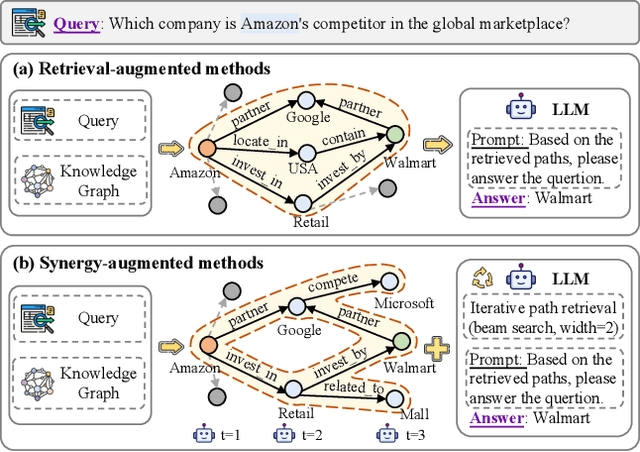
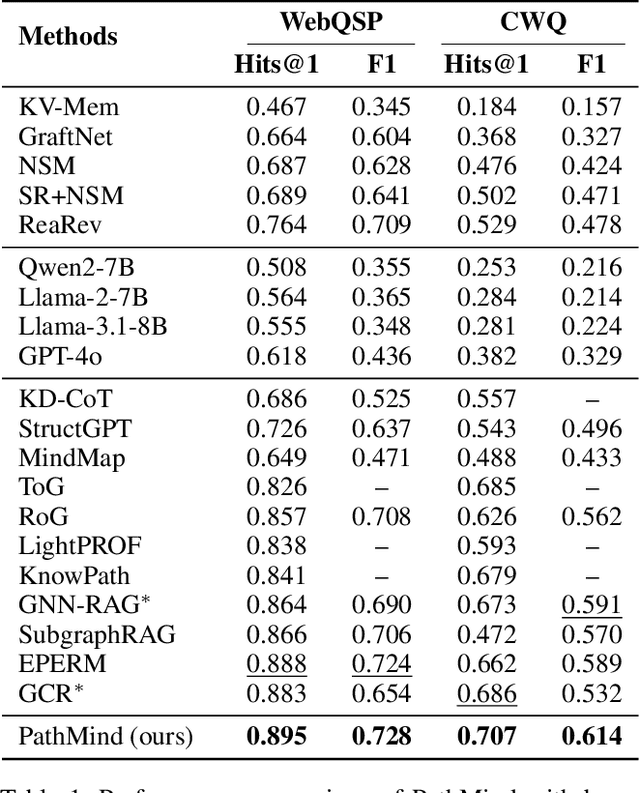
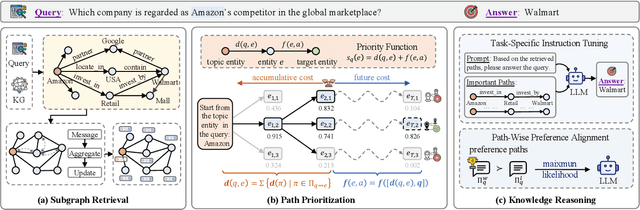
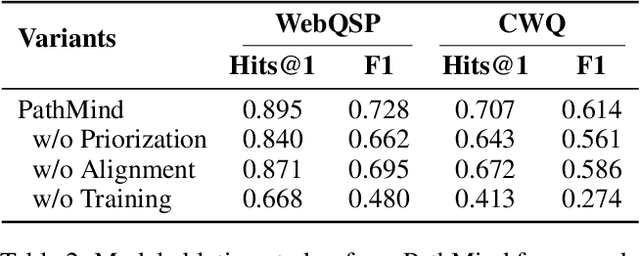
Knowledge graph reasoning (KGR) is the task of inferring new knowledge by performing logical deductions on knowledge graphs. Recently, large language models (LLMs) have demonstrated remarkable performance in complex reasoning tasks. Despite promising success, current LLM-based KGR methods still face two critical limitations. First, existing methods often extract reasoning paths indiscriminately, without assessing their different importance, which may introduce irrelevant noise that misleads LLMs. Second, while many methods leverage LLMs to dynamically explore potential reasoning paths, they require high retrieval demands and frequent LLM calls. To address these limitations, we propose PathMind, a novel framework designed to enhance faithful and interpretable reasoning by selectively guiding LLMs with important reasoning paths. Specifically, PathMind follows a "Retrieve-Prioritize-Reason" paradigm. First, it retrieves a query subgraph from KG through the retrieval module. Next, it introduces a path prioritization mechanism that identifies important reasoning paths using a semantic-aware path priority function, which simultaneously considers the accumulative cost and the estimated future cost for reaching the target. Finally, PathMind generates accurate and logically consistent responses via a dual-phase training strategy, including task-specific instruction tuning and path-wise preference alignment. Extensive experiments on benchmark datasets demonstrate that PathMind consistently outperforms competitive baselines, particularly on complex reasoning tasks with fewer input tokens, by identifying essential reasoning paths.