 Add to Chrome
 Add to Firefox
 Add to Edge
3DIS: Depth-Driven Decoupled Instance Synthesis for Text-to-Image Generation
Oct 16, 2024


The increasing demand for controllable outputs in text-to-image generation has spurred advancements in multi-instance generation (MIG), allowing users to define both instance layouts and attributes. However, unlike image-conditional generation methods such as ControlNet, MIG techniques have not been widely adopted in state-of-the-art models like SD2 and SDXL, primarily due to the challenge of building robust renderers that simultaneously handle instance positioning and attribute rendering. In this paper, we introduce Depth-Driven Decoupled Instance Synthesis (3DIS), a novel framework that decouples the MIG process into two stages: (i) generating a coarse scene depth map for accurate instance positioning and scene composition, and (ii) rendering fine-grained attributes using pre-trained ControlNet on any foundational model, without additional training. Our 3DIS framework integrates a custom adapter into LDM3D for precise depth-based layouts and employs a finetuning-free method for enhanced instance-level attribute rendering. Extensive experiments on COCO-Position and COCO-MIG benchmarks demonstrate that 3DIS significantly outperforms existing methods in both layout precision and attribute rendering. Notably, 3DIS offers seamless compatibility with diverse foundational models, providing a robust, adaptable solution for advanced multi-instance generation. The code is available at: https://github.com/limuloo/3DIS.

MC-Bench: A Benchmark for Multi-Context Visual Grounding in the Era of MLLMs
Oct 16, 2024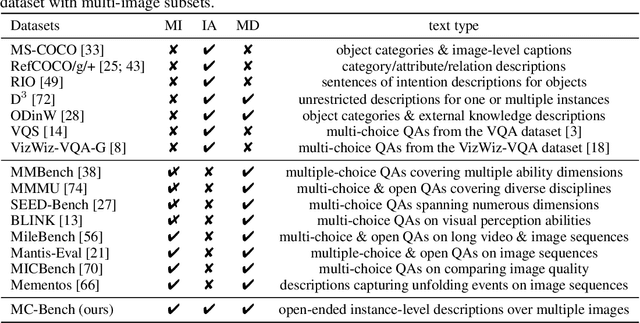
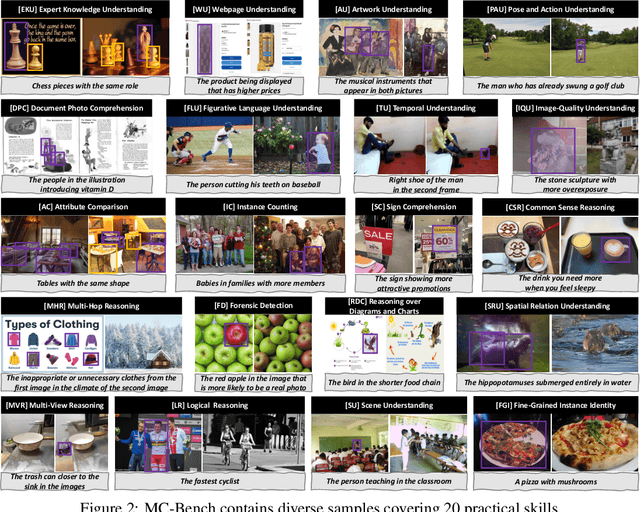
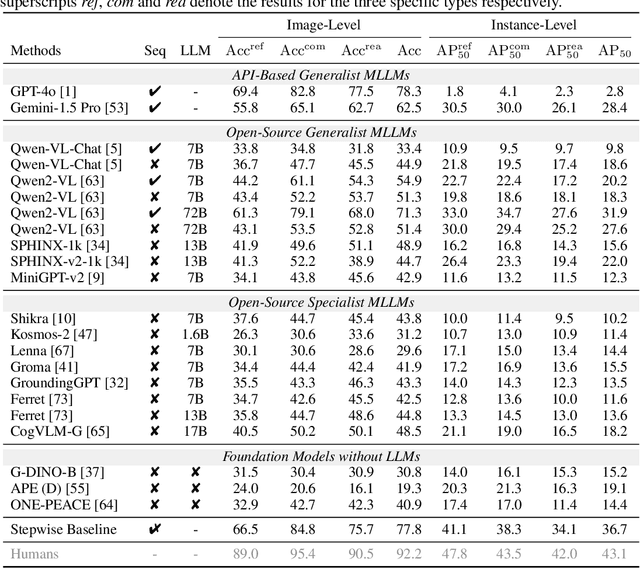
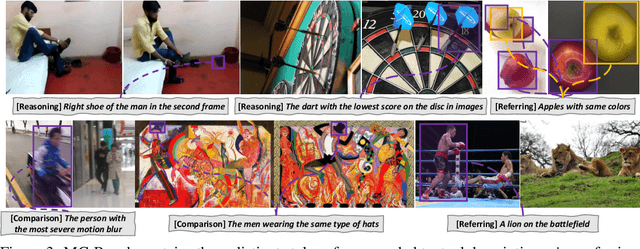
While multimodal large language models (MLLMs) have demonstrated extraordinary vision-language understanding capabilities and shown potential to serve as general-purpose assistants, their abilities to solve instance-level visual-language problems beyond a single image warrant further exploration. In order to assess these unproven abilities of MLLMs, this paper proposes a new visual grounding task called multi-context visual grounding, which aims to localize instances of interest across multiple images based on open-ended text prompts. To facilitate this research, we meticulously construct a new dataset MC-Bench for benchmarking the visual grounding capabilities of MLLMs. MC-Bench features 2K high-quality and manually annotated samples, consisting of instance-level labeled image pairs and corresponding text prompts that indicate the target instances in the images. In total, there are three distinct styles of text prompts, covering 20 practical skills. We benchmark over 20 state-of-the-art MLLMs and foundation models with potential multi-context visual grounding capabilities. Our evaluation reveals a non-trivial performance gap between existing MLLMs and humans across all metrics. We also observe that existing MLLMs typically outperform foundation models without LLMs only on image-level metrics, and the specialist MLLMs trained on single images often struggle to generalize to multi-image scenarios. Moreover, a simple stepwise baseline integrating advanced MLLM and a detector can significantly surpass prior end-to-end MLLMs. We hope our MC-Bench and empirical findings can encourage the research community to further explore and enhance the untapped potentials of MLLMs in instance-level tasks, particularly in multi-image contexts. Project page: https://xuyunqiu.github.io/MC-Bench/.
Point-Calibrated Spectral Neural Operators
Oct 15, 2024Two typical neural models have been extensively studied for operator learning, learning in spatial space via attention mechanism or learning in spectral space via spectral analysis technique such as Fourier Transform. Spatial learning enables point-level flexibility but lacks global continuity constraint, while spectral learning enforces spectral continuity prior but lacks point-wise adaptivity. This work innovatively combines the continuity prior and the point-level flexibility, with the introduced Point-Calibrated Spectral Transform. It achieves this by calibrating the preset spectral eigenfunctions with the predicted point-wise frequency preference via neural gate mechanism. Beyond this, we introduce Point-Calibrated Spectral Neural Operators, which learn operator mappings by approximating functions with the point-level adaptive spectral basis, thereby not only preserving the benefits of spectral prior but also boasting the superior adaptability comparable to the attention mechanism. Comprehensive experiments demonstrate its consistent performance enhancement in extensive PDE solving scenarios.
Open-RGBT: Open-vocabulary RGB-T Zero-shot Semantic Segmentation in Open-world Environments
Oct 09, 2024Semantic segmentation is a critical technique for effective scene understanding. Traditional RGB-T semantic segmentation models often struggle to generalize across diverse scenarios due to their reliance on pretrained models and predefined categories. Recent advancements in Visual Language Models (VLMs) have facilitated a shift from closed-set to open-vocabulary semantic segmentation methods. However, these models face challenges in dealing with intricate scenes, primarily due to the heterogeneity between RGB and thermal modalities. To address this gap, we present Open-RGBT, a novel open-vocabulary RGB-T semantic segmentation model. Specifically, we obtain instance-level detection proposals by incorporating visual prompts to enhance category understanding. Additionally, we employ the CLIP model to assess image-text similarity, which helps correct semantic consistency and mitigates ambiguities in category identification. Empirical evaluations demonstrate that Open-RGBT achieves superior performance in diverse and challenging real-world scenarios, even in the wild, significantly advancing the field of RGB-T semantic segmentation.
Dessie: Disentanglement for Articulated 3D Horse Shape and Pose Estimation from Images
Oct 04, 2024In recent years, 3D parametric animal models have been developed to aid in estimating 3D shape and pose from images and video. While progress has been made for humans, it's more challenging for animals due to limited annotated data. To address this, we introduce the first method using synthetic data generation and disentanglement to learn to regress 3D shape and pose. Focusing on horses, we use text-based texture generation and a synthetic data pipeline to create varied shapes, poses, and appearances, learning disentangled spaces. Our method, Dessie, surpasses existing 3D horse reconstruction methods and generalizes to other large animals like zebras, cows, and deer. See the project website at: \url{https://celiali.github.io/Dessie/}.
Automated Tone Transcription and Clustering with Tone2Vec
Oct 03, 2024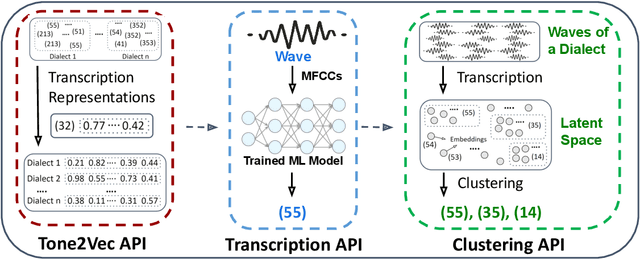
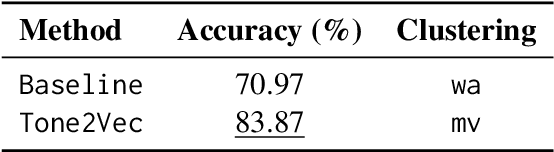
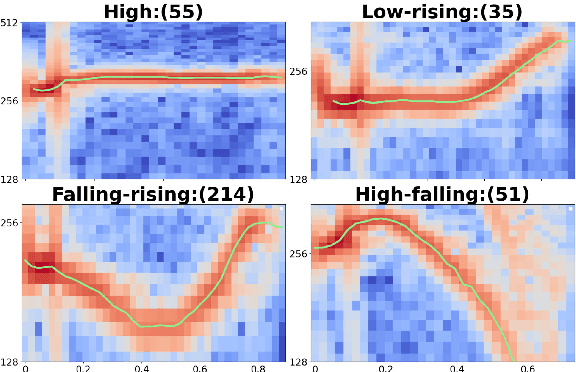
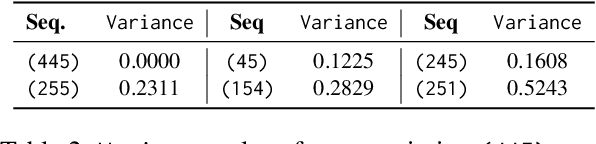
Lexical tones play a crucial role in Sino-Tibetan languages. However, current phonetic fieldwork relies on manual effort, resulting in substantial time and financial costs. This is especially challenging for the numerous endangered languages that are rapidly disappearing, often compounded by limited funding. In this paper, we introduce pitch-based similarity representations for tone transcription, named Tone2Vec. Experiments on dialect clustering and variance show that Tone2Vec effectively captures fine-grained tone variation. Utilizing Tone2Vec, we develop the first automatic approach for tone transcription and clustering by presenting a novel representation transformation for transcriptions. Additionally, these algorithms are systematically integrated into an open-sourced and easy-to-use package, ToneLab, which facilitates automated fieldwork and cross-regional, cross-lexical analysis for tonal languages. Extensive experiments were conducted to demonstrate the effectiveness of our methods.
CktGen: Specification-Conditioned Analog Circuit Generation
Oct 01, 2024


Automatic synthesis of analog circuits presents significant challenges. Existing methods usually treat the task as optimization problems, which limits their transferability and reusability for new requirements. To address this limitation, we introduce a task that directly generates analog circuits based on specified specifications, termed specification-conditioned analog circuit generation. Specifically, we propose CktGen, a simple yet effective variational autoencoder (VAE) model, that maps specifications and circuits into a joint latent space, and reconstructs the circuit from the latent. Moreover, given that a single specification can correspond to multiple distinct circuits, simply minimizing the distance between the mapped latent representations of the circuit and specification does not capture these one-to-many relationships. To address this, we integrate contrastive learning and classifier guidance to prevent model collapse. We conduct comprehensive experiments on the Open Circuit Benchmark (OCB) and introduce new evaluation metrics for cross-model consistency in the specification-to-circuit generation task. Experimental results demonstrate substantial improvements over existing state-of-the-art methods.
Image Copy Detection for Diffusion Models
Sep 30, 2024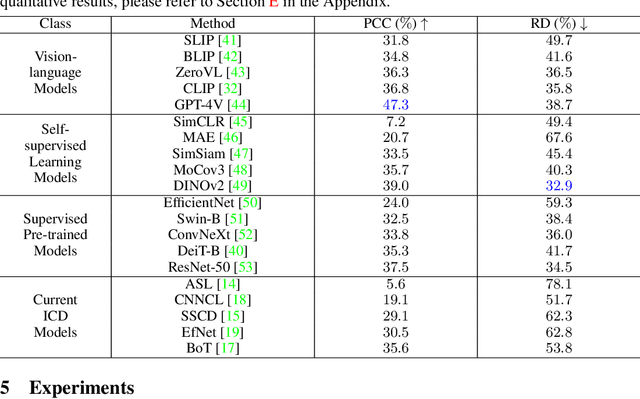
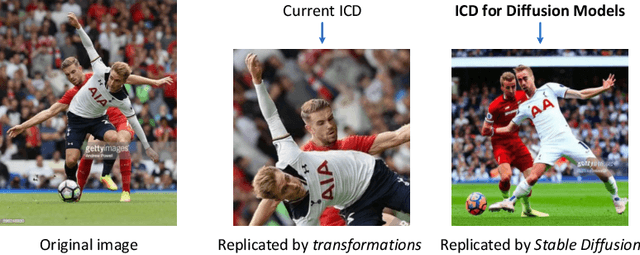
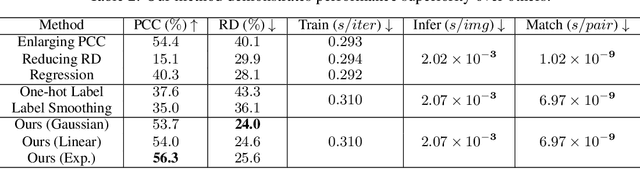
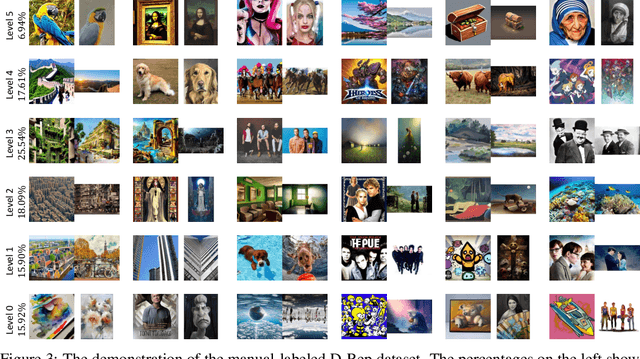
Images produced by diffusion models are increasingly popular in digital artwork and visual marketing. However, such generated images might replicate content from existing ones and pose the challenge of content originality. Existing Image Copy Detection (ICD) models, though accurate in detecting hand-crafted replicas, overlook the challenge from diffusion models. This motivates us to introduce ICDiff, the first ICD specialized for diffusion models. To this end, we construct a Diffusion-Replication (D-Rep) dataset and correspondingly propose a novel deep embedding method. D-Rep uses a state-of-the-art diffusion model (Stable Diffusion V1.5) to generate 40, 000 image-replica pairs, which are manually annotated into 6 replication levels ranging from 0 (no replication) to 5 (total replication). Our method, PDF-Embedding, transforms the replication level of each image-replica pair into a probability density function (PDF) as the supervision signal. The intuition is that the probability of neighboring replication levels should be continuous and smooth. Experimental results show that PDF-Embedding surpasses protocol-driven methods and non-PDF choices on the D-Rep test set. Moreover, by utilizing PDF-Embedding, we find that the replication ratios of well-known diffusion models against an open-source gallery range from 10% to 20%.
Do We Need Domain-Specific Embedding Models? An Empirical Investigation
Sep 27, 2024Embedding models play a crucial role in representing and retrieving information across various NLP applications. Recent advancements in Large Language Models (LLMs) have further enhanced the performance of embedding models, which are trained on massive amounts of text covering almost every domain. These models are often benchmarked on general-purpose datasets like Massive Text Embedding Benchmark (MTEB), where they demonstrate superior performance. However, a critical question arises: Is the development of domain-specific embedding models necessary when general-purpose models are trained on vast corpora that already include specialized domain texts? In this paper, we empirically investigate this question, choosing the finance domain as an example. We introduce the Finance Massive Text Embedding Benchmark (FinMTEB), a counterpart to MTEB that consists of financial domain-specific text datasets. We evaluate the performance of seven state-of-the-art embedding models on FinMTEB and observe a significant performance drop compared to their performance on MTEB. To account for the possibility that this drop is driven by FinMTEB's higher complexity, we propose four measures to quantify dataset complexity and control for this factor in our analysis. Our analysis provides compelling evidence that state-of-the-art embedding models struggle to capture domain-specific linguistic and semantic patterns, even when trained on large general-purpose corpora. This study sheds light on the necessity of developing domain-specific embedding models in the LLM era, offering valuable insights for researchers and practitioners.
Hydra-SGG: Hybrid Relation Assignment for One-stage Scene Graph Generation
Sep 16, 2024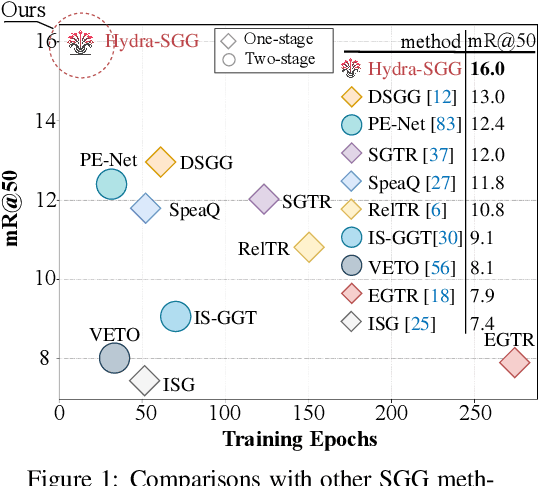
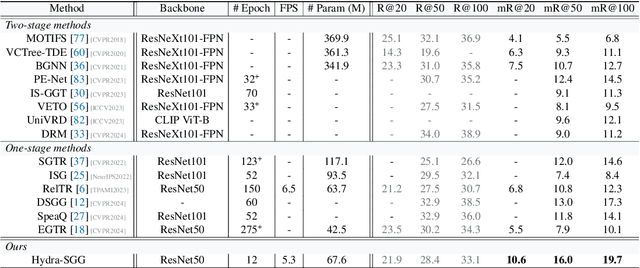
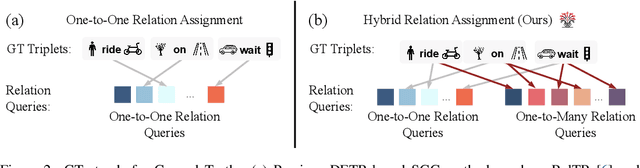
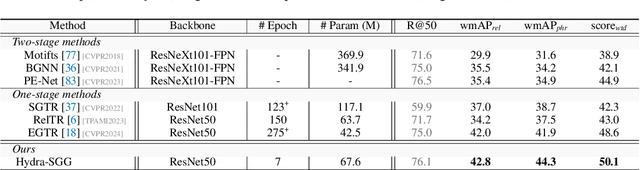
DETR introduces a simplified one-stage framework for scene graph generation (SGG). However, DETR-based SGG models face two challenges: i) Sparse supervision, as each image typically contains fewer than 10 relation annotations, while the models employ over 100 relation queries. This sparsity arises because each ground truth relation is assigned to only one single query during training. ii) False negative samples, since one ground truth relation may have multiple queries with similar matching scores. These suboptimally matched queries are simply treated as negative samples, causing the loss of valuable supervisory signals. As a response, we devise Hydra-SGG, a one-stage SGG method that adopts a new Hybrid Relation Assignment. This assignment combines a One-to-One Relation Assignment with a newly introduced IoU-based One-to-Many Relation Assignment. Specifically, each ground truth is assigned to multiple relation queries with high IoU subject-object boxes. This Hybrid Relation Assignment increases the number of positive training samples, alleviating sparse supervision. Moreover, we, for the first time, empirically show that self-attention over relation queries helps reduce duplicated relation predictions. We, therefore, propose Hydra Branch, a parameter-sharing auxiliary decoder without a self-attention layer. This design promotes One-to-Many Relation Assignment by enabling different queries to predict the same relation. Hydra-SGG achieves state-of-the-art performance with 10.6 mR@20 and 16.0 mR@50 on VG150, while only requiring 12 training epochs. It also sets a new state-of-the-art on Open Images V6 and and GQA.