 Add to Chrome
 Add to Firefox
 Add to Edge
Seamless Detection: Unifying Salient Object Detection and Camouflaged Object Detection
Dec 22, 2024
Achieving joint learning of Salient Object Detection (SOD) and Camouflaged Object Detection (COD) is extremely challenging due to their distinct object characteristics, i.e., saliency and camouflage. The only preliminary research treats them as two contradictory tasks, training models on large-scale labeled data alternately for each task and assessing them independently. However, such task-specific mechanisms fail to meet real-world demands for addressing unknown tasks effectively. To address this issue, in this paper, we pioneer a task-agnostic framework to unify SOD and COD. To this end, inspired by the agreeable nature of binary segmentation for SOD and COD, we propose a Contrastive Distillation Paradigm (CDP) to distil the foreground from the background, facilitating the identification of salient and camouflaged objects amidst their surroundings. To probe into the contribution of our CDP, we design a simple yet effective contextual decoder involving the interval-layer and global context, which achieves an inference speed of 67 fps. Besides the supervised setting, our CDP can be seamlessly integrated into unsupervised settings, eliminating the reliance on extensive human annotations. Experiments on public SOD and COD datasets demonstrate the superiority of our proposed framework in both supervised and unsupervised settings, compared with existing state-of-the-art approaches. Code is available on https://github.com/liuyi1989/Seamless-Detection.

Optical Wireless Communications: Enabling the Next Generation Network of Networks
Dec 21, 2024


Optical wireless communication (OWC) is a promising technology anticipated to play a key role in the next-generation network of networks. To this end, this paper details the potential of OWC, as a complementary technology to traditional radio frequency communications, in enhancing networking capabilities beyond conventional terrestrial networks. Several usage scenarios and the current state of development are presented. Furthermore, a summary of existing challenges and opportunities are provided. Emerging technologies aimed at further enhancing future OWC capabilities are introduced. Additionally, value-added OWC-based technologies that leverage the unique properties of light are discussed, including applications such as positioning and gesture recognition. The paper concludes with the reflection that OWC provides unique functionalities that can play a crucial role in building convergent and resilient future network of networks.
A MapReduce Approach to Effectively Utilize Long Context Information in Retrieval Augmented Language Models
Dec 17, 2024


While holding great promise for improving and facilitating healthcare, large language models (LLMs) struggle to produce up-to-date responses on evolving topics due to outdated knowledge or hallucination. Retrieval-augmented generation (RAG) is a pivotal innovation that improves the accuracy and relevance of LLM responses by integrating LLMs with a search engine and external sources of knowledge. However, the quality of RAG responses can be largely impacted by the rank and density of key information in the retrieval results, such as the "lost-in-the-middle" problem. In this work, we aim to improve the robustness and reliability of the RAG workflow in the medical domain. Specifically, we propose a map-reduce strategy, BriefContext, to combat the "lost-in-the-middle" issue without modifying the model weights. We demonstrated the advantage of the workflow with various LLM backbones and on multiple QA datasets. This method promises to improve the safety and reliability of LLMs deployed in healthcare domains.
PunchBench: Benchmarking MLLMs in Multimodal Punchline Comprehension
Dec 16, 2024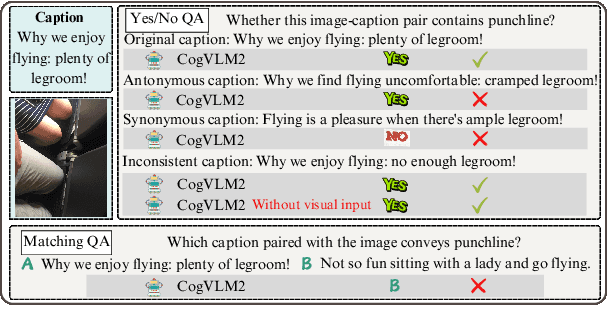

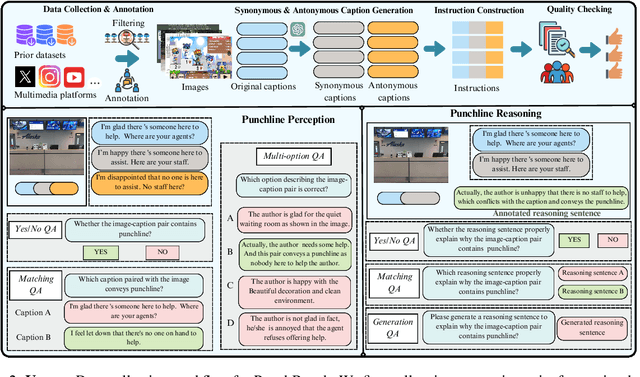

Multimodal punchlines, which involve humor or sarcasm conveyed in image-caption pairs, are a popular way of communication on online multimedia platforms. With the rapid development of multimodal large language models (MLLMs), it is essential to assess their ability to effectively comprehend these punchlines. However, existing benchmarks on punchline comprehension suffer from three major limitations: 1) language shortcuts that allow models to solely rely on text, 2) lack of question diversity, and 3) narrow focus on a specific domain of multimodal content (e.g., cartoon). To address these limitations, we introduce a multimodal \textbf{Punch}line comprehension \textbf{Bench}mark, named \textbf{PunchBench}, which is tailored for accurate and comprehensive evaluation of punchline comprehension. To enhance the evaluation accuracy, we generate synonymous and antonymous captions by modifying original captions, which mitigates the impact of shortcuts in the captions. To provide a comprehensive evaluation, PunchBench incorporates diverse question formats and image-captions from various domains. On this basis, we conduct extensive evaluations and reveal a significant gap between state-of-the-art MLLMs and humans in punchline comprehension. To improve punchline comprehension, we propose Simple-to-Complex Chain-of-Question (SC-CoQ) strategy, enabling the models to incrementally address complicated questions by first mastering simple ones. SC-CoQ effectively enhances the performance of various MLLMs on PunchBench, surpassing in-context learning and chain-of-thought.
Exploring Enhanced Contextual Information for Video-Level Object Tracking
Dec 15, 2024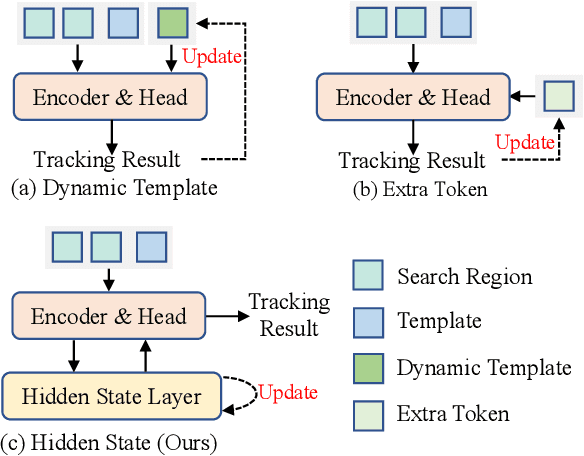
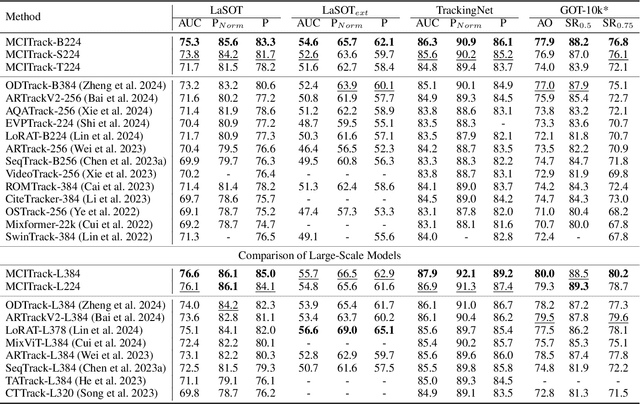
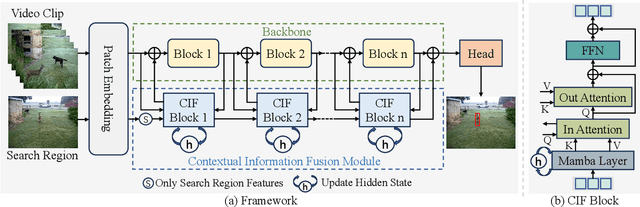
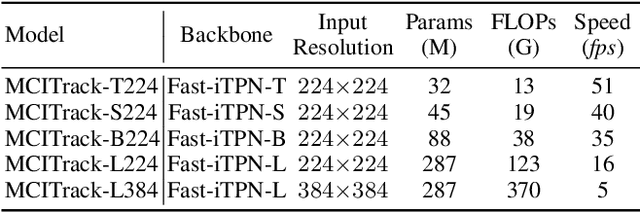
Contextual information at the video level has become increasingly crucial for visual object tracking. However, existing methods typically use only a few tokens to convey this information, which can lead to information loss and limit their ability to fully capture the context. To address this issue, we propose a new video-level visual object tracking framework called MCITrack. It leverages Mamba's hidden states to continuously record and transmit extensive contextual information throughout the video stream, resulting in more robust object tracking. The core component of MCITrack is the Contextual Information Fusion module, which consists of the mamba layer and the cross-attention layer. The mamba layer stores historical contextual information, while the cross-attention layer integrates this information into the current visual features of each backbone block. This module enhances the model's ability to capture and utilize contextual information at multiple levels through deep integration with the backbone. Experiments demonstrate that MCITrack achieves competitive performance across numerous benchmarks. For instance, it gets 76.6% AUC on LaSOT and 80.0% AO on GOT-10k, establishing a new state-of-the-art performance. Code and models are available at https://github.com/kangben258/MCITrack.
Underwater Image Enhancement with Cascaded Contrastive Learning
Nov 16, 2024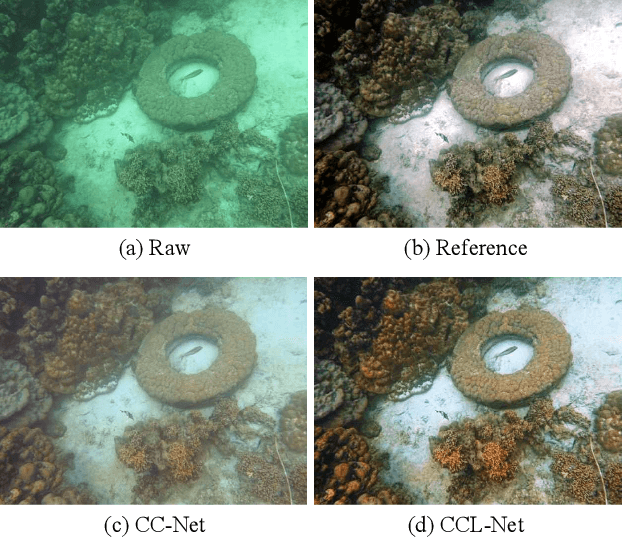
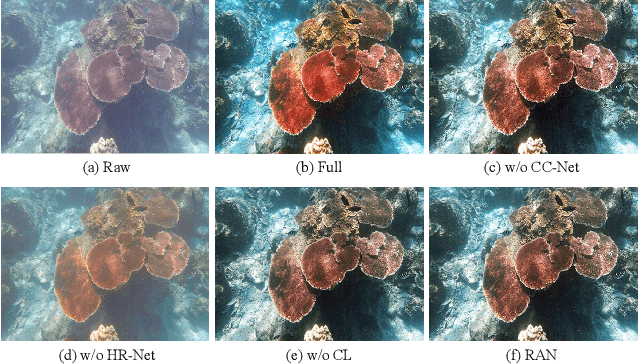
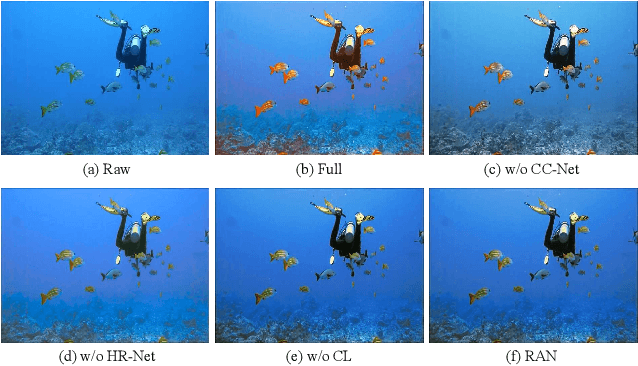
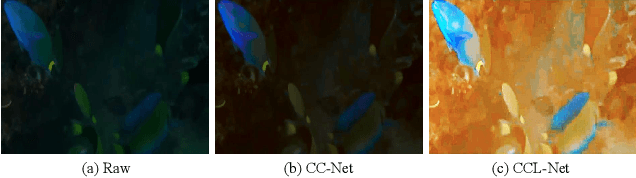
Underwater image enhancement (UIE) is a highly challenging task due to the complexity of underwater environment and the diversity of underwater image degradation. Due to the application of deep learning, current UIE methods have made significant progress. Most of the existing deep learning-based UIE methods follow a single-stage network which cannot effectively address the diverse degradations simultaneously. In this paper, we propose to address this issue by designing a two-stage deep learning framework and taking advantage of cascaded contrastive learning to guide the network training of each stage. The proposed method is called CCL-Net in short. Specifically, the proposed CCL-Net involves two cascaded stages, i.e., a color correction stage tailored to the color deviation issue and a haze removal stage tailored to improve the visibility and contrast of underwater images. To guarantee the underwater image can be progressively enhanced, we also apply contrastive loss as an additional constraint to guide the training of each stage. In the first stage, the raw underwater images are used as negative samples for building the first contrastive loss, ensuring the enhanced results of the first color correction stage are better than the original inputs. While in the second stage, the enhanced results rather than the raw underwater images of the first color correction stage are used as the negative samples for building the second contrastive loss, thus ensuring the final enhanced results of the second haze removal stage are better than the intermediate color corrected results. Extensive experiments on multiple benchmark datasets demonstrate that our CCL-Net can achieve superior performance compared to many state-of-the-art methods. The source code of CCL-Net will be released at https://github.com/lewis081/CCL-Net.
Part-Whole Relational Fusion Towards Multi-Modal Scene Understanding
Oct 19, 2024Multi-modal fusion has played a vital role in multi-modal scene understanding. Most existing methods focus on cross-modal fusion involving two modalities, often overlooking more complex multi-modal fusion, which is essential for real-world applications like autonomous driving, where visible, depth, event, LiDAR, etc., are used. Besides, few attempts for multi-modal fusion, \emph{e.g.}, simple concatenation, cross-modal attention, and token selection, cannot well dig into the intrinsic shared and specific details of multiple modalities. To tackle the challenge, in this paper, we propose a Part-Whole Relational Fusion (PWRF) framework. For the first time, this framework treats multi-modal fusion as part-whole relational fusion. It routes multiple individual part-level modalities to a fused whole-level modality using the part-whole relational routing ability of Capsule Networks (CapsNets). Through this part-whole routing, our PWRF generates modal-shared and modal-specific semantics from the whole-level modal capsules and the routing coefficients, respectively. On top of that, modal-shared and modal-specific details can be employed to solve the issue of multi-modal scene understanding, including synthetic multi-modal segmentation and visible-depth-thermal salient object detection in this paper. Experiments on several datasets demonstrate the superiority of the proposed PWRF framework for multi-modal scene understanding. The source code has been released on https://github.com/liuyi1989/PWRF.
PrefixQuant: Static Quantization Beats Dynamic through Prefixed Outliers in LLMs
Oct 07, 2024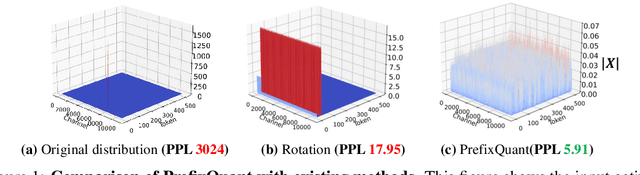
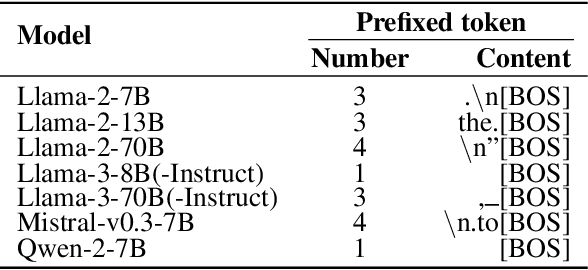
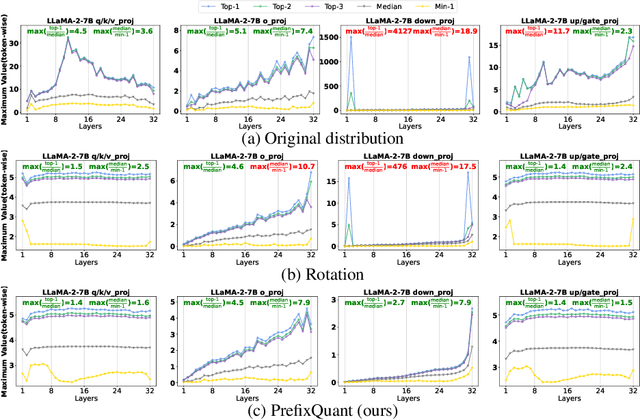

Quantization is essential for deploying Large Language Models (LLMs) by enhancing memory efficiency and inference speed. Existing methods for activation quantization mainly address channel-wise outliers, often neglecting token-wise outliers, leading to reliance on costly per-token dynamic quantization. To address this, we introduce PrefixQuant, a novel technique that isolates outlier tokens offline without re-training. Specifically, PrefixQuant identifies high-frequency outlier tokens and prefixes them in the KV cache, preventing the generation of outlier tokens during inference and simplifying quantization. To our knowledge, PrefixQuant is the first to enable efficient per-tensor static quantization to outperform expensive per-token dynamic quantization. For instance, in W4A4KV4 (4- bit weight, 4-bit activation, and 4-bit KV cache) Llama-3-8B, PrefixQuant with per-tensor static quantization achieves a 7.43 WikiText2 perplexity and 71.08% average accuracy on 5 common-sense reasoning tasks, outperforming previous per-token dynamic quantization methods like QuaRot with 0.98 perplexity improvement and +5.98 points accuracy. Additionally, the inference speed of W4A4 quantized models using PrefixQuant is 1.60x to 2.81x faster than FP16 models and exceeds QuaRot models by 1.2x to 1.3x. Our code is available at \url{https://github.com/ChenMnZ/PrefixQuant}.
Mamba Capsule Routing Towards Part-Whole Relational Camouflaged Object Detection
Oct 05, 2024The part-whole relational property endowed by Capsule Networks (CapsNets) has been known successful for camouflaged object detection due to its segmentation integrity. However, the previous Expectation Maximization (EM) capsule routing algorithm with heavy computation and large parameters obstructs this trend. The primary attribution behind lies in the pixel-level capsule routing. Alternatively, in this paper, we propose a novel mamba capsule routing at the type level. Specifically, we first extract the implicit latent state in mamba as capsule vectors, which abstract type-level capsules from pixel-level versions. These type-level mamba capsules are fed into the EM routing algorithm to get the high-layer mamba capsules, which greatly reduce the computation and parameters caused by the pixel-level capsule routing for part-whole relationships exploration. On top of that, to retrieve the pixel-level capsule features for further camouflaged prediction, we achieve this on the basis of the low-layer pixel-level capsules with the guidance of the correlations from adjacent-layer type-level mamba capsules. Extensive experiments on three widely used COD benchmark datasets demonstrate that our method significantly outperforms state-of-the-arts. Code has been available on https://github.com/Liangbo-Cheng/mamba\_capsule.
FlipGuard: Defending Preference Alignment against Update Regression with Constrained Optimization
Oct 01, 2024


Recent breakthroughs in preference alignment have significantly improved Large Language Models' ability to generate texts that align with human preferences and values. However, current alignment metrics typically emphasize the post-hoc overall improvement, while overlooking a critical aspect: regression, which refers to the backsliding on previously correctly-handled data after updates. This potential pitfall may arise from excessive fine-tuning on already well-aligned data, which subsequently leads to over-alignment and degeneration. To address this challenge, we propose FlipGuard, a constrained optimization approach to detect and mitigate update regression with focal attention. Specifically, FlipGuard identifies performance degradation using a customized reward characterization and strategically enforces a constraint to encourage conditional congruence with the pre-aligned model during training. Comprehensive experiments demonstrate that FlipGuard effectively alleviates update regression while demonstrating excellent overall performance, with the added benefit of knowledge preservation while aligning preferences.