 Add to Chrome
 Add to Firefox
 Add to Edge
Full-Pipeline Inference Optimization for MiMo-V2.5 Series: Pushing Hybrid SWA Efficiency to the Limit
Jul 14, 2026
We present a full-pipeline inference optimization for the MiMo-V2.5 model family, which combines Hybrid Sliding Window Attention (Hybrid SWA), sparse Mixture-of-Experts (MoE), and multimodal encoders. While Hybrid SWA can ideally reduce both attention compute and KVCache storage significantly compared to Full Attention, realizing these gains in production requires substantial engineering effort. We systematically optimize the KVCache system with layerwise prefetch, SWA-aware prefix cache trees, and specialized placement strategies, achieving strict $O(W)$ SWA storage and high cache hit rates. We further build GCache, a high-performance distributed cache infrastructure with RDMA-optimized networking, and develop a KVCache-affinity router to reduce computation while preserving load balancing. We also optimize for multimodal inputs, including GPU image preprocessing, parallel video decoding, and multimodal cache sharing. Together, these optimizations constitute the first large-scale LLM serving system in production that efficiently covers the Hybrid SWA + MoE + multimodal composite architecture.

OmniFocus: Query-Guided Modality-Balanced Token Compression for Omni-Modal Large Language Models
Jul 03, 2026Omni modal large language models (OmniLLMs) have attracted wide attention for their ability to jointly process audio and video, but they generate large token sequences under audio-visual inputs, leading to substantial inference cost. Existing audio-visual token compression methods often rely on unimodal guidance, overlooking the temporal locality of query-relevant evidence in audio-visual inputs and implicitly assuming that the two modalities share a temporally aligned information density distribution. We propose \textbf{OmniFocus}, a training-free query-guided token compression method for OmniLLMs that performs independent importance estimation for video and audio, enabling a modality-symmetric compression design that preserves modality-specific salient evidence while maintaining audio-visual alignment, thereby mitigating the modality bias issue that can arise from unimodal-guided compression. Experiments on the Qwen2.5-Omni model family across four audio-visual benchmarks show that OmniFocus maintains strong compressed performance at low token retention ratios and outperforms existing baselines on several major benchmark scores at 25\% token retention. On DailyOmni with Qwen2.5-Omni-7B at 25\% token retention, OmniFocus maintains 59.40 accuracy while delivering up to 1.38$\times$ prefill speedup relative to the full-token baseline, highlighting a favorable practical accuracy-efficiency trade-off.
Harmonizing Real-Time Constraints and Long-Horizon Reasoning: An Asynchronous Agentic Framework for Dynamic Scheduling
May 28, 2026The Dynamic Flexible Job Shop Scheduling Problem (DFJSP) necessitates a trade-off between instant reaction to stochastic disturbances and global optimization of production goals. Conventional priority rules are insufficiently flexible to handle complex disruptions, whereas learning-based approaches often compromise interpretability or fail to generalize across problem scales. Although Large Language Models (LLMs) offer advanced reasoning capabilities to bridge this gap, their substantial inference latency is incompatible with the millisecond-level decision cycles of industrial control systems. To resolve this conflict, we introduce RACE-Sched, an asynchronous agent-based framework that decouples policy execution from logical reasoning via a dual-stream architecture. The Reactive Stream executes low-latency symbolic heuristics to enable real-time dispatching, while the parallel Deliberative Stream leverages an LLM to synthesize, validate, and evolve these rules. Candidate rules undergo rigorous testing in a sandbox and are deployed via atomic updates, ensuring safety without blocking the control loop. Additionally, a semantic rule repository indexes validated heuristics for retrieval-based initialization which enhances transferability across problem scales. Extensive evaluations on GEN-Bench, MK-Bench, and JMS-Bench demonstrate that RACE-Sched outperforms leading Deep Reinforcement Learning and other LLM-based baselines. This approach harmonizes real-time constraints with long-horizon reasoning to achieve superior solution quality and robust adaptation to dynamic events.
DynaSchedBench: Calibrated Dynamic Scheduling Benchmarks and Observability Paradox in LLM-based Scheduling Agents
May 26, 2026Progress in neural combinatorial optimization for Dynamic Flexible Job Shop Scheduling Problem (DFJSP) is currently hindered by a methodological tension: static benchmarks encourage benchmark overfitting, while uncalibrated generators obscure algorithmic capability with stochastic noise. To resolve this, we introduce \textbf{DynaSchedBench}, a diagnostic framework for DFJSP that rigorously controls the instance-generation process. Instead of relying on parameter sampling, our approach utilizes Sequential Event-Space Calibrator (SESC) that computes a novel Schedule Stress Index (SSI) to stratify instances by difficulty. We demonstrate that SESC is substantially more computationally efficient than evolutionary baselines while converging reliably to the target metrics. The framework integrates modular components for instance generation, snapshot-based simulation, agents, evaluation, and visualization, thereby enabling rigorous testing of reactive and lookahead-based policies. Leveraging this calibrated environment, we identify key limitations of LLM-based scheduling agents. Specifically, in step-wise online decision-making for dynamic scheduling, we identify an ``Observability Paradox'': providing agents with oracle access to full structural information can degrade policy performance, underperforming concise information. Furthermore, despite substantial token overhead, tool-augmented and refinement strategies fail to reliably improve performance, and most LLM agents fail to consistently surpass strong dispatching baselines-behaving more like robust heuristic approximators than superior optimizers.
HySparse: A Hybrid Sparse Attention Architecture with Oracle Token Selection and KV Cache Sharing
Feb 03, 2026This work introduces Hybrid Sparse Attention (HySparse), a new architecture that interleaves each full attention layer with several sparse attention layers. While conceptually simple, HySparse strategically derives each sparse layer's token selection and KV caches directly from the preceding full attention layer. This architecture resolves two fundamental limitations of prior sparse attention methods. First, conventional approaches typically rely on additional proxies to predict token importance, introducing extra complexity and potentially suboptimal performance. In contrast, HySparse uses the full attention layer as a precise oracle to identify important tokens. Second, existing sparse attention designs often reduce computation without saving KV cache. HySparse enables sparse attention layers to reuse the full attention KV cache, thereby reducing both computation and memory. We evaluate HySparse on both 7B dense and 80B MoE models. Across all settings, HySparse consistently outperforms both full attention and hybrid SWA baselines. Notably, in the 80B MoE model with 49 total layers, only 5 layers employ full attention, yet HySparse achieves substantial performance gains while reducing KV cache storage by nearly 10x.
MiMo-V2-Flash Technical Report
Jan 08, 2026We present MiMo-V2-Flash, a Mixture-of-Experts (MoE) model with 309B total parameters and 15B active parameters, designed for fast, strong reasoning and agentic capabilities. MiMo-V2-Flash adopts a hybrid attention architecture that interleaves Sliding Window Attention (SWA) with global attention, with a 128-token sliding window under a 5:1 hybrid ratio. The model is pre-trained on 27 trillion tokens with Multi-Token Prediction (MTP), employing a native 32k context length and subsequently extended to 256k. To efficiently scale post-training compute, MiMo-V2-Flash introduces a novel Multi-Teacher On-Policy Distillation (MOPD) paradigm. In this framework, domain-specialized teachers (e.g., trained via large-scale reinforcement learning) provide dense and token-level reward, enabling the student model to perfectly master teacher expertise. MiMo-V2-Flash rivals top-tier open-weight models such as DeepSeek-V3.2 and Kimi-K2, despite using only 1/2 and 1/3 of their total parameters, respectively. During inference, by repurposing MTP as a draft model for speculative decoding, MiMo-V2-Flash achieves up to 3.6 acceptance length and 2.6x decoding speedup with three MTP layers. We open-source both the model weights and the three-layer MTP weights to foster open research and community collaboration.
MiMo-Audio: Audio Language Models are Few-Shot Learners
Dec 29, 2025Existing audio language models typically rely on task-specific fine-tuning to accomplish particular audio tasks. In contrast, humans are able to generalize to new audio tasks with only a few examples or simple instructions. GPT-3 has shown that scaling next-token prediction pretraining enables strong generalization capabilities in text, and we believe this paradigm is equally applicable to the audio domain. By scaling MiMo-Audio's pretraining data to over one hundred million of hours, we observe the emergence of few-shot learning capabilities across a diverse set of audio tasks. We develop a systematic evaluation of these capabilities and find that MiMo-Audio-7B-Base achieves SOTA performance on both speech intelligence and audio understanding benchmarks among open-source models. Beyond standard metrics, MiMo-Audio-7B-Base generalizes to tasks absent from its training data, such as voice conversion, style transfer, and speech editing. MiMo-Audio-7B-Base also demonstrates powerful speech continuation capabilities, capable of generating highly realistic talk shows, recitations, livestreaming and debates. At the post-training stage, we curate a diverse instruction-tuning corpus and introduce thinking mechanisms into both audio understanding and generation. MiMo-Audio-7B-Instruct achieves open-source SOTA on audio understanding benchmarks (MMSU, MMAU, MMAR, MMAU-Pro), spoken dialogue benchmarks (Big Bench Audio, MultiChallenge Audio) and instruct-TTS evaluations, approaching or surpassing closed-source models. Model checkpoints and full evaluation suite are available at https://github.com/XiaomiMiMo/MiMo-Audio.
Less Is More: Training-Free Sparse Attention with Global Locality for Efficient Reasoning
Aug 09, 2025Large reasoning models achieve strong performance through test-time scaling but incur substantial computational overhead, particularly from excessive token generation when processing short input prompts. While sparse attention mechanisms can reduce latency and memory usage, existing approaches suffer from significant accuracy degradation due to accumulated errors during long-generation reasoning. These methods generally require either high token retention rates or expensive retraining. We introduce LessIsMore, a training-free sparse attention mechanism for reasoning tasks, which leverages global attention patterns rather than relying on traditional head-specific local optimizations. LessIsMore aggregates token selections from local attention heads with recent contextual information, enabling unified cross-head token ranking for future decoding layers. This unified selection improves generalization and efficiency by avoiding the need to maintain separate token subsets per head. Evaluation across diverse reasoning tasks and benchmarks shows that LessIsMore preserves -- and in some cases improves -- accuracy while achieving a $1.1\times$ average decoding speed-up compared to full attention. Moreover, LessIsMore attends to $2\times$ fewer tokens without accuracy loss, achieving a $1.13\times$ end-to-end speed-up compared to existing sparse attention methods.
Data Efficacy for Language Model Training
Jun 26, 2025Data is fundamental to the training of language models (LM). Recent research has been dedicated to data efficiency, which aims to maximize performance by selecting a minimal or optimal subset of training data. Techniques such as data filtering, sampling, and selection play a crucial role in this area. To complement it, we define Data Efficacy, which focuses on maximizing performance by optimizing the organization of training data and remains relatively underexplored. This work introduces a general paradigm, DELT, for considering data efficacy in LM training, which highlights the significance of training data organization. DELT comprises three components: Data Scoring, Data Selection, and Data Ordering. Among these components, we design Learnability-Quality Scoring (LQS), as a new instance of Data Scoring, which considers both the learnability and quality of each data sample from the gradient consistency perspective. We also devise Folding Ordering (FO), as a novel instance of Data Ordering, which addresses issues such as model forgetting and data distribution bias. Comprehensive experiments validate the data efficacy in LM training, which demonstrates the following: Firstly, various instances of the proposed DELT enhance LM performance to varying degrees without increasing the data scale and model size. Secondly, among these instances, the combination of our proposed LQS for data scoring and Folding for data ordering achieves the most significant improvement. Lastly, data efficacy can be achieved together with data efficiency by applying data selection. Therefore, we believe that data efficacy is a promising foundational area in LM training.
SeerAttention-R: Sparse Attention Adaptation for Long Reasoning
Jun 10, 2025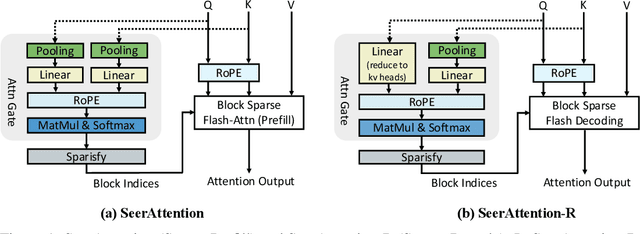
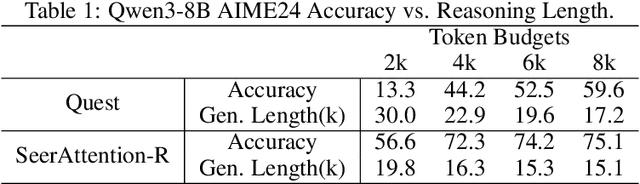
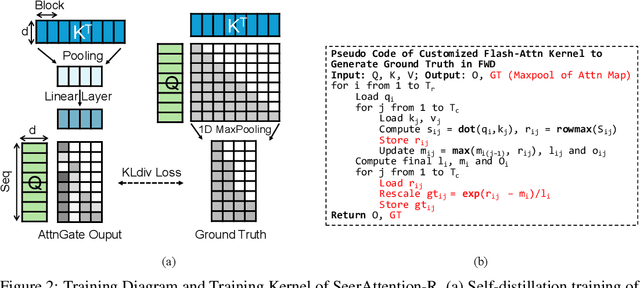

We introduce SeerAttention-R, a sparse attention framework specifically tailored for the long decoding of reasoning models. Extended from SeerAttention, SeerAttention-R retains the design of learning attention sparsity through a self-distilled gating mechanism, while removing query pooling to accommodate auto-regressive decoding. With a lightweight plug-in gating, SeerAttention-R is flexible and can be easily integrated into existing pretrained model without modifying the original parameters. We demonstrate that SeerAttention-R, trained on just 0.4B tokens, maintains near-lossless reasoning accuracy with 4K token budget in AIME benchmark under large sparse attention block sizes (64/128). Using TileLang, we develop a highly optimized sparse decoding kernel that achieves near-theoretical speedups of up to 9x over FlashAttention-3 on H100 GPU at 90% sparsity. Code is available at: https://github.com/microsoft/SeerAttention.