 Add to Chrome
 Add to Firefox
 Add to Edge
SemiAdv: Query-Efficient Black-Box Adversarial Attack with Unlabeled Images
Jul 13, 2024
Adversarial attack has garnered considerable attention due to its profound implications for the secure deployment of robots in sensitive security scenarios. To potentially push for advances in the field, this paper studies the adversarial attack in the black-box setting and proposes an unlabeled data-driven adversarial attack method, called SemiAdv. Specifically, SemiAdv achieves the following breakthroughs compared with previous works. First, by introducing the semi-supervised learning technique into the adversarial attack, SemiAdv substantially decreases the number of queries required for generating adversarial samples. On average, SemiAdv only needs to query a few hundred times to launch an effective attack with more than 90% success rate. Second, many existing black-box adversarial attacks require massive labeled data to mitigate the difference between the local substitute model and the remote target model for a good attack performance. While SemiAdv relaxes this limitation and is capable of utilizing unlabeled raw data to launch an effective attack. Finally, our experiments show that SemiAdv saves up to 12x query accesses for generating adversarial samples while maintaining a competitive attack success rate compared with state-of-the-art attacks.

Skywork-Math: Data Scaling Laws for Mathematical Reasoning in Large Language Models -- The Story Goes On
Jul 11, 2024
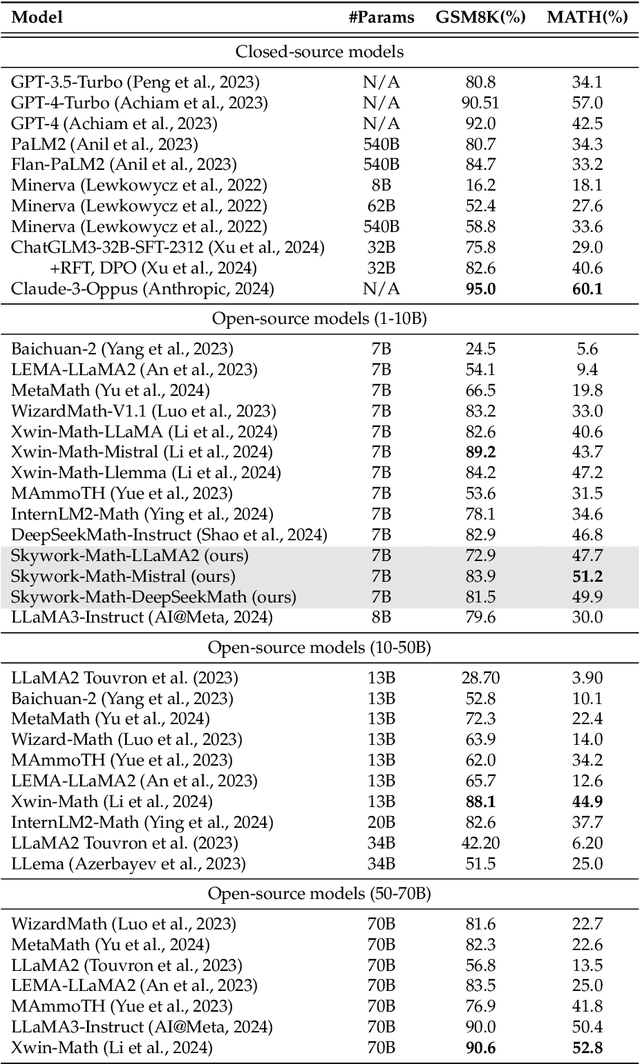
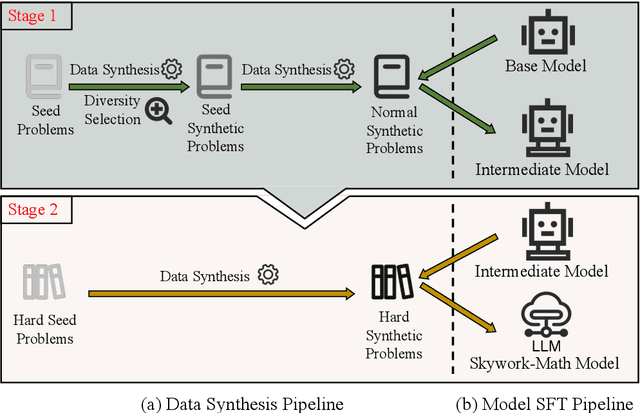
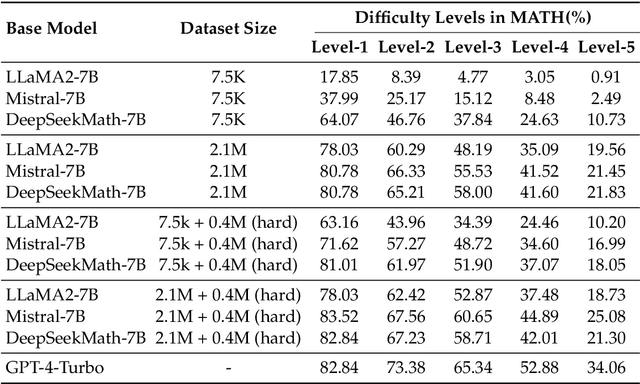
In this paper, we investigate the underlying factors that potentially enhance the mathematical reasoning capabilities of large language models (LLMs). We argue that the data scaling law for math reasoning capabilities in modern LLMs is far from being saturated, highlighting how the model's quality improves with increases in data quantity. To support this claim, we introduce the Skywork-Math model series, supervised fine-tuned (SFT) on common 7B LLMs using our proposed 2.5M-instance Skywork-MathQA dataset. Skywork-Math 7B has achieved impressive accuracies of 51.2% on the competition-level MATH benchmark and 83.9% on the GSM8K benchmark using only SFT data, outperforming an early version of GPT-4 on MATH. The superior performance of Skywork-Math models contributes to our novel two-stage data synthesis and model SFT pipelines, which include three different augmentation methods and a diverse seed problem set, ensuring both the quantity and quality of Skywork-MathQA dataset across varying difficulty levels. Most importantly, we provide several practical takeaways to enhance math reasoning abilities in LLMs for both research and industry applications.
VQA-Diff: Exploiting VQA and Diffusion for Zero-Shot Image-to-3D Vehicle Asset Generation in Autonomous Driving
Jul 10, 2024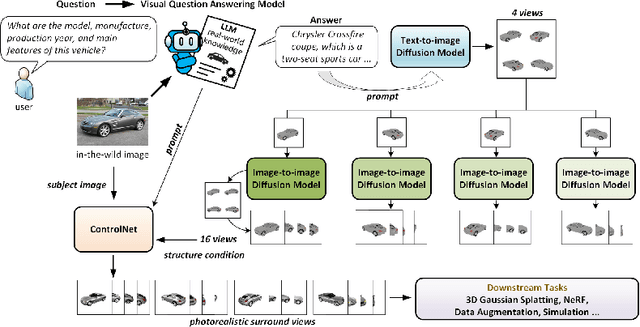
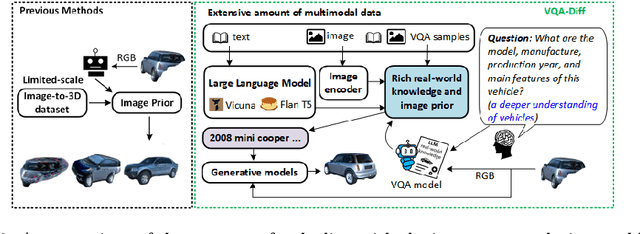
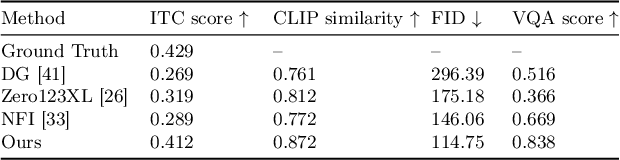
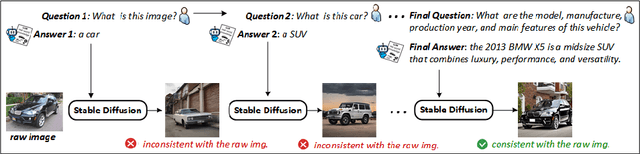
Generating 3D vehicle assets from in-the-wild observations is crucial to autonomous driving. Existing image-to-3D methods cannot well address this problem because they learn generation merely from image RGB information without a deeper understanding of in-the-wild vehicles (such as car models, manufacturers, etc.). This leads to their poor zero-shot prediction capability to handle real-world observations with occlusion or tricky viewing angles. To solve this problem, in this work, we propose VQA-Diff, a novel framework that leverages in-the-wild vehicle images to create photorealistic 3D vehicle assets for autonomous driving. VQA-Diff exploits the real-world knowledge inherited from the Large Language Model in the Visual Question Answering (VQA) model for robust zero-shot prediction and the rich image prior knowledge in the Diffusion model for structure and appearance generation. In particular, we utilize a multi-expert Diffusion Models strategy to generate the structure information and employ a subject-driven structure-controlled generation mechanism to model appearance information. As a result, without the necessity to learn from a large-scale image-to-3D vehicle dataset collected from the real world, VQA-Diff still has a robust zero-shot image-to-novel-view generation ability. We conduct experiments on various datasets, including Pascal 3D+, Waymo, and Objaverse, to demonstrate that VQA-Diff outperforms existing state-of-the-art methods both qualitatively and quantitatively.
RespEar: Earable-Based Robust Respiratory Rate Monitoring
Jul 09, 2024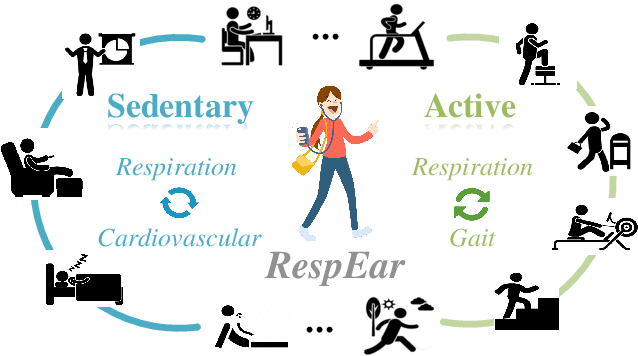
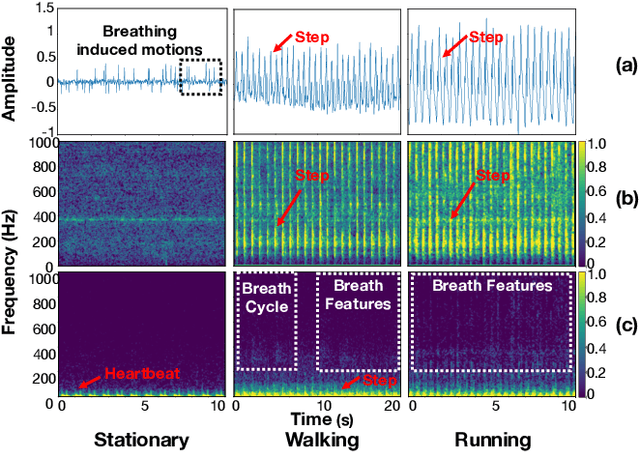
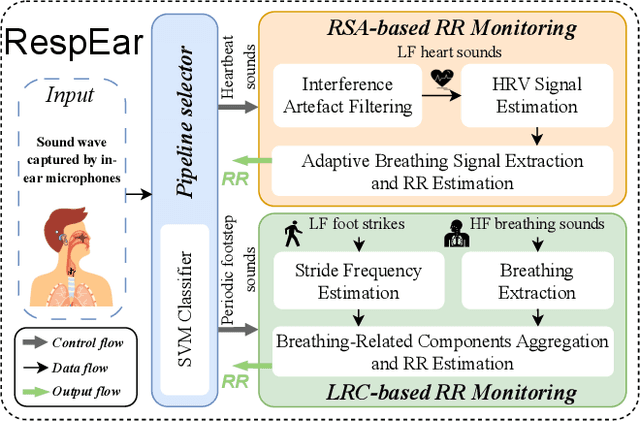
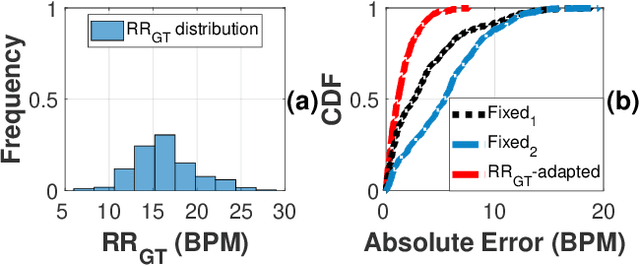
Respiratory rate (RR) monitoring is integral to understanding physical and mental health and tracking fitness. Existing studies have demonstrated the feasibility of RR monitoring under specific user conditions (e.g., while remaining still, or while breathing heavily). Yet, performing accurate, continuous and non-obtrusive RR monitoring across diverse daily routines and activities remains challenging. In this work, we present RespEar, an earable-based system for robust RR monitoring. By leveraging the unique properties of in-ear microphones in earbuds, RespEar enables the use of Respiratory Sinus Arrhythmia (RSA) and Locomotor Respiratory Coupling (LRC), physiological couplings between cardiovascular activity, gait and respiration, to indirectly determine RR. This effectively addresses the challenges posed by the almost imperceptible breathing signals under daily activities. We further propose a suite of meticulously crafted signal processing schemes to improve RR estimation accuracy and robustness. With data collected from 18 subjects over 8 activities, RespEar measures RR with a mean absolute error (MAE) of 1.48 breaths per minutes (BPM) and a mean absolute percent error (MAPE) of 9.12% in sedentary conditions, and a MAE of 2.28 BPM and a MAPE of 11.04% in active conditions, respectively, which is unprecedented for a method capable of generalizing across conditions with a single modality.
Source Code Summarization in the Era of Large Language Models
Jul 09, 2024To support software developers in understanding and maintaining programs, various automatic (source) code summarization techniques have been proposed to generate a concise natural language summary (i.e., comment) for a given code snippet. Recently, the emergence of large language models (LLMs) has led to a great boost in the performance of code-related tasks. In this paper, we undertake a systematic and comprehensive study on code summarization in the era of LLMs, which covers multiple aspects involved in the workflow of LLM-based code summarization. Specifically, we begin by examining prevalent automated evaluation methods for assessing the quality of summaries generated by LLMs and find that the results of the GPT-4 evaluation method are most closely aligned with human evaluation. Then, we explore the effectiveness of five prompting techniques (zero-shot, few-shot, chain-of-thought, critique, and expert) in adapting LLMs to code summarization tasks. Contrary to expectations, advanced prompting techniques may not outperform simple zero-shot prompting. Next, we investigate the impact of LLMs' model settings (including top\_p and temperature parameters) on the quality of generated summaries. We find the impact of the two parameters on summary quality varies by the base LLM and programming language, but their impacts are similar. Moreover, we canvass LLMs' abilities to summarize code snippets in distinct types of programming languages. The results reveal that LLMs perform suboptimally when summarizing code written in logic programming languages compared to other language types. Finally, we unexpectedly find that CodeLlama-Instruct with 7B parameters can outperform advanced GPT-4 in generating summaries describing code implementation details and asserting code properties. We hope that our findings can provide a comprehensive understanding of code summarization in the era of LLMs.
Aligning Cyber Space with Physical World: A Comprehensive Survey on Embodied AI
Jul 09, 2024


Embodied Artificial Intelligence (Embodied AI) is crucial for achieving Artificial General Intelligence (AGI) and serves as a foundation for various applications that bridge cyberspace and the physical world. Recently, the emergence of Multi-modal Large Models (MLMs) and World Models (WMs) have attracted significant attention due to their remarkable perception, interaction, and reasoning capabilities, making them a promising architecture for the brain of embodied agents. However, there is no comprehensive survey for Embodied AI in the era of MLMs. In this survey, we give a comprehensive exploration of the latest advancements in Embodied AI. Our analysis firstly navigates through the forefront of representative works of embodied robots and simulators, to fully understand the research focuses and their limitations. Then, we analyze four main research targets: 1) embodied perception, 2) embodied interaction, 3) embodied agent, and 4) sim-to-real adaptation, covering the state-of-the-art methods, essential paradigms, and comprehensive datasets. Additionally, we explore the complexities of MLMs in virtual and real embodied agents, highlighting their significance in facilitating interactions in dynamic digital and physical environments. Finally, we summarize the challenges and limitations of embodied AI and discuss their potential future directions. We hope this survey will serve as a foundational reference for the research community and inspire continued innovation. The associated project can be found at https://github.com/HCPLab-SYSU/Embodied_AI_Paper_List.
Implicit Regression in Subspace for High-Sensitivity CEST Imaging
Jul 09, 2024


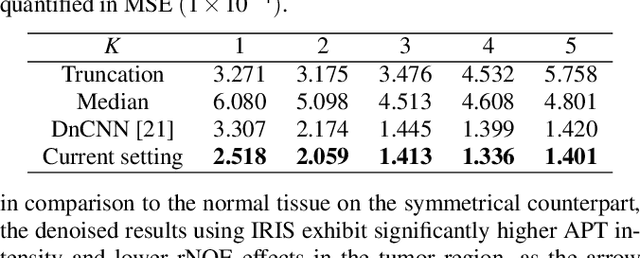
Chemical Exchange Saturation Transfer (CEST) MRI demonstrates its capability in significantly enhancing the detection of proteins and metabolites with low concentrations through exchangeable protons. The clinical application of CEST, however, is constrained by its low contrast and low signal-to-noise ratio (SNR) in the acquired data. Denoising, as one of the post-processing stages for CEST data, can effectively improve the accuracy of CEST quantification. In this work, by modeling spatial variant z-spectrums into low-dimensional subspace, we introduce Implicit Regression in Subspace (IRIS), which is an unsupervised denoising algorithm utilizing the excellent property of implicit neural representation for continuous mapping. Experiments conducted on both synthetic and in-vivo data demonstrate that our proposed method surpasses other CEST denoising methods regarding both qualitative and quantitative performance.
3D Vision and Language Pretraining with Large-Scale Synthetic Data
Jul 08, 2024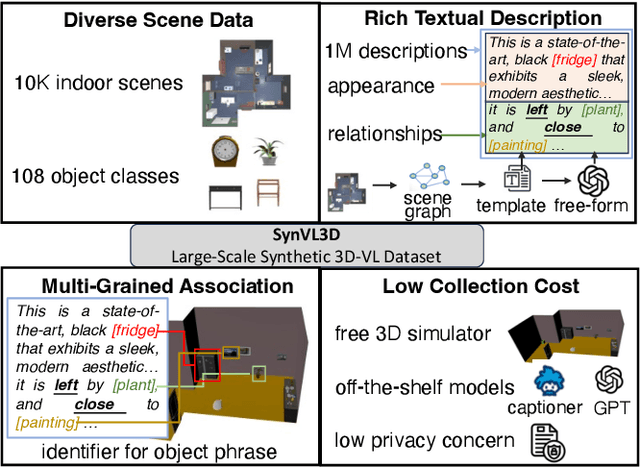
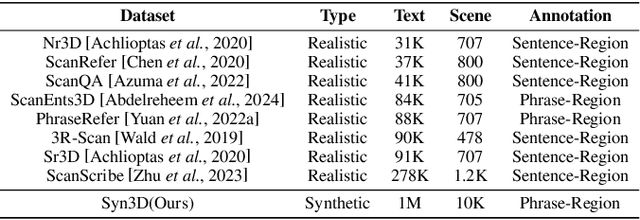
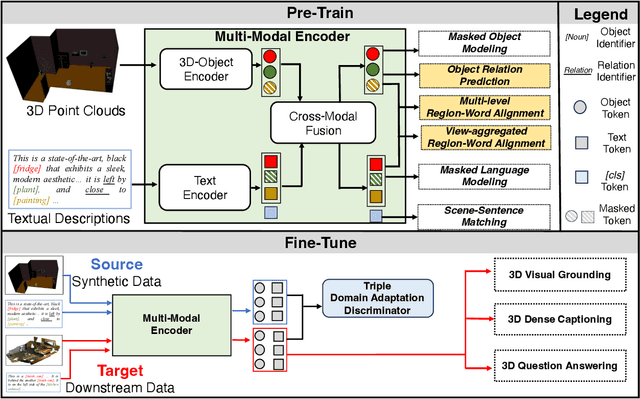
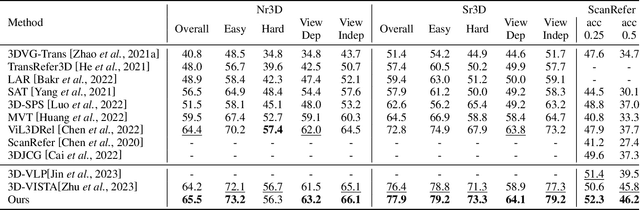
3D Vision-Language Pre-training (3D-VLP) aims to provide a pre-train model which can bridge 3D scenes with natural language, which is an important technique for embodied intelligence. However, current 3D-VLP datasets are hindered by limited scene-level diversity and insufficient fine-grained annotations (only 1.2K scenes and 280K textual annotations in ScanScribe), primarily due to the labor-intensive of collecting and annotating 3D scenes. To overcome these obstacles, we construct SynVL3D, a comprehensive synthetic scene-text corpus with 10K indoor scenes and 1M descriptions at object, view, and room levels, which has the advantages of diverse scene data, rich textual descriptions, multi-grained 3D-text associations, and low collection cost. Utilizing the rich annotations in SynVL3D, we pre-train a simple and unified Transformer for aligning 3D and language with multi-grained pretraining tasks. Moreover, we propose a synthetic-to-real domain adaptation in downstream task fine-tuning process to address the domain shift. Through extensive experiments, we verify the effectiveness of our model design by achieving state-of-the-art performance on downstream tasks including visual grounding, dense captioning, and question answering.
Discovering symbolic expressions with parallelized tree search
Jul 05, 2024Symbolic regression plays a crucial role in modern scientific research thanks to its capability of discovering concise and interpretable mathematical expressions from data. A grand challenge lies in the arduous search for parsimonious and generalizable mathematical formulas, in an infinite search space, while intending to fit the training data. Existing algorithms have faced a critical bottleneck of accuracy and efficiency over a decade when handling problems of complexity, which essentially hinders the pace of applying symbolic regression for scientific exploration across interdisciplinary domains. To this end, we introduce a parallelized tree search (PTS) model to efficiently distill generic mathematical expressions from limited data. Through a series of extensive experiments, we demonstrate the superior accuracy and efficiency of PTS for equation discovery, which greatly outperforms the state-of-the-art baseline models on over 80 synthetic and experimental datasets (e.g., lifting its performance by up to 99% accuracy improvement and one-order of magnitude speed up). PTS represents a key advance in accurate and efficient data-driven discovery of symbolic, interpretable models (e.g., underlying physical laws) and marks a pivotal transition towards scalable symbolic learning.
TongGu: Mastering Classical Chinese Understanding with Knowledge-Grounded Large Language Models
Jul 04, 2024Classical Chinese is a gateway to the rich heritage and wisdom of ancient China, yet its complexities pose formidable comprehension barriers for most modern people without specialized knowledge. While Large Language Models (LLMs) have shown remarkable capabilities in Natural Language Processing (NLP), they struggle with Classical Chinese Understanding (CCU), especially in data-demanding and knowledge-intensive tasks. In response to this dilemma, we propose \textbf{TongGu} (mean understanding ancient and modern), the first CCU-specific LLM, underpinned by three core contributions. First, we construct a two-stage instruction-tuning dataset ACCN-INS derived from rich classical Chinese corpora, aiming to unlock the full CCU potential of LLMs. Second, we propose Redundancy-Aware Tuning (RAT) to prevent catastrophic forgetting, enabling TongGu to acquire new capabilities while preserving its foundational knowledge. Third, we present a CCU Retrieval-Augmented Generation (CCU-RAG) technique to reduce hallucinations based on knowledge-grounding. Extensive experiments across 24 diverse CCU tasks validate TongGu's superior ability, underscoring the effectiveness of RAT and CCU-RAG. The model and dataset will be public available.