 Add to Chrome
 Add to Firefox
 Add to Edge
DreamHand: Repurposing Video Diffusion Models for Occlusion-Robust Egocentric 3D Hand Motion Recovery
Aug 20, 2026
Egocentric video offers scalable manipulation data for embodied AI, yet recovering metric 3D hand trajectories remains challenging due to severe object occlusion and frequent out-of-sight gaps. Existing single-frame and windowed temporal regressors fail when hand shortly leaves the frame, while recent video diffusion models (VDMs) rely on heavy, stochastic multi-step sampling as pixel-space renderers. We instead repurpose VDM into a deterministic geometry encoder. A single forward pass over the clean latent exposes scene content beyond current observations, including occluded and out-of-sight hands. We introduce DreamHand, an offline clip-level framework that extracts features via a Deterministic Clean-Latent Encoder and decodes them with a Bidirectional Spatiotemporal Decoder. DreamHand recovers continuous bimanual trajectories with metric placement and no external detector, while a Ray-Based Camera Solver supports a second configuration that needs no test-time camera intrinsics. Across five egocentric benchmarks, DreamHand sets a new state of the art, cutting MPJPE-p by 30% on occlusion-heavy ARCTIC and 40% on HOT3D. These gains reach 46%-61% once out-of-sight hands are included in the evaluation, offering a scalable path from everyday human video to robot manipulation data.

Hierarchical Advantage Weighting for Online RL Fine-Tuning of VLAs from Sparse Episode Outcomes
Jun 15, 2026When pretrained VLA policies are fine-tuned through online RL, each rollout episode produces only a single binary outcome (success or failure), yet the actor update requires per-transition supervision. Existing approaches commonly reduce this sparse outcome to a single scalar reward or advantage signal, which conflates distinct forms of transition-level feedback and provides limited guidance once basic task success becomes achievable. First, a single scalar signal conflates the two objectives of viability and efficiency; once basic success is achieved, the binary label provides no gradient to distinguish efficient completions from slow ones. Second, real-world rollouts mix autonomous and intervention segments; naively assigning episode outcomes across these boundaries introduces incorrect credit assignment. To address these issues, we propose Hierarchical Advantage-Weighted Behavior Cloning (HABC), which trains separate critic heads for these two objectives on different data subsets and combines their outputs with a state-adaptive balance. A state-adaptive gate $g_t$ merges their one-step advantages, prioritizing viability when success is uncertain and shifting to efficiency only when viability is high, and converts the result into per-transition weights on the actor loss. Intervention-aware credit assignment further restricts outcome labels to segments executed by the current policy, preventing supervision from leaking across intervention boundaries. In real-robot experiments on three contact-rich bimanual tasks, HABC raises success from supervised fine-tuning (SFT) baselines of 36%, 44%, and 12% to 92%, 88%, and 38%.
ACE-Ego-0: Unifying Egocentric Human and Robotic Data for VLA Pretraining
Jun 15, 2026Vision-Language-Action (VLA) models benefit from large-scale and diverse embodied data, yet scaling robot trajectory collection is costly and labor-intensive. Recent advances show that large-scale egocentric human videos provide complementary real-world supervision in pretraining. However, joint training on human and robot data remains challenging due to divergences in action spaces, embodiment structures, temporal dynamics, and supervision quality. We introduce ACE-EGO-0, a unified VLA pretraining framework jointly leveraging heterogeneous data sources. To extract large-scale pretraining supervision from egocentric human videos, we build a scalable egocentric video-to-action pipeline that converts raw human videos into robot-format pseudo-action trajectories. To make these labels comparable with robot demonstrations, ACE-EGO-0 uses a unified action representation based on camera-space actions, morphology conditioning, and time-aligned action chunking. To robustly leverage noisy pseudo-action supervision from egocentric human videos, we formulate a reliability-aware training objective with a human auxiliary loss that concentrates supervision on reliable signals. We instantiate ACE-EGO-0 on 4.53K hours of robot and simulation data, together with 1.48K hours of pseudo-action-labeled egocentric human data. Experiments show that incorporating large-scale human supervision under reliability-aware weighting consistently improves both unified joint pretraining and supervised fine-tuning. ACE-EGO-0 achieves state-of-the-art performance on RoboCasa GR1 TableTop and RoboTwin 2.0, while demonstrating strong transfer to real-world bimanual manipulation.
Bridging the Agent-World Gap: Text World Models for LLM-based Agents
Jun 08, 2026Large language model (LLM)-based agents are increasingly used in interactive textual environments, from web navigation and code editing to tool use and long-horizon dialogue. Yet many remain largely reactive, mapping observations to actions without an explicit model of how these environments are structured and evolve. This motivates text world models (TWMs): transition models over textual states that, given a state and a candidate action, predict the resulting webpage, terminal output, API response, or user reply, thereby supporting planning, efficient learning, and principled evaluation. We systematically review text world models for LLM-based agents, organized around a formal framework and the agent lifecycle: (1) Foundations, defining text world models and characterizing them by state representation and grounding domain; (2) Construction, taxonomizing LLM-as-WM and code-as-WM paradigms and reviewing methods for building them; (3) Application, examining how world models support agents at training time through experience synthesis and at inference time through planning, verification, and adaptation; and (4) Evaluation, covering both evaluation of the world model itself and its use as an evaluation environment for agents. We aim to consolidate this rapidly developing area, clarify its design space, and highlight open challenges for future research.
3DGS-HPC: Distractor-free 3D Gaussian Splatting with Hybrid Patch-wise Classification
Mar 08, 20263D Gaussian Splatting (3DGS) has demonstrated remarkable performance in novel view synthesis and 3D scene reconstruction, yet its quality often degrades in real-world environments due to transient distractors, such as moving objects and varying shadows. Existing methods commonly rely on semantic cues extracted from pre-trained vision models to identify and suppress these distractors, but such semantics are misaligned with the binary distinction between static and transient regions and remain fragile under the appearance perturbations introduced during 3DGS optimization. We propose 3DGS-HPC, a framework that circumvents these limitations by combining two complementary principles: a patch-wise classification strategy that leverages local spatial consistency for robust region-level decisions, and a hybrid classification metric that adaptively integrates photometric and perceptual cues for more reliable separation. Extensive experiments demonstrate the superiority and robustness of our method in mitigating distractors to improve 3DGS-based novel view synthesis.
Aerial Vision-and-Language Navigation with Grid-based View Selection and Map Construction
Mar 14, 2025Aerial Vision-and-Language Navigation (Aerial VLN) aims to obtain an unmanned aerial vehicle agent to navigate aerial 3D environments following human instruction. Compared to ground-based VLN, aerial VLN requires the agent to decide the next action in both horizontal and vertical directions based on the first-person view observations. Previous methods struggle to perform well due to the longer navigation path, more complicated 3D scenes, and the neglect of the interplay between vertical and horizontal actions. In this paper, we propose a novel grid-based view selection framework that formulates aerial VLN action prediction as a grid-based view selection task, incorporating vertical action prediction in a manner that accounts for the coupling with horizontal actions, thereby enabling effective altitude adjustments. We further introduce a grid-based bird's eye view map for aerial space to fuse the visual information in the navigation history, provide contextual scene information, and mitigate the impact of obstacles. Finally, a cross-modal transformer is adopted to explicitly align the long navigation history with the instruction. We demonstrate the superiority of our method in extensive experiments.
Aligning Cyber Space with Physical World: A Comprehensive Survey on Embodied AI
Jul 09, 2024


Embodied Artificial Intelligence (Embodied AI) is crucial for achieving Artificial General Intelligence (AGI) and serves as a foundation for various applications that bridge cyberspace and the physical world. Recently, the emergence of Multi-modal Large Models (MLMs) and World Models (WMs) have attracted significant attention due to their remarkable perception, interaction, and reasoning capabilities, making them a promising architecture for the brain of embodied agents. However, there is no comprehensive survey for Embodied AI in the era of MLMs. In this survey, we give a comprehensive exploration of the latest advancements in Embodied AI. Our analysis firstly navigates through the forefront of representative works of embodied robots and simulators, to fully understand the research focuses and their limitations. Then, we analyze four main research targets: 1) embodied perception, 2) embodied interaction, 3) embodied agent, and 4) sim-to-real adaptation, covering the state-of-the-art methods, essential paradigms, and comprehensive datasets. Additionally, we explore the complexities of MLMs in virtual and real embodied agents, highlighting their significance in facilitating interactions in dynamic digital and physical environments. Finally, we summarize the challenges and limitations of embodied AI and discuss their potential future directions. We hope this survey will serve as a foundational reference for the research community and inspire continued innovation. The associated project can be found at https://github.com/HCPLab-SYSU/Embodied_AI_Paper_List.
OVER-NAV: Elevating Iterative Vision-and-Language Navigation with Open-Vocabulary Detection and StructurEd Representation
Mar 26, 2024Recent advances in Iterative Vision-and-Language Navigation (IVLN) introduce a more meaningful and practical paradigm of VLN by maintaining the agent's memory across tours of scenes. Although the long-term memory aligns better with the persistent nature of the VLN task, it poses more challenges on how to utilize the highly unstructured navigation memory with extremely sparse supervision. Towards this end, we propose OVER-NAV, which aims to go over and beyond the current arts of IVLN techniques. In particular, we propose to incorporate LLMs and open-vocabulary detectors to distill key information and establish correspondence between multi-modal signals. Such a mechanism introduces reliable cross-modal supervision and enables on-the-fly generalization to unseen scenes without the need of extra annotation and re-training. To fully exploit the interpreted navigation data, we further introduce a structured representation, coded Omnigraph, to effectively integrate multi-modal information along the tour. Accompanied with a novel omnigraph fusion mechanism, OVER-NAV is able to extract the most relevant knowledge from omnigraph for a more accurate navigating action. In addition, OVER-NAV seamlessly supports both discrete and continuous environments under a unified framework. We demonstrate the superiority of OVER-NAV in extensive experiments.
Improved Distribution Matching for Dataset Condensation
Jul 19, 2023Dataset Condensation aims to condense a large dataset into a smaller one while maintaining its ability to train a well-performing model, thus reducing the storage cost and training effort in deep learning applications. However, conventional dataset condensation methods are optimization-oriented and condense the dataset by performing gradient or parameter matching during model optimization, which is computationally intensive even on small datasets and models. In this paper, we propose a novel dataset condensation method based on distribution matching, which is more efficient and promising. Specifically, we identify two important shortcomings of naive distribution matching (i.e., imbalanced feature numbers and unvalidated embeddings for distance computation) and address them with three novel techniques (i.e., partitioning and expansion augmentation, efficient and enriched model sampling, and class-aware distribution regularization). Our simple yet effective method outperforms most previous optimization-oriented methods with much fewer computational resources, thereby scaling data condensation to larger datasets and models. Extensive experiments demonstrate the effectiveness of our method. Codes are available at https://github.com/uitrbn/IDM
Exploration and Exploitation of Unlabeled Data for Open-Set Semi-Supervised Learning
Jun 30, 2023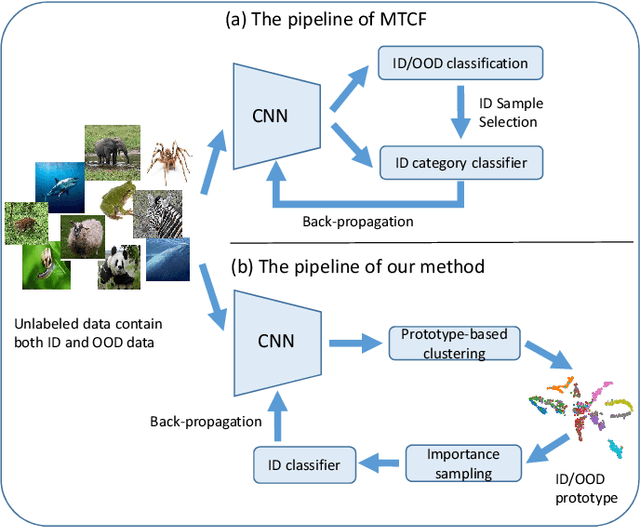


In this paper, we address a complex but practical scenario in semi-supervised learning (SSL) named open-set SSL, where unlabeled data contain both in-distribution (ID) and out-of-distribution (OOD) samples. Unlike previous methods that only consider ID samples to be useful and aim to filter out OOD ones completely during training, we argue that the exploration and exploitation of both ID and OOD samples can benefit SSL. To support our claim, i) we propose a prototype-based clustering and identification algorithm that explores the inherent similarity and difference among samples at feature level and effectively cluster them around several predefined ID and OOD prototypes, thereby enhancing feature learning and facilitating ID/OOD identification; ii) we propose an importance-based sampling method that exploits the difference in importance of each ID and OOD sample to SSL, thereby reducing the sampling bias and improving the training. Our proposed method achieves state-of-the-art in several challenging benchmarks, and improves upon existing SSL methods even when ID samples are totally absent in unlabeled data.