 Add to Chrome
 Add to Firefox
 Add to Edge
ICM-Fusion: In-Context Meta-Optimized LoRA Fusion for Multi-Task Adaptation
Aug 06, 2025
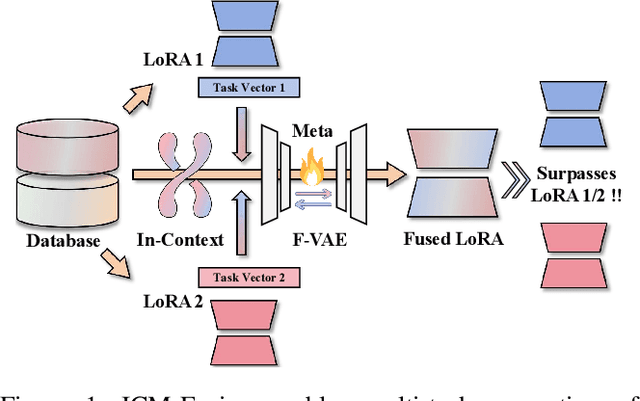
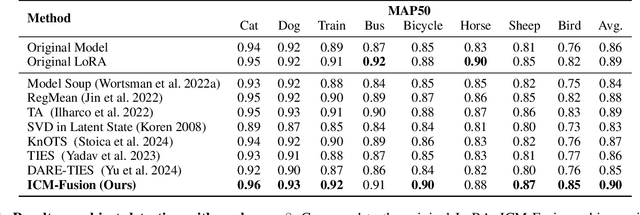
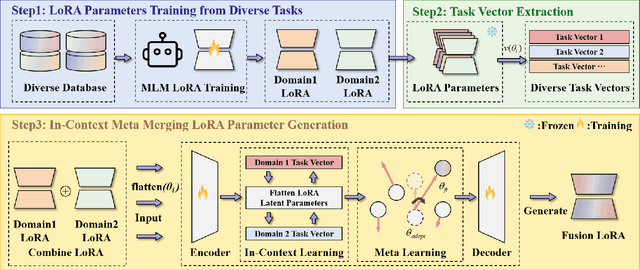
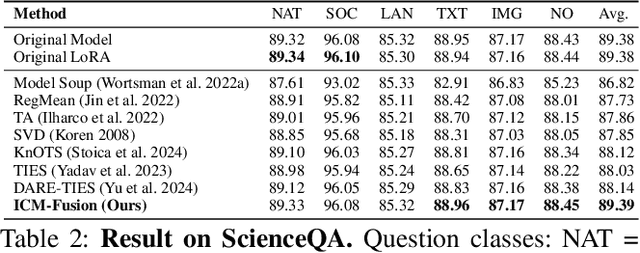
Enabling multi-task adaptation in pre-trained Low-Rank Adaptation (LoRA) models is crucial for enhancing their generalization capabilities. Most existing pre-trained LoRA fusion methods decompose weight matrices, sharing similar parameters while merging divergent ones. However, this paradigm inevitably induces inter-weight conflicts and leads to catastrophic domain forgetting. While incremental learning enables adaptation to multiple tasks, it struggles to achieve generalization in few-shot scenarios. Consequently, when the weight data follows a long-tailed distribution, it can lead to forgetting in the fused weights. To address this issue, we propose In-Context Meta LoRA Fusion (ICM-Fusion), a novel framework that synergizes meta-learning with in-context adaptation. The key innovation lies in our task vector arithmetic, which dynamically balances conflicting optimization directions across domains through learned manifold projections. ICM-Fusion obtains the optimal task vector orientation for the fused model in the latent space by adjusting the orientation of the task vectors. Subsequently, the fused LoRA is reconstructed by a self-designed Fusion VAE (F-VAE) to realize multi-task LoRA generation. We have conducted extensive experiments on visual and linguistic tasks, and the experimental results demonstrate that ICM-Fusion can be adapted to a wide range of architectural models and applied to various tasks. Compared to the current pre-trained LoRA fusion method, ICM-Fusion fused LoRA can significantly reduce the multi-tasking loss and can even achieve task enhancement in few-shot scenarios.

On the Utility of Virtual Staining for Downstream Applications as it relates to Task Network Capacity
Jul 31, 2025Virtual staining, or in-silico-labeling, has been proposed to computationally generate synthetic fluorescence images from label-free images by use of deep learning-based image-to-image translation networks. In most reported studies, virtually stained images have been assessed only using traditional image quality measures such as structural similarity or signal-to-noise ratio. However, in biomedical imaging, images are typically acquired to facilitate an image-based inference, which we refer to as a downstream biological or clinical task. This study systematically investigates the utility of virtual staining for facilitating clinically relevant downstream tasks (like segmentation or classification) with consideration of the capacity of the deep neural networks employed to perform the tasks. Comprehensive empirical evaluations were conducted using biological datasets, assessing task performance by use of label-free, virtually stained, and ground truth fluorescence images. The results demonstrated that the utility of virtual staining is largely dependent on the ability of the segmentation or classification task network to extract meaningful task-relevant information, which is related to the concept of network capacity. Examples are provided in which virtual staining does not improve, or even degrades, segmentation or classification performance when the capacity of the associated task network is sufficiently large. The results demonstrate that task network capacity should be considered when deciding whether to perform virtual staining.
RECALLED: An Unbounded Resource Consumption Attack on Large Vision-Language Models
Jul 24, 2025Resource Consumption Attacks (RCAs) have emerged as a significant threat to the deployment of Large Language Models (LLMs). With the integration of vision modalities, additional attack vectors exacerbate the risk of RCAs in large vision-language models (LVLMs). However, existing red-teaming studies have largely overlooked visual inputs as a potential attack surface, resulting in insufficient mitigation strategies against RCAs in LVLMs. To address this gap, we propose RECALLED (\textbf{RE}source \textbf{C}onsumption \textbf{A}ttack on \textbf{L}arge Vision-\textbf{L}anguag\textbf{E} Mo\textbf{D}els), the first approach for exploiting visual modalities to trigger unbounded RCAs red-teaming. First, we present \textit{Vision Guided Optimization}, a fine-grained pixel-level optimization, to obtain \textit{Output Recall} adversarial perturbations, which can induce repeating output. Then, we inject the perturbations into visual inputs, triggering unbounded generations to achieve the goal of RCAs. Additionally, we introduce \textit{Multi-Objective Parallel Losses} to generate universal attack templates and resolve optimization conflicts when intending to implement parallel attacks. Empirical results demonstrate that RECALLED increases service response latency by over 26 $\uparrow$, resulting in an additional 20\% increase in GPU utilization and memory consumption. Our study exposes security vulnerabilities in LVLMs and establishes a red-teaming framework that can facilitate future defense development against RCAs.
Investigating Training Data Detection in AI Coders
Jul 23, 2025Recent advances in code large language models (CodeLLMs) have made them indispensable tools in modern software engineering. However, these models occasionally produce outputs that contain proprietary or sensitive code snippets, raising concerns about potential non-compliant use of training data, and posing risks to privacy and intellectual property. To ensure responsible and compliant deployment of CodeLLMs, training data detection (TDD) has become a critical task. While recent TDD methods have shown promise in natural language settings, their effectiveness on code data remains largely underexplored. This gap is particularly important given code's structured syntax and distinct similarity criteria compared to natural language. To address this, we conduct a comprehensive empirical study of seven state-of-the-art TDD methods on source code data, evaluating their performance across eight CodeLLMs. To support this evaluation, we introduce CodeSnitch, a function-level benchmark dataset comprising 9,000 code samples in three programming languages, each explicitly labeled as either included or excluded from CodeLLM training. Beyond evaluation on the original CodeSnitch, we design targeted mutation strategies to test the robustness of TDD methods under three distinct settings. These mutation strategies are grounded in the well-established Type-1 to Type-4 code clone detection taxonomy. Our study provides a systematic assessment of current TDD techniques for code and offers insights to guide the development of more effective and robust detection methods in the future.
Skywork-R1V3 Technical Report
Jul 09, 2025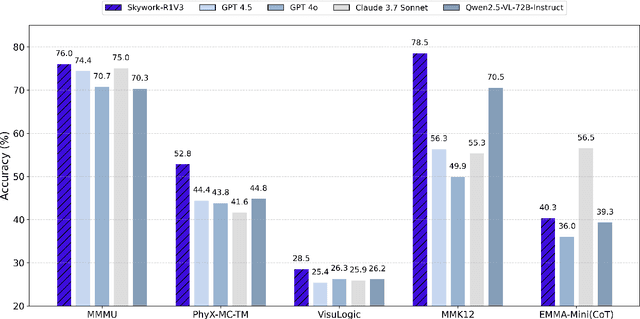
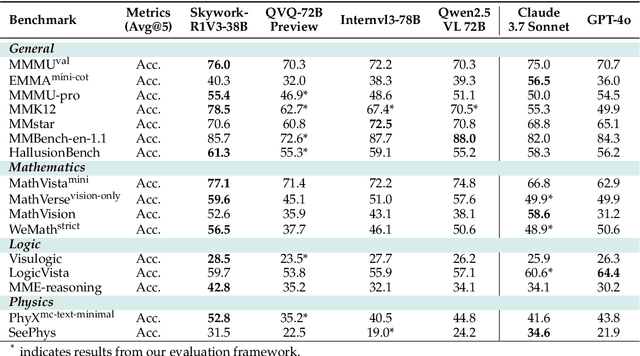
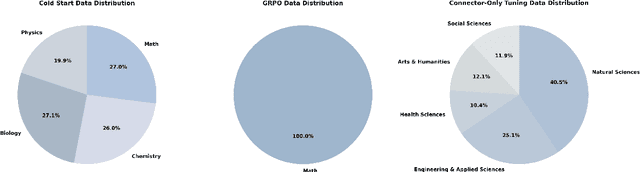

We introduce Skywork-R1V3, an advanced, open-source vision-language model (VLM) that pioneers a new approach to visual reasoning. Its key innovation lies in effectively transferring reasoning skills from text-only Large Language Models (LLMs) to visual tasks. The strong performance of Skywork-R1V3 primarily stems from our elaborate post-training RL framework, which effectively activates and enhances the model's reasoning ability, without the need for additional continue pre-training. Through this framework, we further uncover the fundamental role of the connector module in achieving robust cross-modal alignment for multimodal reasoning models. In addition, we introduce a unique indicator of reasoning capability, the entropy of critical reasoning tokens, which has proven highly effective for checkpoint selection during RL training. Skywork-R1V3 achieves state-of-the-art results on MMMU, significantly improving from 64.3% to 76.0%. This performance matches entry-level human capabilities. Remarkably, our RL-powered post-training approach enables even the 38B parameter model to rival top closed-source VLMs. The implementation successfully transfers mathematical reasoning to other subject-related reasoning tasks. We also include an analysis of curriculum learning and reinforcement finetuning strategies, along with a broader discussion on multimodal reasoning. Skywork-R1V3 represents a significant leap in multimodal reasoning, showcasing RL as a powerful engine for advancing open-source VLM capabilities.
ULC: A Unified and Fine-Grained Controller for Humanoid Loco-Manipulation
Jul 09, 2025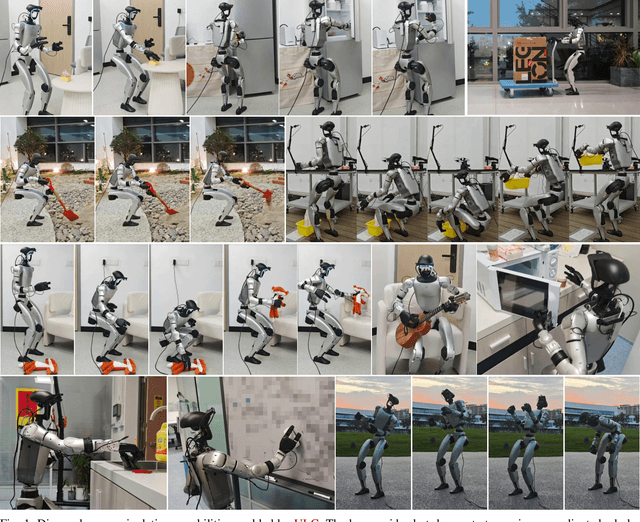
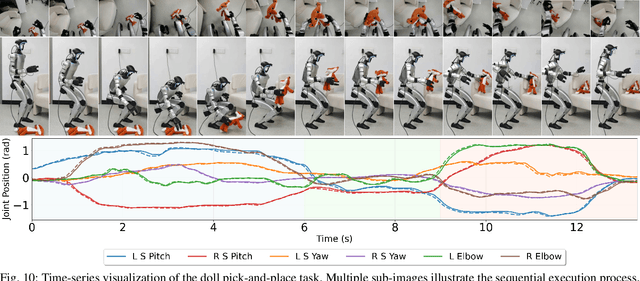
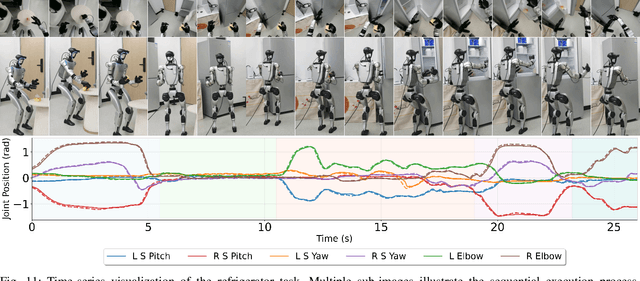
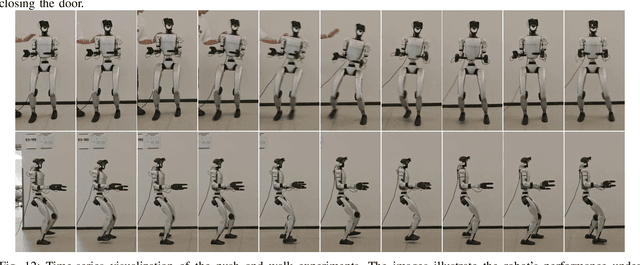
Loco-Manipulation for humanoid robots aims to enable robots to integrate mobility with upper-body tracking capabilities. Most existing approaches adopt hierarchical architectures that decompose control into isolated upper-body (manipulation) and lower-body (locomotion) policies. While this decomposition reduces training complexity, it inherently limits coordination between subsystems and contradicts the unified whole-body control exhibited by humans. We demonstrate that a single unified policy can achieve a combination of tracking accuracy, large workspace, and robustness for humanoid loco-manipulation. We propose the Unified Loco-Manipulation Controller (ULC), a single-policy framework that simultaneously tracks root velocity, root height, torso rotation, and dual-arm joint positions in an end-to-end manner, proving the feasibility of unified control without sacrificing performance. We achieve this unified control through key technologies: sequence skill acquisition for progressive learning complexity, residual action modeling for fine-grained control adjustments, command polynomial interpolation for smooth motion transitions, random delay release for robustness to deploy variations, load randomization for generalization to external disturbances, and center-of-gravity tracking for providing explicit policy gradients to maintain stability. We validate our method on the Unitree G1 humanoid robot with 3-DOF (degrees-of-freedom) waist. Compared with strong baselines, ULC shows better tracking performance to disentangled methods and demonstrating larger workspace coverage. The unified dual-arm tracking enables precise manipulation under external loads while maintaining coordinated whole-body control for complex loco-manipulation tasks.
ETT: Expanding the Long Context Understanding Capability of LLMs at Test-Time
Jul 08, 2025Transformer-based Language Models' computation and memory overhead increase quadratically as a function of sequence length. The quadratic cost poses challenges when employing LLMs for processing long sequences. In this work, we introduce \ourmodelacronym~(Extend at Test-Time), method for extending the context length of short context Transformer-based LLMs, with constant memory requirement and linear computation overhead. ETT enable the extension of the context length at test-time by efficient fine-tuning the model's parameters on the input context, chunked into overlapping small subsequences. We evaluate ETT on LongBench by extending the context length of GPT-Large and Phi-2 up to 32 times, increasing from 1k to 32k tokens. This results in up to a 30 percent improvement in the model's accuracy. We also study how context can be stored in LLM's weights effectively and efficiently. Through a detailed ablation study, we examine which Transformer modules are most beneficial to fine-tune at test-time. Interestingly, we find that fine-tuning the second layer of the FFNs is more effective than full fine-tuning, leading to a further improvement in the models' accuracy.
An AI-Driven Thermal-Fluid Testbed for Advanced Small Modular Reactors: Integration of Digital Twin and Large Language Models
Jul 08, 2025This paper presents a multipurpose artificial intelligence (AI)-driven thermal-fluid testbed designed to advance Small Modular Reactor technologies by seamlessly integrating physical experimentation with advanced computational intelligence. The platform uniquely combines a versatile three-loop thermal-fluid facility with a high-fidelity digital twin and sophisticated AI frameworks for real-time prediction, control, and operational assistance. Methodologically, the testbed's digital twin, built upon the System Analysis Module code, is coupled with a Gated Recurrent Unit (GRU) neural network. This machine learning model, trained on experimental data, enables faster-than-real-time simulation, providing predictive insights into the system's dynamic behavior. The practical application of this AI integration is showcased through case studies. An AI-driven control framework where the GRU model accurately forecasts future system states and the corresponding control actions required to meet operational demands. Furthermore, an intelligent assistant, powered by a large language model, translates complex sensor data and simulation outputs into natural language, offering operators actionable analysis and safety recommendations. Comprehensive validation against experimental transients confirms the platform's high fidelity, with the GRU model achieving a temperature prediction root mean square error of 1.42 K. This work establishes an integrated research environment at the intersection of AI and thermal-fluid science, showcasing how AI-driven methodologies in modeling, control, and operator support can accelerate the innovation and deployment of next-generation nuclear systems.
Skywork-Reward-V2: Scaling Preference Data Curation via Human-AI Synergy
Jul 02, 2025Despite the critical role of reward models (RMs) in reinforcement learning from human feedback (RLHF), current state-of-the-art open RMs perform poorly on most existing evaluation benchmarks, failing to capture the spectrum of nuanced and sophisticated human preferences. Even approaches that incorporate advanced training techniques have not yielded meaningful performance improvements. We hypothesize that this brittleness stems primarily from limitations in preference datasets, which are often narrowly scoped, synthetically labeled, or lack rigorous quality control. To address these challenges, we present a large-scale preference dataset comprising 40 million preference pairs, named SynPref-40M. To enable data curation at scale, we design a human-AI synergistic two-stage pipeline that leverages the complementary strengths of human annotation quality and AI scalability. In this pipeline, humans provide verified annotations, while large language models perform automatic curation based on human guidance. Training on this preference mixture, we introduce Skywork-Reward-V2, a suite of eight reward models ranging from 0.6B to 8B parameters, trained on a carefully curated subset of 26 million preference pairs from SynPref-40M. We demonstrate that Skywork-Reward-V2 is versatile across a wide range of capabilities, including alignment with human preferences, objective correctness, safety, resistance to stylistic biases, and best-of-N scaling, achieving state-of-the-art performance across seven major reward model benchmarks. Ablation studies confirm that the effectiveness of our approach stems not only from data scale but also from high-quality curation. The Skywork-Reward-V2 series represents substantial progress in open reward models, highlighting the untapped potential of existing preference datasets and demonstrating how human-AI curation synergy can unlock significantly higher data quality.
Hierarchical Sub-action Tree for Continuous Sign Language Recognition
Jun 26, 2025Continuous sign language recognition (CSLR) aims to transcribe untrimmed videos into glosses, which are typically textual words. Recent studies indicate that the lack of large datasets and precise annotations has become a bottleneck for CSLR due to insufficient training data. To address this, some works have developed cross-modal solutions to align visual and textual modalities. However, they typically extract textual features from glosses without fully utilizing their knowledge. In this paper, we propose the Hierarchical Sub-action Tree (HST), termed HST-CSLR, to efficiently combine gloss knowledge with visual representation learning. By incorporating gloss-specific knowledge from large language models, our approach leverages textual information more effectively. Specifically, we construct an HST for textual information representation, aligning visual and textual modalities step-by-step and benefiting from the tree structure to reduce computational complexity. Additionally, we impose a contrastive alignment enhancement to bridge the gap between the two modalities. Experiments on four datasets (PHOENIX-2014, PHOENIX-2014T, CSL-Daily, and Sign Language Gesture) demonstrate the effectiveness of our HST-CSLR.