 Add to Chrome
 Add to Firefox
 Add to Edge
Reasoning Jury: Multi-Model Consensus for Evaluating Reasoning Traces
Aug 12, 2026
Improving reasoning LLMs requires the ability to judge the quality of long reasoning traces for effective reasoning data curation, strong training signals during reinforcement learning, and an in-depth understanding of reasoning behaviors during model performance evaluation. Additionally, surfacing reasoning mistakes that the model makes would enable improving the model's performance at runtime through providing feedback. Due to the difficulty of this complex task on long reasoning traces, single-model judges (even frontier models) do not do well at identifying reasoning defects. Additionally, leveraging frontier models during online training of reasoning LLMs is generally prohibited due to guardrails in terms of use. In this work, we introduce Reasoning Jury, a system that replaces the single judge with a jury of LLMs and a moderated consensus mechanism, to improve the fidelity of judgments for identifying reasoning defects. In reasoning jury, defects of a reasoning trace and their severity are surfaced through a deliberation where a moderator conducts a discussion amongst the jury where the jurors critique each other's judgments and get to modify their initial votes. The moderator derives a consensus through deliberation amongst jurors or consolidation of judgements. We show that Reasoning Jury with a jury of open-weight models (e.g., gpt-oss-120b) is able to significantly outperform frontier models (opus-4.6, sonnet-4.6, and gemini-3.1-pro) at correctly identifying reasoning defects. Besides accuracy performance improvements, the aggregated cost of the jury (initial verdicts, deliberations, consolidation, etc.) is a fraction (8 to 15%) of the cost of running frontier models in LLM-as-a-judge setup. We also show how these judgements can be leveraged to understand failure modes of reasoning LLMs on benchmarks, which allows much deeper understanding of a model's performance.

Advancing Creative Physical Intelligence in Large Multimodal Models
May 25, 2026Large multimodal models (LMMs) have rapidly advanced in perception and reasoning; however, it remains unclear whether these capabilities generalize to discovering visually grounded solutions in open-ended environments, beyond pattern recognition. In such settings, intelligence requires more than answering well-posed questions: it involves identifying how elements in a scene can be repurposed in non-obvious yet physically feasible ways. This form of creative problem-solving is central to human intelligence, but remains largely untested in current benchmarks. To evaluate this ability, we introduce MM-CreativityBench, a benchmark for affordance-grounded creative tool use in visually rich, physically constrained environments. Each instance presents a scenario image with structured views of candidate entities and their parts, enabling fine-grained, interactive evaluation of how models iteratively inspect the scene, identify relevant affordances, and compose visually and physically grounded solutions. Our experiments show that current LMMs often fall short, not due to lack of generative capability, but because they do not sustain grounded exploration. Models often overlook relevant entities, under-examine critical parts, or hallucinate attributes not grounded in the image. Motivated by this failure mode, we propose affordance-grounded alignment, which casts creative tool use as a preference learning problem. Using Direct Preference Optimization, we encourage models to prefer attribute-affordance reasoning grounded in visual evidence over hallucinated alternatives. In addition, we incorporate supervision derived from an affordance knowledge base to guide broader entity exploration and multi-turn planning. Our results show consistent gains in selecting the correct entities and parts, while substantially reducing hallucination and grounding-related errors.
AcquisitionSynthesis: Targeted Data Generation using Acquisition Functions
May 13, 2026Data quality remains a critical bottleneck in developing capable, competitive models. Researchers have explored many ways to generate top quality samples. Some works rely on rejection sampling: generating lots of synthetic samples and filtering out low-quality samples. Other works rely on larger or closed-source models to extract model weaknesses, necessary skills, or a curriculum off of which to base data generation. These works have one common limitation: there is no quantitative approach to measure the impact of the generated samples on the downstream learner. Active learning literature provides exactly this, in the form of acquisition functions. Acquisition functions measure the informativeness and/or influence of data, providing interpretable, model-centric signals. Inspired by this, we propose AcquisitionSynthesis: using acquisition functions as reward models to train language models to generate higher-quality synthetic data. We conduct experiments on classic verifiable tasks of math, medical question-answering, and coding. Our experimental results indicate that (1) student models trained with AcquisitionSynthesis data achieve good performance on in-distribution tasks (2-7% gain) and is more robust to catastrophic forgetting, and (2) AcquisitionSynthesis models can generate data for other models and for low-to-high resource training paradigms. By leveraging acquisition rewards, we seek to demonstrate a principled path toward model-aware self-improvement that surpasses static datasets.
Direct Preference Optimization with Rating Information: Practical Algorithms and Provable Gains
Jan 31, 2026The class of direct preference optimization (DPO) algorithms has emerged as a promising approach for solving the alignment problem in foundation models. These algorithms work with very limited feedback in the form of pairwise preferences and fine-tune models to align with these preferences without explicitly learning a reward model. While the form of feedback used by these algorithms makes the data collection process easy and relatively more accurate, its ambiguity in terms of the quality of responses could have negative implications. For example, it is not clear if a decrease (increase) in the likelihood of preferred (dispreferred) responses during the execution of these algorithms could be interpreted as a positive or negative phenomenon. In this paper, we study how to design algorithms that can leverage additional information in the form of rating gap, which informs the learner how much the chosen response is better than the rejected one. We present new algorithms that can achieve faster statistical rates than DPO in presence of accurate rating gap information. Moreover, we theoretically prove and empirically show that the performance of our algorithms is robust to inaccuracy in rating gaps. Finally, we demonstrate the solid performance of our methods in comparison to a number of DPO-style algorithms across a wide range of LLMs and evaluation benchmarks.
CESAR: Automatic Induction of Compositional Instructions for Multi-turn Dialogs
Nov 29, 2023Instruction-based multitasking has played a critical role in the success of large language models (LLMs) in multi-turn dialog applications. While publicly available LLMs have shown promising performance, when exposed to complex instructions with multiple constraints, they lag against state-of-the-art models like ChatGPT. In this work, we hypothesize that the availability of large-scale complex demonstrations is crucial in bridging this gap. Focusing on dialog applications, we propose a novel framework, CESAR, that unifies a large number of dialog tasks in the same format and allows programmatic induction of complex instructions without any manual effort. We apply CESAR on InstructDial, a benchmark for instruction-based dialog tasks. We further enhance InstructDial with new datasets and tasks and utilize CESAR to induce complex tasks with compositional instructions. This results in a new benchmark called InstructDial++, which includes 63 datasets with 86 basic tasks and 68 composite tasks. Through rigorous experiments, we demonstrate the scalability of CESAR in providing rich instructions. Models trained on InstructDial++ can follow compositional prompts, such as prompts that ask for multiple stylistic constraints.
Data-Efficient Alignment of Large Language Models with Human Feedback Through Natural Language
Nov 24, 2023

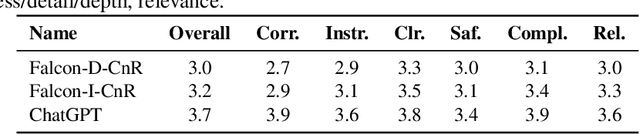

Learning from human feedback is a prominent technique to align the output of large language models (LLMs) with human expectations. Reinforcement learning from human feedback (RLHF) leverages human preference signals that are in the form of ranking of response pairs to perform this alignment. However, human preference on LLM outputs can come in much richer forms including natural language, which may provide detailed feedback on strengths and weaknesses of a given response. In this work we investigate data efficiency of modeling human feedback that is in natural language. Specifically, we fine-tune an open-source LLM, e.g., Falcon-40B-Instruct, on a relatively small amount (1000 records or even less) of human feedback in natural language in the form of critiques and revisions of responses. We show that this model is able to improve the quality of responses from even some of the strongest LLMs such as ChatGPT, BARD, and Vicuna, through critique and revision of those responses. For instance, through one iteration of revision of ChatGPT responses, the revised responses have 56.6% win rate over the original ones, and this win rate can be further improved to 65.9% after applying the revision for five iterations.
"What do others think?": Task-Oriented Conversational Modeling with Subjective Knowledge
May 20, 2023


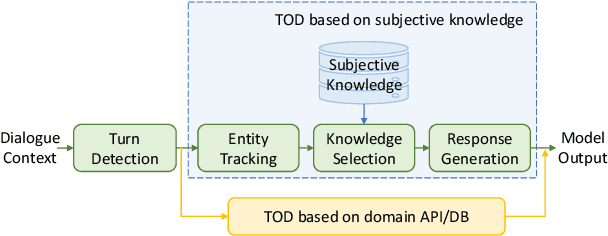
Task-oriented Dialogue (TOD) Systems aim to build dialogue systems that assist users in accomplishing specific goals, such as booking a hotel or a restaurant. Traditional TODs rely on domain-specific APIs/DBs or external factual knowledge to generate responses, which cannot accommodate subjective user requests (e.g., "Is the WIFI reliable?" or "Does the restaurant have a good atmosphere?"). To address this issue, we propose a novel task of subjective-knowledge-based TOD (SK-TOD). We also propose the first corresponding dataset, which contains subjective knowledge-seeking dialogue contexts and manually annotated responses grounded in subjective knowledge sources. When evaluated with existing TOD approaches, we find that this task poses new challenges such as aggregating diverse opinions from multiple knowledge snippets. We hope this task and dataset can promote further research on TOD and subjective content understanding. The code and the dataset are available at https://github.com/alexa/dstc11-track5.
KILM: Knowledge Injection into Encoder-Decoder Language Models
Feb 17, 2023

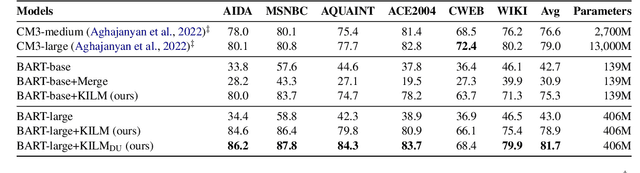

Large pre-trained language models (PLMs) have been shown to retain implicit knowledge within their parameters. To enhance this implicit knowledge, we propose Knowledge Injection into Language Models (KILM), a novel approach that injects entity-related knowledge into encoder-decoder PLMs, via a generative knowledge infilling objective through continued pre-training. This is done without architectural modifications to the PLMs or adding additional parameters. Experimental results over a suite of knowledge-intensive tasks spanning numerous datasets show that KILM enables models to retain more knowledge and hallucinate less, while preserving their original performance on general NLU and NLG tasks. KILM also demonstrates improved zero-shot performances on tasks such as entity disambiguation, outperforming state-of-the-art models having 30x more parameters.
Role of Bias Terms in Dot-Product Attention
Feb 16, 2023Dot-product attention is a core module in the present generation of neural network models, particularly transformers, and is being leveraged across numerous areas such as natural language processing and computer vision. This attention module is comprised of three linear transformations, namely query, key, and value linear transformations, each of which has a bias term. In this work, we study the role of these bias terms, and mathematically show that the bias term of the key linear transformation is redundant and could be omitted without any impact on the attention module. Moreover, we argue that the bias term of the value linear transformation has a more prominent role than that of the bias term of the query linear transformation. We empirically verify these findings through multiple experiments on language modeling, natural language understanding, and natural language generation tasks.
Selective In-Context Data Augmentation for Intent Detection using Pointwise V-Information
Feb 10, 2023

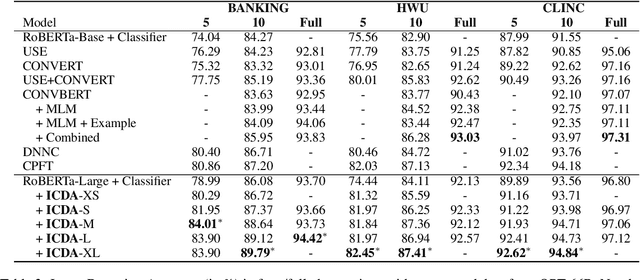
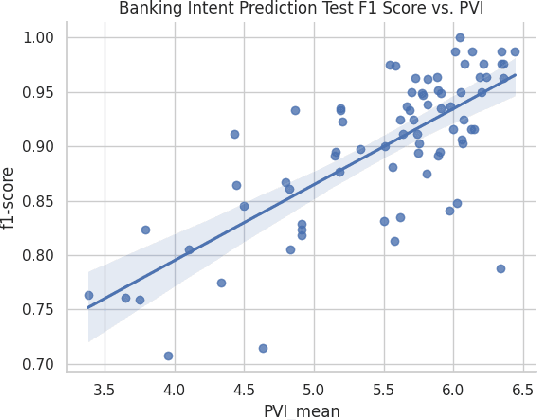
This work focuses on in-context data augmentation for intent detection. Having found that augmentation via in-context prompting of large pre-trained language models (PLMs) alone does not improve performance, we introduce a novel approach based on PLMs and pointwise V-information (PVI), a metric that can measure the usefulness of a datapoint for training a model. Our method first fine-tunes a PLM on a small seed of training data and then synthesizes new datapoints - utterances that correspond to given intents. It then employs intent-aware filtering, based on PVI, to remove datapoints that are not helpful to the downstream intent classifier. Our method is thus able to leverage the expressive power of large language models to produce diverse training data. Empirical results demonstrate that our method can produce synthetic training data that achieve state-of-the-art performance on three challenging intent detection datasets under few-shot settings (1.28% absolute improvement in 5-shot and 1.18% absolute in 10-shot, on average) and perform on par with the state-of-the-art in full-shot settings (within 0.01% absolute, on average).