 Add to Chrome
 Add to Firefox
 Add to Edge
VESTA: Visual Exploration with Statistical Tool Agents
May 29, 2026
Fitting quantitative models to data is a central step in scientific workflows, yet it remains one of the least automated. Recent agent-based systems leverage language and vision-language models (VLMs) to iteratively propose and refine statistical models, but these systems struggle on more challenging modeling tasks. To address these limitations, we introduce VESTA: Visual Exploration with Statistical Tool Agents, a framework that equips VLMs with a dynamically growing exploration toolkit to guide model refinement through data transformations, hypothesis-driven visualizations, and robust statistical tests. Unlike prior systems that rely on iterative critique alone, VESTA actively explores data before and during refinement by selecting or creating diagnostic tools, which accumulate in the model's context and can be reused later. We evaluate VESTA against established baselines in three toolkit configurations: no tools, static expert-written tools, and dynamic model-written tools. To support this evaluation, we introduce DAWN (Dataset for Automated Workflows and Numerical Modeling), a benchmark targeting distribution fitting and time series modeling with varying difficulty tiers, and culminating in real-world astronomy tasks including modeling initial mass functions and gravitational-wave chirp signals. We find that VESTA's dynamic tool creation outperforms prior agentic pipelines, with the largest gains on complex and domain-specific tasks. We further show that dynamically generated tools are substantially more sophisticated than those produced by existing visual tool-creation systems, covering more diagnostic categories per function and strongly preferring visual outputs that the VLM critic can reason over directly.

AI-Assisted Peer Review at Scale: The AAAI-26 AI Review Pilot
Apr 15, 2026Scientific peer review faces mounting strain as submission volumes surge, making it increasingly difficult to sustain review quality, consistency, and timeliness. Recent advances in AI have led the community to consider its use in peer review, yet a key unresolved question is whether AI can generate technically sound reviews at real-world conference scale. Here we report the first large-scale field deployment of AI-assisted peer review: every main-track submission at AAAI-26 received one clearly identified AI review from a state-of-the-art system. The system combined frontier models, tool use, and safeguards in a multi-stage process to generate reviews for all 22,977 full-review papers in less than a day. A large-scale survey of AAAI-26 authors and program committee members showed that participants not only found AI reviews useful, but actually preferred them to human reviews on key dimensions such as technical accuracy and research suggestions. We also introduce a novel benchmark and find that our system substantially outperforms a simple LLM-generated review baseline at detecting a variety of scientific weaknesses. Together, these results show that state-of-the-art AI methods can already make meaningful contributions to scientific peer review at conference scale, opening a path toward the next generation of synergistic human-AI teaming for evaluating research.
LLM REgression with a Latent Iterative State Head
Apr 01, 2026We present RELISH (REgression with a Latent Iterative State Head), a novel, lightweight architecture designed for text regression with large language models. Rather than decoding numeric targets as text or aggregating multiple generated outputs, RELISH predicts scalar values directly from frozen LLM representations by iteratively refining a learned latent state through cross-attention over token-level representations, and then mapping the final state to a point estimate with a linear regressor. Across five datasets, four LLM backbones, and two LLM training regimes, RELISH consistently outperforms prior baselines from all three major LLM regression families, including autoregressive decoding, regression-aware inference, and existing predictive head methods. Despite these gains, RELISH remains highly parameter-efficient, requiring only 3.4-3.7M trainable parameters across frozen LLM backbones (only 0.01-0.04% additional overhead), far less than LoRA-based alternatives that grow with model size (0.26-0.42%).
Instance-level Performance Prediction for Long-form Generation Tasks
Sep 09, 2025We motivate and share a new benchmark for instance-level performance prediction of long-form generation tasks having multi-faceted, fine-grained quality metrics. Our task-, model- and metric-agnostic formulation predicts continuous evaluation metric scores given only black-box model inputs and outputs. Beyond predicting point estimates of metric scores, the benchmark also requires inferring prediction intervals to quantify uncertainty around point estimates. Evaluation spans 11 long-form datasets/tasks with multiple LLMs, baselines, and metrics per task. We show that scores can be effectively predicted across long-form generation tasks using as few as 16 training examples. Overall, we introduce a novel and useful task, a valuable benchmark to drive progress, and baselines ready for practical adoption today.
Exploring Multidimensional Checkworthiness: Designing AI-assisted Claim Prioritization for Human Fact-checkers
Dec 11, 2024Given the massive volume of potentially false claims circulating online, claim prioritization is essential in allocating limited human resources available for fact-checking. In this study, we perceive claim prioritization as an information retrieval (IR) task: just as multidimensional IR relevance, with many factors influencing which search results a user deems relevant, checkworthiness is also multi-faceted, subjective, and even personal, with many factors influencing how fact-checkers triage and select which claims to check. Our study investigates both the multidimensional nature of checkworthiness and effective tool support to assist fact-checkers in claim prioritization. Methodologically, we pursue Research through Design combined with mixed-method evaluation. We develop an AI-assisted claim prioritization prototype as a probe to explore how fact-checkers use multidimensional checkworthiness factors in claim prioritization, simultaneously probing fact-checker needs while also exploring the design space to meet those needs. Our study with 16 professional fact-checkers investigates: 1) how participants assessed the relative importance of different checkworthy dimensions and apply different priorities in claim selection; 2) how they created customized GPT-based search filters and the corresponding benefits and limitations; and 3) their overall user experiences with our prototype. Our work makes a conceptual contribution between multidimensional IR relevance and fact-checking checkworthiness, with findings demonstrating the value of corresponding tooling support. Specifically, we uncovered a hierarchical prioritization strategy fact-checkers implicitly use, revealing an underexplored aspect of their workflow, with actionable design recommendations for improving claim triage across multi-dimensional checkworthiness and tailoring this process with LLM integration.
Argumentative Experience: Reducing Confirmation Bias on Controversial Issues through LLM-Generated Multi-Persona Debates
Dec 10, 2024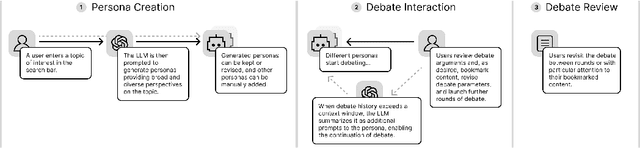
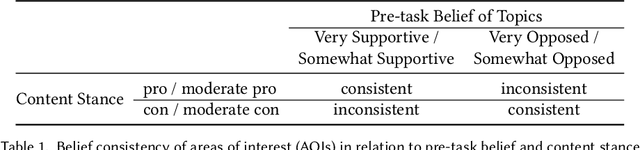
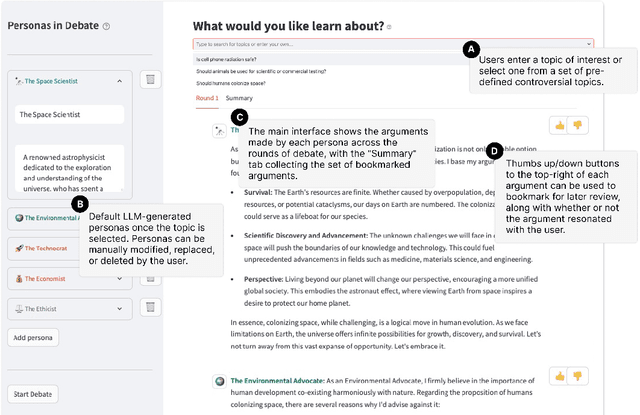

Large language models (LLMs) are enabling designers to give life to exciting new user experiences for information access. In this work, we present a system that generates LLM personas to debate a topic of interest from different perspectives. How might information seekers use and benefit from such a system? Can centering information access around diverse viewpoints help to mitigate thorny challenges like confirmation bias in which information seekers over-trust search results matching existing beliefs? How do potential biases and hallucinations in LLMs play out alongside human users who are also fallible and possibly biased? Our study exposes participants to multiple viewpoints on controversial issues via a mixed-methods, within-subjects study. We use eye-tracking metrics to quantitatively assess cognitive engagement alongside qualitative feedback. Compared to a baseline search system, we see more creative interactions and diverse information-seeking with our multi-persona debate system, which more effectively reduces user confirmation bias and conviction toward their initial beliefs. Overall, our study contributes to the emerging design space of LLM-based information access systems, specifically investigating the potential of simulated personas to promote greater exposure to information diversity, emulate collective intelligence, and mitigate bias in information seeking.
Fairly Accurate: Optimizing Accuracy Parity in Fair Target-Group Detection
Jul 16, 2024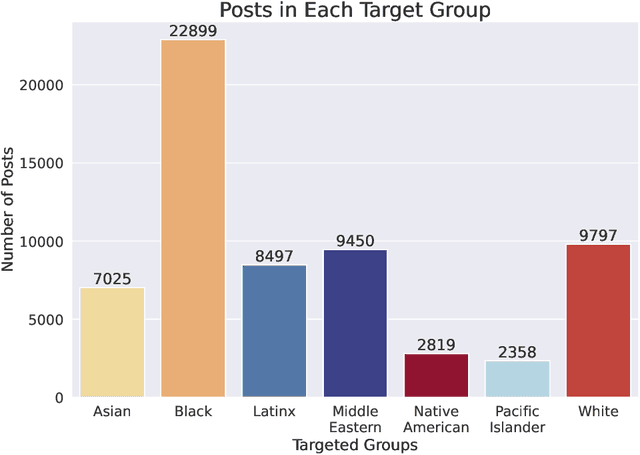

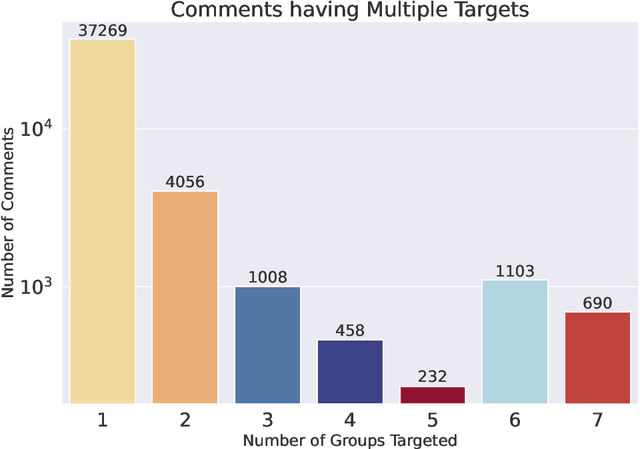
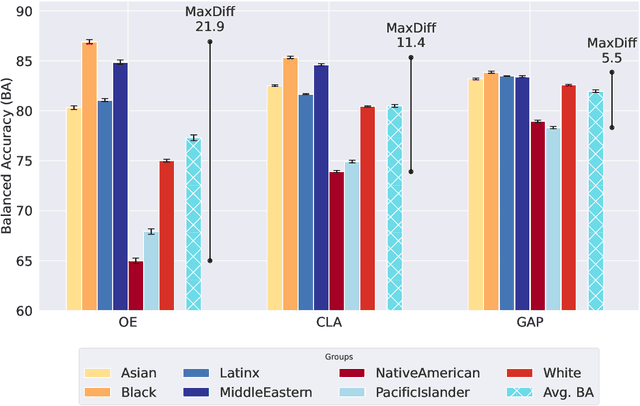
In algorithmic toxicity detection pipelines, it is important to identify which demographic group(s) are the subject of a post, a task commonly known as \textit{target (group) detection}. While accurate detection is clearly important, we further advocate a fairness objective: to provide equal protection to all groups who may be targeted. To this end, we adopt \textit{Accuracy Parity} (AP) -- balanced detection accuracy across groups -- as our fairness objective. However, in order to align model training with our AP fairness objective, we require an equivalent loss function. Moreover, for gradient-based models such as neural networks, this loss function needs to be differentiable. Because no such loss function exists today for AP, we propose \emph{Group Accuracy Parity} (GAP): the first differentiable loss function having a one-on-one mapping to AP. We empirically show that GAP addresses disparate impact on groups for target detection. Furthermore, because a single post often targets multiple groups in practice, we also provide a mathematical extension of GAP to larger multi-group settings, something typically requiring heuristics in prior work. Our findings show that by optimizing AP, GAP better mitigates bias in comparison with other commonly employed loss functions.
Promoting Constructive Deliberation: Reframing for Receptiveness
May 23, 2024To promote constructive discussion of controversial topics online, we propose automatic reframing of disagreeing responses to signal receptiveness while preserving meaning. Drawing on research from psychology, communications, and linguistics, we identify six strategies for reframing. We automatically reframe replies according to each strategy, using a dataset of Reddit comments and replies. Through human-centered experiments, we find that the replies generated with our framework are perceived to be significantly more receptive than the original replies, as well as a generic receptiveness baseline. We analyze and discuss the implications of our results and highlight applications to content moderation. Overall, we illustrate how transforming receptiveness, a particular social science construct, into a computational framework, can make LLM generations more aligned with human perceptions.
Benchmark Transparency: Measuring the Impact of Data on Evaluation
Mar 31, 2024In this paper we present an exploratory research on quantifying the impact that data distribution has on the performance and evaluation of NLP models. We propose an automated framework that measures the data point distribution across 6 different dimensions: ambiguity, difficulty, discriminability, length, noise, and perplexity. We use disproportional stratified sampling to measure how much the data distribution affects absolute (Acc/F1) and relative (Rank) model performance. We experiment on 2 different datasets (SQUAD and MNLI) and test a total of 135 different models (125 on SQUAD and 10 on MNLI). We demonstrate that without explicit control of the data distribution, standard evaluation frameworks are inconsistent and unreliable. We find that the impact of the data is statistically significant and is often larger than the impact of changing the metric. In a second set of experiments, we demonstrate that the impact of data on evaluation is not just observable, but also predictable. We propose to use benchmark transparency as a method for comparing datasets and quantifying the similarity between them. We find that the ``dataset similarity vector'' can be used to predict how well a model generalizes out of distribution.
Diverse, but Divisive: LLMs Can Exaggerate Gender Differences in Opinion Related to Harms of Misinformation
Jan 29, 2024The pervasive spread of misinformation and disinformation poses a significant threat to society. Professional fact-checkers play a key role in addressing this threat, but the vast scale of the problem forces them to prioritize their limited resources. This prioritization may consider a range of factors, such as varying risks of harm posed to specific groups of people. In this work, we investigate potential implications of using a large language model (LLM) to facilitate such prioritization. Because fact-checking impacts a wide range of diverse segments of society, it is important that diverse views are represented in the claim prioritization process. This paper examines whether a LLM can reflect the views of various groups when assessing the harms of misinformation, focusing on gender as a primary variable. We pose two central questions: (1) To what extent do prompts with explicit gender references reflect gender differences in opinion in the United States on topics of social relevance? and (2) To what extent do gender-neutral prompts align with gendered viewpoints on those topics? To analyze these questions, we present the TopicMisinfo dataset, containing 160 fact-checked claims from diverse topics, supplemented by nearly 1600 human annotations with subjective perceptions and annotator demographics. Analyzing responses to gender-specific and neutral prompts, we find that GPT 3.5-Turbo reflects empirically observed gender differences in opinion but amplifies the extent of these differences. These findings illuminate AI's complex role in moderating online communication, with implications for fact-checkers, algorithm designers, and the use of crowd-workers as annotators. We also release the TopicMisinfo dataset to support continuing research in the community.