 Add to Chrome
 Add to Firefox
 Add to Edge
Context Matters: Auditing Gender Bias in T2I Generation through Risk-Tiered Use-Case Profiles
May 13, 2026
Text-to-image (T2I) generative models are increasingly used to produce content for education, media, and public-facing communication, and are starting to be integrated into higher-impact pipelines. Since generated images tend to reinforce stereotypes, producing representational erasure via "default" depictions and shaping perceptions of who belongs in certain roles, a growing body of work has proposed metrics to quantify gender bias in T2I outputs. Yet existing evaluations remain fragmented. Metrics are often reported without a shared view of what they measure, what assumptions they entail, or how their results should be interpreted under different deployment contexts. This limits the usefulness of gender bias measurement for both technical auditing and emerging governance discussions. We propose a risk-aligned auditing framework for gender bias in T2I models composed of three constituents that connects risk categories, evaluation metrics, and harms. First, we identify risk-tiered use-case profiles aligned with the EU AI Act's risk categories to motivate why auditing expectations may vary with deployment contexts and stakeholder exposure. Second, we construct a metric catalog that consolidates gender-bias evaluation methods and organizes them in three measurement categories: gender prediction, embedding similarity, and downstream task. Third, we introduce a harm typology that maps context-dependent harm categories (e.g., representational, quality-of-service) to specific risk-tired scenarios. Finally, we introduce THUMB cards (Text-to-image Harms-informed Use-case-aligned Metrics of gender Bias) that help formulate auditing systematically by the incorporation of context, scenario and bias manifestation, harm hypotheses, and audit strategy.

Beyond Accuracy: Policy Invariance as a Reliability Test for LLM Safety Judges
May 07, 2026LLM-as-a-Judge pipelines have become the de facto evaluator for agent safety, yet existing benchmarks treat their verdicts as ground-truth proxies without checking whether the verdicts depend on the agent's behavior or merely on how the evaluation policy happens to be worded. We argue that any trustworthy safety judge must satisfy a basic property we call policy invariance, and we operationalize it as three testable principles: rubric-semantics invariance under certified-equivalent rewrites, rubric-threshold invariance under intentional strict-to-lenient shifts, and ambiguity-aware calibration so that verdict instability concentrates on genuinely ambiguous cases. Instantiating these principles as a stress-test protocol with four agent-class judges on trajectories drawn from ASSEBench and R-Judge, we surface a previously unmeasured failure mode: today's judges respond to meaningful normative shifts and to meaningless structural rewrites with comparable strength, and cannot tell the two apart. Content-preserving policy rewrites flip up to 9.1% of verdicts above baseline jitter, and 18-43% of all observed flips occur on unambiguous cases under such rewrites, so existing safety scores conflate what the agent did with how the evaluator was prompted. Beyond the diagnosis, we contribute the Policy Invariance Score and the Judge Card reporting protocol, which expose an order-of-magnitude spread in judge reliability that is invisible to accuracy-only leaderboards. We release the protocol and code so that future agent-safety benchmarks can audit their own evaluators rather than trust them by default.
Where Did It Go Wrong? Capability-Oriented Failure Attribution for Vision-and-Language Navigation Agents
Apr 28, 2026Embodied agents in safety-critical applications such as Vision-Language Navigation (VLN) rely on multiple interdependent capabilities (e.g., perception, memory, planning, decision), making failures difficult to localize and attribute. Existing testing methods are largely system-level and provide limited insight into which capability deficiencies cause task failures. We propose a capability-oriented testing approach that enables failure detection and attribution by combining (1) adaptive test case generation via seed selection and mutation, (2) capability oracles for identifying capability-specific errors, and (3) a feedback mechanism that attributes failures to capabilities and guides further test generation. Experiments show that our method discovers more failure cases and more accurately pinpoints capability-level deficiencies than state-of-the-art baselines, providing more interpretable and actionable guidance for improving embodied agents.
AutoEG: Exploiting Known Third-Party Vulnerabilities in Black-Box Web Applications
Apr 01, 2026Large-scale web applications are widely deployed with complex third-party components, inheriting security risks arising from component vulnerabilities. Security assessment is therefore required to determine whether such known vulnerabilities remain practically exploitable in real applications. Penetration testing is a widely adopted approach that validates exploitability by launching concrete attacks against known vulnerabilities in real-world black-box systems. However, existing approaches often fail to automatically generate reliable exploits, limiting their effectiveness in practical security assessment. This limitation mainly stems from two issues: (1) precisely triggering vulnerabilities with correct technical details, and (2) adapting exploits to diverse real-world deployment settings. In this paper, we propose AutoEG, a fully automated multi-agent framework for exploit generation targeting black-box web applications. AutoEG has two phases: First, AutoEG extracts precise vulnerability trigger logic from unstructured vulnerability information and encapsulates it into reusable trigger functions. Second, AutoEG uses trigger functions for concrete attack objectives and iteratively refines exploits through feedback-driven interaction with the target application. We evaluate AutoEG on 104 real-world vulnerabilities with 29 attack objectives, resulting in 660 exploitation tasks and 55,440 exploit attempts. AutoEG achieves an average success rate of 82.41%, substantially outperforming state-of-the-art baselines, whose best performance reaches only 32.88%.
PentestEval: Benchmarking LLM-based Penetration Testing with Modular and Stage-Level Design
Dec 16, 2025Penetration testing is essential for assessing and strengthening system security against real-world threats, yet traditional workflows remain highly manual, expertise-intensive, and difficult to scale. Although recent advances in Large Language Models (LLMs) offer promising opportunities for automation, existing applications rely on simplistic prompting without task decomposition or domain adaptation, resulting in unreliable black-box behavior and limited insight into model capabilities across penetration testing stages. To address this gap, we introduce PentestEval, the first comprehensive benchmark for evaluating LLMs across six decomposed penetration testing stages: Information Collection, Weakness Gathering and Filtering, Attack Decision-Making, Exploit Generation and Revision. PentestEval integrates expert-annotated ground truth with a fully automated evaluation pipeline across 346 tasks covering all stages in 12 realistic vulnerable scenarios. Our stage-level evaluation of 9 widely used LLMs reveals generally weak performance and distinct limitations across the stages of penetration-testing workflow. End-to-end pipelines reach only 31% success rate, and existing LLM-powered systems such as PentestGPT, PentestAgent, and VulnBot exhibit similar limitations, with autonomous agents failing almost entirely. These findings highlight that autonomous penetration testing demands stronger structured reasoning, where modularization enhances each individual stage and improves overall performance. PentestEval provides the foundational benchmark needed for future research on fine-grained, stage-level evaluation, paving the way toward more reliable LLM-based automation.
AutoEmpirical: LLM-Based Automated Research for Empirical Software Fault Analysis
Oct 06, 2025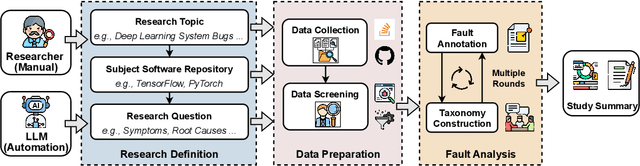
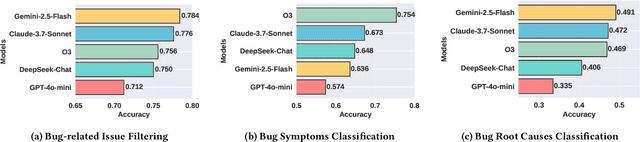
Understanding software faults is essential for empirical research in software development and maintenance. However, traditional fault analysis, while valuable, typically involves multiple expert-driven steps such as collecting potential faults, filtering, and manual investigation. These processes are both labor-intensive and time-consuming, creating bottlenecks that hinder large-scale fault studies in complex yet critical software systems and slow the pace of iterative empirical research. In this paper, we decompose the process of empirical software fault study into three key phases: (1) research objective definition, (2) data preparation, and (3) fault analysis, and we conduct an initial exploration study of applying Large Language Models (LLMs) for fault analysis of open-source software. Specifically, we perform the evaluation on 3,829 software faults drawn from a high-quality empirical study. Our results show that LLMs can substantially improve efficiency in fault analysis, with an average processing time of about two hours, compared to the weeks of manual effort typically required. We conclude by outlining a detailed research plan that highlights both the potential of LLMs for advancing empirical fault studies and the open challenges that required be addressed to achieve fully automated, end-to-end software fault analysis.
Chimera: Harnessing Multi-Agent LLMs for Automatic Insider Threat Simulation
Aug 12, 2025Insider threats, which can lead to severe losses, remain a major security concern. While machine learning-based insider threat detection (ITD) methods have shown promising results, their progress is hindered by the scarcity of high-quality data. Enterprise data is sensitive and rarely accessible, while publicly available datasets, when limited in scale due to cost, lack sufficient real-world coverage; and when purely synthetic, they fail to capture rich semantics and realistic user behavior. To address this, we propose Chimera, the first large language model (LLM)-based multi-agent framework that automatically simulates both benign and malicious insider activities and collects diverse logs across diverse enterprise environments. Chimera models each employee with agents that have role-specific behavior and integrates modules for group meetings, pairwise interactions, and autonomous scheduling, capturing realistic organizational dynamics. It incorporates 15 types of insider attacks (e.g., IP theft, system sabotage) and has been deployed to simulate activities in three sensitive domains: technology company, finance corporation, and medical institution, producing a new dataset, ChimeraLog. We assess ChimeraLog via human studies and quantitative analysis, confirming its diversity, realism, and presence of explainable threat patterns. Evaluations of existing ITD methods show an average F1-score of 0.83, which is significantly lower than 0.99 on the CERT dataset, demonstrating ChimeraLog's higher difficulty and utility for advancing ITD research.
The Foundation Cracks: A Comprehensive Study on Bugs and Testing Practices in LLM Libraries
Jun 14, 2025Large Language Model (LLM) libraries have emerged as the foundational infrastructure powering today's AI revolution, serving as the backbone for LLM deployment, inference optimization, fine-tuning, and production serving across diverse applications. Despite their critical role in the LLM ecosystem, these libraries face frequent quality issues and bugs that threaten the reliability of AI systems built upon them. To address this knowledge gap, we present the first comprehensive empirical investigation into bug characteristics and testing practices in modern LLM libraries. We examine 313 bug-fixing commits extracted across two widely-adopted LLM libraries: HuggingFace Transformers and vLLM.Through rigorous manual analysis, we establish comprehensive taxonomies categorizing bug symptoms into 5 types and root causes into 14 distinct categories.Our primary discovery shows that API misuse has emerged as the predominant root cause (32.17%-48.19%), representing a notable transition from algorithm-focused defects in conventional deep learning frameworks toward interface-oriented problems. Additionally, we examine 7,748 test functions to identify 7 distinct test oracle categories employed in current testing approaches, with predefined expected outputs (such as specific tensors and text strings) being the most common strategy. Our assessment of existing testing effectiveness demonstrates that the majority of bugs escape detection due to inadequate test cases (41.73%), lack of test drivers (32.37%), and weak test oracles (25.90%). Drawing from these findings, we offer some recommendations for enhancing LLM library quality assurance.
TokenProber: Jailbreaking Text-to-image Models via Fine-grained Word Impact Analysis
May 11, 2025Text-to-image (T2I) models have significantly advanced in producing high-quality images. However, such models have the ability to generate images containing not-safe-for-work (NSFW) content, such as pornography, violence, political content, and discrimination. To mitigate the risk of generating NSFW content, refusal mechanisms, i.e., safety checkers, have been developed to check potential NSFW content. Adversarial prompting techniques have been developed to evaluate the robustness of the refusal mechanisms. The key challenge remains to subtly modify the prompt in a way that preserves its sensitive nature while bypassing the refusal mechanisms. In this paper, we introduce TokenProber, a method designed for sensitivity-aware differential testing, aimed at evaluating the robustness of the refusal mechanisms in T2I models by generating adversarial prompts. Our approach is based on the key observation that adversarial prompts often succeed by exploiting discrepancies in how T2I models and safety checkers interpret sensitive content. Thus, we conduct a fine-grained analysis of the impact of specific words within prompts, distinguishing between dirty words that are essential for NSFW content generation and discrepant words that highlight the different sensitivity assessments between T2I models and safety checkers. Through the sensitivity-aware mutation, TokenProber generates adversarial prompts, striking a balance between maintaining NSFW content generation and evading detection. Our evaluation of TokenProber against 5 safety checkers on 3 popular T2I models, using 324 NSFW prompts, demonstrates its superior effectiveness in bypassing safety filters compared to existing methods (e.g., 54%+ increase on average), highlighting TokenProber's ability to uncover robustness issues in the existing refusal mechanisms.
Holistic Audit Dataset Generation for LLM Unlearning via Knowledge Graph Traversal and Redundancy Removal
Feb 26, 2025In recent years, Large Language Models (LLMs) have faced increasing demands to selectively remove sensitive information, protect privacy, and comply with copyright regulations through unlearning, by Machine Unlearning. While evaluating unlearning effectiveness is crucial, existing benchmarks are limited in scale and comprehensiveness, typically containing only a few hundred test cases. We identify two critical challenges in generating holistic audit datasets: ensuring audit adequacy and handling knowledge redundancy between forget and retain dataset. To address these challenges, we propose HANKER, an automated framework for holistic audit dataset generation leveraging knowledge graphs to achieve fine-grained coverage and eliminate redundant knowledge. Applying HANKER to the popular MUSE benchmark, we successfully generated over 69,000 and 111,000 audit cases for the News and Books datasets respectively, identifying thousands of knowledge memorization instances that the previous benchmark failed to detect. Our empirical analysis uncovers how knowledge redundancy significantly skews unlearning effectiveness metrics, with redundant instances artificially inflating the observed memorization measurements ROUGE from 19.7% to 26.1% and Entailment Scores from 32.4% to 35.2%, highlighting the necessity of systematic deduplication for accurate assessment.