 Add to Chrome
 Add to Firefox
 Add to Edge
TrajWiki: Source-Grounded Memory Trajectories for Long-Horizon Dialogue Agents
Aug 02, 2026
Large language model agents have shown strong capabilities in generating coherent and contextually appropriate responses, yet robust long-horizon dialogue remains limited by the lack of external memory that is traceable, updatable, and diagnostically transparent. Existing memory-augmented agents often store memories as isolated records or overwritable states, making it difficult to preserve how information originates, evolves, conflicts, or becomes obsolete over time. We propose TrajWiki, a trajectory-based memory framework for long-horizon conversational agents. Instead of treating memory as static entries, TrajWiki represents each memory as a source-grounded evolution trajectory, maintained through immutable episodic snapshots and claim-level operations such as ADD, REVISE, and DEPRECATE. To reduce fragmentation and retrieval cost, TrajWiki further introduces Memory Wiki, a persistent intermediate layer that incrementally compiles dialogue history into structured and interlinked wiki pages capturing salient entities, events, quantities, topics, and conflicts. At inference time, queries are routed hierarchically from relevant wiki pages to linked memory trajectories, then to corresponding snapshots and source messages for evidence-grounded answer synthesis. Experiments on LoCoMo and MedMT show that TrajWiki improves long-horizon dialogue performance across both open-source and closed-source LLM backbones, while providing greater interpretability and diagnostic visibility into memory evolution, retrieval failures, and answer generation.

SoftVTBench: A Safety-Aware Visuo-Tactile Benchmark for Physically Constrained Robotic Manipulation of Deformable Objects
Jul 05, 2026Deformable object manipulation poses challenges beyond task completion: successful execution must also maintain safe physical interaction, holding the object stably without slip or drop while avoiding excessive deformation. However, existing manipulation benchmarks are predominantly success-oriented and rarely evaluate whether a policy remains physically safe throughout execution. We present SoftVTBench, a safety-aware visuo-tactile benchmark for physically constrained deformable object manipulation. Built in Isaac Sim with finite-element-simulated deformable objects, SoftVTBench provides multi-view RGB observations, RGB tactile sensing with marker motion, proprioception, and language instructions, and defines four matched task suites over object type (deformable vs. rigid) and variation axis (object vs. spatial). It separately reports Goal Success and Safety Success; the latter additionally requires no drop and peak deformation below a calibrated object-specific threshold, measured from policy-hidden privileged Finite Element Method (FEM) states. We implement pi0.5-based baselines under this protocol. Experiments show that success-only evaluation substantially overstates policy performance, as a large fraction of goal-completing rollouts still violate physical safety. Furthermore, incorporating tactile sensing improves Safety Success (e.g., from 21.4% to 35.6% on object-centric deformable tasks) and reduces object deformation during execution, while maintaining comparable Goal Success. SoftVTBench provides a reproducible benchmark for studying visuo-tactile deformable manipulation under physical interaction constraints.
Are Reasoning Vision-Language Models Robust to Semantic Visual Distractions?
Jun 08, 2026Reasoning Vision-Language Models (VLMs) achieve strong performance on complex multimodal tasks, but reliable real-world application requires handling visual inputs that are messier than clean, curated benchmarks. Existing works mainly evaluate such reliability of VLMs through input corruptions, such as noise, blur and weather effects, which make visual evidence harder to perceive. This leaves a critical reliability failure mode underexplored: a model may perceive the evidence correctly, yet reason from plausible but irrelevant and distracting evidence and propagate this mistake to its final answer. To address this gap, we introduce \textbf{Distract-Bench}, a benchmark for evaluating VLM robustness to \textbf{semantic visual distractions}, defined as meaningful but task-irrelevant visual cues added to inputs while preserving the ground-truth answer. We comprehensively evaluate eight leading open-source and two closed-source VLMs across conventional vision corruptions and Distract-Bench. Our results show that Distract-Bench exposes a robustness failure distinct from vision corruptions: reasoning VLMs largely track their non-reasoning base models under perceptual degradation, but show consistently lower robustness to semantic distractions. Further analysis shows that these distractions often enter the reasoning process of VLMs, are treated as evidence, and lead to incorrect answers. Together, these findings reframe robustness evaluation for reasoning VLMs, shifting the focus from degraded perception to distractions for reliable real-world visual reasoning. Our data and code are available at https://github.com/Yizheng-Sun/Distract-Bench.
Computational Lesions in Multilingual Language Models Separate Shared and Language-specific Brain Alignment
Apr 12, 2026How the brain supports language across different languages is a basic question in neuroscience and a useful test for multilingual artificial intelligence. Neuroimaging has identified language-responsive brain regions across languages, but it cannot by itself show whether the underlying processing is shared or language-specific. Here we use six multilingual large language models (LLMs) as controllable systems and create targeted ``computational lesions'' by zeroing small parameter sets that are important across languages or especially important for one language. We then compare intact and lesioned models in predicting functional magnetic resonance imaging (fMRI) responses during 100 minutes of naturalistic story listening in native English, Chinese and French (112 participants). Lesioning a compact shared core reduces whole-brain encoding correlation by 60.32% relative to intact models, whereas language-specific lesions preserve cross-language separation in embedding space but selectively weaken brain predictivity for the matched native language. These results support a shared backbone with embedded specializations and provide a causal framework for studying multilingual brain-model alignment.
Short-term power load forecasting method based on CNN-SAEDN-Res
Sep 02, 2023In deep learning, the load data with non-temporal factors are difficult to process by sequence models. This problem results in insufficient precision of the prediction. Therefore, a short-term load forecasting method based on convolutional neural network (CNN), self-attention encoder-decoder network (SAEDN) and residual-refinement (Res) is proposed. In this method, feature extraction module is composed of a two-dimensional convolutional neural network, which is used to mine the local correlation between data and obtain high-dimensional data features. The initial load fore-casting module consists of a self-attention encoder-decoder network and a feedforward neural network (FFN). The module utilizes self-attention mechanisms to encode high-dimensional features. This operation can obtain the global correlation between data. Therefore, the model is able to retain important information based on the coupling relationship between the data in data mixed with non-time series factors. Then, self-attention decoding is per-formed and the feedforward neural network is used to regression initial load. This paper introduces the residual mechanism to build the load optimization module. The module generates residual load values to optimize the initial load. The simulation results show that the proposed load forecasting method has advantages in terms of prediction accuracy and prediction stability.
Collaborative Optimization of Multi-microgrids System with Shared Energy Storage Based on Multi-agent Stochastic Game and Reinforcement Learning
Jun 19, 2023Achieving the economical and stable operation of Multi-microgrids (MMG) systems is vital. However, there are still some challenging problems to be solved. Firstly, from the perspective of stable operation, it is necessary to minimize the energy fluctuation of the main grid. Secondly, the characteristics of energy conversion equipment need to be considered. Finally, privacy protection while reducing the operating cost of an MMG system is crucial. To address these challenges, a Data-driven strategy for MMG systems with Shared Energy Storage (SES) is proposed. The Mixed-Attention is applied to fit the conditions of the equipment, additionally, Multi-Agent Soft Actor-Critic(MA-SAC) and (Multi-Agent Win or Learn Fast Policy Hill-Climbing)MA-WoLF-PHC are proposed to solve the partially observable dynamic stochastic game problem. By testing the operation data of the MMG system in Northwest China, following conclusions are drawn: the R-Square (R2) values of results reach 0.999, indicating the neural network effectively models the nonlinear conditions. The proposed MMG system framework can reduce energy fluctuations in the main grid by 1746.5kW in 24 hours and achieve a cost reduction of 16.21% in the test. Finally, the superiority of the proposed algorithms is verified through their fast convergence speed and excellent optimization performance.
ResGrad: Residual Denoising Diffusion Probabilistic Models for Text to Speech
Dec 30, 2022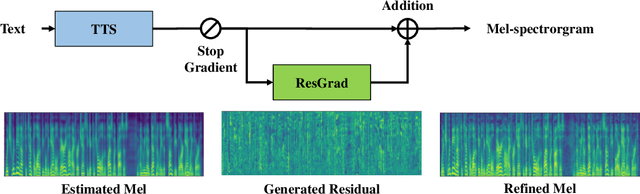
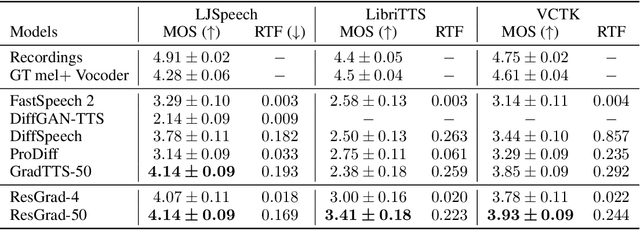

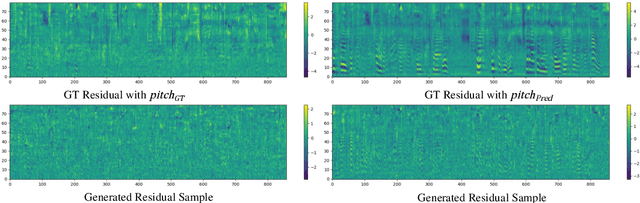
Denoising Diffusion Probabilistic Models (DDPMs) are emerging in text-to-speech (TTS) synthesis because of their strong capability of generating high-fidelity samples. However, their iterative refinement process in high-dimensional data space results in slow inference speed, which restricts their application in real-time systems. Previous works have explored speeding up by minimizing the number of inference steps but at the cost of sample quality. In this work, to improve the inference speed for DDPM-based TTS model while achieving high sample quality, we propose ResGrad, a lightweight diffusion model which learns to refine the output spectrogram of an existing TTS model (e.g., FastSpeech 2) by predicting the residual between the model output and the corresponding ground-truth speech. ResGrad has several advantages: 1) Compare with other acceleration methods for DDPM which need to synthesize speech from scratch, ResGrad reduces the complexity of task by changing the generation target from ground-truth mel-spectrogram to the residual, resulting into a more lightweight model and thus a smaller real-time factor. 2) ResGrad is employed in the inference process of the existing TTS model in a plug-and-play way, without re-training this model. We verify ResGrad on the single-speaker dataset LJSpeech and two more challenging datasets with multiple speakers (LibriTTS) and high sampling rate (VCTK). Experimental results show that in comparison with other speed-up methods of DDPMs: 1) ResGrad achieves better sample quality with the same inference speed measured by real-time factor; 2) with similar speech quality, ResGrad synthesizes speech faster than baseline methods by more than 10 times. Audio samples are available at https://resgrad1.github.io/.