 Add to Chrome
 Add to Firefox
 Add to Edge
SoftVTBench: A Safety-Aware Visuo-Tactile Benchmark for Physically Constrained Robotic Manipulation of Deformable Objects
Jul 05, 2026
Deformable object manipulation poses challenges beyond task completion: successful execution must also maintain safe physical interaction, holding the object stably without slip or drop while avoiding excessive deformation. However, existing manipulation benchmarks are predominantly success-oriented and rarely evaluate whether a policy remains physically safe throughout execution. We present SoftVTBench, a safety-aware visuo-tactile benchmark for physically constrained deformable object manipulation. Built in Isaac Sim with finite-element-simulated deformable objects, SoftVTBench provides multi-view RGB observations, RGB tactile sensing with marker motion, proprioception, and language instructions, and defines four matched task suites over object type (deformable vs. rigid) and variation axis (object vs. spatial). It separately reports Goal Success and Safety Success; the latter additionally requires no drop and peak deformation below a calibrated object-specific threshold, measured from policy-hidden privileged Finite Element Method (FEM) states. We implement pi0.5-based baselines under this protocol. Experiments show that success-only evaluation substantially overstates policy performance, as a large fraction of goal-completing rollouts still violate physical safety. Furthermore, incorporating tactile sensing improves Safety Success (e.g., from 21.4% to 35.6% on object-centric deformable tasks) and reduces object deformation during execution, while maintaining comparable Goal Success. SoftVTBench provides a reproducible benchmark for studying visuo-tactile deformable manipulation under physical interaction constraints.

Multi-level and multi-modal feature fusion for accurate 3D object detection in Connected and Automated Vehicles
Dec 19, 2022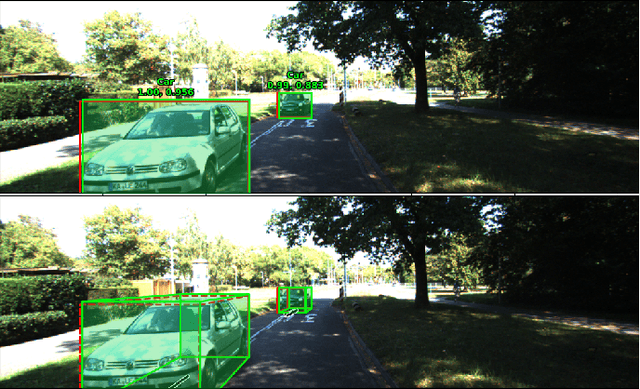
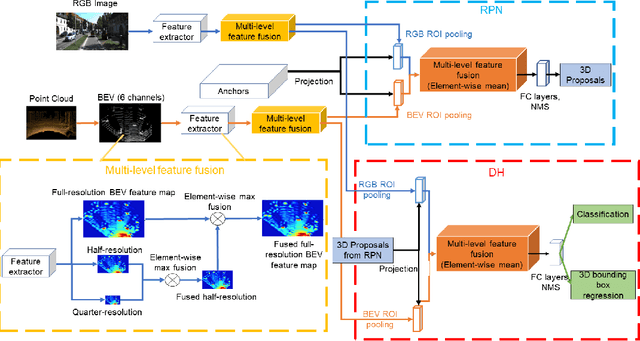
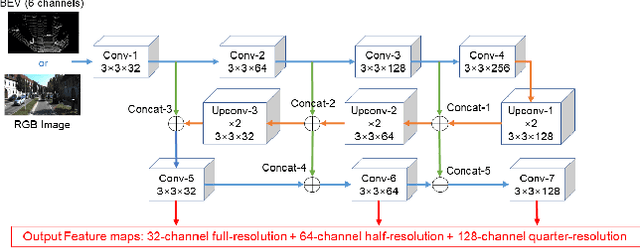
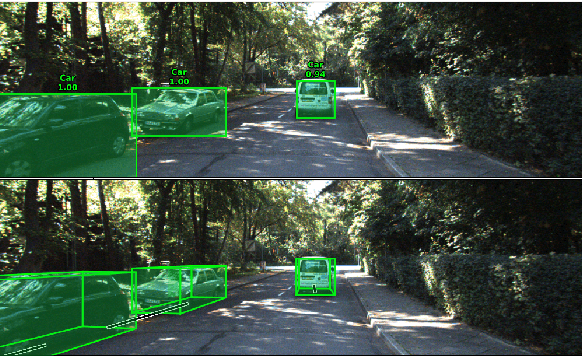
Aiming at highly accurate object detection for connected and automated vehicles (CAVs), this paper presents a Deep Neural Network based 3D object detection model that leverages a three-stage feature extractor by developing a novel LIDAR-Camera fusion scheme. The proposed feature extractor extracts high-level features from two input sensory modalities and recovers the important features discarded during the convolutional process. The novel fusion scheme effectively fuses features across sensory modalities and convolutional layers to find the best representative global features. The fused features are shared by a two-stage network: the region proposal network (RPN) and the detection head (DH). The RPN generates high-recall proposals, and the DH produces final detection results. The experimental results show the proposed model outperforms more recent research on the KITTI 2D and 3D detection benchmark, particularly for distant and highly occluded instances.