 Add to Chrome
 Add to Firefox
 Add to Edge
ST-WAM: Semantic-Temporal World Action Model for Robust Manipulation under Visual Distribution Shifts
Jul 31, 2026
World Action Models (WAMs) have emerged as a promising paradigm by jointly modeling robot actions and future visual dynamics. However, their reliance on pixel-generative future supervision can entangle action-relevant state transitions with task-irrelevant visual content, limiting robustness under visual distribution shifts. We identify Training-Distribution Hallucination, a recurring phenomenon in which futures conditioned on visually shifted observations hallucinate training-domain content rather than remain faithful to the current scene. A controlled frame-triplet diagnosis further shows that DINOv3 features remain more stable across visual shifts while better preserving task-state distinctions than Wan-VAE latents. Rather than correcting the predicted futures, we propose Semantic-Temporal WAM (ST-WAM) to improve action robustness by using DINOv3 as a shared semantic representation for future prediction and history retrieval while retaining fine-grained VAE dynamics. Its Dual-Space Future Experts (DSFE) jointly predict future VAE latents and DINO features, while Current-Anchored Intent Retrieval (CAIR) retrieves task-relevant evidence from recent DINO history under the current visual-language context. ST-WAM is trained end-to-end without additional embodied pretraining or task-specific annotations, and requires no explicit future generation at inference. It achieves 98.7% on LIBERO and 92.8% on RoboTwin 2.0; more importantly, compared with Fast-WAM, it improves zero-shot LIBERO-Plus performance by 21.3 percentage points and more than doubles real-world success under visual shifts from 25.8% to 61.5%. These results demonstrate that semantic-temporal modeling effectively complements pixel-generative dynamics for robust manipulation.

SoftVTBench: A Safety-Aware Visuo-Tactile Benchmark for Physically Constrained Robotic Manipulation of Deformable Objects
Jul 05, 2026Deformable object manipulation poses challenges beyond task completion: successful execution must also maintain safe physical interaction, holding the object stably without slip or drop while avoiding excessive deformation. However, existing manipulation benchmarks are predominantly success-oriented and rarely evaluate whether a policy remains physically safe throughout execution. We present SoftVTBench, a safety-aware visuo-tactile benchmark for physically constrained deformable object manipulation. Built in Isaac Sim with finite-element-simulated deformable objects, SoftVTBench provides multi-view RGB observations, RGB tactile sensing with marker motion, proprioception, and language instructions, and defines four matched task suites over object type (deformable vs. rigid) and variation axis (object vs. spatial). It separately reports Goal Success and Safety Success; the latter additionally requires no drop and peak deformation below a calibrated object-specific threshold, measured from policy-hidden privileged Finite Element Method (FEM) states. We implement pi0.5-based baselines under this protocol. Experiments show that success-only evaluation substantially overstates policy performance, as a large fraction of goal-completing rollouts still violate physical safety. Furthermore, incorporating tactile sensing improves Safety Success (e.g., from 21.4% to 35.6% on object-centric deformable tasks) and reduces object deformation during execution, while maintaining comparable Goal Success. SoftVTBench provides a reproducible benchmark for studying visuo-tactile deformable manipulation under physical interaction constraints.
CounterScene: Counterfactual Causal Reasoning in Generative World Models for Safety-Critical Closed-Loop Evaluation
Mar 22, 2026Generating safety-critical driving scenarios requires understanding why dangerous interactions arise, rather than merely forcing collisions. However, existing methods rely on heuristic adversarial agent selection and unstructured perturbations, lacking explicit modeling of interaction dependencies and thus exhibiting a realism--adversarial trade-off. We present CounterScene, a framework that endows closed-loop generative BEV world models with structured counterfactual reasoning for safety-critical scenario generation. Given a safe scene, CounterScene asks: what if the causally critical agent had behaved differently? To answer this, we introduce causal adversarial agent identification to identify the critical agent and classify conflict types, and develop a conflict-aware interactive world model in which a causal interaction graph is used to explicitly model dynamic inter-agent dependencies. Building on this structure, stage-adaptive counterfactual guidance performs minimal interventions on the identified agent, removing its spatial and temporal safety margins while allowing risk to emerge through natural interaction propagation. Extensive experiments on nuScenes demonstrate that CounterScene achieves the strongest adversarial effectiveness while maintaining superior trajectory realism across all horizons, improving long-horizon collision rate from 12.3% to 22.7% over the strongest baseline with better realism (ADE 1.88 vs.2.09). Notably, this advantage further widens over longer rollouts, and CounterScene generalizes zero-shot to nuPlan with state-of-the-art realism.
ReconDrive: Fast Feed-Forward 4D Gaussian Splatting for Autonomous Driving Scene Reconstruction
Mar 08, 2026High-fidelity visual reconstruction and novel-view synthesis are essential for realistic closed-loop evaluation in autonomous driving. While 4D Gaussian Splatting (4DGS) offers a promising balance of accuracy and efficiency, existing per-scene optimization methods require costly iterative refinement, rendering them unscalable for extensive urban environments. Conversely, current feed-forward approaches often suffer from degraded photometric quality. To address these limitations, we propose ReconDrive, a feed-forward framework that leverages and extends the 3D foundation model VGGT for rapid, high-fidelity 4DGS generation. Our architecture introduces two core adaptations to tailor the foundation model to dynamic driving scenes: (1) Hybrid Gaussian Prediction Heads, which decouple the regression of spatial coordinates and appearance attributes to overcome the photometric deficiencies inherent in generalized foundation features; and (2) a Static-Dynamic 4D Composition strategy that explicitly captures temporal motion via velocity modeling to represent complex dynamic environments. Benchmarked on nuScenes, ReconDrive significantly outperforms existing feed-forward baselines in reconstruction, novel-view synthesis, and 3D perception. It achieves performance competitive with per-scene optimization while being orders of magnitude faster, providing a scalable and practical solution for realistic driving simulation.
RCooper: A Real-world Large-scale Dataset for Roadside Cooperative Perception
Mar 31, 2024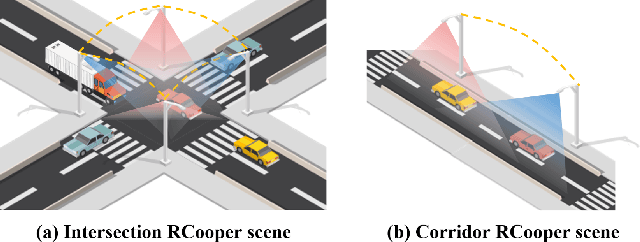
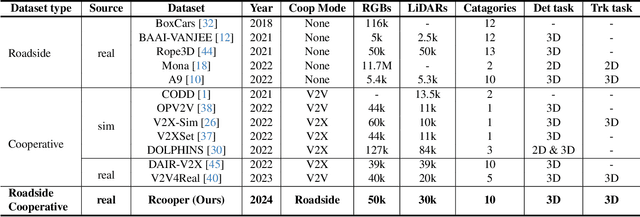
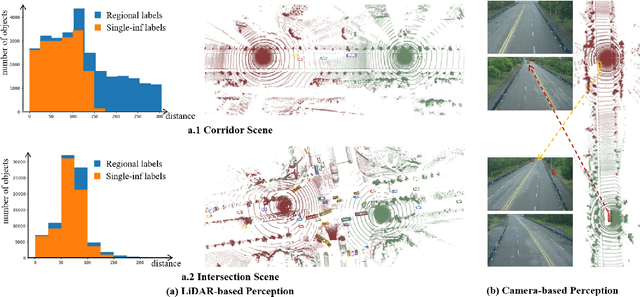
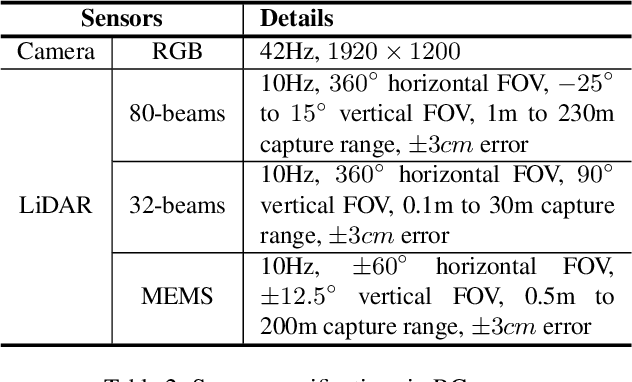
The value of roadside perception, which could extend the boundaries of autonomous driving and traffic management, has gradually become more prominent and acknowledged in recent years. However, existing roadside perception approaches only focus on the single-infrastructure sensor system, which cannot realize a comprehensive understanding of a traffic area because of the limited sensing range and blind spots. Orienting high-quality roadside perception, we need Roadside Cooperative Perception (RCooper) to achieve practical area-coverage roadside perception for restricted traffic areas. Rcooper has its own domain-specific challenges, but further exploration is hindered due to the lack of datasets. We hence release the first real-world, large-scale RCooper dataset to bloom the research on practical roadside cooperative perception, including detection and tracking. The manually annotated dataset comprises 50k images and 30k point clouds, including two representative traffic scenes (i.e., intersection and corridor). The constructed benchmarks prove the effectiveness of roadside cooperation perception and demonstrate the direction of further research. Codes and dataset can be accessed at: https://github.com/AIR-THU/DAIR-RCooper.