 Add to Chrome
 Add to Firefox
 Add to Edge
SoftVTBench: A Safety-Aware Visuo-Tactile Benchmark for Physically Constrained Robotic Manipulation of Deformable Objects
Jul 05, 2026
Deformable object manipulation poses challenges beyond task completion: successful execution must also maintain safe physical interaction, holding the object stably without slip or drop while avoiding excessive deformation. However, existing manipulation benchmarks are predominantly success-oriented and rarely evaluate whether a policy remains physically safe throughout execution. We present SoftVTBench, a safety-aware visuo-tactile benchmark for physically constrained deformable object manipulation. Built in Isaac Sim with finite-element-simulated deformable objects, SoftVTBench provides multi-view RGB observations, RGB tactile sensing with marker motion, proprioception, and language instructions, and defines four matched task suites over object type (deformable vs. rigid) and variation axis (object vs. spatial). It separately reports Goal Success and Safety Success; the latter additionally requires no drop and peak deformation below a calibrated object-specific threshold, measured from policy-hidden privileged Finite Element Method (FEM) states. We implement pi0.5-based baselines under this protocol. Experiments show that success-only evaluation substantially overstates policy performance, as a large fraction of goal-completing rollouts still violate physical safety. Furthermore, incorporating tactile sensing improves Safety Success (e.g., from 21.4% to 35.6% on object-centric deformable tasks) and reduces object deformation during execution, while maintaining comparable Goal Success. SoftVTBench provides a reproducible benchmark for studying visuo-tactile deformable manipulation under physical interaction constraints.

Dual-Flow Reinforcement Learning with State-Aware Exploration
Jun 29, 2026In complex continuous-control reinforcement learning tasks, multimodal optimal actions often coincide with uncertain, multimodal return distributions, making reliable value estimation and multimodal exploration challenging. Existing value estimation methods using unimodal Gaussians restrict expressiveness and yield biased estimates. Recent generative policies can represent multimodal actions but often collapse to a few modes and under-explore high-value areas of the action space. Motivated by these challenges, we propose Dual-Flow RL, a unified actor-critic framework that jointly models a continuous return distribution and a multimodal policy distribution using conditional flow matching (CFM). This design supports reliable value estimation and sustained multimodal exploration. To further enhance exploration, we introduce an Entropy-Covariance Exploration Regulator (ECER) that enables state-aware exploration regulation leveraging policy entropy and action-uncertainty covariance. Experiments on DeepMind Control Suite and Humanoid-Bench show that Dual-Flow RL achieves state-of-the-art performance on most tasks, significantly outperforming prior diffusion-based and flow-based methods.
Dynamics Are Learned, Not Told: Semi-Supervised Discovery of Latent Dynamics Geometries For Zero-Shot Policy Adaptation
Jun 01, 2026Real-world dynamics shifts pose a critical challenge for reinforcement learning in robotics, as policies tightly coupled to nominal environments often fail catastrophically when physical conditions change. Most existing methods rely on encoding explicitly identified physical parameters into a latent context, a parameter-centric paradigm that depends on pre-specified axes of variation and becomes brittle under unmodeled or compound dynamics changes. We revisit dynamics adaptation from an outcome-centric perspective: rather than telling policies what the dynamics are, we enable them to learn how dynamics affect interaction outcomes. Theoretically, this is grounded in a monotonic relationship between target-domain regret and the Lipschitz constant of a trajectory dynamics encoder. Practically, this constant can be upper-bounded through contrastive learning, yielding a smooth, task-relevant latent topology without privileged dynamics information. On MuJoCo benchmarks, our method consistently outperforms parameter-centric baselines under severe dynamics shifts, including unmodeled and time-varying parameters, while also improving in-distribution stability and latent interpretability. Overall, these results validate that controlling latent geometry is a principled mechanism for robust adaptation.
GaussianDream: A Feed-Forward 3D Gaussian World Model for Robotic Manipulation
May 20, 2026Vision-language-action (VLA) policies have advanced language-conditioned robotic manipulation by transferring semantic priors from pretrained vision-language models to action generation. Yet, standard action-imitation training often provides limited explicit supervision for 3D geometry, dense visual structure, and short-horizon environment evolution, which are critical for physically precise manipulation. We introduce \textbf{GaussianDream}, a feed-forward 3D Gaussian world-model plug-in that turns robot trajectories into structured spatial-temporal supervision. The key idea is to couple current Gaussian reconstruction with horizon-conditioned future Gaussian prediction during training, forcing a compact spatio-temporal prefix to be decodable into renderable 3D Gaussian states. This enables dense RGB rendering, depth, and pseudo 3D scene-flow supervision without requiring test-time Gaussian decoding. At inference, GaussianDream discards all auxiliary decoding heads and retains only the learned prefix to condition action generation, avoiding rendering, video rollout, or additional planning during closed-loop control. Experiments on LIBERO, RoboCasa Human-50, and real-robot tasks demonstrate strong and highly competitive performance, achieving \textbf{98.4\%} average success on LIBERO, \textbf{52.6\%} on RoboCasa Human-50, and \textbf{50.0\%} in real-world evaluation.
CounterScene: Counterfactual Causal Reasoning in Generative World Models for Safety-Critical Closed-Loop Evaluation
Mar 22, 2026Generating safety-critical driving scenarios requires understanding why dangerous interactions arise, rather than merely forcing collisions. However, existing methods rely on heuristic adversarial agent selection and unstructured perturbations, lacking explicit modeling of interaction dependencies and thus exhibiting a realism--adversarial trade-off. We present CounterScene, a framework that endows closed-loop generative BEV world models with structured counterfactual reasoning for safety-critical scenario generation. Given a safe scene, CounterScene asks: what if the causally critical agent had behaved differently? To answer this, we introduce causal adversarial agent identification to identify the critical agent and classify conflict types, and develop a conflict-aware interactive world model in which a causal interaction graph is used to explicitly model dynamic inter-agent dependencies. Building on this structure, stage-adaptive counterfactual guidance performs minimal interventions on the identified agent, removing its spatial and temporal safety margins while allowing risk to emerge through natural interaction propagation. Extensive experiments on nuScenes demonstrate that CounterScene achieves the strongest adversarial effectiveness while maintaining superior trajectory realism across all horizons, improving long-horizon collision rate from 12.3% to 22.7% over the strongest baseline with better realism (ADE 1.88 vs.2.09). Notably, this advantage further widens over longer rollouts, and CounterScene generalizes zero-shot to nuPlan with state-of-the-art realism.
LSRE: Latent Semantic Rule Encoding for Real-Time Semantic Risk Detection in Autonomous Driving
Dec 31, 2025Real-world autonomous driving must adhere to complex human social rules that extend beyond legally codified traffic regulations. Many of these semantic constraints, such as yielding to emergency vehicles, complying with traffic officers' gestures, or stopping for school buses, are intuitive for humans yet difficult to encode explicitly. Although large vision-language models (VLMs) can interpret such semantics, their inference cost makes them impractical for real-time deployment.This work proposes LSRE, a Latent Semantic Rule Encoding framework that converts sparsely sampled VLM judgments into decision boundaries within the latent space of a recurrent world model. By encoding language-defined safety semantics into a lightweight latent classifier, LSRE enables real-time semantic risk assessment at 10 Hz without per-frame VLM queries. Experiments on six semantic-failure scenarios in CARLA demonstrate that LSRE attains semantic risk detection accuracy comparable to a large VLM baseline, while providing substantially earlier hazard anticipation and maintaining low computational latency. LSRE further generalizes to rarely seen semantic-similar test cases, indicating that language-guided latent classification offers an effective and deployable mechanism for semantic safety monitoring in autonomous driving.
DTCCL: Disengagement-Triggered Contrastive Continual Learning for Autonomous Bus Planners
Dec 22, 2025Autonomous buses run on fixed routes but must operate in open, dynamic urban environments. Disengagement events on these routes are often geographically concentrated and typically arise from planner failures in highly interactive regions. Such policy-level failures are difficult to correct using conventional imitation learning, which easily overfits to sparse disengagement data. To address this issue, this paper presents a Disengagement-Triggered Contrastive Continual Learning (DTCCL) framework that enables autonomous buses to improve planning policies through real-world operation. Each disengagement triggers cloud-based data augmentation that generates positive and negative samples by perturbing surrounding agents while preserving route context. Contrastive learning refines policy representations to better distinguish safe and unsafe behaviors, and continual updates are applied in a cloud-edge loop without human supervision. Experiments on urban bus routes demonstrate that DTCCL improves overall planning performance by 48.6 percent compared with direct retraining, validating its effectiveness for scalable, closed-loop policy improvement in autonomous public transport.
Are All Data Necessary? Efficient Data Pruning for Large-scale Autonomous Driving Dataset via Trajectory Entropy Maximization
Dec 22, 2025Collecting large-scale naturalistic driving data is essential for training robust autonomous driving planners. However, real-world datasets often contain a substantial amount of repetitive and low-value samples, which lead to excessive storage costs and bring limited benefits to policy learning. To address this issue, we propose an information-theoretic data pruning method that effectively reduces the training data volume without compromising model performance. Our approach evaluates the trajectory distribution information entropy of driving data and iteratively selects high-value samples that preserve the statistical characteristics of the original dataset in a model-agnostic manner. From a theoretical perspective, we show that maximizing trajectory entropy effectively constrains the Kullback-Leibler divergence between the pruned subset and the original data distribution, thereby maintaining generalization ability. Comprehensive experiments on the NuPlan benchmark with a large-scale imitation learning framework demonstrate that the proposed method can reduce the dataset size by up to 40% while maintaining closed-loop performance. This work provides a lightweight and theoretically grounded approach for scalable data management and efficient policy learning in autonomous driving systems.
Sequence of Expert: Boosting Imitation Planners for Autonomous Driving through Temporal Alternation
Dec 15, 2025Imitation learning (IL) has emerged as a central paradigm in autonomous driving. While IL excels in matching expert behavior in open-loop settings by minimizing per-step prediction errors, its performance degrades unexpectedly in closed-loop due to the gradual accumulation of small, often imperceptible errors over time.Over successive planning cycles, these errors compound, potentially resulting in severe failures.Current research efforts predominantly rely on increasingly sophisticated network architectures or high-fidelity training datasets to enhance the robustness of IL planners against error accumulation, focusing on the state-level robustness at a single time point. However, autonomous driving is inherently a continuous-time process, and leveraging the temporal scale to enhance robustness may provide a new perspective for addressing this issue.To this end, we propose a method termed Sequence of Experts (SoE), a temporal alternation policy that enhances closed-loop performance without increasing model size or data requirements. Our experiments on large-scale autonomous driving benchmarks nuPlan demonstrate that SoE method consistently and significantly improves the performance of all the evaluated models, and achieves state-of-the-art performance.This module may provide a key and widely applicable support for improving the training efficiency of autonomous driving models.
Dynamically Local-Enhancement Planner for Large-Scale Autonomous Driving
Feb 28, 2025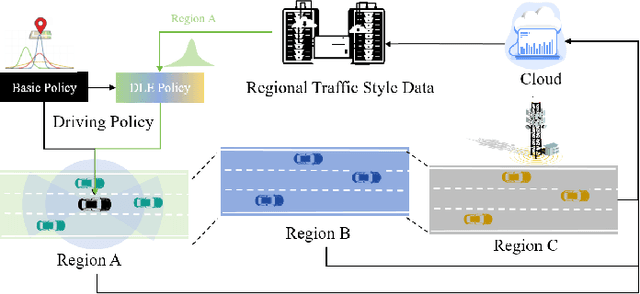
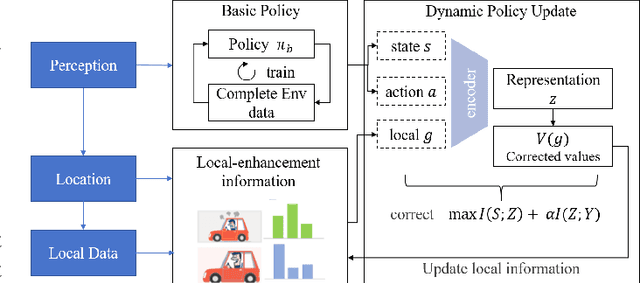
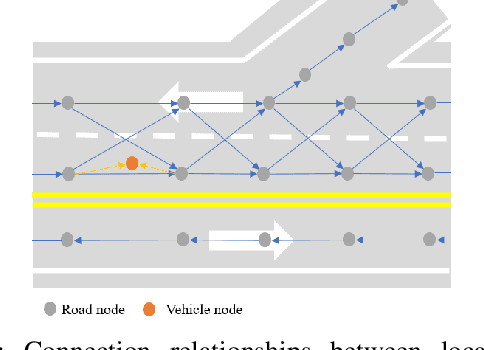
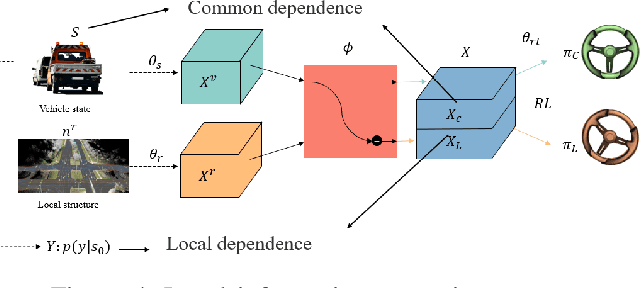
Current autonomous vehicles operate primarily within limited regions, but there is increasing demand for broader applications. However, as models scale, their limited capacity becomes a significant challenge for adapting to novel scenarios. It is increasingly difficult to improve models for new situations using a single monolithic model. To address this issue, we introduce the concept of dynamically enhancing a basic driving planner with local driving data, without permanently modifying the planner itself. This approach, termed the Dynamically Local-Enhancement (DLE) Planner, aims to improve the scalability of autonomous driving systems without significantly expanding the planner's size. Our approach introduces a position-varying Markov Decision Process formulation coupled with a graph neural network that extracts region-specific driving features from local observation data. The learned features describe the local behavior of the surrounding objects, which is then leveraged to enhance a basic reinforcement learning-based policy. We evaluated our approach in multiple scenarios and compared it with a one-for-all driving model. The results show that our method outperforms the baseline policy in both safety (collision rate) and average reward, while maintaining a lighter scale. This approach has the potential to benefit large-scale autonomous vehicles without the need for largely expanding on-device driving models.