 Add to Chrome
 Add to Firefox
 Add to Edge
NeuroQA: A Large-Scale Image-Grounded Benchmark for 3D Brain MRI Understanding
May 19, 2026
We present NeuroQA, a large-scale benchmark for visual question answering in 3D brain magnetic resonance imaging (MRI), with 56,953 QA pairs from 12,977 subjects across 12 datasets. It spans ages 5-104 and five clinical domains: Alzheimer's, Parkinson's, tumors, white matter disease, and neurodevelopment. Unlike prior medical Visual Question Answering (VQA) efforts that operate on 2D slices or rely on narrow diagnostic labels, NeuroQA pairs every item with a full 3D volume. It evaluates 11 clinically grounded reasoning skills across Yes/No, multiple-choice, and open-ended formats. Of the 203 templates, 131 are image-grounded (answerable from a 3-plane viewer) and 72 are image-informed (ground truth from quantitative volumetry or clinical instruments). To remove text-only shortcuts, we apply answer-distribution refinement, reducing closed-format text-only accuracy from $>$80% to 44.6%; image necessity is assessed separately through an image-grounding protocol released with the benchmark. A 38-rule deterministic pipeline and two rounds of expert review verify every QA pair against FreeSurfer measurements, metadata, or radiology report fields, with zero same-subject contradictions across templates. We conduct a clinician evaluation in which two clinicians independently assess 100 frozen test items on a three-plane viewer. On closed-format (Yes/No + multiple-choice) test-public items, the best zero-shot vision-language model and a supervised 3D CNN baseline reach 47.5% and 43.7% accuracy respectively, both below the 49.4% text-only majority-template floor. NeuroQA adopts a two-tier release with public QA pairs for open-access datasets and reproducible generation scripts for datasets restricted by data use agreements (DUAs), plus subject-level splits, a held-out private test set, and an online leaderboard.

A Reasoning-Enabled Vision-Language Foundation Model for Chest X-ray Interpretation
Apr 01, 2026Chest X-rays (CXRs) are among the most frequently performed imaging examinations worldwide, yet rising imaging volumes increase radiologist workload and the risk of diagnostic errors. Although artificial intelligence (AI) systems have shown promise for CXR interpretation, most generate only final predictions, without making explicit how visual evidence is translated into radiographic findings and diagnostic predictions. We present CheXOne, a reasoning-enabled vision-language model for CXR interpretation. CheXOne jointly generates diagnostic predictions and explicit, clinically grounded reasoning traces that connect visual evidence, radiographic findings, and these predictions. The model is trained on 14.7 million instruction and reasoning samples curated from 30 public datasets spanning 36 CXR interpretation tasks, using a two-stage framework that combines instruction tuning with reinforcement learning to improve reasoning quality. We evaluate CheXOne in zero-shot settings across visual question answering, report generation, visual grounding and reasoning assessment, covering 17 evaluation settings. CheXOne outperforms existing medical and general-domain foundation models and achieves strong performance on independent public benchmarks. A clinical reader study demonstrates that CheXOne-drafted reports are comparable to or better than resident-written reports in 55% of cases, while effectively addressing clinical indications and enhancing both report writing and CXR interpretation efficiency. Further analyses involving radiologists reveal that the generated reasoning traces show high clinical factuality and provide causal support for the final predictions, offering a plausible explanation for the performance gains. These results suggest that explicit reasoning can improve model performance, interpretability and clinical utility in AI-assisted CXR interpretation.
3D Foundation AI Model for Generalizable Disease Detection in Head Computed Tomography
Feb 04, 2025
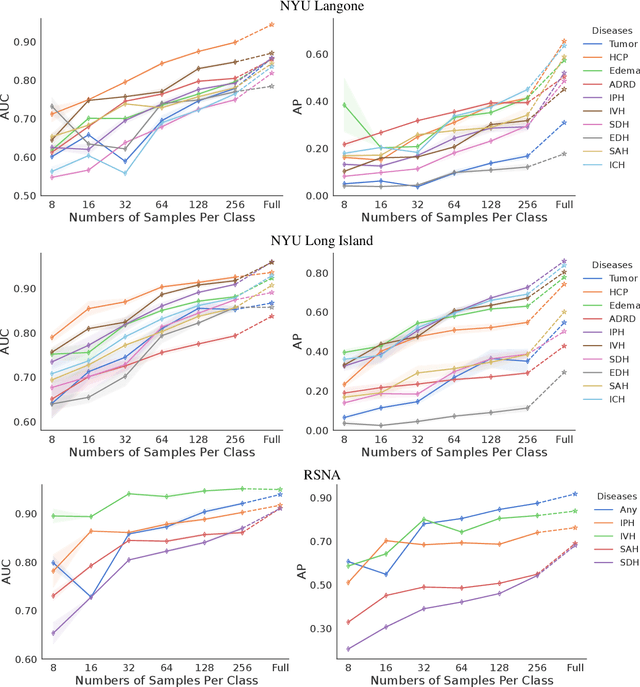


Head computed tomography (CT) imaging is a widely-used imaging modality with multitudes of medical indications, particularly in assessing pathology of the brain, skull, and cerebrovascular system. It is commonly the first-line imaging in neurologic emergencies given its rapidity of image acquisition, safety, cost, and ubiquity. Deep learning models may facilitate detection of a wide range of diseases. However, the scarcity of high-quality labels and annotations, particularly among less common conditions, significantly hinders the development of powerful models. To address this challenge, we introduce FM-CT: a Foundation Model for Head CT for generalizable disease detection, trained using self-supervised learning. Our approach pre-trains a deep learning model on a large, diverse dataset of 361,663 non-contrast 3D head CT scans without the need for manual annotations, enabling the model to learn robust, generalizable features. To investigate the potential of self-supervised learning in head CT, we employed both discrimination with self-distillation and masked image modeling, and we construct our model in 3D rather than at the slice level (2D) to exploit the structure of head CT scans more comprehensively and efficiently. The model's downstream classification performance is evaluated using internal and three external datasets, encompassing both in-distribution (ID) and out-of-distribution (OOD) data. Our results demonstrate that the self-supervised foundation model significantly improves performance on downstream diagnostic tasks compared to models trained from scratch and previous 3D CT foundation models on scarce annotated datasets. This work highlights the effectiveness of self-supervised learning in medical imaging and sets a new benchmark for head CT image analysis in 3D, enabling broader use of artificial intelligence for head CT-based diagnosis.
An experimental system for detection and localization of hemorrhage using ultra-wideband microwaves with deep learning
Oct 03, 2023Stroke is a leading cause of mortality and disability. Emergent diagnosis and intervention are critical, and predicated upon initial brain imaging; however, existing clinical imaging modalities are generally costly, immobile, and demand highly specialized operation and interpretation. Low-energy microwaves have been explored as low-cost, small form factor, fast, and safe probes of tissue dielectric properties, with both imaging and diagnostic potential. Nevertheless, challenges inherent to microwave reconstruction have impeded progress, hence microwave imaging (MWI) remains an elusive scientific aim. Herein, we introduce a dedicated experimental framework comprising a robotic navigation system to translate blood-mimicking phantoms within an anatomically realistic human head model. An 8-element ultra-wideband (UWB) array of modified antipodal Vivaldi antennas was developed and driven by a two-port vector network analyzer spanning 0.6-9.0 GHz at an operating power of 1 mw. Complex scattering parameters were measured, and dielectric signatures of hemorrhage were learned using a dedicated deep neural network for prediction of hemorrhage classes and localization. An overall sensitivity and specificity for detection >0.99 was observed, with Rayliegh mean localization error of 1.65 mm. The study establishes the feasibility of a robust experimental model and deep learning solution for UWB microwave stroke detection.