 Add to Chrome
 Add to Firefox
 Add to Edge
Symbal: Detecting Systematic Misalignments in Model-Generated Captions
Jul 16, 2026
Multimodal large language models (MLLMs) often introduce errors when generating image captions, resulting in misaligned image-text pairs. Our work focuses on a class of captioning errors that we refer to as systematic misalignments, where a recurring error in MLLM-generated captions is closely associated with the presence of a specific visual feature in the paired image. Given a vision-language dataset with MLLM-generated captions, our aim in this work is to detect such errors, a task we refer to as systematic misalignment detection. As our first key contribution, we present Symbal, which utilizes a structured, dual-stage setup with off-the-shelf foundation models to identify systematic misalignments and summarize results in natural language. As our second key contribution, we introduce SymbalBench, a benchmark designed to evaluate automated methods on our proposed task. SymbalBench consists of 1.7 million image-text pairs from two domains (natural and medical images), organized into 420 vision-language datasets with annotated systematic misalignments. Symbal exhibits strong performance on this benchmark, correctly identifying systematic misalignments in 63.8% of datasets, a nearly 4x improvement over the closest baseline. We supplement our evaluations on SymbalBench with real-world evaluations, showing that (1) Symbal can accurately surface systematic misalignments in captions generated by four MLLMs and (2) Symbal is a powerful tool for auditing off-the-shelf image-caption datasets. Ultimately, our novel task, method, and benchmark can aid users with auditing MLLM-generated captions and identifying critical errors, without requiring access to the underlying MLLM. Code is available at https://github.com/Stanford-AIMI/Symbal.

A Reasoning-Enabled Vision-Language Foundation Model for Chest X-ray Interpretation
Apr 01, 2026Chest X-rays (CXRs) are among the most frequently performed imaging examinations worldwide, yet rising imaging volumes increase radiologist workload and the risk of diagnostic errors. Although artificial intelligence (AI) systems have shown promise for CXR interpretation, most generate only final predictions, without making explicit how visual evidence is translated into radiographic findings and diagnostic predictions. We present CheXOne, a reasoning-enabled vision-language model for CXR interpretation. CheXOne jointly generates diagnostic predictions and explicit, clinically grounded reasoning traces that connect visual evidence, radiographic findings, and these predictions. The model is trained on 14.7 million instruction and reasoning samples curated from 30 public datasets spanning 36 CXR interpretation tasks, using a two-stage framework that combines instruction tuning with reinforcement learning to improve reasoning quality. We evaluate CheXOne in zero-shot settings across visual question answering, report generation, visual grounding and reasoning assessment, covering 17 evaluation settings. CheXOne outperforms existing medical and general-domain foundation models and achieves strong performance on independent public benchmarks. A clinical reader study demonstrates that CheXOne-drafted reports are comparable to or better than resident-written reports in 55% of cases, while effectively addressing clinical indications and enhancing both report writing and CXR interpretation efficiency. Further analyses involving radiologists reveal that the generated reasoning traces show high clinical factuality and provide causal support for the final predictions, offering a plausible explanation for the performance gains. These results suggest that explicit reasoning can improve model performance, interpretability and clinical utility in AI-assisted CXR interpretation.
Diffusion MRI Transformer with a Diffusion Space Rotary Positional Embedding (D-RoPE)
Mar 26, 2026Diffusion Magnetic Resonance Imaging (dMRI) plays a critical role in studying microstructural changes in the brain. It is, therefore, widely used in clinical practice; yet progress in learning general-purpose representations from dMRI has been limited. A key challenge is that existing deep learning approaches are not well-suited to capture the unique properties of diffusion signals. Brain dMRI is normally composed of several brain volumes, each with different attenuation characteristics dependent on the direction and strength of the diffusion-sensitized gradients. Thus, there is a need to jointly model spatial, diffusion-weighting, and directional dependencies in dMRI. Furthermore, varying acquisition protocols (e.g., differing numbers of directions) further limit traditional models. To address these gaps, we introduce a diffusion space rotatory positional embedding (D-RoPE) plugged into our dMRI transformer to capture both the spatial structure and directional characteristics of diffusion data, enabling robust and transferable representations across diverse acquisition settings and an arbitrary number of diffusion directions. After self-supervised masked autoencoding pretraining, tests on several downstream tasks show that the learned representations and the pretrained model can provide competitive or superior performance compared to several baselines in these downstream tasks (even compared to a fully trained baseline); the finetuned features from our pretrained encoder resulted in a 6% higher accuracy in classifying mild cognitive impairment and a 0.05 increase in the correlation coefficient when predicting cognitive scores. Code is available at: github.com/gustavochau/D-RoPE.
Clinician input steers frontier AI models toward both accurate and harmful decisions
Mar 14, 2026Large language models (LLMs) are entering clinician workflows, yet evaluations rarely measure how clinician reasoning shapes model behavior during clinical interactions. We combined 61 New England Journal of Medicine Case Records with 92 real-world clinician-AI interactions to evaluate 21 reasoning LLM variants across 8 frontier models on differential diagnosis generation and next step recommendations under three conditions: reasoning alone, after expert clinician context, and after adversarial clinician context. LLM-clinician concordance increased substantially after clinician exposure, with simulations sharing >=3 differential diagnosis items rising from 65.8% to 93.5% and >=3 next step recommendations from 20.3% to 53.8%. Expert context significantly improved correct final diagnosis inclusion across all 21 models (mean +20.4 percentage points), reflecting both reasoning improvement and passive content echoing, while adversarial context caused significant diagnostic degradation in 14 models (mean -5.4 percentage points). Multi-turn disagreement probes revealed distinct model phenotypes ranging from highly conformist to dogmatic, with adversarial arguments remaining a persistent vulnerability even for otherwise resilient models. Inference-time scaling reduced harmful echoing of clinician-introduced recommendations across WHO-defined harm severity tiers (relative reductions: 62.7% mild, 57.9% moderate, 76.3% severe, 83.5% death-tier). In GPT-4o experiments, explicit clinician uncertainty signals improved diagnostic performance after adversarial context (final diagnosis inclusion 27% to 42%) and reduced alignment with incorrect arguments by 21%. These findings establish a foundation for evaluating clinician-AI collaboration, introducing interactive metrics and mitigation strategies essential for safety and robustness.
Attention Head Entropy of LLMs Predicts Answer Correctness
Feb 14, 2026Large language models (LLMs) often generate plausible yet incorrect answers, posing risks in safety-critical settings such as medicine. Human evaluation is expensive, and LLM-as-judge approaches risk introducing hidden errors. Recent white-box methods detect contextual hallucinations using model internals, focusing on the localization of the attention mass, but two questions remain open: do these approaches extend to predicting answer correctness, and do they generalize out-of-domains? We introduce Head Entropy, a method that predicts answer correctness from attention entropy patterns, specifically measuring the spread of the attention mass. Using sparse logistic regression on per-head 2-Renyi entropies, Head Entropy matches or exceeds baselines in-distribution and generalizes substantially better on out-of-domains, it outperforms the closest baseline on average by +8.5% AUROC. We further show that attention patterns over the question/context alone, before answer generation, already carry predictive signal using Head Entropy with on average +17.7% AUROC over the closest baseline. We evaluate across 5 instruction-tuned LLMs and 3 QA datasets spanning general knowledge, multi-hop reasoning, and medicine.
MIRIAD: Augmenting LLMs with millions of medical query-response pairs
Jun 06, 2025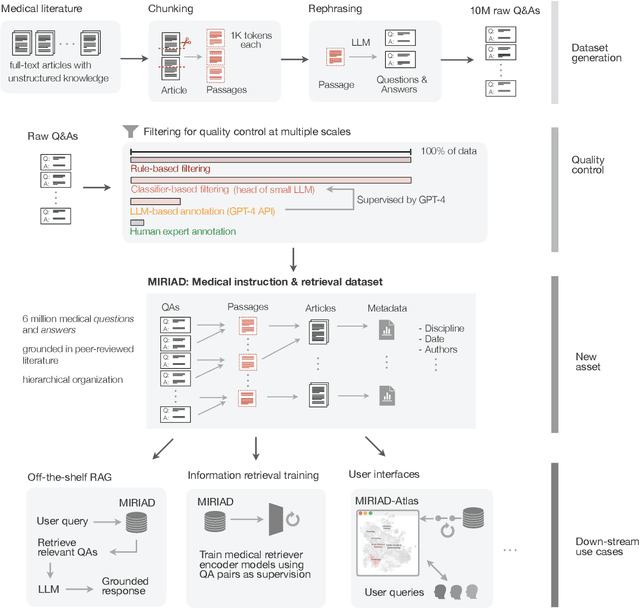
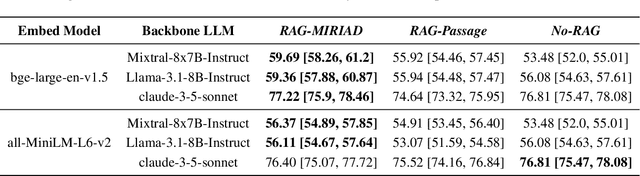
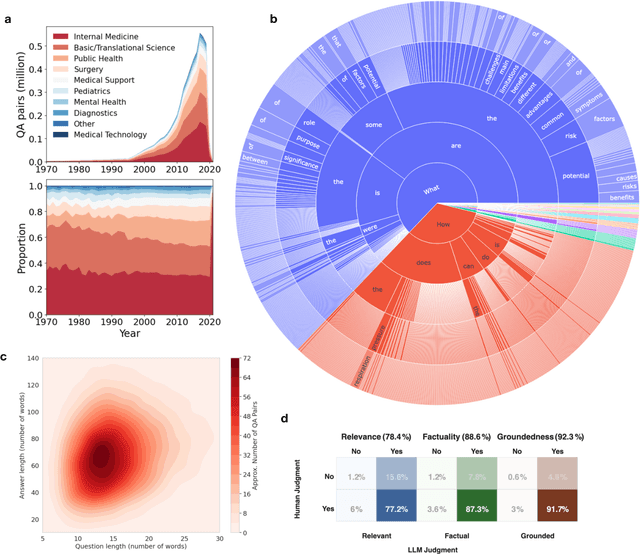

LLMs are bound to transform healthcare with advanced decision support and flexible chat assistants. However, LLMs are prone to generate inaccurate medical content. To ground LLMs in high-quality medical knowledge, LLMs have been equipped with external knowledge via RAG, where unstructured medical knowledge is split into small text chunks that can be selectively retrieved and integrated into the LLMs context. Yet, existing RAG pipelines rely on raw, unstructured medical text, which can be noisy, uncurated and difficult for LLMs to effectively leverage. Systematic approaches to organize medical knowledge to best surface it to LLMs are generally lacking. To address these challenges, we introduce MIRIAD, a large-scale, curated corpus of 5,821,948 medical QA pairs, each rephrased from and grounded in a passage from peer-reviewed medical literature using a semi-automated pipeline combining LLM generation, filtering, grounding, and human annotation. Unlike prior medical corpora, which rely on unstructured text, MIRIAD encapsulates web-scale medical knowledge in an operationalized query-response format, which enables more targeted retrieval. Experiments on challenging medical QA benchmarks show that augmenting LLMs with MIRIAD improves accuracy up to 6.7% compared to unstructured RAG baselines with the same source corpus and with the same amount of retrieved text. Moreover, MIRIAD improved the ability of LLMs to detect medical hallucinations by 22.5 to 37% (increase in F1 score). We further introduce MIRIAD-Atlas, an interactive map of MIRIAD spanning 56 medical disciplines, enabling clinical users to visually explore, search, and refine medical knowledge. MIRIAD promises to unlock a wealth of down-stream applications, including medical information retrievers, enhanced RAG applications, and knowledge-grounded chat interfaces, which ultimately enables more reliable LLM applications in healthcare.
Automated Structured Radiology Report Generation
May 30, 2025Automated radiology report generation from chest X-ray (CXR) images has the potential to improve clinical efficiency and reduce radiologists' workload. However, most datasets, including the publicly available MIMIC-CXR and CheXpert Plus, consist entirely of free-form reports, which are inherently variable and unstructured. This variability poses challenges for both generation and evaluation: existing models struggle to produce consistent, clinically meaningful reports, and standard evaluation metrics fail to capture the nuances of radiological interpretation. To address this, we introduce Structured Radiology Report Generation (SRRG), a new task that reformulates free-text radiology reports into a standardized format, ensuring clarity, consistency, and structured clinical reporting. We create a novel dataset by restructuring reports using large language models (LLMs) following strict structured reporting desiderata. Additionally, we introduce SRR-BERT, a fine-grained disease classification model trained on 55 labels, enabling more precise and clinically informed evaluation of structured reports. To assess report quality, we propose F1-SRR-BERT, a metric that leverages SRR-BERT's hierarchical disease taxonomy to bridge the gap between free-text variability and structured clinical reporting. We validate our dataset through a reader study conducted by five board-certified radiologists and extensive benchmarking experiments.
MedVAE: Efficient Automated Interpretation of Medical Images with Large-Scale Generalizable Autoencoders
Feb 20, 2025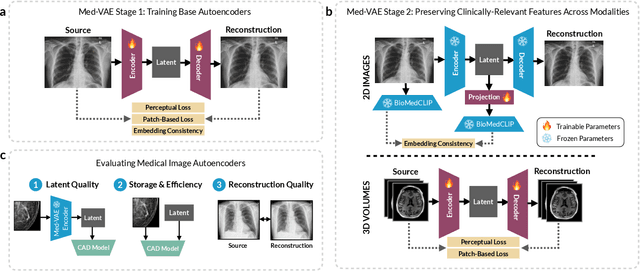
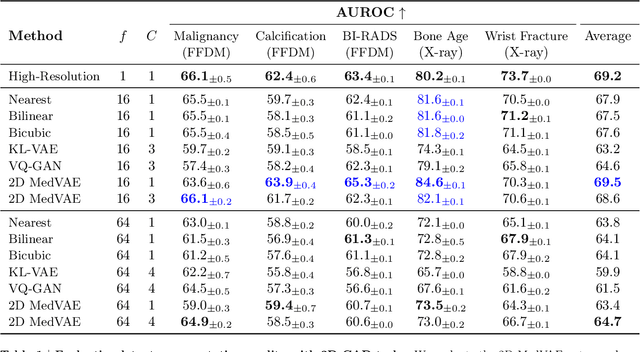
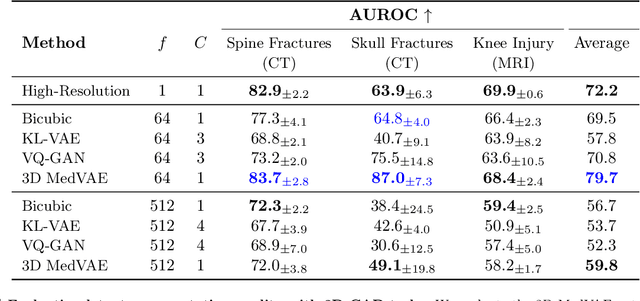
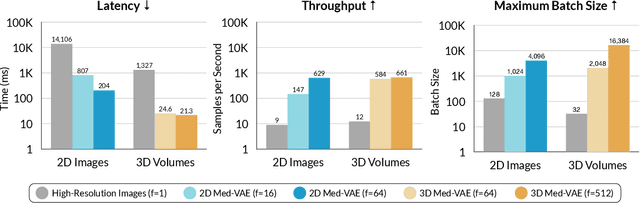
Medical images are acquired at high resolutions with large fields of view in order to capture fine-grained features necessary for clinical decision-making. Consequently, training deep learning models on medical images can incur large computational costs. In this work, we address the challenge of downsizing medical images in order to improve downstream computational efficiency while preserving clinically-relevant features. We introduce MedVAE, a family of six large-scale 2D and 3D autoencoders capable of encoding medical images as downsized latent representations and decoding latent representations back to high-resolution images. We train MedVAE autoencoders using a novel two-stage training approach with 1,052,730 medical images. Across diverse tasks obtained from 20 medical image datasets, we demonstrate that (1) utilizing MedVAE latent representations in place of high-resolution images when training downstream models can lead to efficiency benefits (up to 70x improvement in throughput) while simultaneously preserving clinically-relevant features and (2) MedVAE can decode latent representations back to high-resolution images with high fidelity. Our work demonstrates that large-scale, generalizable autoencoders can help address critical efficiency challenges in the medical domain. Our code is available at https://github.com/StanfordMIMI/MedVAE.
Preference Fine-Tuning for Factuality in Chest X-Ray Interpretation Models Without Human Feedback
Oct 09, 2024
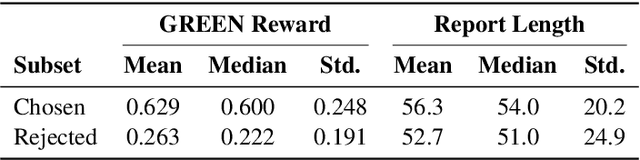
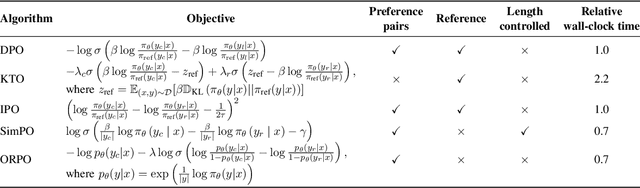

Radiologists play a crucial role by translating medical images into medical reports. However, the field faces staffing shortages and increasing workloads. While automated approaches using vision-language models (VLMs) show promise as assistants, they require exceptionally high accuracy. Most current VLMs in radiology rely solely on supervised fine-tuning (SFT). Meanwhile, in the general domain, additional preference fine-tuning has become standard practice. The challenge in radiology lies in the prohibitive cost of obtaining radiologist feedback. We propose a scalable automated preference alignment technique for VLMs in radiology, focusing on chest X-ray (CXR) report generation. Our method leverages publicly available datasets with an LLM-as-a-Judge mechanism, eliminating the need for additional expert radiologist feedback. We evaluate and benchmark five direct alignment algorithms (DAAs). Our results show up to a 57.4% improvement in average GREEN scores, a LLM-based metric for evaluating CXR reports, and a 9.2% increase in an average across six metrics (domain specific and general), compared to the SFT baseline. We study reward overoptimization via length exploitation, with reports lengthening by up to 3.2x. To assess a potential alignment tax, we benchmark on six additional diverse tasks, finding no significant degradations. A reader study involving four board-certified radiologists indicates win rates of up to 0.62 over the SFT baseline, while significantly penalizing verbosity. Our analysis provides actionable insights for the development of VLMs in high-stakes fields like radiology.
LieRE: Generalizing Rotary Position Encodings
Jun 14, 2024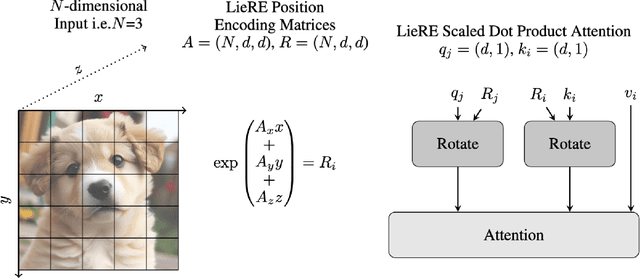
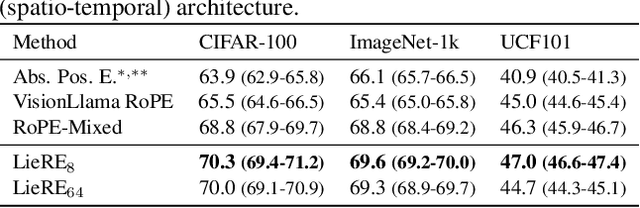
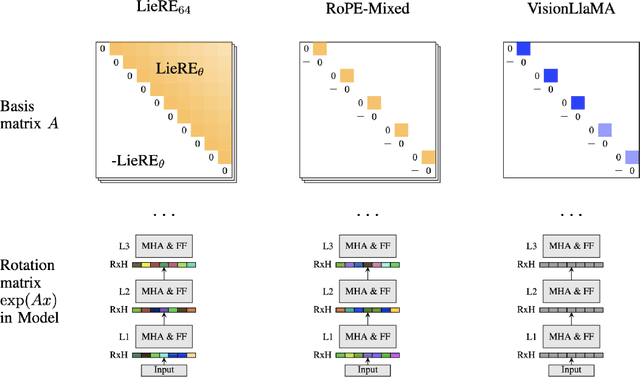
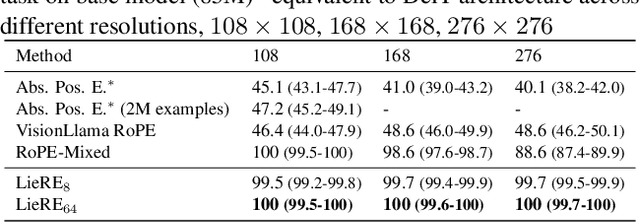
While Rotary Position Embeddings (RoPE) for natural language performs well and has become widely adopted, its adoption for other modalities has been slower. Here, we introduce Lie group Relative position Encodings (LieRE) that goes beyond RoPE in supporting higher dimensional inputs. We evaluate the performance of LieRE on 2D and 3D image classification tasks and observe that LieRE leads to marked improvements in performance (up to 6%), training efficiency (3.5x reduction), data efficiency (30%) compared to the baselines of RoFormer, DeiT III, RoPE-Mixed and Vision-Llama