 Add to Chrome
 Add to Firefox
 Add to Edge
CodecArena: Codec Quality Assessment via Visual Reinforcement Learning
Aug 10, 2026
Video coding is advancing into the low and ultra-low bitrate regime, driven by end-to-end codecs that replace the hand-crafted pipeline with jointly optimized neural networks and generative codecs that exploit the priors of video generation models. Yet the dominant metrics, LPIPS and DISTS, measure feature and texture similarity rather than content fidelity: a reconstruction that hallucinates a wrong face or blurs text into convincing strokes can still score well, even when a human rejects it instantly. To address this, we propose CodecArena, the first vision-language framework for video coding quality assessment, casting codec evaluation as source-conditioned comparative reasoning between a reference and its reconstructions. We optimize CodecArena with Facet-GRPO, a visual reinforcement learning scheme that aligns pairwise codec preferences while grounding the verdict in five fidelity facets: identity, objects, text, texture, and temporal consistency. Its facet-anchored reward uses automatically derived facet directions as weak anchors, rather than human per-facet labels, to prevent any single sub-score from dominating the holistic preference and to yield interpretable fine-grained quality judgments. To support training and evaluation in this underexplored regime, we construct two complementary resources: CodecArena-1K, a fully automatic preference dataset of 1,500 comparison groups built from traditional, neural, and generative codec reconstructions with fused vision-language and objective supervision; and CodecArena-Bench, a human-ranked benchmark with source-disjoint videos for fair out-of-domain evaluation. Extensive experiments demonstrate that CodecArena achieves state-of-the-art agreement with human judgments on source-disjoint content across diverse codecs and bitrates, surpassing perceptual metrics and prior vision-language evaluators.

TextWand: A Unified Framework for Scene Text Editing
Jun 04, 2026We propose TextWand, a general-purpose framework that unifies scene text removal, generation, and replacement into a single model. By decomposing complex editing tasks into the atomic primitives of rendering and erasure, TextWand achieves precise control over both text appearance and background integrity. Specifically, we introduce a novel design, Overlay-Reference Positional Encoding (ORPE), to enforce pixel-level layout fidelity and exemplar-driven style control, alongside a new strategy, Region-Adaptive Suppression (RAS), to ensure clean text erasure. To address the absence of a comprehensive benchmark for general-purpose scene text editing among existing single-task datasets, we construct TextWand-Bench. Extensive experiments demonstrate that TextWand outperforms existing leading open-source and closed-source models by delivering superior text content accuracy, layout and style consistency, and overall image quality across scene text removal, generation and replacement tasks.
VQ-Jarvis: Retrieval-Augmented Video Restoration Agent with Sharp Vision and Fast Thought
Mar 24, 2026Video restoration in real-world scenarios is challenged by heterogeneous degradations, where static architectures and fixed inference pipelines often fail to generalize. Recent agent-based approaches offer dynamic decision making, yet existing video restoration agents remain limited by insufficient quality perception and inefficient search strategies. We propose VQ-Jarvis, a retrieval-augmented, all-in-one intelligent video restoration agent with sharper vision and faster thought. VQ-Jarvis is designed to accurately perceive degradations and subtle differences among paired restoration results, while efficiently discovering optimal restoration trajectories. To enable sharp vision, we construct VSR-Compare, the first large-scale video paired enhancement dataset with 20K comparison pairs covering 7 degradation types, 11 enhancement operators, and diverse content domains. Based on this dataset, we train a multiple operator judge model and a degradation perception model to guide agent decisions. To achieve fast thought, we introduce a hierarchical operator scheduling strategy that adapts to video difficulty: for easy cases, optimal restoration trajectories are retrieved in a one-step manner from a retrieval-augmented generation (RAG) library; for harder cases, a step-by-step greedy search is performed to balance efficiency and accuracy. Extensive experiments demonstrate that VQ-Jarvis consistently outperforms existing methods on complex degraded videos.
OARS: Process-Aware Online Alignment for Generative Real-World Image Super-Resolution
Mar 13, 2026Aligning generative real-world image super-resolution models with human visual preference is challenging due to the perception--fidelity trade-off and diverse, unknown degradations. Prior approaches rely on offline preference optimization and static metric aggregation, which are often non-interpretable and prone to pseudo-diversity under strong conditioning. We propose OARS, a process-aware online alignment framework built on COMPASS, a MLLM-based reward that evaluates the LR to SR transition by jointly modeling fidelity preservation and perceptual gain with an input-quality-adaptive trade-off. To train COMPASS, we curate COMPASS-20K spanning synthetic and real degradations, and introduce a three-stage perceptual annotation pipeline that yields calibrated, fine-grained training labels. Guided by COMPASS, OARS performs progressive online alignment from cold-start flow matching to full-reference and finally reference-free RL via shallow LoRA optimization for on-policy exploration. Extensive experiments and user studies demonstrate consistent perceptual improvements while maintaining fidelity, achieving state-of-the-art performance on Real-ISR benchmarks.
Improved Adversarial Diffusion Compression for Real-World Video Super-Resolution
Feb 28, 2026While many diffusion models have achieved impressive results in real-world video super-resolution (Real-VSR) by generating rich and realistic details, their reliance on multi-step sampling leads to slow inference. One-step networks like SeedVR2, DOVE, and DLoRAL alleviate this through condensing generation into one single step, yet they remain heavy, with billions of parameters and multi-second latency. Recent adversarial diffusion compression (ADC) offers a promising path via pruning and distilling these models into a compact AdcSR network, but directly applying it to Real-VSR fails to balance spatial details and temporal consistency due to its lack of temporal awareness and the limitations of standard adversarial learning. To address these challenges, we propose an improved ADC method for Real-VSR. Our approach distills a large diffusion Transformer (DiT) teacher DOVE equipped with 3D spatio-temporal attentions, into a pruned 2D Stable Diffusion (SD)-based AdcSR backbone, augmented with lightweight 1D temporal convolutions, achieving significantly higher efficiency. In addition, we introduce a dual-head adversarial distillation scheme, in which discriminators in both pixel and feature domains explicitly disentangle the discrimination of details and consistency into two heads, enabling both objectives to be effectively optimized without sacrificing one for the other. Experiments demonstrate that the resulting compressed AdcVSR model reduces complexity by 95% in parameters and achieves an 8$\times$ acceleration over its DiT teacher DOVE, while maintaining competitive video quality and efficiency.
TalkPhoto: A Versatile Training-Free Conversational Assistant for Intelligent Image Editing
Jan 05, 2026Thanks to the powerful language comprehension capabilities of Large Language Models (LLMs), existing instruction-based image editing methods have introduced Multimodal Large Language Models (MLLMs) to promote information exchange between instructions and images, ensuring the controllability and flexibility of image editing. However, these frameworks often build a multi-instruction dataset to train the model to handle multiple editing tasks, which is not only time-consuming and labor-intensive but also fails to achieve satisfactory results. In this paper, we present TalkPhoto, a versatile training-free image editing framework that facilitates precise image manipulation through conversational interaction. We instruct the open-source LLM with a specially designed prompt template to analyze user needs after receiving instructions and hierarchically invoke existing advanced editing methods, all without additional training. Moreover, we implement a plug-and-play and efficient invocation of image editing methods, allowing complex and unseen editing tasks to be integrated into the current framework, achieving stable and high-quality editing results. Extensive experiments demonstrate that our method not only provides more accurate invocation with fewer token consumption but also achieves higher editing quality across various image editing tasks.
ACD: Direct Conditional Control for Video Diffusion Models via Attention Supervision
Dec 24, 2025Controllability is a fundamental requirement in video synthesis, where accurate alignment with conditioning signals is essential. Existing classifier-free guidance methods typically achieve conditioning indirectly by modeling the joint distribution of data and conditions, which often results in limited controllability over the specified conditions. Classifier-based guidance enforces conditions through an external classifier, but the model may exploit this mechanism to raise the classifier score without genuinely satisfying the intended condition, resulting in adversarial artifacts and limited effective controllability. In this paper, we propose Attention-Conditional Diffusion (ACD), a novel framework for direct conditional control in video diffusion models via attention supervision. By aligning the model's attention maps with external control signals, ACD achieves better controllability. To support this, we introduce a sparse 3D-aware object layout as an efficient conditioning signal, along with a dedicated Layout ControlNet and an automated annotation pipeline for scalable layout integration. Extensive experiments on benchmark video generation datasets demonstrate that ACD delivers superior alignment with conditioning inputs while preserving temporal coherence and visual fidelity, establishing an effective paradigm for conditional video synthesis.
Audio-Visual Cross-Modal Compression for Generative Face Video Coding
Dec 17, 2025Generative face video coding (GFVC) is vital for modern applications like video conferencing, yet existing methods primarily focus on video motion while neglecting the significant bitrate contribution of audio. Despite the well-established correlation between audio and lip movements, this cross-modal coherence has not been systematically exploited for compression. To address this, we propose an Audio-Visual Cross-Modal Compression (AVCC) framework that jointly compresses audio and video streams. Our framework extracts motion information from video and tokenizes audio features, then aligns them through a unified audio-video diffusion process. This allows synchronized reconstruction of both modalities from a shared representation. In extremely low-rate scenarios, AVCC can even reconstruct one modality from the other. Experiments show that AVCC significantly outperforms the Versatile Video Coding (VVC) standard and state-of-the-art GFVC schemes in rate-distortion performance, paving the way for more efficient multimodal communication systems.
MIND-Edit: MLLM Insight-Driven Editing via Language-Vision Projection
May 25, 2025Recent advances in AI-generated content (AIGC) have significantly accelerated image editing techniques, driving increasing demand for diverse and fine-grained edits. Despite these advances, existing image editing methods still face challenges in achieving high precision and semantic accuracy in complex scenarios. Recent studies address this issue by incorporating multimodal large language models (MLLMs) into image editing pipelines. However, current MLLM-based methods mainly rely on interpreting textual instructions, leaving the intrinsic visual understanding of large models largely unexplored, thus resulting in insufficient alignment between textual semantics and visual outcomes. To overcome these limitations, we propose MIND-Edit, an end-to-end image-editing framework integrating pretrained diffusion model with MLLM. MIND-Edit introduces two complementary strategies: (1) a text instruction optimization strategy that clarifies ambiguous user instructions based on semantic reasoning from the MLLM, and (2) an MLLM insight-driven editing strategy that explicitly leverages the intrinsic visual understanding capability of the MLLM to infer editing intent and guide the diffusion process via generated visual embeddings. Furthermore, we propose a joint training approach to effectively integrate both strategies, allowing them to reinforce each other for more accurate instruction interpretation and visually coherent edits aligned with user intent. Extensive experiments demonstrate that MIND-Edit outperforms state-of-the-art image editing methods in both quantitative metrics and visual quality, particularly under complex and challenging scenarios.
Q-Insight: Understanding Image Quality via Visual Reinforcement Learning
Mar 28, 2025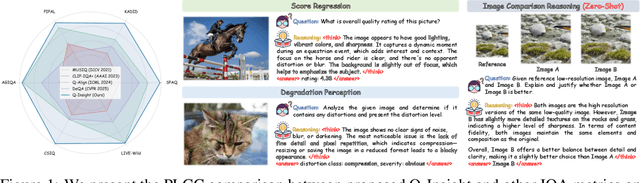
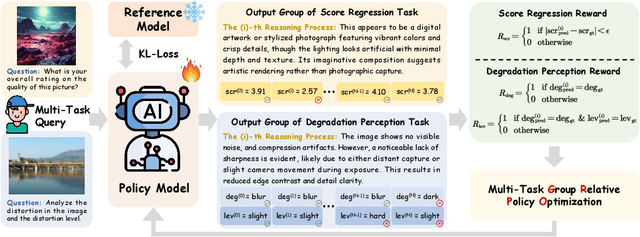
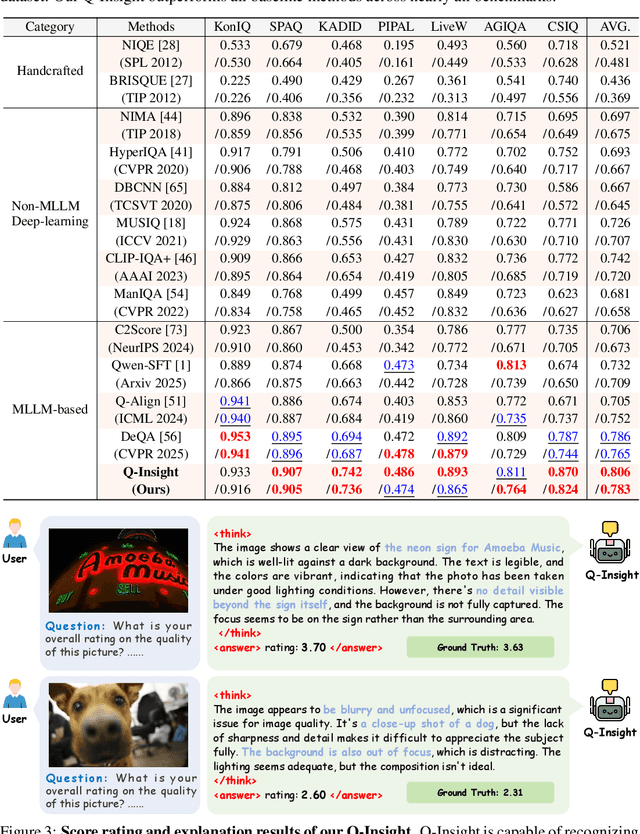
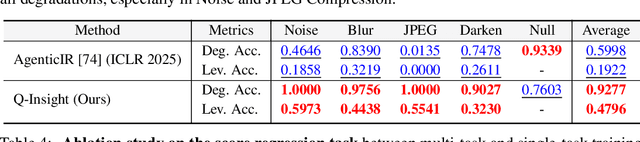
Image quality assessment (IQA) focuses on the perceptual visual quality of images, playing a crucial role in downstream tasks such as image reconstruction, compression, and generation. The rapid advancement of multi-modal large language models (MLLMs) has significantly broadened the scope of IQA, moving toward comprehensive image quality understanding that incorporates content analysis, degradation perception, and comparison reasoning beyond mere numerical scoring. Previous MLLM-based methods typically either generate numerical scores lacking interpretability or heavily rely on supervised fine-tuning (SFT) using large-scale annotated datasets to provide descriptive assessments, limiting their flexibility and applicability. In this paper, we propose Q-Insight, a reinforcement learning-based model built upon group relative policy optimization (GRPO), which demonstrates strong visual reasoning capability for image quality understanding while requiring only a limited amount of rating scores and degradation labels. By jointly optimizing score regression and degradation perception tasks with carefully designed reward functions, our approach effectively exploits their mutual benefits for enhanced performance. Extensive experiments demonstrate that Q-Insight substantially outperforms existing state-of-the-art methods in both score regression and degradation perception tasks, while exhibiting impressive zero-shot generalization to comparison reasoning tasks. Code will be available at https://github.com/lwq20020127/Q-Insight.