 Add to Chrome
 Add to Firefox
 Add to Edge
LoViF 2026 Challenge on Human-oriented Semantic Image Quality Assessment: Methods and Results
Apr 13, 2026
This paper reviews the LoViF 2026 Challenge on Human-oriented Semantic Image Quality Assessment. This challenge aims to raise a new direction, i.e., how to evaluate the loss of semantic information from the human perspective, intending to promote the development of some new directions, like semantic coding, processing, and semantic-oriented optimization, etc. Unlike existing datasets of quality assessment, we form a dataset of human-oriented semantic quality assessment, termed the SeIQA dataset. This dataset is divided into three parts for this competition: (i) training data: 510 pairs of degraded images and their corresponding ground truth references; (ii) validation data: 80 pairs of degraded images and their corresponding ground-truth references; (iii) testing data: 160 pairs of degraded images and their corresponding ground-truth references. The primary objective of this challenge is to establish a new and powerful benchmark for human-oriented semantic image quality assessment. There are a total of 58 teams registered in this competition, and 6 teams submitted valid solutions and fact sheets for the final testing phase. These submissions achieved state-of-the-art (SOTA) performance on the SeIQA dataset.

Image Registration Based Flicker Solving in Video Face Replacement and Analysis Based Sub-pixel Image Registration
Mar 09, 2018
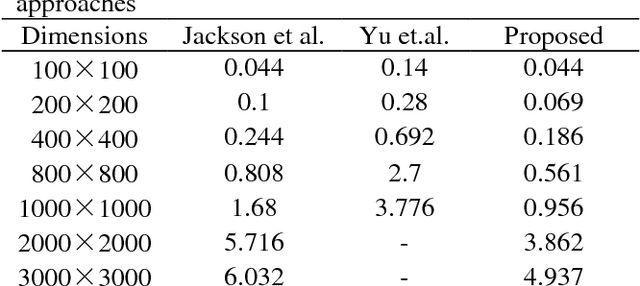
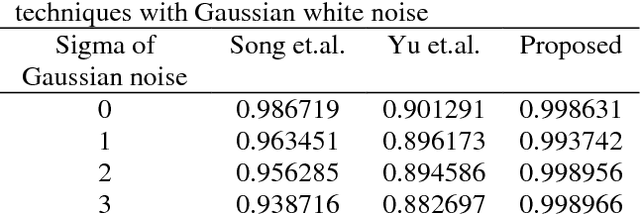
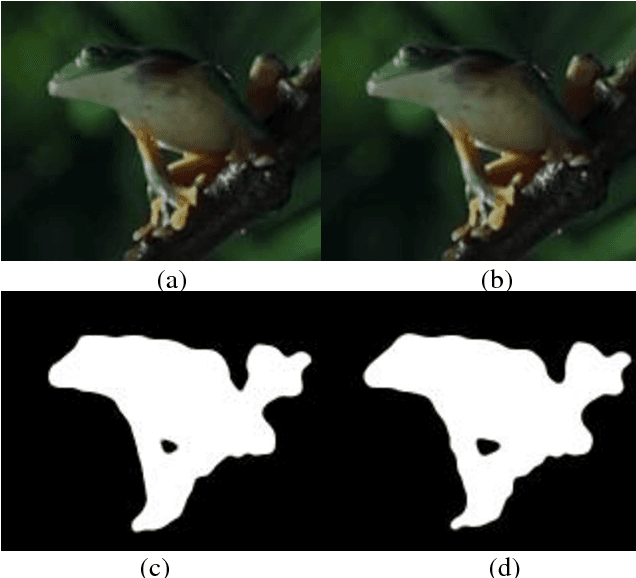
In this paper, a framework of video face replacement is proposed and it deals with the flicker of swapped face in video sequence. This framework contains two main innovations: 1) the technique of image registration is exploited to align the source and target video faces for eliminating the flicker or jitter of the segmented video face sequence; 2) a fast subpixel image registration method is proposed for farther accuracy and efficiency. Unlike the priori works, it minimizes the overlapping region and takes spatiotemporal coherence into account. Flicker in resulted videos is usually caused by the frequently changed bound of the blending target face and unregistered faces between and along video sequences. The subpixel image registration method is proposed to solve the flicker problem. During the alignment process, integer pixel registration is formulated by maximizing the similarity of images with down sampling strategy speeding up the process and sub-pixel image registration is a single-step image match via analytic method. Experimental results show the proposed algorithm reduces the computation time and gets a high accuracy when conducting experiments on different data sets.